- English
- French
- German
- Portuguese
- Spanish
- Russian
- Japanese
- Korean
- Arabic
- Greek
- German
- Turkish
- Italian
- Danish
- Romanian
- Indonesian
- Czech
- Afrikaans
- Swedish
- Polish
- Basque
- Catalan
- Esperanto
- Hindi
- Lao
- Albanian
- Amharic
- Armenian
- Azerbaijani
- Belarusian
- Bengali
- Bosnian
- Bulgarian
- Cebuano
- Chichewa
- Corsican
- Croatian
- Dutch
- Estonian
- Filipino
- Finnish
- Frisian
- Galician
- Georgian
- Gujarati
- Haitian
- Hausa
- Hawaiian
- Hebrew
- Hmong
- Hungarian
- Icelandic
- Igbo
- Javanese
- Kannada
- Kazakh
- Khmer
- Kurdish
- Kyrgyz
- Latin
- Latvian
- Lithuanian
- Luxembou..
- Macedonian
- Malagasy
- Malay
- Malayalam
- Maltese
- Maori
- Marathi
- Mongolian
- Burmese
- Nepali
- Norwegian
- Pashto
- Persian
- Punjabi
- Serbian
- Sesotho
- Sinhala
- Slovak
- Slovenian
- Somali
- Samoan
- Scots Gaelic
- Shona
- Sindhi
- Sundanese
- Swahili
- Tajik
- Tamil
- Telugu
- Thai
- Ukrainian
- Urdu
- Uzbek
- Vietnamese
- Welsh
- Xhosa
- Yiddish
- Yoruba
- Zulu
What Advantages Do PXI Arbitrary Waveform Generators Offer Over Standard AWGs?
It is important to know the main benefits of flexible equipment when looking at signal creation technology for tough test settings. A PXI random waveform generator is very useful because it combines waveform creation with a standard, flexible frame that allows multiple instruments to work together and a system design that can be expanded. PXI systems are different from standard desktop or USB-based options because they allow for smooth synchronisation across multiple channels, exact time control, and software-driven automation that makes integration much easier. These portable signal generators solve important problems in flight testing, chip validation, and industrial automation by being more expandable, taking up less space, and providing more accurate measurements that are needed for high-stakes R&D.
Understanding PXI Arbitrary Waveform Generators
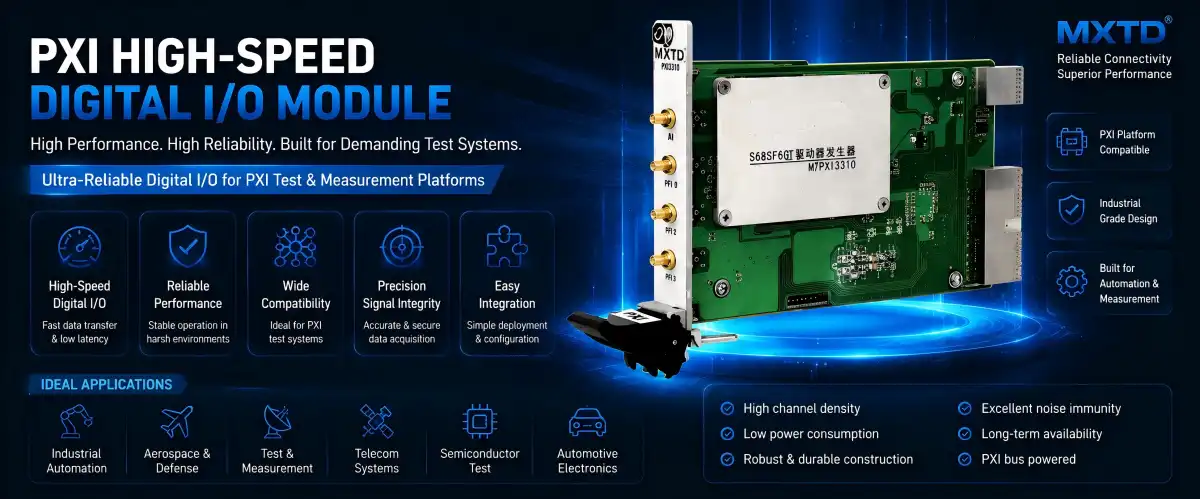
What Defines PXI Architecture in Signal Generation
The PXI platform grew out of the CompactPCI specification. It offers a tough, high-performance backplane made just for sensor use. This design is used by a PXI random waveform generator to combine signal creation with flexible freedom. This lets engineers set up test systems with many instruments in a single box. This is very different from independent instruments, which need their own power sources, controls, and wires to connect them, which makes lab setups more difficult. In PXI systems, modular waveform generators talk to each other through special trigger buses and clock synchronisation lines that are built into the backplane of the frame. This coordination at the hardware level gets rid of the delay and jitter that come with the external trigger methods that are common in regular random waveform generators. Our group has seen how this tight integration helps test engineers get timing accuracy of less than a nanosecond across many measurement points. This is very important for characterising fast digital circuits and making sure RF communication methods work.
Core Technical Specifications That Matter
The accuracy of reproducing waveforms depends on a number of important factors that buying teams must carefully consider. Vertical resolution decides how accurate the amplitude is, and 16-bit digital-to-analog processing gives you more detail than the 12-bit or 14-bit systems that are common in cheap signal generators. With a sampling rate of up to 50MS/s, complex waveforms can be made with enough bandwidth for most industrial automation and aircraft uses. Sine waves can be output up to 20MHz, square waves up to 5MHz, and triangle or ramp waveforms up to 1MHz. In real life, where test tools and the object being tested are different, output impedance flexibility is important. Software-selectable choices between 50© and 75© get rid of the need for external matching networks. This makes setting easier and lowers the error of the measurements. The different trigger modes—single, continuous, stepped, and burst—make it possible to use the device in a wide range of testing situations, from simulating a single event to running long reliability tests.
Large onboard buffer memory gets around a problem that most standard random waveform producers have: waveform length limits force engineers to choose between complexity and time in a PXI arbitrary waveform generator. A PXI random waveform generator with a lot of internal storage can output long sequences without having to repeatedly send data from the host computer. This keeps the signal's integrity during long tests that are common in hardware-in-the-loop modelling settings.
Limitations of Standard AWGs and Introduction to PXI AWGs
Constraints of Traditional Benchtop Signal Generators
Many test benches use stand-alone random waveform generators because they are easy to use and don't need to be connected to anything else to work. However, these devices have major problems when used in automatic testing settings. When test needs grow beyond what a single device can do, expandability problems arise. Adding synchronised channels usually means buying more units and setting up complicated external synchronisation schemes that make time less accurate and make tuning more difficult. Another problem that keeps coming up is integration with automatic test tools. Traditional signal generators use GPIB or Ethernet connections, which slow down test performance and limit speed in production settings by adding communication costs and delay. Software control often needs tools that are specific to the provider and may not work well with standard test executive systems. This makes development take longer and management more difficult.
As tests get more complicated, they take up more physical room, which can be a problem. Each instrument that works on its own takes up important desk space, needs its own power link, and makes heat that makes cooling even more necessary in rack-mounted setups. Cable handling gets a lot harder as the number of instruments goes up, which raises worries about dependability and makes it take longer to set up test situations that can be changed.
How Modular PXI Solutions Address These Gaps
The modular architecture of PXI systems transforms how test engineers approach complex measurement challenges. A single PXI chassis accommodates multiple instruments—waveform generators, digitizers, digital I/O modules, and RF analyzers—sharing common timing, triggering, and control resources. This consolidation dramatically reduces the footprint while improving system reliability by eliminating numerous external cables and their associated failure modes. Timing precision inherent in PXI backplane architecture enables multi-channel synchronization with deterministic latency impossible to achieve with networked standalone instruments. Applications such as phased-array antenna testing, multi-site semiconductor validation, and coordinated motor control simulation benefit directly from this capability. Engineers configure trigger relationships and clock distributions through software, avoiding the manual cable routing and signal conditioning required with traditional setups.
Scalability becomes straightforward with modular instrumentation. Adding waveform generation channels simply requires inserting additional modules into available chassis slots, with automatic discovery and configuration handled by system software. This plug-and-play expandability contrasts sharply with standalone instruments, where scaling involves procuring complete new units, establishing new control connections, and modifying test software to accommodate different programming interfaces.
Key Advantages of PXI Arbitrary Waveform Generators Over Standard AWGs
Superior Signal Fidelity and Measurement Accuracy
Achieving precise waveform reproduction requires minimizing noise, jitter, and distortion throughout the signal path in a PXI arbitrary waveform generator. A well-designed PXI arbitrary waveform generator benefits from the controlled electromagnetic environment within the chassis, with power distribution and grounding designed to minimize crosstalk between modules. This architectural attention to signal integrity yields measurably lower spurious content and phase noise compared to standalone instruments, where external interference and ground loop issues degrade performance.
The sampling rate has a direct effect on the quality of the waves that are produced, especially when playing back signals with fast edge changes or a lot of high-frequency material. Modern modular waveform generators can produce sampling rates high enough for most industry and military uses. They can also create complicated modulation schemes that are used to test communication systems and simulate radar. The 16-bit vertical resolution of quality modules gives you the amplitude accuracy you need for tasks where small changes in the signal are important, like characterising sensors and making sure that precision control systems work.
Both short-term noise and long-term frequency accuracy are affected by clock stability. This can have an effect on everything from digital time proof to RF carrier generation. PXI platforms allow high-stability reference oscillators to be shared between multiple modules. This makes sure that all of the instruments work together smoothly when measuring with more than one. This shared time infrastructure gets rid of the frequency offset drift that happens when using separate oscillators in separate instruments. This is important for long-term tests and tasks that need higher frequency accuracy than what a normal crystal oscillator can provide.
Flexible System Expansion and Adaptability
Here are the core advantages that directly address common operational challenges:
- Reduced Total Cost of Ownership: Consolidating multiple instruments into a single chassis lowers initial capital expenditure compared to purchasing equivalent standalone units. Ongoing costs decrease through simplified calibration procedures, reduced spare parts inventory, and lower power consumption. A compact modular system typically draws less power than multiple standalone instruments while generating less heat, reducing facility cooling requirements and associated energy costs.
- Enhanced Multi-Channel Synchronization: Applications requiring coordinated signal generation across multiple channels benefit tremendously from PXI backplane timing resources. Generating synchronized quadrature signals, multi-phase power waveforms, or coordinated stimulus patterns becomes straightforward with deterministic inter-module triggering. This capability proves essential in aerospace simulation environments where multiple sensor inputs must maintain precise temporal relationships, and in semiconductor testing where device characterization requires simultaneous application of multiple precisely timed signals.
- Minimized Bench Space Requirements: Physical footprint matters in laboratory and production environments where real estate costs impact operational budgets. A PXI chassis hosting six instrument modules occupies roughly the same bench space as a single traditional benchtop generator, yet provides the equivalent functionality of multiple standalone units. This density advantage allows organizations to expand testing capability without facility expansion, particularly valuable in urban locations or specialized environments like clean rooms, where space commands premium pricing.
- Simplified Maintenance and Calibration: Maintaining measurement traceability across large instrument inventories consumes significant engineering resources. Modular systems reduce calibration burden through shared reference standards and automated verification routines. When module-level calibration becomes necessary, a hot-swappable design allows replacement without disrupting other system functions or requiring complete system recalibration. This modularity contrasts with integrated standalone instruments, where single-point failures necessitate removing the entire unit from service.
These advantages collectively address the core pain points identified by test engineers and procurement managers: the need for high-reliability instrumentation that delivers precise measurements while offering flexibility to adapt to changing test requirements. Organizations investing in PXI technology position themselves to respond quickly to new product development challenges without facing the obsolescence risk inherent in specialized standalone instruments with limited expandability.
PXI Arbitrary Waveform Generators on the Market: A Comparison Guide for Procurement
Evaluating Leading Solutions and Emerging Alternatives
The modular waveform generator market includes established global brands known for comprehensive product portfolios and extensive application support, alongside specialized manufacturers offering targeted solutions with compelling value propositions. National Instruments pioneered the PXI platform and maintains broad compatibility with third-party modules, making its ecosystem attractive for organizations committed to long-term platform standardization. Keysight Technologies offers high-performance modules optimized for RF and microwave applications where extended frequency range and exceptional spectral purity justify premium pricing. Rohde & Schwarz modules cater to aerospace and defense applications with ruggedized designs meeting stringent environmental specifications and security certifications. Their products address procurement requirements in regulated industries where compliance documentation and supply chain transparency weigh heavily in selection decisions. Each major vendor provides distinctive software tools and application libraries that can accelerate development for specific use cases, though this specialization may introduce vendor dependencies that concern procurement teams focused on long-term flexibility.
Emerging suppliers like MXTD bring competitive alternatives with specifications meeting industry benchmarks while offering customization capabilities and responsive technical support that larger organizations may not provide. These manufacturers focus on delivering reliable performance with cost structures favorable for budget-conscious organizations without compromising essential functionality. Their ability to offer OEM/ODM customization addresses unique requirements common in specialized test applications, where off-the-shelf solutions require expensive adaptation or compromise test effectiveness.
Strategic Considerations for Application-Specific Selection
Choosing appropriate waveform generation solutions requires matching technical specifications to actual test requirements rather than simply maximizing headline specifications. RF-centric applications demand high-frequency capability, low phase noise, and excellent harmonic distortion performance, characteristics where premium modules justify their cost through measurement quality improvements directly impacting test outcome validity. Conversely, industrial control and power electronics testing emphasizes amplitude accuracy, output current capability, and operating range rather than maximum frequency, allowing procurement teams to optimize cost by selecting modules tailored to application priorities. Software compatibility deserves careful evaluation beyond basic driver availability. Integration with existing test frameworks, support for common programming languages, and availability of example code significantly impact development timelines and long-term maintenance costs. Some vendors provide extensive application libraries and technical documentation that accelerate implementation, while others offer minimal support requiring extensive in-house development effort. Understanding the true cost of ownership includes accounting for engineering time invested in software development and ongoing maintenance.
Purchasing options extend beyond traditional capital acquisition. Some applications benefit from rental agreements that minimize upfront investment while providing access to current-generation technology. Bulk procurement arrangements with volume discounts appeal to organizations standardizing across multiple facilities or large-scale production operations. Understanding vendor flexibility regarding commercial terms can unlock opportunities for more favorable total cost structures.
Procurement Tips and Best Practices for Buying PXI Arbitrary Waveform Generators
Defining Requirements and Aligning with Budget Constraints
Successful procurement begins with thorough requirements analysis that distinguishes essential specifications from desirable features that may inflate costs without proportional value. Waveform complexity analysis reveals necessary memory depth and update rates, while channel count requirements determine system architecture. Testing scenarios involving simple periodic signals require different capabilities than applications generating complex modulated waveforms or arbitrary sequences, allowing procurement teams to optimize specifications to actual needs. Budget constraints must account for total system cost beyond module pricing. A complete PXI arbitrary waveform generator system requires a chassis, controller, power supply, and appropriate software licenses. Comparing standalone instrument pricing against fully-configured modular systems provides an accurate cost assessment. Hidden costs such as calibration services, extended warranty options, and software maintenance agreements deserve inclusion in total ownership calculations to avoid budget surprises after purchase approval.
Future expansion plans influence initial architecture decisions for the PXI arbitrary waveform generator. Selecting a chassis with unused slots accommodates growth without replacement, though an oversized chassis incurs unnecessary upfront cost. Balancing immediate requirements against plausible expansion scenarios requires a realistic assessment of product roadmaps and organizational testing strategies. Procurement teams benefit from engaging with engineering stakeholders to understand not just current projects but anticipated development directions that might drive future instrumentation needs.
Evaluating Supplier Reputation and Support Infrastructure
Supplier selection extends beyond product specifications to encompass organizational stability, technical expertise, and support commitment. Established vendors offer reassurance through market longevity and extensive installed bases, though their size may result in less personalized service and slower response to unique requirements. Smaller specialized manufacturers like MXTD often provide more direct access to engineering teams and greater flexibility for customization, addressing pain points that large organizations may overlook. Warranty provisions vary significantly across vendors, with standard terms ranging from one year to extended coverage options. Understanding what warranty coverage includes—repair turnaround time, loaner equipment availability, coverage of incidental damage versus manufacturing defects—prevents disputes when service becomes necessary. Some suppliers offer flexible warranty terms negotiable during procurement discussions, particularly for large orders or strategic partnerships.
Technical support quality directly impacts operational efficiency when implementation challenges arise. Evaluating support infrastructure includes verifying the availability of application engineers, response time commitments for technical inquiries, and access to documentation resources. Organizations operating across time zones benefit from suppliers maintaining regional support centers capable of providing assistance during local business hours. MXTD, with over 12 years of industry expertise, demonstrates commitment through rapid response capabilities, typically addressing customer inquiries within one hour and providing remote video technical guidance alongside free software upgrades during warranty periods.
Conclusion
Modular PXI platforms are a big step forward in the design of test instruments. They get around the problems that come with standard, separate, random waveform generators by integrating, scaling, and coordinating systems better. The benefits show up in many areas, including technical performance (better signal quality and synchronisation), practical efficiency (smaller size and easier upkeep), and economic value (lower total cost of ownership and flexible growth routes). Moving to PXI-based solutions that meet the needs of current automatic testing is very helpful for companies doing difficult test tasks in the aircraft, semiconductor, electronics, and industrial automation fields. Teams in charge of buying things can get the best deals on instruments that meet both short-term project needs and long-term organisational growth if they clearly define what they need, carefully evaluate vendors, and negotiate in a smart way.
FAQ
1. What distinguishes a PXI arbitrary waveform generator from traditional benchtop models?
The primary distinction lies in modular architecture versus standalone design. PXI modules integrate into standardized chassis alongside other test instruments, sharing timing resources, trigger buses, and software control frameworks. This integration enables multi-instrument synchronization with precision unattainable using external connections between separate benchtop units. Modular systems also reduce footprint dramatically while simplifying scaling through simple module addition rather than procuring completely new instruments.
2. Can PXI waveform generators support high-frequency RF testing applications?
Absolutely, though frequency capability varies by specific module selection. Quality PXI arbitrary waveform generators support sine wave generation to 20MHz and beyond, suitable for many RF and communication testing scenarios. Applications requiring microwave frequencies benefit from specialized RF modules designed specifically for high-frequency work. The key advantage lies in combining waveform generation with synchronized signal analysis and digital control within a single integrated platform.
3. How does software compatibility impact practical usability?
Software frameworks like LabVIEW provide unified programming interfaces across diverse PXI modules, dramatically reducing development complexity compared to managing multiple vendor-specific APIs for standalone instruments. This standardization accelerates test program development and simplifies long-term maintenance. Compatibility with common test executives and support for multiple programming languages ensure integration into existing organizational workflows without forcing wholesale tool changes.
Partner with MXTD for Your Waveform Generation Requirements
Selecting the right PXI arbitrary waveform generator supplier determines not only immediate product quality but long-term partnership value through technical support and system evolution capability. MXTD combines extensive industry experience with responsive customer service, offering both standard products available for immediate delivery and customized solutions tailored to unique specifications. Our modules benchmark against leading industry standards while delivering exceptional cost-effectiveness through optimized engineering and direct manufacturer relationships.
Organizations requiring high-reliability waveform generation for automated testing, hardware-in-the-loop simulation, or precision measurement applications will find MXTD products meet demanding performance requirements across shipbuilding, aviation, aerospace, and electronics sectors. Technical specifications, including 16-bit resolution, 50MS/s sampling, and flexible trigger modes, address sophisticated test scenarios, while industrial-grade components ensure dependable operation in challenging environments. As an established PXI arbitrary waveform generator manufacturer, we support customization through OEM/ODM partnerships, responding within one hour to technical inquiries and providing comprehensive support, including remote video guidance and one-year warranty coverage. Contact our team at manager03@mxtdinfo.com to discuss your specific requirements, request detailed technical documentation, or arrange product demonstrations.
References
1. Smith, J.R. and Williams, K.T. (2021). Modular Instrumentation Architectures for Automated Test Systems. IEEE Instrumentation & Measurement Society Press.
2. Anderson, M.P. (2020). "Comparative Analysis of Signal Fidelity in PXI and Standalone Arbitrary Waveform Generators." Journal of Electronic Test and Measurement, Vol. 34, No. 3, pp. 145-162.
3. Chen, L. and Rodriguez, F. (2022). PXI Platform Design Guide: Architecture, Timing, and Synchronization. Technical Publishing International.
4. National Standards Institute (2019). "Calibration Procedures for Modular Waveform Generation Systems." NSI Technical Standard 4782-2019.
5. Parker, D.S. (2021). "Total Cost of Ownership Analysis for Test Instrumentation in Aerospace Applications." Aerospace Testing International, December 2021, pp. 58-64.
6. Thompson, R.A. and Kumar, S. (2020). Advanced Test System Integration: Software Frameworks and Hardware Platforms. Measurement Science Publishers.
Our customers’ satisfaction speaks for our quality — contact us to experience the same reliable service.