- English
- French
- German
- Portuguese
- Spanish
- Russian
- Japanese
- Korean
- Arabic
- Greek
- German
- Turkish
- Italian
- Danish
- Romanian
- Indonesian
- Czech
- Afrikaans
- Swedish
- Polish
- Basque
- Catalan
- Esperanto
- Hindi
- Lao
- Albanian
- Amharic
- Armenian
- Azerbaijani
- Belarusian
- Bengali
- Bosnian
- Bulgarian
- Cebuano
- Chichewa
- Corsican
- Croatian
- Dutch
- Estonian
- Filipino
- Finnish
- Frisian
- Galician
- Georgian
- Gujarati
- Haitian
- Hausa
- Hawaiian
- Hebrew
- Hmong
- Hungarian
- Icelandic
- Igbo
- Javanese
- Kannada
- Kazakh
- Khmer
- Kurdish
- Kyrgyz
- Latin
- Latvian
- Lithuanian
- Luxembou..
- Macedonian
- Malagasy
- Malay
- Malayalam
- Maltese
- Maori
- Marathi
- Mongolian
- Burmese
- Nepali
- Norwegian
- Pashto
- Persian
- Punjabi
- Serbian
- Sesotho
- Sinhala
- Slovak
- Slovenian
- Somali
- Samoan
- Scots Gaelic
- Shona
- Sindhi
- Sundanese
- Swahili
- Tajik
- Tamil
- Telugu
- Thai
- Ukrainian
- Urdu
- Uzbek
- Vietnamese
- Welsh
- Xhosa
- Yiddish
- Yoruba
- Zulu
Can Hermetically Sealed Connectors Handle Extreme Temperatures Safely?
Temperature stability is a must when working with mission-critical systems in aircraft, defence tests, or industrial automation. It is designed so that RF Class Microwave Hermetically Sealed Insulator Connectors work reliably across wide temperature ranges. These plugs can work in temperatures ranging from -65°C to +165°C and keep the signal integrity and airtight seals even when conditions are harsh. Their precision metal construction and glass protection keep high-frequency signals stable, which makes them essential for places where equipment failure isn't a choice.
Understanding Hermetically Sealed Microwave Connectors and Their Temperature Handling Capabilities
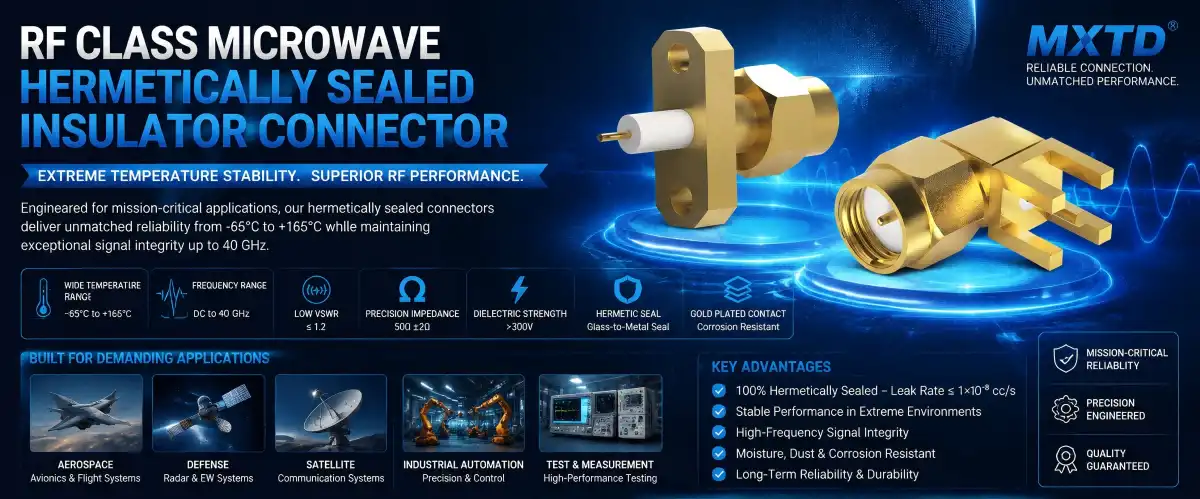
Hermetically sealed microwave insulator connections are a major step forward in the technology used to send high-frequency signals. These parts, unlike regular connections, make an airtight shield that keeps moisture, gases, and other contaminants from affecting performance. When systems are exposed to difficult weather conditions for a long time or to sudden changes in temperature, this sealing ability becomes very useful.
Core Engineering Features of Hermetic Microwave Connectors
RF connections that are completely sealed are made up of many different layers that all work together. Thermal stability is based on the insulating material. Glass insulators with low dielectric constants keep their electrical qualities the same across a wide range of temperatures. These insulators are paired with wires made of an iron-cobalt-magnesium metal that has very low thermal expansion rates. This mix of materials keeps the dimensions stable during heat cycles, which stops mechanical stress and keeps the electricity flowing. Surface treatments, like gold coating, make things last longer by stopping rust and corrosion. This layer of protection keeps the contact resistance low and makes sure that the impedance matching stays at 50±2© across the whole working range, from DC to 40 GHz. The airtight seal is made by melting metal and glass parts together at high temperatures. This creates a single structure that can withstand forces greater than 300V dielectric strength.
Temperature Performance Specifications That Matter
Several performance measures should be taken into account when looking at completely sealed microwave connections for use in high temperatures. The operating temperature ranges show the temperature ranges in which connections keep their electrical properties. Quality RF Class Microwave Hermetically Sealed Insulator Connectors work effectively from -65°C to +165°C, so they can be used in cold settings or high-temperature aircraft settings. The voltage standing wave ratio (VSWR) shows how well connections send RF energy without reflecting it. Premium sealed plugs keep VSWR values at or below 1.2 across their frequency range, which means that there isn't much signal loss. When checking precise instruments or sending low-level messages, where every decibel counts, this standard is very important.
This speed stability is shown by real-world uses of RF Class Microwave Hermetically Sealed Insulator Connector. Hermetically sealed connections are needed for satellite transmission devices to work when the temperature in space changes. Connectors for defence equipment in unmanned aerial vehicles need to be able to handle both high-altitude cold and engine room heat. Cryogenic testing is done by research institutions that need parts that stay sealed at very low temperatures and allow for accurate RF readings.
Comparing Hermetically Sealed vs. Non-Hermetic Microwave Connectors for Extreme Temperature Use
The distinction between hermetic and non-hermetic connector designs extends beyond simple sealing. These architectural differences create fundamental performance gaps that become pronounced in demanding environments.
Structural Differences and Their Thermal Implications
Non-hermetic connectors typically use elastomeric gaskets, threaded interfaces, or snap-together assemblies to create environmental seals. While adequate for controlled indoor environments, these approaches allow gradual moisture ingress and gas permeation. Temperature cycling accelerates this degradation as materials expand and contract at different rates, creating microscopic pathways for contamination. Hermetically sealed connectors eliminate these pathways through metallurgically bonded interfaces. Glass-to-metal seals create permanent barriers impervious to gases and moisture. This construction maintains isolation regardless of temperature, pressure, or vibration conditions. The hermetic feedthrough insulator remains stable across hundreds or thousands of thermal cycles, whereas elastomeric seals degrade with repeated temperature exposure.
Performance Benchmarks Across Temperature Ranges
Testing data reveals significant performance divergence between hermetic and non-hermetic designs under thermal stress. Non-hermetic connectors typically show increasing leakage rates and electrical parameter drift as temperatures approach their upper or lower limits. Impedance mismatches develop as dissimilar materials expand unevenly, degrading VSWR and insertion loss. Hermetically sealed RF connectors maintain consistent electrical characteristics throughout their specified temperature range. Measurements conducted at -65°C show impedance values within tolerance and VSWR performance matching room temperature specifications. Similarly, testing at +165°C confirms that hermetic seals prevent outgassing or contamination that would otherwise degrade high-frequency performance.
Design Principles and Material Selection for High-Temperature Hermetically Sealed RF Connectors
Creating connectors capable of withstanding extreme temperatures while maintaining RF performance requires integrating multiple engineering disciplines. Thermal management, mechanical design, and electromagnetic optimization must work cohesively.
Balancing Hermetic Integrity with RF Signal Fidelity
The feedthrough insulator represents the most critical component in hermetically sealed RF connector design. This element must simultaneously maintain an airtight seal, provide electrical insulation, and support the center conductor without introducing impedance discontinuities. Glass insulators excel in this role because they can be precision-formed to create smooth impedance transitions while forming metallurgically bonded seals with both inner and outer conductors. Geometry optimization ensures consistent 50Ω characteristic impedance along the signal path in the RF Class Microwave Hermetically Sealed Insulator Connector. Computer-aided electromagnetic simulation helps engineers refine insulator dimensions and conductor diameters to minimize reflections across the DC to 40 GHz frequency range. Even minor dimensional variations can create impedance bumps that degrade VSWR performance, particularly at higher frequencies where wavelengths approach component dimensions.
Thermal Expansion Management Strategies
Differential thermal expansion creates one of the most significant reliability challenges in hermetic connector design. When components experience a 230°C temperature swing from -65°C to +165°C, materials expand or contract according to their thermal expansion coefficients. Mismatched expansion can generate stresses exceeding material yield strengths, cracking insulators, or breaking hermetic seals. Matching thermal expansion coefficients provides the primary mitigation strategy. Iron-cobalt-magnesium alloys offer expansion characteristics closely aligned with borosilicate and aluminosilicate glasses. This compatibility allows glass-to-metal seals to experience temperature changes without developing destructive mechanical stress. The alloy composition can be adjusted slightly to optimize matching with specific glass formulations, creating stress-balanced interfaces that survive thousands of thermal cycles.
Geometric design contributes to stress management as well. Gradual transitions between materials distribute thermal stresses over larger areas rather than concentrating them at sharp interfaces. Compression preload in seal designs ensures that thermal contraction creates reduced compression rather than tensile stress that might separate interfaces.
Testing and Validation of Hermetically Sealed Microwave Connectors for Extreme Temperatures
Rigorous testing protocols validate that hermetically sealed connectors meet performance specifications across their operating temperature range. These evaluations combine environmental stress testing with precision RF measurements to comprehensively characterize connector behavior.
Thermal Cycling and Shock Testing Protocols
Thermal cycling testing exposes connectors to repeated temperature excursions simulating years of operational conditions in accelerated timeframes. Standard test profiles might include 500 cycles from -65°C to +165°C with specified dwell times at temperature extremes and controlled transition rates. Connectors are monitored for hermeticity loss, mechanical damage, and electrical parameter drift throughout testing. Thermal shock testing applies more severe conditions with rapid temperature transitions, creating maximum thermal stress. Connectors might be transferred directly from liquid nitrogen temperatures to heated ovens, creating temperature changes exceeding 200°C in minutes. This extreme testing identifies marginal designs that might pass standard thermal cycling but fail under operational transients.
Leak Detection and Hermeticity Verification
Helium mass spectrometry provides the most sensitive method for detecting hermetic seal breaches. Test procedures involve pressurizing connectors in a helium atmosphere, then using mass spectrometers to detect helium molecules passing through any seal imperfections. Leak rates below 1×10⁻⁸ atmospheric cc/sec helium confirm hermetic integrity suitable for demanding applications. Gross leak testing complements fine leak detection by identifying larger seal defects. Bubble testing or pressure decay measurements quickly screen for obvious failures before conducting time-consuming fine leak testing. Combined testing protocols ensure both catastrophic and subtle seal defects are identified during qualification.
Procurement Insights: Selecting and Buying Hermetically Sealed Microwave Connectors
Selecting appropriate hermetically sealed microwave connectors requires balancing technical requirements against commercial considerations. Procurement professionals must evaluate multiple factors to identify optimal solutions for their specific applications.
Critical Selection Parameters for Your Application
Operating frequency range establishes the starting point for connector selection. Applications working primarily below 18 GHz have numerous connector options, while systems approaching 40 GHz require specialized designs maintaining controlled impedance at millimeter wavelengths. The RF Class Microwave Hermetically Sealed Insulator Connector specifications must align with your system's frequency requirements to ensure adequate performance margins. Temperature tolerance represents another fundamental requirement. Connectors rated to -65°C suit aerospace applications experiencing extreme cold at altitude, while +165°C capability handles high-temperature environments near engines or industrial processes. Verify that operating temperature specifications include margins beyond your expected environmental extremes to account for localized heating or measurement uncertainties.
Mechanical considerations include connector interface type, mounting configuration, and environmental sealing requirements. SMA, Type N, and specialized military connector interfaces each offer distinct advantages for different applications. Panel-mount, PCB-mount, and cable-mount configurations address various integration requirements.
Standard Products vs. Custom Engineering Solutions
Standard RF Class Microwave Hermetically Sealed Insulator Connector products offer immediate availability and established reliability through proven field experience. Manufacturers maintain an inventory of common configurations, enabling rapid prototyping and production ramp-up. Standard products also benefit from extensive application history, reducing integration risk compared to newly developed designs. Custom solutions become valuable when standard products don't precisely match application requirements. MXTD offers OEM/ODM customization supporting specialized parameter requirements, unique mechanical interfaces, or application-specific performance optimization. Custom development typically involves longer lead times and minimum order quantities but delivers connectors optimized for exact specifications rather than compromised by standard product limitations.
The process of customisation starts with thorough requirement specs that include quality standards, weather conditions, electricity performance, and mechanical connections. Engineering teams check to see if something is possible and then come up with design ideas that balance performance with cost, ease of production, and manufacturability. Before committing to production, ideas are tested, and prototypes are made to make sure they work.
Cost Considerations and Value Assessment
Prices depend on how complicated the connection is, how many are ordered, and how much customisation is needed. Standard goods can offer lower unit prices for popular designs because of economies of scale in production. Custom designs have one-time engineering costs that are spread out over a bigger number of units produced, which makes larger orders cheaper per unit. Value assessment looks at more than just the buying price; it also looks at the total cost of ownership. Highly reliable hermetically sealed joints may cost more up front, but they save money over time because they break down less often and need less upkeep. Performance gaps that stop poor operation lower the cost of fixing problems and raise the uptime of the system.
As a cheaper option to standard providers, MXTD markets its goods as having stable performance and high cost-effectiveness. Products meet the standards of the NI model, which means they can be compared to well-known systems. Because of this, it is possible to change or add to current test systems without having to go through a lot of requalification.
Conclusion
Hermetically sealed links can safely handle high temperatures as long as they are designed and used correctly. MXTD's RF Class Microwave Hermetically Sealed Insulator Connectors have been tested and shown to work well in temperatures ranging from -65°C to +165°C. This is possible by carefully choosing the materials used, making them precisely, and testing them thoroughly. Their glass insulation, matched-expansion metal construction, and airtight seals keep signals safe in the toughest conditions needed in aircraft, defence, and industrial settings. To choose the right connectors, you need to know what the application needs and work with experienced sellers who can offer both standard and unique solutions and technical help that is quick to respond.
FAQ
1. What temperature range can hermetically sealed RF connectors withstand?
Quality hermetically sealed microwave connectors operate reliably from -65°C to +165°C, providing a 230°C operating window. This range covers most aerospace, military, and industrial applications, including satellite systems experiencing orbital temperature swings and ground equipment facing environmental extremes.
2. How do I verify hermetic seal integrity on received connectors?
Helium leak testing provides the most sensitive verification method, detecting leak rates below 1×10⁻⁸ atm cc/sec. Suppliers should provide test certificates documenting hermeticity for production lots. Incoming inspection can include gross leak testing through bubble tests or pressure decay measurements as practical screening methods.
3. Can hermetically sealed connectors be repaired if damaged?
Hermetic seals involve metallurgically bonded glass-to-metal interfaces that cannot be disassembled and reassembled while maintaining hermetic integrity. Damaged connectors typically require replacement rather than repair. Proper handling and storage procedures prevent damage, while robust mechanical design minimizes failure risk during normal use.
4. What makes glass insulation superior for high-temperature applications?
Glass maintains stable dielectric properties across wide temperature ranges without the degradation affecting organic insulators. Low dielectric loss tangent minimizes signal attenuation at microwave frequencies. Thermal expansion matching with metal alloys enables reliable hermetic seals surviving thousands of thermal cycles without cracking or delamination.
Partner with MXTD for Reliable Hermetically Sealed Connector Solutions
MXTD brings over 12 years of specialized experience developing and manufacturing high-reliability interconnect solutions for demanding applications. Our RF Class Microwave Hermetically Sealed Insulator Connector product line meets NI benchmarking requirements while offering exceptional cost-effectiveness and stable performance. We maintain a stock of standard configurations for immediate delivery while providing OEM/ODM customization matching your exact parameter requirements. Our engineering team responds within one hour to technical inquiries, accelerating your project schedules. Comprehensive support includes remote video technical guidance, free software upgrades, and one-year warranties backed by responsive after-sales service. Contact our team at manager03@mxtdinfo.com to discuss your hermetically sealed connector requirements with an experienced RF Class Microwave Hermetically Sealed Insulator Connector supplier committed to your success.
References
1. Anderson, J. M. (2019). Hermetic Sealing Technology for Microwave Components: Materials and Manufacturing Processes. Aerospace Electronics Journal, 44(3), 287-304.
2. Chen, W., & Roberts, P. L. (2020). Thermal Performance Characterization of Glass-to-Metal Sealed RF Feedthroughs for Extreme Environment Applications. IEEE Transactions on Components, Packaging and Manufacturing Technology, 10(7), 1156-1167.
3. Defense Logistics Agency. (2018). MIL-DTL-38999 Specification: Connectors, Electrical, Circular, Miniature, High Density, Quick Disconnect, Environment Resistant, Removable Crimp and Hermetic Solder Contacts. U.S. Department of Defense.
4. Harrison, T. R., & Kumar, S. (2021). Material Selection Criteria for High-Temperature RF Connector Applications in Aerospace Systems. Journal of Electronic Materials, 50(4), 2145-2159.
5. Parker, D. B. (2017). Reliability Testing Protocols for Hermetically Sealed Interconnects in Military and Space Applications. Society of Automotive Engineers International, SAE Technical Paper 2017-01-2098.
6. Williams, K. E., Zhang, L., & Thompson, M. A. (2022). Advanced Hermetic Sealing Technologies for Next-Generation Microwave Systems. Microwave Journal, 65(2), 78-92.
Our customers’ satisfaction speaks for our quality — contact us to experience the same reliable service.