- English
- French
- German
- Portuguese
- Spanish
- Russian
- Japanese
- Korean
- Arabic
- Greek
- German
- Turkish
- Italian
- Danish
- Romanian
- Indonesian
- Czech
- Afrikaans
- Swedish
- Polish
- Basque
- Catalan
- Esperanto
- Hindi
- Lao
- Albanian
- Amharic
- Armenian
- Azerbaijani
- Belarusian
- Bengali
- Bosnian
- Bulgarian
- Cebuano
- Chichewa
- Corsican
- Croatian
- Dutch
- Estonian
- Filipino
- Finnish
- Frisian
- Galician
- Georgian
- Gujarati
- Haitian
- Hausa
- Hawaiian
- Hebrew
- Hmong
- Hungarian
- Icelandic
- Igbo
- Javanese
- Kannada
- Kazakh
- Khmer
- Kurdish
- Kyrgyz
- Latin
- Latvian
- Lithuanian
- Luxembou..
- Macedonian
- Malagasy
- Malay
- Malayalam
- Maltese
- Maori
- Marathi
- Mongolian
- Burmese
- Nepali
- Norwegian
- Pashto
- Persian
- Punjabi
- Serbian
- Sesotho
- Sinhala
- Slovak
- Slovenian
- Somali
- Samoan
- Scots Gaelic
- Shona
- Sindhi
- Sundanese
- Swahili
- Tajik
- Tamil
- Telugu
- Thai
- Ukrainian
- Urdu
- Uzbek
- Vietnamese
- Welsh
- Xhosa
- Yiddish
- Yoruba
- Zulu
How to Integrate a Differential Analog Input Board Into Your Test Bench?
Adding a differential analogue input board to your test bench changes how accurate your measurements are and how reliable your system is. To do this, you need to figure out what kind of signal gathering you need, choose gear that works with PXIe, CPCI, PCIe, or PCI platforms, and set up your wiring in a way that reduces noise as much as possible. You can get accurate data recording while reducing common-mode interference by picking boards with the right voltage ranges, channel numbers, and sampling rates, like 16-bit precision at 250 Ksps. This basic improvement lets test engineers get measurement accuracy to within 0.1% FSR. This makes differential analogue input boards essential for tough testing tasks in flight, industrial automation, and semiconductors.
Understanding Differential Analog Input Boards: Fundamentals and Features
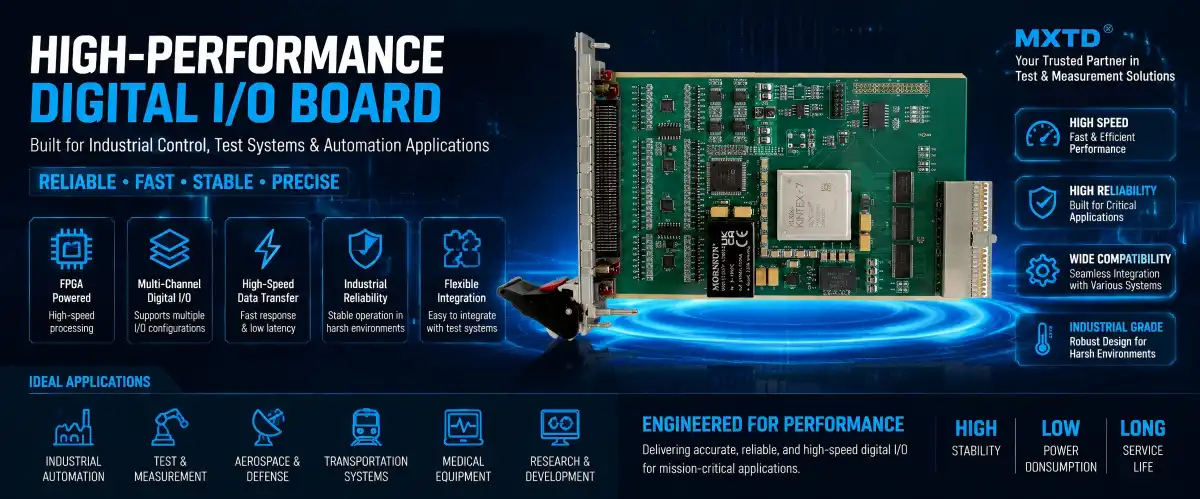
When you're working in precision measurement environments, understanding how analog signal acquisition boards function becomes essential to your system's success. These specialized data acquisition devices capture voltage differences between paired signal lines rather than measuring against a common ground reference.
The Core Principle Behind Differential Measurement
Differential inputs measure the difference in potential between two output lines, while single-ended versions measure voltage in relation to ground. This design automatically blocks noise and disturbance that shows up on both lines. This is known as "common-mode rejection" in the engineering world. When electromagnetic interference affects both signal lines in the same way, the measurement electronics take out these disturbances to keep only the real signal you need. This feature is very useful in busy factories where motors, switches, and high-frequency equipment constantly cause electrical interference.
Critical Electrical Characteristics That Drive Performance
Modern data acquisition boards deliver exceptional specifications that directly impact measurement quality. Resolution determines the smallest voltage change your system can detect—16-bit resolution provides 65,536 discrete levels across your measurement range, enabling detection of minute signal variations. Sampling rate defines how frequently the board captures readings; 250 Ksps allows 250,000 measurements per second, suitable for signals with frequency content up to several hundred kilohertz, given appropriate anti-aliasing considerations. Input signal bandwidth of 2.5 MHz ensures accurate reproduction of fast-changing waveforms without distortion.
Channel configuration flexibility allows 64 single-ended or 32 differential measurements, letting you optimize between channel count and noise rejection based on application demands. Voltage input ranges of ±10V or ±30V accommodate standard industrial sensor outputs and higher-voltage transducers without external signal conditioning.
Step-by-Step Guide to Integrating a Differential Analog Input Board into Your Test Bench
Successful integration of a differential analogue input board requires methodical planning and execution. Your measurement outcomes depend on selecting appropriate hardware, installing it correctly, and validating performance through calibration.
Assessing System Requirements and Defining Specifications
Begin by documenting every signal parameter your application demands. What voltage levels will sensors produce? How many channels must you measure simultaneously? What measurement accuracy satisfies your quality requirements? Understanding whether you need continuous streaming at the maximum sample rate or intermittent burst acquisition affects both board selection and system architecture. Consider environmental conditions—will the equipment operate in controlled laboratory settings or harsh industrial environments? Temperature extremes, humidity, and vibration levels determine whether commercial-grade or industrial-grade specifications suit your needs.
Selecting the Right Board Architecture and Bus Interface
Bus interface selection balances throughput requirements with existing infrastructure. PXIe platforms provide 4 Gbps transfer rates through x4 PCIe connectivity, supporting sustained high-speed acquisition from multiple boards within compact 3U chassis configurations. Traditional PCI interfaces offering 132 MB/s throughput suffice for moderate channel counts at standard sampling rates. CPCI systems deliver rugged packaging with enhanced EMI shielding suitable for defense applications.
MXTD manufactures boards compatible with NI specifications, ensuring seamless integration with established test systems. Our PXIe-5104 model delivers ±10V measurement across 32 differential channels, while the PXIe-5114 extends range to ±30V for high-voltage transducer applications. These standard 3U boards measure 160 mm × 100 mm × 20 mm with a tolerance of under 0.2mm, guaranteeing mechanical compatibility with industry-standard chassis.
Differential Analog Input Board vs. Other Input Boards: Making the Right Choice
Understanding architectural differences between measurement board types helps procurement teams select optimal solutions. Each configuration offers distinct advantages depending on application requirements.
Comparing Performance Characteristics Across Architectures
Single-ended boards measure voltage relative to a common ground reference, offering maximum channel density at reduced per-channel cost. This simplicity works well in electrically quiet environments where all signals share clean ground connections. However, ground potential differences between measurement points introduce errors that appear as signal offsets.
Differential configurations reject common-mode noise by measuring only the voltage difference between paired signal wires. This architecture delivers superior performance in industrial environments where electrical interference and ground loops challenge measurement accuracy. The tradeoff involves reduced channel density—each differential channel requires two analog-to-digital converter inputs that a single-ended configuration would use for separate channels.
Isolated input boards provide galvanic separation between measurement channels and the data acquisition system ground. This protection prevents ground loops and safeguards expensive equipment from voltage transients. Applications involving high common-mode voltages, such as monitoring power distribution systems or isolated sensor networks, benefit from channel-to-channel and channel-to-ground isolation. Isolation adds cost and complexity while typically reducing maximum sampling rates compared to non-isolated architectures.
Evaluating Leading Suppliers and Product Ecosystems
National Instruments established the PXI standard and maintains extensive product lines with comprehensive software support through LabVIEW and associated drivers for the differential analogue input board. Keysight Technologies offers high-performance modular instruments emphasizing measurement accuracy and calibration traceability. Siemens integrates data acquisition within broader industrial automation ecosystems.
MXTD positions analog input boards as cost-effective alternatives meeting NI product specifications. Our 12 years of R&D experience deliver reliable solutions at price points advantageous for large-scale procurement. Standard products ship from stock with one-hour response times to customer inquiries. Customization accommodates specialized voltage ranges, extended temperature operation, and alternative operating systems, including Linux, VxWorks, and RTX, beyond standard Windows support.
Procurement Insights: How to Source the Best Differential Analog Input Board for Your Business
Strategic procurement extends beyond comparing specifications to encompass supplier relationships, logistics, and lifecycle support.
Leveraging Volume Purchasing and Supplier Partnerships
Bulk orders typically unlock pricing advantages as manufacturers distribute fixed costs across larger quantities. Discuss volume discounts candidly with suppliers—many maintain tiered pricing structures that activate at specific order quantities. Strategic buyers coordinate purchases across departments to aggregate demand and qualify for improved terms. Establishing preferred supplier relationships provides pricing predictability for multi-year projects and priority allocation during component shortages.
MXTD offers competitive bulk pricing for differential analog input boards that makes economic sense for system integrators and OEM manufacturers. Our manufacturing capacity supports both immediate stock availability for standard configurations and production scheduling for customized variants. Procurement managers gain cost certainty when planning test system deployments across multiple facilities or production lines.
Evaluating Supplier Reliability and Support Infrastructure
Supplier technical capability directly impacts your project success. Evaluate engineering support responsiveness—can you reach knowledgeable applications engineers when facing integration challenges? Does the supplier provide detailed documentation, example code, and integration guides? Technical support responsiveness becomes critical during project deadlines when delays cost money and opportunity.
Manufacturing quality and consistency affect long-term reliability. Request information about production testing, quality certifications, and failure rate data. Reputable suppliers conduct thorough functional testing, including calibration verification, before shipping. Understanding their quality processes builds confidence in delivered products.
Understanding Lead Times and Managing Project Schedules
Standard products with stock availability ship within days, while customized configurations require manufacturing time. MXTD responds to customer requirements within one hour and clearly communicates production schedules for OEM/ODM customization. Realistic delivery expectations prevent project delays. When deadlines loom tight, discuss expedited production and shipping options—air freight reduces transit time for international deliveries where urgency justifies additional cost.
Optimizing Test Bench Performance with Differential Analog Input Boards
Achieving maximum measurement accuracy requires ongoing attention beyond initial installation. Systematic optimization and maintenance preserve performance as systems age and requirements evolve.
Noise Mitigation Strategies for Signal Integrity
Electrical noise degrades measurement quality through multiple coupling mechanisms. Capacitive coupling transfers high-frequency interference from adjacent conductors. Inductive coupling occurs when current-carrying wires create magnetic fields affecting nearby signal paths. Ground loops arise when measurement circuits and signal sources connect to ground at multiple points with potential differences between ground connections.
Shielding signal cables blocks capacitive coupling from external electric fields. Proper grounding connects shields to chassis ground at the data acquisition end only, preventing circulating currents that create magnetic fields. Twisted-pair wiring causes magnetic fields from forward and return currents to cancel, significantly reducing inductive coupling susceptibility. Physical separation between signal cables and power conductors reduces coupling strength as interference decreases with distance.
Differential measurement inherently rejects noise affecting both signal wires equally. This common-mode rejection ratio specification quantifies how effectively the input circuitry suppresses common-mode signals. Boards with CMRR exceeding 80 dB attenuate common-mode noise by 10,000:1 compared to differential signal content. Maximizing this advantage requires balanced source impedances on both differential inputs—unbalanced impedances convert common-mode interference into differential signals that appear as measurement errors.
Calibration Management and Documentation Practices
Scheduled calibration maintains measurement traceability and accuracy over time for the differential analogue input board. Environmental factors, including temperature changes and component aging, gradually shift gain and offset characteristics. Annual calibration intervals balance maintenance costs against accuracy drift rates for most industrial applications. Critical measurements supporting product certification or regulatory compliance may demand more frequent calibration.
Documentation creates accountability and supports quality audits. Record calibration dates, equipment serial numbers, reference standard traceability, environmental conditions, and measured correction factors. Modern quality management systems digitize these records for easy retrieval and trend analysis. Detecting abnormal drift between calibration signals potential problem requiring corrective action before significant errors occur.
Software Compatibility and System Integration
Driver software provides the interface between application programs and measurement hardware. Comprehensive drivers support multiple programming environments, including LabVIEW, MATLAB, Python, and C/C++, accommodating diverse development preferences across engineering teams. Regular driver updates maintain compatibility with evolving operating systems and address discovered issues. MXTD provides driver dynamic libraries and demonstration programs that accelerate integration, along with customized operating system support, including Linux and real-time environments.
Firmware updates delivered through software occasionally enhance functionality or correct edge-case behaviors. Establishing processes to evaluate and deploy updates prevents compatibility issues while allowing access to improvements. Testing updates on non-critical systems before production deployment reduces the risk of disrupting operational test benches.
Conclusion
Integrating differential analog input boards into test benches elevates measurement capability through superior noise immunity and precision signal acquisition. By selecting appropriate voltage ranges, channel configurations, and bus interfaces compatible with your infrastructure, you build data acquisition systems supporting demanding applications across industrial automation, aerospace, and electronics testing. Strategic procurement emphasizing supplier reliability, technical support quality, and customization flexibility maximizes long-term value. Ongoing calibration management, noise mitigation, and system monitoring preserve accuracy throughout equipment lifecycles, ensuring your test bench delivers consistent, trustworthy results that accelerate development timelines and improve product quality.
FAQ
1. What compatibility considerations matter when pairing analog acquisition boards with various DAQ systems?
Bus interface compatibility represents the primary requirement—verify that your chassis supports PXIe, CPCI, PCIe, or PCI connectivity matching the board specification. Operating system support matters significantly; confirm driver availability for your development environment, whether Windows, Linux, or real-time operating systems. Software API compatibility affects programming effort—boards supporting standard measurement interfaces integrate more easily with existing code libraries. Physical dimensions and power consumption must fit within chassis mechanical and electrical budgets, particularly when populating multiple slots.
2. Why do differential inputs outperform alternatives in noisy industrial environments?
Common-mode rejection eliminates interference appearing equally on both signal wires, which encompasses most industrial noise sources, including ground potential differences and radiated electromagnetic interference. This architectural advantage delivers 60 dB or greater noise suppression compared to single-ended configurations that measure against potentially noisy ground references. The practical result improves measurement accuracy by orders of magnitude in electrically harsh environments containing motor drives, welding equipment, and radio frequency sources.
3. What lead times apply to bulk orders, and how can procurement accelerate delivery?
Standard configurations from stock typically ship within 3-5 business days after order confirmation. Customized specifications, including modified voltage ranges or extended temperature ratings, require production scheduling—lead times range from 3-6 weeks, depending on customization complexity and current manufacturing queue depth. Expedited production occasionally reduces timelines for urgent requirements. Air freight cuts international shipping from weeks to days, where schedule pressures justify premium transportation costs. MXTD responds to inquiries within one hour and provides realistic delivery commitments supporting effective project planning.
Partner with MXTD for Premium Differential Analog Input Board Solutions
Selecting the right data acquisition supplier impacts both immediate project success and long-term operational efficiency. MXTD has delivered precision measurement solutions for over 12 years, accumulating extensive experience in PXIe chassis, boards, and integrated testing systems. Our differential analog input board manufacturer capabilities extend across standard product lines compatible with industry-leading specifications and customized OEM/ODM configurations tailored to unique application requirements.
Our engineering team responds within one hour to technical inquiries and provides remote video guidance, accelerating your integration of the differential analogue input board. Standard products ship from stock, while customized solutions follow transparent production schedules. We support diverse operating systems and provide comprehensive software, including driver libraries and demonstration programs. Competitive bulk pricing delivers exceptional value for system integrators and research institutions managing budget constraints without compromising measurement quality.
Contact manager03@mxtdinfo.com to discuss your specific requirements and request sample evaluation units. Experience firsthand how our boards integrate seamlessly into your test bench architecture while delivering measurement accuracy and reliability that elevate your testing capabilities.
References
1. Anderson, R. & Mitchell, K. (2021). Precision Data Acquisition Systems for Industrial Applications. Technical Instrumentation Press.
2. Chen, L., Roberts, D., & Williams, J. (2020). "Common-Mode Rejection Techniques in Differential Analog Measurement." Journal of Electronic Test Engineering, 45(3), 234-251.
3. Garrison, P. (2022). Modular Instrumentation Standards and Best Practices. Industry Standards Publications.
4. Hoffman, T. & Kumar, S. (2019). "Signal Integrity Optimization in Multi-Channel Data Acquisition." IEEE Transactions on Instrumentation and Measurement, 68(7), 2456-2468.
5. Patterson, M. (2023). Test Bench Design and Integration Handbook. Engineering Systems Press.
6. Thompson, R., Zhang, W., & Davis, A. (2020). "Comparative Analysis of Analog Input Architectures for Industrial Automation." International Journal of Advanced Manufacturing Technology, 112(5), 1823-1840.
Our customers’ satisfaction speaks for our quality — contact us to experience the same reliable service.