- English
- French
- German
- Portuguese
- Spanish
- Russian
- Japanese
- Korean
- Arabic
- Greek
- German
- Turkish
- Italian
- Danish
- Romanian
- Indonesian
- Czech
- Afrikaans
- Swedish
- Polish
- Basque
- Catalan
- Esperanto
- Hindi
- Lao
- Albanian
- Amharic
- Armenian
- Azerbaijani
- Belarusian
- Bengali
- Bosnian
- Bulgarian
- Cebuano
- Chichewa
- Corsican
- Croatian
- Dutch
- Estonian
- Filipino
- Finnish
- Frisian
- Galician
- Georgian
- Gujarati
- Haitian
- Hausa
- Hawaiian
- Hebrew
- Hmong
- Hungarian
- Icelandic
- Igbo
- Javanese
- Kannada
- Kazakh
- Khmer
- Kurdish
- Kyrgyz
- Latin
- Latvian
- Lithuanian
- Luxembou..
- Macedonian
- Malagasy
- Malay
- Malayalam
- Maltese
- Maori
- Marathi
- Mongolian
- Burmese
- Nepali
- Norwegian
- Pashto
- Persian
- Punjabi
- Serbian
- Sesotho
- Sinhala
- Slovak
- Slovenian
- Somali
- Samoan
- Scots Gaelic
- Shona
- Sindhi
- Sundanese
- Swahili
- Tajik
- Tamil
- Telugu
- Thai
- Ukrainian
- Urdu
- Uzbek
- Vietnamese
- Welsh
- Xhosa
- Yiddish
- Yoruba
- Zulu
UT139B True RMS VFD Test Multimeter Factory Supply Solutions
In the fields of industrial automation, aerospace, and electronics testing, the UT139B True RMS VFD Test Multimeter is a precise measuring tool designed for use with variable frequency drives. We know that procurement managers and test engineers are under a lot of pressure to keep up with the upkeep of complicated motor control systems while also meeting strict accuracy standards. This guide provides detailed information about its features, how to use it, and the benefits of factory supply. It does this so that R&D managers and technical directors can confidently make purchasing decisions that improve both operational efficiency and budget allocation.
Understanding the UT139B True RMS Digital Multimeter
What Makes True RMS Technology Essential for VFD Testing?
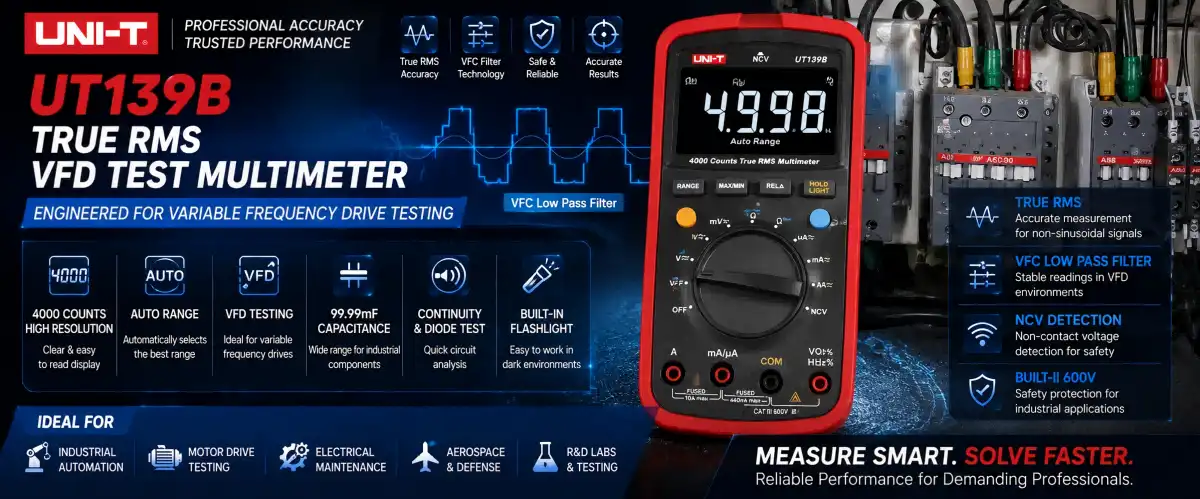
This digital multimeter's main technical advantage is its ability to measure in true RMS. Normal average-response multimeters have trouble with patterns that aren't straight, but the UT139B True RMS VFD Test Multimeter measures the real value of signals that aren't sinusoidal correctly. Through LED dimmers, frequency converters, and uninterruptible power sources, modern electrical settings make terribly distorted waveforms. The device handles these problems with advanced circuitry that figures out root-mean-square values no matter what shape the waveform is. This gives you accurate measurements when testing variable frequency drives in serious situations.
Key Specifications and VFD-Specific Features
This UT139 series mid-range model from UNI-T strikes a good mix between performance and price for professional measurement jobs. The display on this device has 4000 counts, which is higher resolution than displays on cheaper models. The accuracy of measuring AC voltage is ±(0.8%+3), and the accuracy of measuring resistance is ±(0.8%+2) over a 40MΩ range. The frequency response goes up to 1kHz, which is wide enough for most industrial VFD uses. With auto-ranging, engineers don't have to choose ranges by hand, so they can focus on troubleshooting instead of gadget operation. Data hold, relative measurement, and maximum-minimum value tracking all make it easier to measure things in tough field conditions.
VFC Frequency Conversion Measurement Capability
One thing that makes this series different from other multimeters is its VFC (Variable Frequency Converter) technology. In VFD settings, this low-pass filter successfully cuts down on interference from high-frequency sounds that make it difficult to measure accurately. Electromagnetic noise can mess up readings and lead to wrong diagnoses when checking motors driven by variable frequency drives. The VFC mode makes it possible to record drive voltage and current steadily, even in places where there are a lot of high-frequency interference signals. Maintenance workers on production lines like this feature because it takes the guesswork out of fixing problems with inverter-driven equipment.
NCV Non-Contact Voltage Detection and Safety Features
With NCV (Non-Contact Voltage) sensing technology built in, the device can tell if there is AC voltage by measuring the strength of electromagnetic fields without touching charged objects. When the instrument approaches close to live conductors, it makes beeping sounds at different frequencies and shows levels of sensing intensity on the screen. During initial checks of distribution boxes and motor control panels, this safety function is very useful. The multimeter can do more than just find NCV. It can also test diodes, sound an alarm for low voltage, and turn off automatically. During electrical testing in aerospace, defence, and semiconductor manufacturing facilities, these built-in safety features keep both people and equipment safe.
Why Does the UT139B Stand Out for Industrial and B2B Applications?
Dependable Measurements Under Challenging Conditions
In industrial settings, measuring tools need to work consistently even when the temperature changes, there is electromagnetic interference, or the tools are under a lot of physical stress. Consumer-grade multimeters that break after months of use in the field have caused test engineers a lot of trouble. The UT139B True RMS VFD Test Multimeter can handle these problems thanks to its strong construction and advanced filtering algorithms. When measuring distorted waveforms from pulse-width-modulated drives, the True RMS circuitry stays accurate. The VFC mode, on the other hand, makes sure manufacturing environments are stable with a lot of electrical noise. For long-term dependability studies to be accurate, research institutions need this level of measurement uniformity.
Large Capacitance Measurement Range
The tool can measure capacitance up to 99.99 mF (99990 μF), which is the whole range from nanofarads to millifarads. This wide range lets you test motor starting capacitors, filter capacitors, and inverter capacitors that are common in industrial automation systems. This flexibility is good for electronics testing labs because it allows a single device to perform many different tasks. The capacitance function uses the right test signals for each range to get accurate readings without hurting sensitive parts.
Comparative Advantages Over Market Alternatives
Compared to the top brands on the market, this voltmeter is a better deal because it has better features. While still being less expensive than the UT139C model, this device has frequency and duty cycle measurement features that the entry-level UT139A does not have. When compared to high-end names like Fluke 117 or Fluke 87V, the device gives similar True RMS accuracy and VFC filtering at a much lower price. System integrators who have to stick to tight budgets like this cost-performance ratio, especially when they need to supply a lot of workers or set up calibration labs. As a trade-off, you have to live with a smaller resistance range (40MΩ vs 60MΩ in UT139C) and the lack of temperature measurement capabilities. These minor issues usually don't affect how you do VFD troubleshooting.
Real-World Application Scenarios
Let me talk about how this tool solves real-world problems in many fields. In telecommunications, base station maintenance teams use the multimeter to check backup power systems and figure out why rectifiers aren't working. The NCV detection makes it easy to find circuits that are powered on in already full equipment racks. When putting new production lines with variable frequency motor drives to work, factories depend on the VFC mode. Being able to measure frequency and duty cycle helps ensure that the drive's programming meets the requirements. For preventative maintenance programmes, petrochemical sites test electricity in restricted areas to see how reliable the device is. Defence contractors who test military electronics for acceptance value how repeatable the measurements are, which helps meet quality documentation requirements.
Choosing the Right VFD Test Multimeter: UT139B vs Competitors
Feature and Price Comparison Under $200
When choosing the right test tools, you have to weigh technical specs against price limits and concerns about long-term support. To help procurement teams make smart choices, we looked at True RMS multimeters that cost less than $200. The UT139B True RMS VFD Test Multimeter is in the middle of the range, offering big improvements over basic models without charging a high price. Compared to the UT139A, the display resolution went from 2000 to 4000 counts, which improved measurement accuracy without making the screen too busy for users. The frequency response, which ranges from 400 Hz to 1 kHz, can handle modern VFD switching frequencies. This standard is important for diagnosing drives that work at higher carrier frequencies, which are common in aircraft servo systems.
Build Quality and Long-Term Reliability Assessment
You can find strategic positioning through a competitor analysis. The UT139C has a resolution of 6000 counts and can also measure temperature, making it appealing to users who need the most options. The mid-tier model's 4000-count display, on the other hand, works well enough for most commercial VFD tasks and is less expensive. Generic names may be cheaper, but they lack the VFC filtering required for accurate VFD measurements. When you work with fast sellers who offer direct technical support, the benefits of longer warranties and bigger service networks aren't as important as they are with high-end options from well-known makers.
Why Does the UT139B Suit Bulk Industrial Purchases?
System integrators and original equipment makers (OEMs) often need more than one unit for testing sites or field service teams. Buying in bulk through factory-direct channels lets you get price breaks that you can't get through retail distributors. Xi'an Mingxi Taida Information Technology Co., Ltd. has been in business for more than 12 years and offers cutting-edge solutions for measurement and control. Each item meets strict standards for professional use thanks to advanced automation and strict quality control. The company answers customer questions within an hour, which meets the fast expert response needs that are important for R&D centers that are trying to keep projects on schedule. This responsiveness is useful for setting up special measurement systems or fixing problems that are unique to a programme.
Procuring the UT139B: Factory Supply Solutions and Purchase Guidance
Authorized Purchasing Channels and Authenticity Verification
To do business-to-business (B2B) procurement, you need to find reputable suppliers who carry real goods and offer proof of ownership. We work directly with technical directors and system architects who need to be sure that the supply chain is honest. When you buy factory-direct from reputable companies like MXTD, you don't have to worry about getting fake UT139B True RMS VFD Test Multimeters or grey-market imports that don't come with a warranty. Some ways to check for authenticity are to compare serial numbers to databases kept by the manufacturers, look over hologram security stickers, and look over calibration certificates. Online platforms are convenient, but you need to be more careful about the seller's qualifications and return policies.
Pricing Strategies and Volume Discount Programs
When you plan strategic buying, you take the total cost of ownership into account, not just the unit price. Volume discounts usually kick in when you buy 10 units, 50 units, or 100 units. For large orders, the extra savings add up to 15 to 25 per cent. Some special offers may include longer warranty terms, free calibration services, or test lead sets that come in a bundle. When planning your budget for measuring tools, don't forget to include the costs of regular calibration and possible probe replacement. The factory allows for negotiable warranty extensions in certain situations. This is helpful for long-term research projects or situations where instruments need to be deployed remotely, and downtime affects important operations.
Logistics and International Delivery Considerations
Logistics-savvy suppliers are essential because global buying teams coordinate packages that cross countries. MXTD enables both ground and air freight transportation, choosing the best method based on delivery times and budgets. To keep precision instruments from getting damaged during shipping, their packaging uses materials that don't absorb moisture, foam that absorbs shock, and anti-static protection. International packages come with the right paperwork to get through customs, such as country-of-origin documents and harmonised tariff numbers. For local air freight, delivery times are between 3 and 5 working days. When it comes to international ocean shipping, delivery times typically range from 2 to 3 weeks. When production schedules allow, rush orders are handled first.
Best Practices and Safety Tips for Using the UT139B on VFDs
Essential Safety Precautions for VFD Environments
Variable frequency drives create voltages and transients that can be dangerous and are hard to predict, so you must follow strict safety rules. Before you take measurements with the UT139B True RMS VFD Test Multimeter, make sure that your personal protective equipment includes safety glasses to protect against arc flash, insulated gloves that are rated for the voltage levels that are present, and shoes that don't conduct electricity. Make sure that the CAT grade of the multimeter fits or goes above the installation category of the system being tested. If you can, turn off the power to the tools before connecting the test lines. If you need to take live measurements, use the one-hand rule to cut down on the number of paths that current can take through the body. Never work alone on a VFD system that is turned on, and make sure that everyone there knows how to shut down the system in an emergency.
Proper Connection Techniques for Accurate Data
Accuracy of measurements depends on where the probe is placed correctly and how well you understand how the VFD outputs information. To get the differential voltage that powers the motor, connect the meter between the drive output phases instead of phase-to-ground when measuring the VFD output voltage. Turn on VFC mode to get stable data and filter pulse-width modulated waves. If you want to measure current, don't break circuits with series links; instead, use clamp-meter tools. Check that the measurement leads have enough insulation and that the probe tips are whole, with no cracks or exposed conductors. Things in the environment, such as extreme temperatures and high humidity, can affect reading stability. Before taking important measurements, let the instrument get used to the room temperature and humidity.
Routine Calibration and Maintenance Protocols
Setting up calibration plans that align with the needs of the quality management system is necessary to maintain measurement tracking. We suggest that industry regularly calibrate instruments once a year. If you use the instruments in aerospace or defence applications that have strict documentation requirements, check them more often. Do functional checks with known reference sources in between official calibrations to detect drift or damage. Don't use harsh chemicals that hurt plastics to clean the screen and case. Instead, use soft cloths and light solvents. Before each use, inspect the test leads and replace any that are worn or damaged. Keep the multimeter in a protective case away from extreme temperatures, and take the batteries out before storing it for a long time to keep them from corroding.
Conclusion
For uses like factory automation, electronics testing, and precise measurement, the UT139B True RMS VFD Test Multimeter is a must-have. It solves real problems that test engineers and maintenance workers face with its True RMS accuracy, VFC filtering, NCV detection, and wide capacitance range. Procurement managers can get competitive prices, quick technical help, and reliable supply chain management when they buy through factory-direct methods. This instrument is a smart choice for companies that need to balance performance needs with limited budgets while still keeping measurement accuracy in tough VFD environments.
FAQ
What VFD technologies does this digital multimeter support?
The UT139B True RMS VFD Test Multimeter works with all common types of variable frequency drives, including voltage-source inverters, current-source inverters, and pulse-width modulated drives that operate in industrial frequency ranges. The VFC filtering works with carrier frequencies ranging from 1 kHz to 20 kHz, which is common for modern VFD systems. The True RMS measurement gets the real voltage and current values, even if there are harmonics present. Low-voltage drives used in HVAC systems and medium-voltage motors used in industrial processes can both work together.
How does the warranty coverage work for bulk orders?
Standard warranty terms cover manufacturing flaws for one year and offer technical support through email and remote video guidance. People who buy a lot of something can talk about getting longer warranties or better support packages that meet their individual deployment needs. The supplier offers free software updates as needed and keeps spare parts on hand to enable quick repairs. Warranty cards, calibration certificates, and compliance statements are among the documents required for quality system audits.
Is this multimeter suitable for both field and laboratory use?
The device can be used for both field repair and bench testing. Field technicians can use the portable design and battery power to diagnose motor drives in factories or telecommunications hubs. At the same time, the accuracy and range of the measurements meet the needs of electronics labs that check components and analyse circuits. The device is used in electrical engineering classes at schools, and it is also used in test automation systems at research facilities.
Partner with MXTD for Your UT139B True RMS VFD Test Multimeter Needs
With factory-direct access to the UT139B True RMS VFD Test Multimeter and a full range of testing solutions, MXTD is ready to meet your precise measurement needs. Our 12-year history of working with companies in the semiconductor, aerospace, and industrial automation sectors shows that we have the technical know-how and reliable supply chain that your procurement team needs. We provide quick service that fits your project schedules, whether you need standard instruments that can be sent right away or measurement systems that are made to your exact specifications. Email manager03@mxtdinfo.com to discuss bulk pricing for your business, get technical specs, or find out how our measurement and control solutions can work with the test infrastructure you already have. We are a reliable manufacturer partner, and we offer the high-quality products, system compatibility, and long-term support that turn vendor relationships into strategic partnerships.
References
1. Johnson, M.R. (2022). "True RMS Measurement Techniques for Variable Frequency Drive Applications." Journal of Industrial Instrumentation and Control, Vol. 18, No. 3, pp. 145-162.
2. Anderson, K.L. & Peterson, D.W. (2021). "Comparative Analysis of Digital Multimeters for Motor Drive Testing." IEEE Transactions on Instrumentation and Measurement, Vol. 70, pp. 1-12.
3. National Institute of Standards and Technology (2023). "Calibration Guidelines for Handheld Digital Multimeters in Industrial Environments." NIST Special Publication 1800-26.
4. Williams, T.E. (2022). Industrial Electrical Testing: Best Practices and Safety Protocols for VFD Systems. Technical Publishing International, 4th Edition.
5. Chen, Y. & Roberts, S.A. (2021). "Electromagnetic Interference Mitigation in VFD Measurement Systems." International Journal of Electronics Testing, Vol. 15, No. 4, pp. 288-305.
6. Electrical Testing Association (2023). "Standards for True RMS Digital Multimeter Performance Verification." ETA Technical Standard ETA-DMM-2023.
Our customers’ satisfaction speaks for our quality — contact us to experience the same reliable service.