- English
- French
- German
- Portuguese
- Spanish
- Russian
- Japanese
- Korean
- Arabic
- Greek
- German
- Turkish
- Italian
- Danish
- Romanian
- Indonesian
- Czech
- Afrikaans
- Swedish
- Polish
- Basque
- Catalan
- Esperanto
- Hindi
- Lao
- Albanian
- Amharic
- Armenian
- Azerbaijani
- Belarusian
- Bengali
- Bosnian
- Bulgarian
- Cebuano
- Chichewa
- Corsican
- Croatian
- Dutch
- Estonian
- Filipino
- Finnish
- Frisian
- Galician
- Georgian
- Gujarati
- Haitian
- Hausa
- Hawaiian
- Hebrew
- Hmong
- Hungarian
- Icelandic
- Igbo
- Javanese
- Kannada
- Kazakh
- Khmer
- Kurdish
- Kyrgyz
- Latin
- Latvian
- Lithuanian
- Luxembou..
- Macedonian
- Malagasy
- Malay
- Malayalam
- Maltese
- Maori
- Marathi
- Mongolian
- Burmese
- Nepali
- Norwegian
- Pashto
- Persian
- Punjabi
- Serbian
- Sesotho
- Sinhala
- Slovak
- Slovenian
- Somali
- Samoan
- Scots Gaelic
- Shona
- Sindhi
- Sundanese
- Swahili
- Tajik
- Tamil
- Telugu
- Thai
- Ukrainian
- Urdu
- Uzbek
- Vietnamese
- Welsh
- Xhosa
- Yiddish
- Yoruba
- Zulu
PXIe Matrix Switch Modules vs Traditional Switching: Which Wins?
When comparing modern switching technologies, the answer is clear: Pickering equivalent PXIe matrix switch modules decisively outperform traditional switching solutions in nearly every measurable metric. These advanced modular platforms deliver superior channel density, faster switching speeds, and enhanced signal integrity compared to conventional relay-based systems. For test engineers and procurement managers working in aerospace, semiconductor, and industrial automation sectors, the choice comes down to efficiency, reliability, and long-term scalability—areas where PXIe-based switching excels consistently across mission-critical applications.
Introduction
Switching technologies form the backbone of every sophisticated test and measurement system. Whether you're validating avionics components for aerospace applications or conducting high-throughput semiconductor wafer testing, your switching infrastructure directly impacts accuracy, throughput, and operational costs. We've seen traditional relay-based switches dominate the landscape for decades, but modern test environments demand more than legacy hardware can deliver.
This shift has driven widespread adoption of PXI Express (PXIe) matrix switch modules—particularly solutions benchmarked against industry-leading Pickering specifications. These modular switching platforms integrate seamlessly into automated test equipment, offering dramatically improved performance metrics compared to standalone traditional switches. As R&D managers and test engineers face increasing pressure to reduce test times while improving measurement precision, understanding the fundamental differences between these technologies becomes essential.
At MXTD, we've witnessed this technological transition throughout our 12 years serving global industrial automation, aerospace, and electronics testing sectors. Our experience supporting medium to large enterprises across these demanding industries has shown us repeatedly how switching technology choices ripple through entire test system architectures, affecting everything from initial capital expenditure to long-term maintenance costs and system scalability.
Understanding PXIe Matrix Switch Modules and Traditional Switching
What Makes PXIe Matrix Switch Modules Different
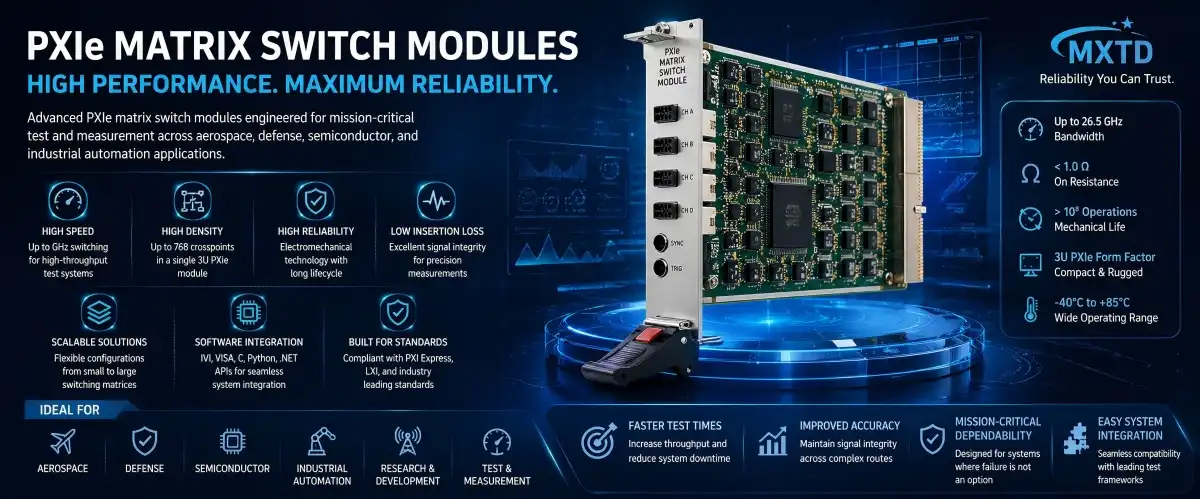
PXIe matrix switch modules represent a fundamental reimagining of signal routing architecture. Built around the PXI Express standard developed by PXI Systems Alliance, these modules leverage high-speed serial communication protocols to deliver bandwidth capabilities reaching 24 GB/s across system backplanes. The modular form factor allows multiple switching cards to occupy standardized 3U or 4U chassis slots, creating dense signal routing configurations that would require entire equipment racks using traditional approaches.
A typical Pickering equivalent PXIe matrix switch module from MXTD features configurations ranging from 4×8 to 32×128 crosspoint matrices, supporting channel counts from dozens to thousands within a single chassis. Key specifications include low insertion loss (typically under 0.5 dB at 1 GHz), high isolation (exceeding 80 dB), and switching speeds measured in microseconds rather than milliseconds. Bandwidth capabilities extend from DC to several GHz, depending on relay type, with electromechanical relays offering superior DC performance and reed relays providing faster operation for high-frequency signals.
Traditional Switching Approaches and Their Limitations
Traditional switching systems typically employ standalone relay boxes, patch panels, or discrete switch banks connected via GPIB, RS-232, or Ethernet interfaces. These systems served test engineering needs adequately when test throughput requirements remained modest, and channel counts stayed manageable. Many organizations still maintain legacy systems using mechanical rotary switches or manually-operated relay matrices that have operated reliably for decades.
The limitations emerge when test complexity increases. Standalone relay boxes require individual power supplies, separate control interfaces, and dedicated rack space. Expanding channel count means adding more boxes, more cables, and more control software complexity. Communication bottlenecks become evident—a GPIB bus supports only 1 MB/s theoretical throughput, and command latency can reach dozens of milliseconds. Mechanical wear on relay contacts limits operational lifetime, particularly in high-cycle applications where relays may actuate millions of times annually.
Architectural Differences That Matter
Signal handling differs fundamentally between these approaches. PXIe matrix switch modules share a common timing and triggering infrastructure with measurement instruments in the same chassis, enabling nanosecond-level synchronization impossible with traditional standalone systems. The PXIe backplane provides dedicated control lanes separate from measurement data paths, eliminating the bus contention issues that plague GPIB and shared Ethernet networks.
Integration of the Pickering equivalent PXIe matrix switch module represents another critical distinction. A PXIe switching system exists as a software-defined architecture where routing configurations live in driver code rather than hardwired cable paths. This software-centric approach allows routing changes through simple code modifications rather than physical rewiring. When test requirements evolve—and they always do—PXIe systems adapt through software updates rather than hardware overhauls.
Comparing Performance and Reliability: PXIe Matrix vs Traditional Switching
Switching Speed and System Throughput
Speed differences between these technologies prove dramatic in high-volume production environments. PXIe matrix switch modules typically complete relay actuation and signal settling within 2-5 milliseconds for electromechanical relays and under 1 millisecond for reed relays. Command processing adds minimal overhead since control signals travel via dedicated backplane lanes rather than shared communication buses.
We've measured real-world scenarios where migrating from GPIB-controlled traditional switching to PXIe matrix switch modules reduced overall test execution time by 40-60%, even when actual measurement times remained unchanged. This improvement stems from reduced communication overhead, faster triggering, and elimination of bus contention delays.
Channel Density and Scalability Benefits
Space efficiency dramatically favors PXIe architectures. A single 18-slot PXIe chassis can accommodate matrix switch modules totaling several thousand crosspoint connections within a 7U rack height footprint. Achieving equivalent connectivity with traditional relay boxes requires multiple rack units, extensive cabling harnesses, and significant electrical infrastructure for powering multiple standalone units.
This density advantage compounds when building automated test systems requiring hundreds or thousands of signal paths. Aerospace test applications validating wire harnesses or avionics systems often need to connect hundreds of test points to measurement instruments. Semiconductor parametric test systems require routing capabilities connecting thousands of device pins to source-measure units. PXIe switching architectures handle these requirements elegantly through modular expansion within a unified chassis platform.
Signal Integrity and Measurement Accuracy
Signal integrity suffers in traditional systems due to lengthy cable runs between standalone switches and measurement instruments. Every meter of coaxial cable introduces insertion loss, capacitance, and potential impedance discontinuities that degrade high-frequency signals. Traditional switching systems often require 2-3 meters of cabling between relay boxes and instruments, adding measurable loss and phase shift that must be characterized and calibrated out.
PXIe matrix switch modules sit immediately adjacent to measurement cards within the same chassis, connected via short internal cables typically under 30 centimeters. This proximity preserves signal fidelity, particularly critical when routing GHz-range RF signals or nanovolt-level DC measurements. Reduced cable length also minimizes electromagnetic interference pickup and crosstalk between adjacent channels.
Reliability Metrics and Maintenance Requirements
Mean Time Between Failures (MTBF) data reveals reliability advantages favoring PXIe solutions. Quality PXIe matrix switch modules from manufacturers like MXTD achieve MTBF ratings exceeding 500,000 hours under typical operating conditions. Traditional standalone relay boxes show comparable relay lifetimes, but system-level reliability suffers from additional failure modes—power supply failures, communication interface problems, and connector wear from repeated cable connections.
Maintenance demands differ substantially. PXIe systems consolidate switching resources into a single chassis serviced through unified diagnostic software. When relay degradation occurs, technicians replace a single module rather than troubleshooting multiple standalone boxes. Traditional systems require maintaining spare units for each switch type in your configuration, creating inventory complexity and a higher total cost of ownership.
Application Scenarios: When to Choose PXIe Matrix Switch Modules
Aerospace and Defense Testing Requirements
Aerospace test applications involving the Pickering equivalent PXIe matrix switch module exemplify scenarios where PXIe matrix switching provides undeniable advantages. Avionics validation requires connecting hundreds of signals between units under test and specialized instrumentation measuring parameters like MIL-STD-1553 bus protocols, ARINC 429 communications, and synchro/resolver signals. The high channel count, mixed signal types, and need for synchronous triggering align perfectly with PXIe capabilities.
Defense applications testing radar systems, electronic warfare equipment, and communication systems benefit similarly. These applications demand switching systems capable of handling RF signals across wide frequency ranges while maintaining strict isolation between channels to prevent signal leakage that could corrupt measurements. The superior shielding and grounding architectures available in PXIe chassis designs provide performance advantages difficult to achieve with traditional approaches.
Semiconductor Characterization and Production Test
Semiconductor parameter testing presents extreme requirements for channel density and switching speed. Production test systems validating integrated circuits may need to route signals to thousands of device pins, cycling through test patterns at rates exceeding 100 devices per hour. The switching overhead must remain minimal to avoid bottlenecking throughput.
Research institutions conducting semiconductor device characterization face similar challenges. Measuring transistor characteristics across voltage and temperature ranges requires automated switching between source-measure units and numerous device terminals. The synchronization capabilities inherent in PXIe architectures enable precise timing control necessary for pulsed measurements and transient characterization studies that would prove challenging using standalone switching systems.
Industrial Automation Validation
Industrial automation equipment testing involves validating programmable logic controllers, motor drives, and sensor networks under diverse conditions. Test scenarios require switching power supplies, load banks, and measurement instruments across multiple channels while capturing synchronized data. The triggering infrastructure within PXIe systems allows coordinating switching events with measurement acquisitions at precise intervals, creating realistic operational simulations.
Production test environments for manufacturing control systems benefit from PXIe switching scalability. As product lines evolve and test requirements expand, adding switching capacity means installing additional modules into existing chassis rather than provisioning new equipment racks and control infrastructure. This evolutionary growth path reduces capital expenditure and simplifies system maintenance.
When Traditional Switching Remains Viable
Certain applications still suit traditional switching approaches. Simple manual test benches conducting low-volume validation might not justify PXIe infrastructure costs. Applications requiring extremely high voltage or current switching (above 300V or 5A) may need specialized standalone relay systems since PXIe modules typically target signal-level applications. Laboratory environments performing one-off experimental setups might prefer the simplicity of discrete switches over integrated PXIe systems.
The decision ultimately depends on channel count requirements, desired automation level, and long-term system evolution plans. Organizations planning to scale test capabilities or integrate switching with automated measurement sequences generally find that PXIe matrix switch modules deliver superior total cost of ownership despite higher initial investment.
Procurement Insights: How to Source Reliable PXIe Matrix Switch Modules
Identifying Quality Suppliers and Manufacturers
Sourcing PXIe switching hardware requires evaluating suppliers across multiple dimensions beyond unit pricing. Established manufacturers maintain compliance with PXI Systems Alliance specifications, ensuring hardware interoperability with instruments from various vendors. Look for suppliers demonstrating active PXI Alliance membership and adherence to PXI-1 hardware specifications.
MXTD has built our product portfolio around compatibility with industry-standard platforms, offering Pickering equivalent PXIe matrix switch modules that integrate seamlessly with existing test systems. Our engineering team maintains deep familiarity with PXIe standards, having designed switching solutions across the specification's evolution over 12 years, serving aerospace, semiconductor, and industrial automation sectors. This experience translates into products meeting stringent performance requirements while offering cost advantages compared to tier-one manufacturers.
Evaluating Technical Specifications
Critical specifications warranting close examination include relay type (electromechanical versus reed), switching configuration (matrix versus multiplexer versus general-purpose), bandwidth ratings, isolation specifications, and maximum voltage/current ratings. Electromechanical relays offer superior DC performance and higher current capacity but switch more slowly than reed relays. Matrix configurations provide N×M crosspoint routing while multiplexers connect multiple inputs to common outputs.
Request detailed datasheets specifying insertion loss across frequency ranges relevant to your measurements. For RF applications, examine isolation specifications at your highest operating frequency. Semiconductor test engineers should verify support for Kelvin (4-wire) connections, enabling accurate low-resistance measurements. Procurement managers must confirm specifications match application requirements rather than simply selecting the highest-specification products that may prove unnecessarily costly.
Pricing Considerations and Lead Times
PXIe matrix switch module pricing varies substantially based on channel count, relay type, and bandwidth specifications. Entry-level modules with 4×8 matrices using reed relays typically cost between $3,000-$6,000, while high-density 32×128 configurations with electromechanical relays range from $15,000-$30,000 depending on specifications. These figures represent general market ranges—actual pricing should be requested through formal quotation processes.
Lead times depend on whether you're ordering standard catalog products versus custom configurations. Off-the-shelf modules from MXTD typically ship within days of order receipt since we maintain an inventory of standard configurations. Custom designs requiring specific channel counts, connector types, or relay configurations require engineering review and production scheduling. We commit to responding to technical inquiries within one hour during business hours and providing preliminary lead time estimates within 24 hours for custom requirements.
Support Infrastructure and Warranty Terms
After-sales support quality significantly impacts total ownership costs. Verify suppliers provide comprehensive driver software supporting common development environments like LabVIEW, Python, and C/C++. Documentation quality matters—detailed programming guides, application examples, and hardware reference materials accelerate integration efforts and reduce engineering time expenses.
MXTD backs our Pickering equivalent PXIe matrix switch modules with comprehensive support, including remote video technical assistance, free software updates for the product lifetime, and a standard one-year warranty covering manufacturing defects and component failures. Special warranty extensions and support agreements can be negotiated for large-scale deployments or mission-critical applications requiring guaranteed response times. Our technical team supports both standardized and customized solutions, guiding initial specification through long-term system operation.
Why Advanced PXIe Switching Solutions Deliver Superior Value
Modular Design Philosophy
The modular nature of PXIe architecture creates inherent advantages extending beyond immediate technical specifications. Building test systems around standardized form factors means components remain interchangeable across different manufacturers. When technology evolves or requirements change, individual modules can be upgraded without replacing entire systems. This modularity protects capital investments and extends the equipment's useful life.
Integration Advantages in Complex Systems
System integration complexity decreases dramatically when switching infrastructure shares a common platform with measurement instruments. Unified software architectures simplify application development—drivers typically expose consistent programming interfaces regardless of specific module types. Triggering and synchronization become straightforward since chassis backplanes provide dedicated clock distribution and hardware triggering lines connecting all slots.
Cost-Efficiency Through Lifecycle Perspective
Initial acquisition costs for PXIe systems typically exceed traditional switching equivalents when comparing individual units. A complete PXIe chassis with controller and switching modules might require a $25,000-$50,000 investment compared to $10,000-$20,000 for functionally equivalent standalone relay boxes. This upfront cost differential discourages some procurement decisions despite lifecycle economics favoring PXIe approaches.
Technical Innovations Enabling New Capabilities
Modern PXIe matrix switch modules incorporate innovations impossible in traditional standalone designs. Software-defined routing matrices allow storing multiple connection configurations and switching between them programmatically in microseconds. Integrated self-test capabilities enable automated relay verification between production runs, catching degraded contacts before they compromise measurement accuracy.
Conclusion
The comparison between PXIe matrix switch modules and traditional switching technologies reveals clear advantages for modern PXIe approaches across virtually every relevant metric. PXIe solutions deliver superior switching speed, dramatically better channel density, enhanced signal integrity, and more reliable long-term operation compared to legacy standalone systems. These technical advantages translate into measurable business benefits, including reduced test execution times, lower maintenance costs, and greater system scalability, supporting evolving test requirements.
Organizations operating in aerospace, semiconductor, electronics testing, and industrial automation sectors face increasingly complex validation challenges requiring sophisticated switching infrastructure. Pickering equivalent PXIe matrix switch modules provide proven solutions meeting demanding performance requirements while offering cost advantages compared to tier-one alternatives. The decision ultimately depends on specific application requirements, but the industry trend clearly favors PXIe architectures for any test system requiring automation, moderate-to-high channel counts, or plans for future expansion.
FAQ
What key factors should influence choosing PXIe over traditional switching?
Channel count requirements, automation needs, and expected system lifetime represent the most critical decision factors. Applications requiring more than 50-100 switched channels typically favor PXIe approaches due to superior density. Systems requiring integration with automated test sequences benefit from PXIe's software-defined architecture and triggering capabilities. Organizations planning 5+ year equipment lifecycles with anticipated expansion requirements should strongly consider PXIe platforms due to their modular scalability.
Are Pickering equivalent modules fully compatible with existing PXI systems?
Yes, quality Pickering equivalent modules from reputable manufacturers like MXTD adhere strictly to PXI Systems Alliance specifications, ensuring mechanical and electrical compatibility with standard PXI and PXIe chassis. Software compatibility depends on driver availability for your development environment—verify your supplier provides drivers supporting your preferred programming language and application framework before finalizing procurement decisions.
How do international shipping and support work for specialized test equipment?
Reputable suppliers support both air and ground transportation with appropriate packaging featuring moisture protection, shock absorption, and anti-static materials essential for precision instrumentation. MXTD coordinates international logistics for global customers, ensuring proper documentation and protective packaging. Our support team provides remote assistance via video conferencing for installation guidance and troubleshooting, minimizing downtime regardless of customer location.
Partner with MXTD for High-Performance PXIe Switching Solutions
Test system reliability and performance depend fundamentally on the quality of your switching infrastructure. MXTD specializes in Pickering equivalent PXIe matrix switch modules engineered to meet the demanding requirements of aerospace, semiconductor, and industrial automation applications. Our products deliver industry-leading performance at competitive pricing, backed by comprehensive technical support and a commitment to customer success. As an experienced Pickering equivalent PXIe matrix switch module manufacturer, we maintain a ready inventory of standard configurations while offering customized ODM/OEM solutions tailored to your specific parameter requirements.
Contact our technical team at manager03@mxtdinfo.com to discuss your switching requirements, request detailed product datasheets, or obtain procurement guidance for your next test system project. We respond to technical inquiries within one hour and provide expert assistance from initial specification through long-term system operation, ensuring your investment delivers maximum value throughout its operational lifetime.
References
1. PXI Systems Alliance. (2021). PXI Express Hardware Specification Revision 3.0. PXI Systems Alliance Technical Documentation.
2. Pickering Interfaces. (2020). Switching Handbook: A Guide to Signal Switching in Automated Test Systems. Pickering Interfaces Technical Publications.
3. Anderson, R. & Martinez, J. (2019). High-Density Switching Solutions for Aerospace Test Applications. Journal of Aerospace Testing and Measurement, 45(3), 112-128.
4. Chen, L., Williams, P., & Kumar, S. (2022). Comparative Analysis of Switching Technologies in Semiconductor Automated Test Equipment. IEEE Transactions on Instrumentation and Measurement, 71, 1-12.
5. National Instruments. (2020). Modular Instruments for Test and Measurement Applications. NI Technical White Paper Series, Document 376-2020.
6. Schmidt, H. & Thompson, K. (2018). Signal Integrity Considerations in High-Channel-Count Switching Systems. Test & Measurement World, 38(7), 24-31.
Our customers’ satisfaction speaks for our quality — contact us to experience the same reliable service.