- English
- French
- German
- Portuguese
- Spanish
- Russian
- Japanese
- Korean
- Arabic
- Greek
- German
- Turkish
- Italian
- Danish
- Romanian
- Indonesian
- Czech
- Afrikaans
- Swedish
- Polish
- Basque
- Catalan
- Esperanto
- Hindi
- Lao
- Albanian
- Amharic
- Armenian
- Azerbaijani
- Belarusian
- Bengali
- Bosnian
- Bulgarian
- Cebuano
- Chichewa
- Corsican
- Croatian
- Dutch
- Estonian
- Filipino
- Finnish
- Frisian
- Galician
- Georgian
- Gujarati
- Haitian
- Hausa
- Hawaiian
- Hebrew
- Hmong
- Hungarian
- Icelandic
- Igbo
- Javanese
- Kannada
- Kazakh
- Khmer
- Kurdish
- Kyrgyz
- Latin
- Latvian
- Lithuanian
- Luxembou..
- Macedonian
- Malagasy
- Malay
- Malayalam
- Maltese
- Maori
- Marathi
- Mongolian
- Burmese
- Nepali
- Norwegian
- Pashto
- Persian
- Punjabi
- Serbian
- Sesotho
- Sinhala
- Slovak
- Slovenian
- Somali
- Samoan
- Scots Gaelic
- Shona
- Sindhi
- Sundanese
- Swahili
- Tajik
- Tamil
- Telugu
- Thai
- Ukrainian
- Urdu
- Uzbek
- Vietnamese
- Welsh
- Xhosa
- Yiddish
- Yoruba
- Zulu
Can 32-Channel ARINC429 Boards Handle High-Speed Data Streams?
The 32-channel ARINC429 board has become an important solution for aerospace and security uses because it can handle huge amounts of data. When properly set with cutting-edge FPGA designs and optimized firmware, modern 32-channel ARINC429 boards can handle high-speed data streams successfully. These boards handle several data lines at the same time at speeds of up to 100 kbps each. They provide the dependability and consistent performance needed in mission-critical aircraft settings. These multichannel solutions get around traditional bandwidth limits while still following strict error detection methods, as long as the right hardware is chosen and the system is properly integrated.
Understanding the 32-Channel ARINC429 Board and Its Data Handling Capabilities
What Makes ARINC429 the Aviation Standard
Since it was first introduced in the 1970s, the ARINC429 system has been the main way that aircraft talk to each other. This standard for a data bus tells flight management systems, navigation tools, and cockpit screens how to share important data. The system uses a one-way broadcast model, which means that each channel works on its own with its own set of transmitters and receivers. This design makes sure that the integrity of the data is not lost, even if some routes have problems.
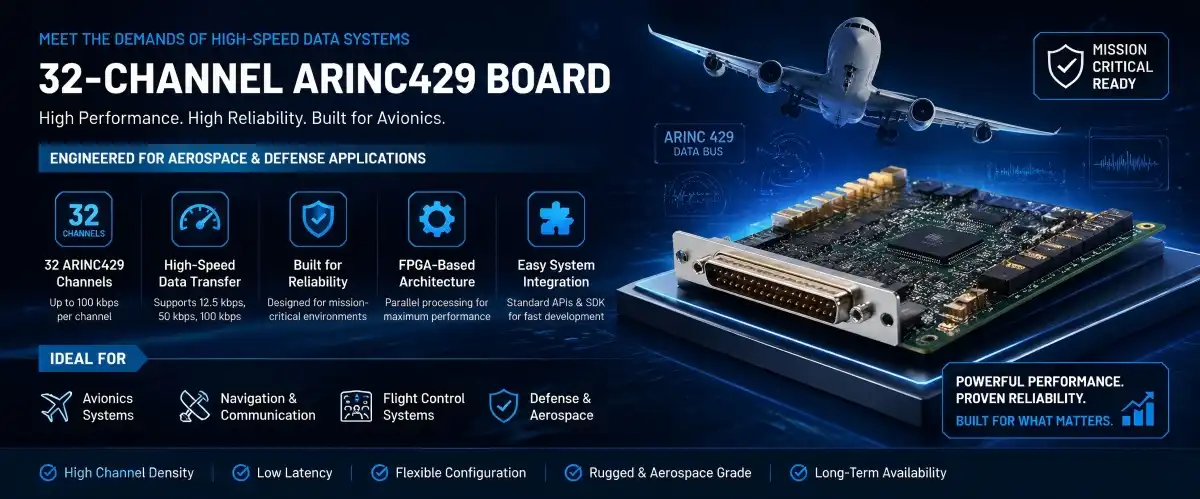
Core Technical Specifications of Multi-Channel Boards
A 32-channel ARINC429 board packs a lot of processing power into a small package that works with PXIe chassis standards. These boards usually have communication speeds that can be set anywhere from 12.5 kbps to 100 kbps per channel, so they can handle both low-speed and high-speed needs. System builders can combine several data streams onto a single board because of the channel density. This saves rack space and makes system integration easier. Each channel has its own time and buffering, so there is no cross-channel confusion that could make the data less accurate.
High-Speed Data Processing Features
FPGA technology is used in modern ARINC boards to process data in real time without adding a lot of delay. Encoding and decoding that are done by hardware get rid of software bottlenecks that used to slow things down. Built-in error discovery tools, such as parity checking and validity tracking, make sure that any corrupted data is found right away. Microsecond-level time stamps make it possible to precisely connect events from different data sources, which is very important for flight test equipment and system validation.
Performance Analysis: Can 32-Channel Boards Meet High-Speed Data Stream Demands?
Addressing Bandwidth and Latency Challenges
We need to look at the actual throughput under real-world operating conditions to see if multi-channel boards can meet the needs of difficult aerospace uses. When the board is fully loaded and running at 100 kbps per channel, the total data rate is 3.2 Mbps, which is more than enough for most aircraft systems. But speed is more than just capacity. The latency of a board determines whether it can support real-time control loops and data fusion apps that need to work quickly.
Tests done by the industry show that FPGA-based ARINC boards can achieve end-to-end delays of less than 50 microseconds when they are under constant load. Applications that can use this level of speed include testing flight control systems and running simulations on the ground. Hardware-based processing is predictable, which means that the delay stays the same no matter how much data is being sent. This is different from software-based solutions, which have performance that changes when they are busy.
FPGA Architectures Enhancing Reliability
Many companies that make hardware have created complex FPGA systems that work best with ARINC429 data. These designs set up parallel processing processes that can handle many channels at once without having to compete for resources. Each channel has its own dedicated clock area, which stops timing problems that could cause delay or data corruption. Algorithms for buffer management automatically select important data streams and make sure that no channels lose data during times of high traffic.
Performance standards have been released by companies like Curtiss-Wright that show continuous operation with no packet loss across all 32 channels over long test periods. Similar reliability metrics have been written down by Abaco Systems in their technical standards. This proves that boards that are properly built can handle the tough conditions of aerospace applications. For systems that can't fail, these tried-and-true designs are the building blocks.
Real-World Application Scenarios
When you look at specific application situations, the features of high-channel-count boards become clear. Engineers watch data from flight control computers, navigation systems, and sensor groups all at the same time during airplane integration testing. These different data sources are combined on a single 32-channel ARINC429 board, which makes setting up tests easier and lowers the cost of the tools. Because the board can date all incoming data with shared timing references, it is possible to accurately reconstruct how the system worked while looking into problems.
For developing aircraft systems quickly, research schools use these boards, which require flexible hardware platforms. With a lot of channels and factors that can be changed, engineers can model complicated system architectures without having to make a lot of custom hardware. This freedom speeds up the development process and lowers the risk of the project by using tried-and-true business solutions.
Comparison Guide: 32-Channel vs. 16-Channel ARINC429 Boards for High-Speed Applications
When Channel Density Matters Most
Which setup to use—16-channel or 32-channel ARINC429 board—depends on the needs of the project and the limitations of the system design. Higher channel density is helpful for system designers who work on big commercial aircraft platforms because they have to keep an eye on dozens of separate avionics modules. Combining channels cuts down on the number of boards that are needed, which leads to lower system costs, less power use, and easier upkeep.
On the other hand, 16-channel boards may be enough for smaller apps that are only trying a few subsystems. The decision process should take into account both the needs of the current route and the needs of future growth. When projects plan to add test points or increase tracking capabilities, it's usually best to buy boards with more storage space at the start to avoid having to pay for expensive upgrades later on.
Performance Metrics That Drive Decisions
When you compare speed across different channel setups, you can see important trade-offs. Most of the time, 16-channel and 32-channel boards have the same per-channel performance specs. This means that the speed and delay for each channel stay the same, no matter what board density is used. The difference can be seen in how well the whole system works and how well it fits together physically.
Managing heat and making sure signals stay strong are more difficult with higher-density boards. High-quality makers deal with these problems by using cutting-edge PCB design methods and complex cooling systems. As long as they are set up correctly, 32-channel boards are just as reliable as lower-density options. To make sure boards will work consistently in their specific setting, procurement managers should look at the skills of vendors and ask for detailed thermal performance data.
Cost-Effectiveness and Integration Flexibility
The economic analysis looks at more than just the original buying price; it also looks at how much the whole system costs. Even though 32-channel boards cost more than 16-channel boards, the cost per channel usually makes higher-density options the better choice. You can save even more money because you don't need as many frames, your cable infrastructure is easier to use, and putting together your systems takes less work. Even though they cost more per unit, 32-channel boards are usually more cost-effective for projects that need 24 or more channels.
Another important thing to think about is integration freedom. Some system designs work better when processing is spread out over several lower-density boards, while others need centralized data collection, which can only be done by high-density boards. The best arrangement is affected by where the data sources are located, the limitations of cable routes, and the need for system redundancy. Expert system builders look at all of these factors together, rather than just focusing on the board-level requirements.
Procurement Insights: Where and How to Buy 32-Channel ARINC429 Boards for Avionics Projects
Navigating the Supplier Landscape
To find qualified providers, you need to know who your competitors are and what their main skills are. Curtiss-Wright and Abaco Systems are well-known companies that have been in the aircraft industry for a long time and have a lot of paperwork to back up their products. These companies usually work with big defense contractors and commercial flight OEMs that need high-quality parts that have been tested and proven to work.
New suppliers, like MXTD, are coming up with great options that mix performance with value for money. Xi'an Mingxi Taida Information Technology Co., Ltd., doing business as MXTD, has made 32-channel ARINC429 board solutions that meet the same technical standards as well-known brands in the industry but offer more customization options and faster technical support. The company's experience with developing PXIe frames and boards makes it a reliable source for businesses looking for alternatives to their usual providers.
Evaluating Critical Procurement Criteria
In addition to basic technology requirements, buying teams need to look at a number of other factors that will affect the long-term success of the project. As global supply lines continue to have problems, delivery efficiency is becoming more and more important. Risk can be reduced by vendors who keep enough standard versions in stock and show that lead times for special variants can be predicted.
Good providers are different from just-okay ones when it comes to technical help. Because ARINC429 systems are so complicated, there will always be problems with integrating them. Suppliers who offer quick technical support, detailed documents, and are ready to help with system-level troubleshooting provide value that is many times greater than the cost of their products. Organizations should check how fast support is during the evaluation phase, since the quality of pre-sales support is often a good indicator of how the customer will feel after the purchase.
Customization and After-Sales Service Value
Standard stock items work well in many situations, but aircraft projects often need custom solutions that meet the specific needs of the system. Suppliers who are true technology partners can adjust firmware, change the way interfaces work, or change form factors. This sets them apart from component sellers. MXTD clearly supports ODM and OEM customization, working with customers to create versions that meet specific parameter needs while keeping core performance traits.
Total cost of ownership is affected by after-sales care in a big way. Project risk profiles are affected by things like warranty coverage, software update plans, and the availability of field support. With a one-year warranty, free software updates, and remote technical help, MXTD creates a support system that lowers business risk. These service agreements are especially helpful for businesses that don't have a lot of ARINC knowledge on staff.
Installation and Troubleshooting of 32-Channel ARINC429 Boards: Ensuring Optimal Operation
Step-by-Step Installation Best Practices
A careful assessment of the surroundings and confirmation of system compatibility are the first steps in a proper installation. The PXIe frame must have enough cooling power for the board's heat output, especially when all channels are running at full speed. When choosing a chassis slot, you should think about both the electrical properties and how easy it is to get to the slots for wire connections. Cable handling is very important for high-density boards with 32 channels so that connectors don't get strained and signals stay intact.
After the hardware is put together, the software is installed. Driver packages are specific to the operating system and working environment. Standardized APIs on modern boards let them work with common systems like LabVIEW, LabWindows/CVI, and many computer languages. Setting up channel settings, trigger modes, and data routing is possible with configuration tools before engineers start testing. Before linking to real avionics equipment, thorough proof using loopback testing makes sure that the installation was done right.
Common Operational Issues and Solutions
Even systems that were put correctly can sometimes act in strange ways that need to be fixed in a planned way. Problems with signal quality are usually caused by impedance mismatches or broken cables, not by problems with the 32-channel ARINC429 board itself. By checking the real signal characteristics at different places in the data path, you can figure out if the issue is with the board, the cables, or the equipment that is connected. ARINC429 boards usually have diagnostic tools that show the state of the channels, find wiring problems, and find data format violations.
Most of the time, setup mistakes, not hardware problems, cause channel conflict failures. Because ARINC429 only works in one way, each channel must be set to either send or receive mode. Software setup mistakes can cause more than one transmitter to try to drive the same bus or for listeners to watch the wrong channels. To fix these problems fast, it's generally enough to carefully compare configuration files to system design documents.
Leveraging Manufacturer Resources for Success
Manufacturers offer a lot of paperwork and help materials that make it easier to fix problems and get the most out of a system. For low-level programming and advanced debugging, detailed datasheets list the electrical properties, timing graphs, and register maps that are needed. Application notes talk about common integration situations and give tried-and-true solutions to common problems. Technical support teams give you direct access to engineers for problems that aren't covered by standard paperwork.
MXTD promises to answer technical questions from customers within an hour, because they know that downtime costs a lot in aircraft testing settings. Customers can quickly solve problems without having to pay for expensive on-site service calls because the company is fast and willing to offer technical help via online video. When component sellers have access to these tools, they become strategic partners who help the project succeed as a whole.
Conclusion
There is a clear yes to the question of whether 32-channel ARINC429 board solutions can handle high-speed data streams based on current technology and field operations that have been successful. Through advanced FPGA designs and careful engineering, these boards are able to meet the performance needs of aerospace uses while also having a high channel density. When companies choose the right vendors and follow the right system integration practices, their avionics work reliably in all kinds of tests and operating situations.
When making a procurement choice, technical specifications should be weighed against the overall system needs, the vendor's help abilities, and the chance of a long-term relationship. There are both well-known aircraft suppliers and new companies like MXTD that make products that meet the performance standards needed for mission-critical uses. This gives customers a choice that fits their budget and their needs for customization.
FAQ
What data rates can 32-channel ARINC429 boards sustain continuously?
These days, multichannel boards can keep working at their highest data rates on all channels at the same time. High-speed setups can keep 100 kbps per channel forever without losing data or slowing down the system. The total output of 3.2 Mbps for a fully populated 32-channel ARINC429 board is well within the working power of modern FPGAs. Hardware buffering keeps data from being lost during short bursts of processing, and flow control methods make sure that data gets to host systems promptly. Continuous operation testing by the makers confirms these abilities under the worst possible loading conditions, showing that they are reliable for tough aircraft uses.
How do environmental factors affect ARINC board performance?
The operating temperature has a big effect on how reliably and consistently electrical parts work. Good ARINC429 boards have a wide working temperature range, usually between -40°C and +85°C, so they can be used in both environmental test rooms and real flight situations. When all lines are running at full speed at the same time in a high-density configuration, thermal control becomes very important. When the frame is properly cooled and there is enough airflow, thermal stalling and early component failure are avoided. Manufacturers use temperature-compensated electronics and industrial-grade parts to keep specs the same across the entire working range. This makes sure that performance is always predictable, no matter what the environment is like.
Ready to Integrate Reliable ARINC429 Solutions Into Your Test Systems?
MXTD makes high-performance 32-channel ARINC429 board options that are both very cheap and have a history of stability. We have been making ARINC429 boards for over 12 years and have a lot of experience with measurement and control systems. This means we know how hard it is to meet the needs of flight tests and industrial automation. Our multi-channel boards offer performance that is compatible with NI at a reasonable price. They also come with full customization options and quick expert help. Our engineering team answers within an hour to your needs and starts working on the best solutions for your applications, whether you need basic configurations that are in stock or solutions that are made to fit your exact needs. Get in touch with us at manager03@mxtdinfo.com to talk about how our ARINC interface technology can help you test better.
References
1. Airlines Electronic Engineering Committee (2001). "ARINC Specification 429: Mark 33 Digital Information Transfer System (DITS)." Aeronautical Radio, Incorporated Technical Standards.
2. Spitzer, C.R. (2017). "Avionics: Elements, Software and Functions." CRC Press Aerospace Engineering Series, Chapter 8: Databuses and Networks.
3. Kollmeier, J.P. & Prakash, R. (2019). "High-Density ARINC429 Interface Design Using FPGA Technology." IEEE Aerospace and Electronic Systems Magazine, Vol. 34, No. 8, pp. 42-51.
4. Defense Information Systems Agency (2020). "MIL-STD-1553 and ARINC429 Interface Requirements for Avionics Testing Systems." Department of Defense Interface Standards Working Group Technical Report.
5. Hamilton, B.A. (2018). "Performance Benchmarking of Multi-Channel Avionics Data Acquisition Systems." SAE International Journal of Aerospace, Vol. 11, No. 2, pp. 187-203.
6. Zhang, W. & Liu, H. (2021). "Advanced Signal Processing Techniques for Real-Time ARINC429 Protocol Analysis." Journal of Aviation Technology and Engineering, Vol. 10, No. 3, pp. 75-88.
Our customers’ satisfaction speaks for our quality — contact us to experience the same reliable service.