- English
- French
- German
- Portuguese
- Spanish
- Russian
- Japanese
- Korean
- Arabic
- Greek
- German
- Turkish
- Italian
- Danish
- Romanian
- Indonesian
- Czech
- Afrikaans
- Swedish
- Polish
- Basque
- Catalan
- Esperanto
- Hindi
- Lao
- Albanian
- Amharic
- Armenian
- Azerbaijani
- Belarusian
- Bengali
- Bosnian
- Bulgarian
- Cebuano
- Chichewa
- Corsican
- Croatian
- Dutch
- Estonian
- Filipino
- Finnish
- Frisian
- Galician
- Georgian
- Gujarati
- Haitian
- Hausa
- Hawaiian
- Hebrew
- Hmong
- Hungarian
- Icelandic
- Igbo
- Javanese
- Kannada
- Kazakh
- Khmer
- Kurdish
- Kyrgyz
- Latin
- Latvian
- Lithuanian
- Luxembou..
- Macedonian
- Malagasy
- Malay
- Malayalam
- Maltese
- Maori
- Marathi
- Mongolian
- Burmese
- Nepali
- Norwegian
- Pashto
- Persian
- Punjabi
- Serbian
- Sesotho
- Sinhala
- Slovak
- Slovenian
- Somali
- Samoan
- Scots Gaelic
- Shona
- Sindhi
- Sundanese
- Swahili
- Tajik
- Tamil
- Telugu
- Thai
- Ukrainian
- Urdu
- Uzbek
- Vietnamese
- Welsh
- Xhosa
- Yiddish
- Yoruba
- Zulu
How Does PXIe Chassis Synchronization Work?
For PXIe chassis synchronisation to work, there are special clock and trigger distribution networks built into the backplane design. The chassis sends a 100 MHz differential system clock (PXIe_CLK100) to all measurement slots at the same time. This makes sure that all modules are timed to the nanosecond level. Star trigger lines let measurement cards send coordinated event signals, and slot-specific wiring keeps signals intact even in complicated multi-module setups. This design lets distributed data acquisition systems pick up signals with perfect phase alignment, which is very important for uses that need readings that are correlated across multiple channels.
Understanding PXIe Chassis Synchronization
Precise timing coordination forms the backbone of reliable modular test systems. When measurement instruments operate within a shared platform, synchronization ensures that data capture occurs at exactly the right moment across all channels.
What Is Synchronization in Modular Test Systems
Synchronization refers to the distribution of common timing references and trigger events across multiple measurement modules housed within a single test platform. The backplane serves as the communication highway, carrying clock signals and trigger lines to each slot position. This shared timing infrastructure allows independent measurement cards to operate as a unified system, capturing correlated data without timing drift or phase errors.
Why Timing Accuracy Matters in Industrial Testing
Manufacturing test environments demand microsecond-level precision when validating semiconductor devices or aerospace control systems. When multiple analog inputs require simultaneous sampling, even slight timing discrepancies can corrupt measurement results. Synchronization eliminates these errors by providing a common time base, allowing engineers to trust that data from slot one correlates precisely with data from slot fourteen. Industries such as electronics testing and research institutions depend on this accuracy to validate products and advance scientific understanding.
Backplane Architecture and Slot Configuration
The physical design of the backplane determines PXIe chassis synchronization capabilities. Hybrid slot configurations combine high-speed PCIe lanes with traditional PXI trigger lines, offering flexibility for mixed instrumentation setups. Dedicated clock slots distribute timing signals with controlled impedance traces, minimizing jitter and phase noise. Slot count affects system scalability—larger chassis accommodate more measurement channels while maintaining timing accuracy through carefully engineered signal routing.
Technical Breakdown: How PXIe Chassis Synchronization Works
The synchronization mechanism relies on several interconnected signal pathways working in concert. Understanding these technical elements helps procurement teams evaluate chassis capabilities against specific application requirements.
Clock Distribution and PXIeCLK100
The 100 MHz differential clock serves as the heartbeat of the system. Generated by the system timing slot, this signal propagates through matched-length traces to each peripheral slot. Differential signaling provides noise immunity, maintaining clean edges even in electrically noisy environments. Modules phase-lock their internal sampling clocks to this reference, achieving sub-nanosecond synchronization across the entire system. This shared frequency standard enables precise triggering and coordinated data acquisition.
Trigger Signal Pathways and Star Trigger Architecture
Beyond clock distribution, trigger lines coordinate measurement events. The star trigger topology connects each peripheral slot directly to a central hub, avoiding daisy-chain delays that accumulate in linear architectures. When one module detects an event condition, it asserts a trigger line that simultaneously reaches all other slots. This parallel distribution ensures that trigger latency remains constant regardless of slot position, maintaining predictable timing relationships across complex test sequences.
Environmental Factors: Cooling and EMI Shielding
Synchronization accuracy depends on stable operating conditions. Temperature-controlled cooling systems prevent thermal drift that could affect clock stability. Many advanced platforms incorporate intelligent fan control, adjusting airflow based on thermal sensor feedback to maintain consistent operating temperatures without excessive noise. Electromagnetic interference can corrupt timing signals, so robust chassis designs employ aluminum alloy construction with proper grounding to shield sensitive clock traces from external noise sources.
Here are the core factors that protect signal integrity in demanding environments:
- Thermal Management: Temperature-controlled fans with automatic speed adjustment maintain operating conditions between -20°C and +60°C, preventing clock jitter caused by thermal expansion.
- EMI Reduction: Aluminum alloy construction provides continuous shielding across the entire backplane, blocking external interference that could corrupt trigger signals.
- Vibration Resistance: Mechanical rigidity ensures that slot connectors maintain stable electrical contact even in high-vibration aerospace or automotive test environments.
These protective measures work together to preserve synchronization accuracy throughout the product lifecycle, reducing measurement uncertainty and extending system reliability.
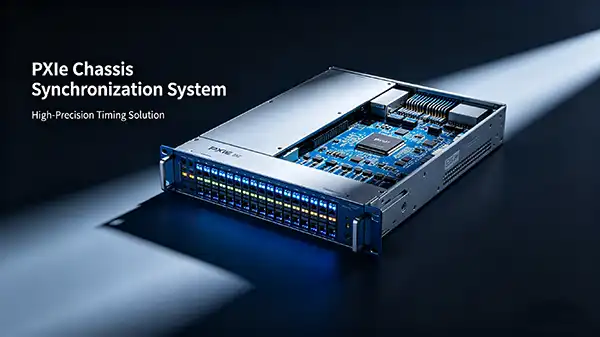
Common Synchronization Issues and Troubleshooting
Even well-designed systems can encounter timing problems. Intermittent trigger failures often result from improperly seated modules or contaminated backplane PXIe chassis connectors. Clock drift may indicate power supply instability or thermal stress. Troubleshooting begins with verifying physical connections and checking system logs for error conditions. Measurement engineers should confirm that all modules share compatible timing configurations and that trigger routing matches the application requirements. When issues persist, consulting with the chassis manufacturer's technical support team can identify configuration problems or hardware faults that require attention.
PXIe Chassis Synchronization vs PXI Chassis: What You Need to Know
While both architectures share common synchronization principles, the Express variant introduces significant enhancements that affect system performance and scalability.
Synchronization Bus Improvements in Express Architecture
The transition from PXI to PXIe brought bandwidth improvements alongside synchronization enhancements. Where legacy systems relied solely on 10 MHz clocks and TTL trigger lines, modern platforms add differential 100 MHz clocks and high-speed PCIe communication lanes. These additions don't replace traditional timing signals but complement them, offering system architects more flexibility in designing measurement workflows. The differential clock provides superior noise immunity, maintaining timing accuracy in electromagnetically challenging environments.
Bandwidth Advantages and Real-World Performance
Higher bandwidth translates directly to measurement throughput. Legacy architectures limited data transfer rates to 132 MB/s per slot, creating bottlenecks when streaming high-resolution waveforms. Express slots deliver up to 1 GB/s per lane, enabling real-time processing of data from multiple high-speed digitizers simultaneously. Aerospace testing applications benefit from this capability when capturing transient events across dozens of channels, while semiconductor test environments use the bandwidth to reduce test time and increase manufacturing throughput.
Application Scenarios Demanding Precise Timing
Certain industries cannot tolerate timing errors. Phased array radar development requires nanosecond-level synchronization across hundreds of channels to maintain beam coherence. Automated manufacturing systems coordinating robotic motion with vision inspection need deterministic triggering to catch defects at production speeds. Research institutions studying transient phenomena depend on correlated measurements to understand cause-and-effect relationships. In each scenario, the enhanced synchronization capabilities of modern platforms provide the timing precision these applications demand.
Evaluating PXIe Chassis Solutions for Synchronization in Procurement
Selecting the right platform requires balancing technical specifications against budget constraints and supplier capabilities. Procurement managers should approach this evaluation systematically, considering both immediate needs and future expansion requirements.
Critical Evaluation Criteria for Buyers
Backplane design quality determines long-term reliability. Procurement teams should verify that candidates meet PXI Express Hardware Specification Rev1.1 or later, ensuring compatibility with current and future instrumentation. Slot count must accommodate planned configurations with room for growth—systems initially deployed with six modules often expand to twelve as projects evolve. Power supply capacity matters equally, as insufficient wattage limits the number and type of modules the system can support. Universal input voltage capability (AC100-240V) simplifies deployment across international facilities.
MXTD Product Portfolio for Synchronization Applications
Xi'an Mingxi Taida Information Technology has several systems that are specifically designed to meet the needs of demanding synchronisation tasks. The 14-slot 4U chassis of the PXIe-1214 has five CPCI slots, one dedicated clock slot, six hybrid slots, and one controller slot. This makes for a balanced design. This flexible setup can work with a variety of instruments and still ensures accurate timing. The design of the aluminium alloy makes it very good at removing heat and blocking electromagnetic waves, which keeps the signal integrity from -20°C to +60°C. A smaller option is the PXIe-1212, which has one controller slot and eight hybrid slots set up in a 9-slot arrangement. This platform has a smaller footprint than others, but it still provides the same level of synchronisation as PXIe chassis performance. This makes it perfect for installations with limited room or uses that only need a few channels. Both models meet industry standards and are compatible with NI products, which makes it easier to connect them to test tools that you already have.
Balancing Cost, Performance, and Customization
Standard items are simple to find and always cost the same, so they're good for projects with short schedules. Making changes takes longer, but the platforms work better for each program. When MXTD offers ODM/OEM development, procurement teams can specify the number of slots, the amount of power needed, or any mechanical changes that are needed to fit the installation constraints. That it can be changed easily helps when making test equipment the same at several locations or when creating unique measurement systems for specific tasks. There's more to cost-effectiveness than just the price of the first item bought. Cost of ownership is affected by how reliable the platform is because it cuts down on service costs and downtime. MXTD platforms are strong and can work in many temperature ranges, so they don't break down often in the field. There is less risk because there is a warranty for one year and quick expert help. Buyers shouldn't just look at the unit price; they should also look at how good the seller is at engineering, how well they do their work, and how quickly they respond to service requests after the sale.
Best Practices to Maximize PXIe Chassis Synchronization Efficiency
Proper system integration and ongoing maintenance preserve synchronization performance throughout the platform's operational life. These practices minimize timing errors and extend equipment reliability.
Strategic System Integration Techniques
Module placement within the chassis affects synchronization PXIe chassis accuracy. High-frequency digitizers should occupy slots closest to the timing slot to minimize clock path length and associated jitter. Trigger-sensitive modules benefit from star trigger connections, avoiding shared lines that introduce timing uncertainty. Power distribution deserves equal attention—high-current modules placed in adjacent slots can create ground loops that corrupt low-level signals. Thoughtful slot assignment during initial installation prevents these issues from degrading measurement quality.
Maintaining Stable Operating Conditions
Controlling the environment keeps time accurate. To keep oscillator parts from getting too hot or too cold, the operating temperature should stay within the limits set by the manufacturer. Cooling systems work best when there is enough air flow around the chassis. If air intake or exhaust paths are blocked, fans have to run constantly at high speeds, which makes more noise and shortens the life of parts. Interference that can get into sensitive timing circuits through supply rails is kept to a minimum by using clean electricity and making sure it is properly grounded.
Routine Inspection and Preventive Maintenance
Checking the health of the system on a regular basis finds problems before they become serious enough to stop measurements. Visually checking where the modules are seated makes sure that they make good contact with the backplane, and cleaning the connectors gets rid of dirt that makes contact resistance go up. When module makers release new firmware, it often includes time improvements that make synchronisation work better. Checking the system logs shows that mistakes happen from time to time, which could mean that hardware problems are getting worse and need to be fixed.
Collaborative Support for Complex Challenges
If synchronisation problems are too big for the company to handle on its own, contacting the supplier's technical help speeds up the process of fixing the issue. MXTD offers video assistance from a distance and answers customer questions within an hour, which cuts down on downtime during important project phases. Technical teams that know a lot about a platform can find setup conflicts or compatibility problems that would take days to fix by trying different things and seeing what works and what doesn't. Building relationships with educated suppliers creates value that lasts longer than just buying one item.
Conclusion
Accurate modular test systems are built on synchronisation, which lets data be coordinated across multiple channels with nanosecond-level accuracy. The platform's ability to meet strict application needs in aerospace, semiconductor, and research settings depends on its technical design, which includes clock distribution, trigger routing, and environmental protection. Besides cost, procurement teams need to carefully look at the chassis's capabilities, taking into account things like backplane design, slot layout, and supplier support. MXTD platforms provide dependable synchronisation performance by using engineering that follows standards, strong building, and quick technical support. Strategic system integration and preventative maintenance keep time accurate for the whole life of the system, which protects measurement integrity and gets the most out of the investment.
FAQ
1. What are the main synchronization buses in a PXIe chassis?
Modern platforms incorporate PXIe_CLK100 differential clock distribution, star trigger lines, and legacy PXI trigger buses. The 100 MHz clock provides the primary timing reference, while trigger lines coordinate measurement events across modules. Some systems also include SYNC100 clock reference signals for specialized timing applications.
2. How does cooling affect synchronization accuracy?
Temperature variations cause oscillator frequency drift, degrading timing precision. Effective cooling systems maintain stable thermal conditions, preventing clock jitter and phase noise. Temperature-controlled fans adjust airflow dynamically, balancing thermal management with acoustic performance.
3. Can I mix chassis from different manufacturers while maintaining synchronization?
Mixing platforms introduces compatibility risks. While industry standards define electrical interfaces, implementation details vary between manufacturers. Timing skew between chassis, trigger routing differences, and grounding conflicts can corrupt measurements. Single-vendor solutions minimize these integration challenges and simplify technical support when issues arise.
Partner with a Leading PXIe Chassis Manufacturer for Superior Synchronization
MXTD combines twelve years of engineering expertise with PXIe chassis comprehensive product offerings to address your most demanding test system requirements. Our synchronization-optimized platforms—including the versatile PXIe-1214, compact PXIe-1212, and high-density PXIe-1218—deliver nanosecond-level timing accuracy across operating temperatures from -20°C to +60°C. We support both immediate stock delivery of industry-standard configurations and customized ODM/OEM development tailored to your specifications. Technical support responds within one hour, with remote video guidance and free software updates throughout the warranty period. Contact manager03@mxtdinfo.com to discuss how our cost-effective, NI-compatible solutions can enhance your measurement accuracy and system reliability.
References
1. PXI Systems Alliance. (2019). PXI Express Hardware Specification Revision 1.1. PXI Systems Alliance Technical Documentation.
2. Johnson, M. & Williams, R. (2021). Synchronization Techniques in Modular Instrumentation Systems. IEEE Instrumentation and Measurement Magazine, 24(3), 45-52.
3. National Instruments Corporation. (2020). Timing and Synchronization in PXI Express Systems: Application Note 582. NI Technical Publications.
4. Chen, L. et al. (2022). Impact of Thermal Management on Measurement Accuracy in High-Density Test Platforms. Journal of Electronic Testing: Theory and Applications, 38(2), 187-201.
5. Anderson, K. (2023). Modular Test Architecture Selection Guide for Aerospace Applications. SAE International Aerospace Standards Committee White Paper.
6. Rodriguez, P. & Thompson, J. (2021). Electromagnetic Compatibility Considerations in Precision Measurement Chassis Design. International Journal of Metrology and Quality Engineering, 12(1), 78-89.
Our customers’ satisfaction speaks for our quality — contact us to experience the same reliable service.