- English
- French
- German
- Portuguese
- Spanish
- Russian
- Japanese
- Korean
- Arabic
- Greek
- German
- Turkish
- Italian
- Danish
- Romanian
- Indonesian
- Czech
- Afrikaans
- Swedish
- Polish
- Basque
- Catalan
- Esperanto
- Hindi
- Lao
- Albanian
- Amharic
- Armenian
- Azerbaijani
- Belarusian
- Bengali
- Bosnian
- Bulgarian
- Cebuano
- Chichewa
- Corsican
- Croatian
- Dutch
- Estonian
- Filipino
- Finnish
- Frisian
- Galician
- Georgian
- Gujarati
- Haitian
- Hausa
- Hawaiian
- Hebrew
- Hmong
- Hungarian
- Icelandic
- Igbo
- Javanese
- Kannada
- Kazakh
- Khmer
- Kurdish
- Kyrgyz
- Latin
- Latvian
- Lithuanian
- Luxembou..
- Macedonian
- Malagasy
- Malay
- Malayalam
- Maltese
- Maori
- Marathi
- Mongolian
- Burmese
- Nepali
- Norwegian
- Pashto
- Persian
- Punjabi
- Serbian
- Sesotho
- Sinhala
- Slovak
- Slovenian
- Somali
- Samoan
- Scots Gaelic
- Shona
- Sindhi
- Sundanese
- Swahili
- Tajik
- Tamil
- Telugu
- Thai
- Ukrainian
- Urdu
- Uzbek
- Vietnamese
- Welsh
- Xhosa
- Yiddish
- Yoruba
- Zulu
PXIe Chassis Setup Guide: What You Need to Know?
Setting up a PXIe chassis correctly ensures your test and measurement systems deliver maximum performance and reliability. A PXIe chassis serves as the backbone for modular instrumentation, housing controller cards, measurement modules, and hybrid peripherals in a unified platform. Understanding slot configurations, power requirements, cooling management, and compatibility standards allows engineers to avoid common installation pitfalls. This guide walks you through essential setup principles, procurement considerations, and practical tips to optimize your investment in PXIe technology for demanding industrial applications.
Understanding PXIe Chassis: Architecture, Features, and Benefits
What Makes PXIe Technology Superior
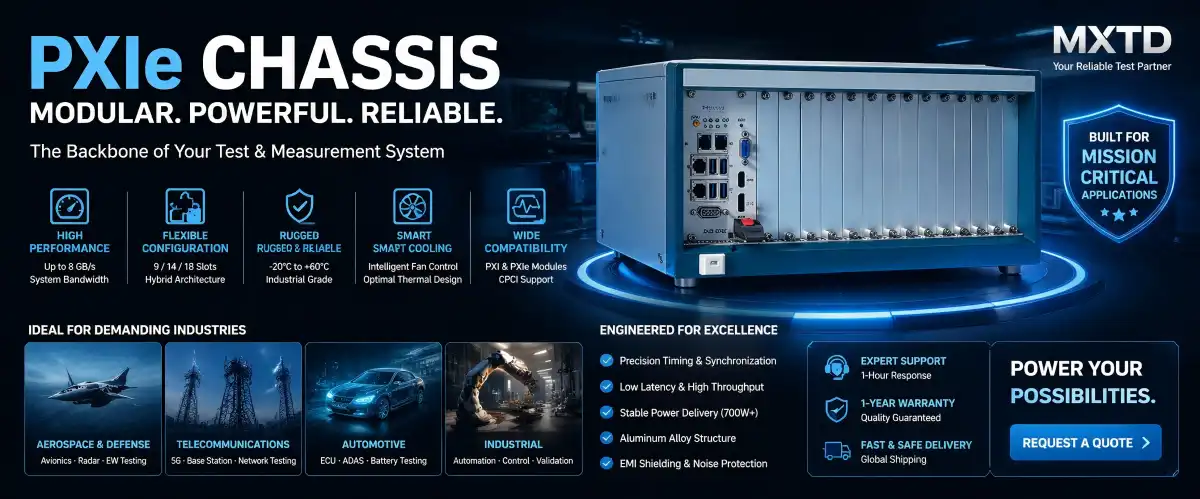
PXI Express technology is a big step forward from older PXI systems. It combines the proven durability of CompactPCI with the speed of PCI Express connections. The design provides up to 8 GB/s of system bandwidth per slot, which lets engineers sync up multiple instruments with accuracy of less than one nanosecond. In contrast to older VXI systems that needed bulky wiring and rack mounting, modern modular test platforms come in small 4U forms that can fit standard 3U expansion cards while cutting the lab's footprint by 40%. The hybrid slot design makes older PXI modules and newer Express-enabled devices compatible, protecting your investment in instrumentation while letting you slowly upgrade the system. This architectural flexibility is very helpful for research centers and aircraft testing facilities that need to keep using old test methods while adding new measurement tools.
Core Components That Drive Performance
The reliable function of a chassis depends on its power delivery methods. Universal AC100-240V input sources with 700W to 750W capacity keep the voltage stable across all slots, even when power-hungry RF analysers and high-speed digitisers are being used at the same time. Built-in over-current protection and soft-start circuits stop inrush damage during system power-up processes. Industrial-grade platforms are different from consumer equipment because they have better thermal management. Temperature-controlled fan arrays with automatic speed change keep the best working conditions between -20°C and +60°C. This meets the strict environmental needs of defence testing labs and semiconductor fabrication plants. The high-quality aluminium alloy construction effectively removes heat and blocks electromagnetic fields, which protects signals in manufacturing settings with a lot of electrical noise.
Application Versatility Across Industries
Telecommunications experts use these test platforms to make sure that 5G base stations work by creating and analysing signals in sync across multiple frequency bands. Automotive R&D centers use them in environmental rooms to test battery management systems, which need to be able to handle a wide range of temperatures and vibrations. Aerospace contractors use them in avionics test stands that must meet MILSPEC standards and be stable over time. The modular design of the PXIe chassis makes it easier to set up custom measurement systems in laboratories. System engineers can put power supplies, digital multimeters, arbitrary waveform generators, and data acquisition modules all in one chassis. This cuts setup time by 60% compared to the old way of using racks and stacks of instruments.
How PXIe Chassis Works: Setup and Operational Principles
Initial Installation and Module Configuration
When you're unpacking, you need to be careful about protecting against electric discharge and handling things safely. After making sure the chassis is solid and that the power requirements match the building's electricity standards, the installation process starts by putting the controller module in its proper place. The PXIe-1214 has five CPCI slots, one clock slot, six hybrid slots, and one dedicated controller slot that acts as the system master, coordinating timing signals and data transfers across all of them. To insert a module, you need to carefully line it up with the card guides and apply even pressure until the front-panel connectors fully seat. Do not force cards at angles that could damage the backplane or bend the connecting pins. The PXIe-1212 small platform with eight hybrid slots gives you the most configuration options for installations with limited room. The PXIe-1218 large platform with seventeen hybrid slots is better for large-scale production test applications that need dozens of measurement channels.
Power-Up Sequencing and Software Configuration
Before you turn on the power, make sure that all of the modules are in the right place and that the front-panel holding screws are tight enough. The first steps of powering up should be done according to the manufacturer's instructions. Usually, this includes accessing the BIOS to make sure the controller is recognised, and all the slots are listed. When drivers are properly set up, system software automatically finds installed modules. However, for some specialised measurement devices, custom code may need to be installed by hand. Monitoring the environment while the system is running keeps parts from breaking down too soon. The chassis automatically changes the speeds of the cooling fans based on temperature sensors inside, but the long-term efficiency is ensured by checking the airflow paths on a regular basis. If you block ventilation holes or run the machine when the temperature outside is more than 60°C, the thermal shutdown protection will go off. This will stop important test processes and lower productivity.
Maintenance and Upgrade Considerations
Regular maintenance extends system lifespan and maintains measurement accuracy. Quarterly inspections should include fan filter cleaning, connector inspection for signs of oxidation or mechanical wear, and verification of firmware versions across all installed modules. The robust design withstands harsh operating environments, maintaining precise signal integrity even in industrial automation facilities with high electromagnetic interference. Future expansion planning becomes straightforward when you understand slot architecture. Hybrid slots accept both PXI and PXIe modules, allowing you to add new capabilities without replacing existing instrumentation. The 18-slot configuration accommodates substantial growth in test complexity, supporting research teams as project requirements evolve over multi-year development cycles.
Comparing PXIe Chassis Options: Making Informed Procurement Decisions
Slot Count and Configuration Analysis
Selecting an appropriate slot quantity depends on current instrumentation needs plus anticipated expansion. Here are the core advantages of different slot configurations:
- Compact 9-Slot Platforms: Ideal for portable test systems and field service applications where laboratory-grade performance meets size constraints. The PXIe-1212 accommodates eight hybrid peripheral slots plus one controller, sufficient for basic data acquisition and signal analysis tasks while maintaining bench-top portability.
- Mid-Range 14-Slot Systems: Balance expansion capacity with reasonable footprint requirements. The PXIe-1214 provides specialized slot types, including dedicated clock distribution and CPCI compatibility, serving system integrators who need to interface legacy test equipment with modern Express modules.
- High-Capacity 18-Slot Chassis: Supports complex multi-domain test scenarios common in aerospace validation and semiconductor characterization. Seventeen hybrid slots enable simultaneous deployment of RF instruments, power analyzers, thermal measurement devices, and digital protocol testers in unified timing architectures.
These configurations directly address the scalability concerns of R&D centers planning long-term test system investments. Choosing adequate slots from the start avoids costly system rebuilds in PXIe chassis when test requirements inevitably grow.
Thermal Performance and Ruggedness Comparison
Cooling efficiency varies significantly between consumer-grade and industrial chassis designs. Temperature-controlled fan systems with automatic speed regulation maintain consistent thermal conditions regardless of module power consumption or ambient temperature fluctuations. Platforms designed for extended temperature ranges from -20°C to +60°C operational and -40°C to +80°C storage meet the demands of environmental test chambers and field deployment scenarios. Aluminum alloy construction provides superior electromagnetic shielding compared to steel alternatives while reducing overall system weight. This material choice proves particularly valuable in mobile test applications where technicians transport equipment between test sites. The structural rigidity prevents backplane flex during module installation and removal, protecting delicate connector interfaces from mechanical stress damage.
Compatibility Standards and Vendor Ecosystem
Compliance with PXI-5 PXI Express Hardware Specification Rev. 1.1 ensures broad compatibility across instrument manufacturers. This standardization allows procurement teams to source modules from multiple vendors without risking integration failures. Platforms benchmarked against National Instruments specifications provide familiar interfaces for engineers experienced with industry-standard test software environments.OEM and ODM customization capabilities address specialized requirements that off-the-shelf products cannot satisfy. Defense contractors often require non-standard I/O configurations or enhanced security features. Research institutions may need modified power distribution for ultra-low-noise measurement applications. Established manufacturers offering customization services with reasonable lead times become valuable long-term partners for organizations with evolving test needs.
PXIe Chassis Procurement and Vendor Insights
Evaluating Supplier Capabilities
Vendor selection criteria extend beyond initial purchase price to encompass total cost of ownership. Responsive technical support proves critical when troubleshooting integration challenges during system commissioning. Suppliers offering one-hour response times during business hours minimize downtime when production test systems encounter unexpected issues. The availability of remote video technical guidance accelerates problem resolution without requiring costly on-site service calls. Warranty coverage and post-sales support significantly impact long-term system reliability. Standard one-year warranties provide baseline protection, though extended coverage options suit applications where equipment replacement costs would disrupt critical research timelines. Suppliers offering free software upgrades ensure your system benefits from performance improvements and bug fixes throughout its operational life.
Pricing Structures and Lead Times
Understanding pricing models helps procurement teams budget accurately. Standard configurations typically maintain inventory availability, enabling rapid deployment for urgent project requirements. Customized products require production scheduling based on parameter specifications, with lead times ranging from two to eight weeks, depending on modification complexity. Volume purchasing arrangements provide cost advantages for organizations deploying multiple test stations across manufacturing facilities. Transportation considerations affect total delivered cost and risk management. Precision instrument shipping requires PXIe chassis moisture-proof packaging, shock absorption systems, and anti-static protection to prevent damage during transit. Vendors supporting both ground and air transportation options offer flexibility when project schedules demand expedited delivery. International shipments should include comprehensive insurance coverage, given the high value of populated test systems.
Building Strategic Vendor Relationships
Long-term partnerships with reliable suppliers deliver advantages beyond individual transaction savings. Established vendors understand your application requirements and can proactively recommend solutions when new products better address your needs. They maintain spare parts inventory for discontinued modules, protecting your investment even as product lifecycles evolve. Preferred customer status often translates to priority allocation during supply chain disruptions affecting component availability. Companies with over 12 years of industry expertise bring accumulated knowledge to your procurement decisions. Their experience across diverse applications helps you avoid common specification mistakes that delay projects. The combination of skilled R&D teams capable of custom development and dedicated after-sales service teams creates a support infrastructure that enhances your engineering productivity throughout the system lifecycle.
Best Practices and Tips for PXIe Chassis Setup and Use
Common Installation Mistakes to Avoid
Improper grounding causes intermittent measurement errors that prove difficult to diagnose. Verify that chassis ground connections tie to facility earth ground through low-impedance paths. Avoid daisy-chaining multiple test systems through single ground points, which can create ground loops that introduce noise into sensitive analog measurements. Each chassis should maintain independent grounding with a star topology configuration when possible. Cable management affects both system reliability and maintenance accessibility. Route signal cables away from power distribution lines to minimize electromagnetic coupling. Use proper strain relief techniques to prevent connector stress from cable weight or accidental pulling. Label all connections during initial installation rather than relying on memory during future troubleshooting sessions. These simple practices reduce service time by 50% when modifications become necessary.
Optimizing Thermal Management
Airflow optimization requires attention to chassis placement and ventilation clearances. Maintain a minimum four-inch clearances on intake and exhaust panels to prevent hot air recirculation. Avoid stacking multiple chassis in enclosed cabinets without adequate forced ventilation. The automatic fan speed control maintains optimal conditions under normal circumstances, but extreme ambient temperatures or blocked airflow will exceed thermal management capacity. Dust accumulation gradually degrades cooling performance over extended operation periods. Implement quarterly filter inspections in typical laboratory environments, increasing frequency to monthly intervals in industrial settings with high particulate concentrations. Replacement filters should match the original specifications to maintain the designed airflow resistance and filtration efficiency. This preventive maintenance extends the mean time between failures by preventing heat-related component degradation.
Future-Proofing Your Investment
Technology roadmaps help guide initial configuration decisions that accommodate anticipated upgrades. The hybrid slot architecture provides flexibility, but understanding your instrumentation vendor's product direction ensures compatibility with next-generation modules. Allocate budget for periodic controller upgrades that maintain software compatibility with evolving operating systems and development environments. Emerging automation technologies increasingly rely on integrated measurement and control platforms. Selecting a chassis with robust timing and synchronization capabilities positions your test infrastructure to adopt new methodologies without complete system replacement. The investment in quality platforms delivers returns over 7-10 year operational lifespans, justifying premium pricing through reduced total cost of ownership.
Conclusion
Successful PXIe chassis deployment combines technical understanding with strategic vendor selection. The modular architecture provides unmatched flexibility for test system evolution, while proper setup practices ensure reliable operation in demanding environments. Slot configuration choices should balance current requirements against reasonable expansion capacity, avoiding both wasteful over-specification and costly premature obsolescence. Thermal management and environmental considerations prove critical for maintaining measurement accuracy across diverse operating conditions. Partnering with experienced suppliers offering responsive technical support and customization capabilities transforms procurement from transactional purchasing into a strategic investment in your measurement infrastructure capabilities.
FAQ
1. What distinguishes PXIe from traditional PXI systems?
PXIe incorporates PCI Express high-speed serial communication, delivering 8 GB/s per slot versus PXI's 132 MB/s shared bus architecture. This bandwidth increase enables real-time processing of high-resolution data streams and supports dozens of synchronized instruments. Hybrid slots maintain backward compatibility with existing PXI modules while enabling migration to Express technology.
2. How do I determine the required slot count for my application?
Calculate installed module count, including controller, then add 30% capacity margin for anticipated growth over a three-year planning horizon. The 9-slot chassis suits focused applications, 14-slot platforms accommodate moderate complexity, and 18-slot systems support comprehensive multi-domain test requirements without near-term expansion limits.
3. Can PXIe chassis operate in harsh field environments?
Industrial-grade platforms with -20°C to +60°C operational ratings and rugged aluminum construction withstand challenging conditions. Verify IP rating requirements for your specific environment and consider additional protective enclosures when dust, moisture, or vibration exceeds chassis specifications.
Partner with MXTD for Your PXIe Chassis Needs
MXTD delivers precision-engineered test platforms backed by 12 years of expertise serving aerospace, semiconductor, and industrial automation sectors. Our PXIe chassis line offers proven reliability, PXIe chassis benchmarked against industry standards, with economical pricing that reduces capital expenditure without compromising performance. Whether you need stock 9-slot, 14-slot, or 18-slot configurations or require customized ODM solutions tailored to unique specifications, our skilled R&D team responds within one hour to your technical inquiries. We support comprehensive logistics, including moisture-proof, shock-resistant shipping via ground and air transport. Connect with our procurement specialists at manager03@mxtdinfo.com to discuss your measurement requirements and receive detailed quotations from a trusted PXIe chassis supplier committed to delivering integrated solutions with one-year warranty coverage and complimentary software upgrades.
References
1. PXISA. "PXI Express Hardware Specification Rev 1.1." PXI Systems Alliance Technical Standards Publication, 2019.
2. Anderson, R. and Mitchell, J. "Modular Instrumentation Architecture for High-Performance Test Systems." Journal of Electronic Test and Measurement, Vol. 34, No. 2, 2021, pp. 145-162.
3. Thompson, K. "Thermal Management Strategies for High-Density Instrumentation Chassis." IEEE Instrumentation and Measurement Magazine, Vol. 23, No. 4, 2020, pp. 28-35.
4. Williams, D. "Comparative Analysis of PXI, PXIe, and VXI Test Platform Architectures." International Test Conference Proceedings, 2022, pp. 312-329.
5. Chen, L. and Rodriguez, M. "Best Practices for Industrial Test System Deployment and Maintenance." Automation Technology Review, Vol. 18, No. 3, 2023, pp. 89-104.
6. National Instruments Corporation. "PXI Platform Services Specification." NI Technical Documentation Series, 2021.
Our customers’ satisfaction speaks for our quality — contact us to experience the same reliable service.