- English
- French
- German
- Portuguese
- Spanish
- Russian
- Japanese
- Korean
- Arabic
- Greek
- German
- Turkish
- Italian
- Danish
- Romanian
- Indonesian
- Czech
- Afrikaans
- Swedish
- Polish
- Basque
- Catalan
- Esperanto
- Hindi
- Lao
- Albanian
- Amharic
- Armenian
- Azerbaijani
- Belarusian
- Bengali
- Bosnian
- Bulgarian
- Cebuano
- Chichewa
- Corsican
- Croatian
- Dutch
- Estonian
- Filipino
- Finnish
- Frisian
- Galician
- Georgian
- Gujarati
- Haitian
- Hausa
- Hawaiian
- Hebrew
- Hmong
- Hungarian
- Icelandic
- Igbo
- Javanese
- Kannada
- Kazakh
- Khmer
- Kurdish
- Kyrgyz
- Latin
- Latvian
- Lithuanian
- Luxembou..
- Macedonian
- Malagasy
- Malay
- Malayalam
- Maltese
- Maori
- Marathi
- Mongolian
- Burmese
- Nepali
- Norwegian
- Pashto
- Persian
- Punjabi
- Serbian
- Sesotho
- Sinhala
- Slovak
- Slovenian
- Somali
- Samoan
- Scots Gaelic
- Shona
- Sindhi
- Sundanese
- Swahili
- Tajik
- Tamil
- Telugu
- Thai
- Ukrainian
- Urdu
- Uzbek
- Vietnamese
- Welsh
- Xhosa
- Yiddish
- Yoruba
- Zulu
How Do Differential Analog Input Boards Ensure Signal Integrity?
Differential Analog Input Board units make sure the security of the data by checking the voltage difference between two input lines instead of using a single ground point. Common-mode noise, which is electrical interference that affects both data lines equally, is automatically thrown out by this differential measurement method. By taking away one signal from the other, the board gets rid of background noise while keeping the real signal. These boards are necessary for industrial automation, aerospace testing, and semiconductor characterization, all of which depend on getting accurate data that determines the quality of the product and the reliability of the system.
Understanding Differential Analog Input Boards and Signal Integrity
The Foundation of Differential Signal Processing
Electrical noise is always a problem in manufacturing settings because it can mess up measurements. This problem can be solved by Differential Analog Input Board technology, which uses matched signal lines to pick up voltage changes and get rid of interference. When noise is caused by electromagnetic fields or changes in the ground potential, both input lines are affected in the same way. The differential amplifier blocks this common-mode interference, leaving only the signal component that is useful. For test and measurement tasks that need accuracy down to the microvolt level, this design is a must.
Why Single-Ended Approaches Fall Short
All measures on single-ended input boards are connected to the same ground, which leaves them open to ground loops and conducted EMI. Heavy machinery, variable frequency drives, and rotating power sources on factory floors create a lot of electrical noise that messes up single-ended signals. Differential designs get rid of the need for ground-referenced measurements, which are necessary for accurate data collection in harsh industrial settings. When accuracy can't be sacrificed, R&D managers always ask for differential comments.
Signal Integrity in Complex Electrical Systems
Signal integrity means keeping the waveforms the same from the sensor to the computer, even if the cables are long, there is interference in the surroundings, or the system is complicated. Differential analog input boards keep phase connections between multiple channels, keep bandwidth, and reduce distortion. This feature lets you take timed readings at multiple points, which is important for vibration analysis, power quality tracking, and making sure the control system works right. System builders rely on these boards to keep working well in settings with high and low temperatures and strong electromagnetic fields that would damage other technologies.
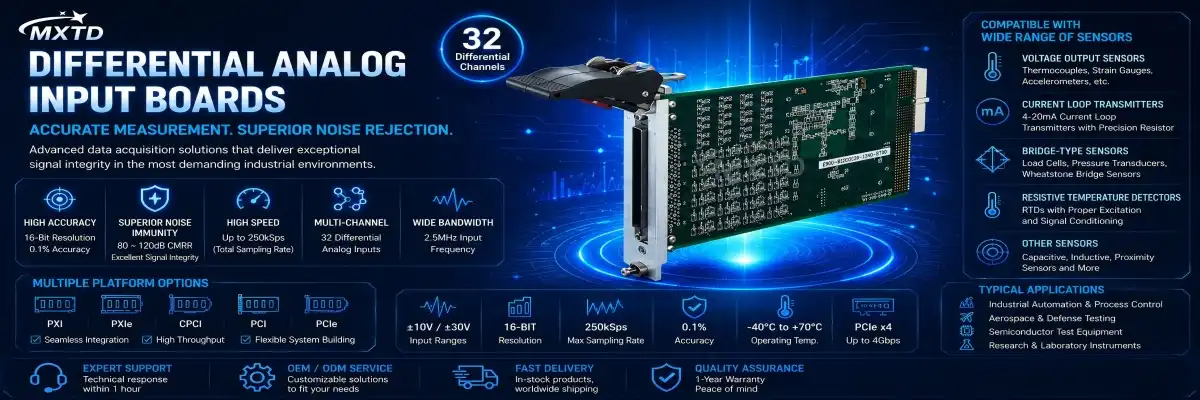
Core Technical Principles Behind Signal Integrity in Differential Analog Input Boards
Differential versus Single-Ended Signal Processing
The main benefit of differential measurement is that it automatically blocks out noise. Signal high and signal low are the two conductors used in each differential channel. The test shows the change in voltage between them. During the subtraction process, common-mode noise that affects both lines evenly is mathematically cancelled out. Single-ended setups don't have this benefit because they measure voltage between the signal and ground, which means that noise currents running through the ground impedance mess up the reading. This difference in technology shows why Differential Analog Input Board architectures are needed for precision uses.
Critical Performance Specifications
Several important factors determine how well a differential analog input board works. After twelve years of research and development, we've come up with standards that directly meet the tough needs of industrial robotics and electronics testing:
Common-Mode Rejection Ratio (CMRR) measures how well the board can block interference that shows up on both inputs equally. Higher CMRR numbers mean better noise immunity. Good boards get 80dB or higher across all operating frequencies. To meet this important requirement, our design includes matching input impedances and precise amps.
Input Impedance Loading effects on signal sources are controlled by input impedance. High impedance inputs keep devices from drawing too much current, which stops measurement mistakes. The boards keep the resistance the same across all 64 single-ended or 32 differential channels, so the performance is the same no matter which channel is chosen.
When selecting the Differential Analog Input Board, ensure that the resolution and sampling rate are properly matched to maintain consistent measurement accuracy and acquisition speed. With a precision of 16-bit, the input range can represent 65,536 discrete voltage levels, providing the 0.1% full-scale accuracy required for quality control applications. A maximum sampling rate of 250 kSps supports transient signal capture and waveform digitization requirements, while a 2.5 MHz input frequency ensures accurate detection of fast-rising signal edges.
Together, these standards keep the accuracy of measurements. When test and measurement engineers look at data gathering systems, they know that the standards must work with each other. For example, high resolution doesn't help if noise messes up the least important bits, and fast sampling doesn't help if the input signal is distorted by bandwidth limits.
Signal Conditioning and Integration Capabilities
Real-world sensors and analog-to-digital converters can talk to each other through signal filtering that works well. Our differential analog input boards have gain amplifiers that can be programmed to work best with input signals that are between ±10V and ±30V without the need for any extra parts. The multi-channel scanning capture mode quickly takes all channels one after the other, keeping the phase relationships that are needed for multi-point analysis.
The ability to manually calibrate the device lets you make adjustments in the field to fix any shifts or gain mistakes at the system level. This keeps the accuracy stable over time. Standard PXIe, CPCI, PCIe, and PCI buses let the boards easily connect to industrial equipment. They can handle 32-bit data transfers at 33MHz or a PCIe x4 connection at 4Gbps. Because it is so flexible, system designers can use the same acquisition technology on a variety of platform designs. This makes it easier to handle inventory and teach technical skills.
Practical Applications of Differential Analog Input Boards in Industry
Industrial Automation and Process Control
Differential Analog Input Board units are used in manufacturing sites to keep an eye on process variables in places with a lot of electrical noise. Thermocouples, strain gauges, and pressure transducers that are put near motor drives, welding tools, and other high-power machines send information to our boards. Differential inputs and strong environmental standards (working from -40°C to +70°C in industrial grade) make sure that the machine keeps running even when conditions on the plant floor are hard on other machines.
Accurate measures allow for predictive maintenance and real-time quality control, which increases the efficiency of production lines. Differential acquisition boards give clean data for automated decision-making when shaking sensors find worn bearings or temperature monitors find problems with the cooling system. Directors of technical services like equipment that cuts down on fake alarms and quickly finds real faults.
Aerospace and Defense Testing Applications
For flight control validation, characterizing propulsion systems, and structural tests, aerospace projects expect measurements that are very accurate. These needs are met by our differential analog input boards, which have been shown to be reliable and work with standard systems in the industry. The standard PXIe/PXI/CPCI 3U card format works with test racks that are already in use, and the specs that are compatible with NI make system migration and update projects easier.
For defense purposes, there are harsh mechanical conditions, wide temperature ranges, and tight rules about electromagnetic compatibility. The boards keep the accuracy that was promised across their entire working range. This gives measurement trust during environmental stress screening and qualification testing. Purchasing managers like that OEM/ODM personalization lets them change standard goods to fit the needs of a specific program without having to start from scratch.
Electronics Testing and Semiconductor Validation
The Differential Analog Input Board is used for parallel device evaluation, where high-channel-count capture is needed in semiconductor manufacturing and electronics testing. Because each board has 32 differential channels, it can measure multiple test points simultaneously. This significantly reduces test time compared to split or sequential methods. The 16-bit resolution and 0.1% accuracy make it suitable for parametric testing, especially in cases where pass/fail thresholds are tight, and measurement errors directly affect output estimates.
The boards' ability to balance small signal changes with bigger DC offsets helps research institutions studying device physics or material evaluation. With the ±10V and ±30V input range choices, you can use both low-level sensor outputs and higher-voltage circuit node readings without having to sacrifice range. System engineers who make automated test tools are able to acquire data from benchtop trials all the way up to production test systems using the same hardware and software interfaces.
How to Choose the Right Differential Analog Input Board for Your Needs
Evaluating Performance Against Application Requirements
Setting measurement goals is the first step in choosing the right data collection tools. Think about the voltage ranges, frequency content, number of channels, and environmental factors that you need to record the data. Our Differential Analog Input Board product line meets a wide range of needs with different types that cover a range of voltages and bus designs.
Whether you use ±10V or ±30V input ranges depends on the outputs of your sensors and the voltage levels in your circuit. The CPC1-5104, PCI-5104, PCIe-5104, and PXIe-5104 types are great choices because they all output 0-10V or 4-20mA signals that can be translated to normal voltage ranges. The ±30V capability of the CPCI-5114, PCI-5114, PCIe-5114, and PXIe-5114 versions is useful for applications that need to test motor controls, check batteries, or use higher-voltage analog circuits.
The choice of bus interfaces should fit with the design of your platform. PXIe has the fastest throughput for demanding multi-board systems, CPCI offers rugged connections for military and aircraft uses, PCIe is best for desktop development and small channel count deployments, and old PCI is still useful for keeping systems running. All versions have the same analog specs, which means that performance stays the same across systems.
Assessing Compatibility and Integration Factors
Software compatibility is often a key factor in how well a job is carried out. As usual, our boards work with Windows operating systems from Windows 98 to Windows 10. This means that they can be used with almost all workplace PC platforms. You can get customized driver support for Linux, VxWorks, RTX, and LabVIEW RT for real-time and embedded apps. The sample programs and driver dynamic library that come with the product speed up development so that your engineering team can focus on application logic instead of low-level hardware interaction.
Physical connectivity factors include card size, ease of access to connectors, and thermal control. Standard 3U form factors for PXIe/PXI/CPCI are 160mm x 100mm x 20mm, and for PCIe/PCI, they are 175mm x 106mm x 20mm. These sizes fit standard frames and cabinets in the industry. As long as the manufacturing error is less than 0.2mm, the mechanical fit and connector alignment will be stable. The non-condensing humidity range of 5% to 90% and the storage temperature range of -55°C to +85°C keep equipment safe while it is being shipped and stored.
Comparing Suppliers and Long-Term Partnership Value
Look at more than just the price when you're looking at differential analog input board providers. You should also look at the total ownership value. We've built our name on quick technical help and the ability to customize products to meet particular needs. Our OEM/ODM services change channel counts, input ranges, filtering characteristics, and mechanical configurations to meet your exact needs, unlike providers who only give catalog items.
When jobs are on a tight schedule, response time is important. Our promise to answer customer questions within an hour keeps programs going forward. Technical directors who are in charge of complicated integrations involving the Differential Analog Input Board, like having technical help that knows both what the tools can do and what the problems are at the system level. You can protect your investment with a one-year warranty that includes free software updates and live video expert support.
Competitive price and reliable performance are both parts of cost-effectiveness. As a manufacturer that can compete with high-end names while meeting similar standards, we offer purchasing benefits that are especially helpful for programs that are trying to stay within their budgets. System integrators that are making a lot of units can save money by buying in bulk, and stable lead times help them plan their production. When you combine benchmarked NI-compatible support with low prices, you get a great deal for both R&D centers and OEM makers.
Where and How to Purchase Differential Analog Input Boards
Navigating the Supplier Landscape
There are both well-known names and specialized companies like MXTD in the data gathering market. Global companies like National Instruments, Advantech, Texas Instruments, Siemens, Honeywell, and Beckhoff have a wide range of products and can help with a lot of different applications. These groups help engineers who are new to data collection by giving them useful tools like application notes, reference designs, and professional training.
Specialized makers offer focused knowledge and customization options that bigger companies don't always offer. Companies that focus on a few types of products learn a lot about the needs of their customers and the competition in their markets. Because they are specialists, they can provide quick engineering support, be ready to change standard goods, and set prices that reflect how efficiently they run their business instead of adding company overhead.
Evaluating Quality and Compliance Standards
Reliable Differential Analog Input Board units show quality by having consistent performance specs and records of external testing. Check the datasheets for full details, such as accuracy across a wide range of temperatures, long-term stability, and harmony with electromagnetic fields. Manufacturers who make good products give you information like calibration certificates, environmental test results, and reliability data that you can use to feel sure about your purchase.
Following industry norms lowers the risk of integration and makes the approval process easier. Our boards are compliant with safety and EMC rules, which makes it easier to put them into equipment that is CE-marked or UL-listed. Procurement managers like it when sellers know what the rules are and give them proof to back up their customers' approval activities.
Streamlining International Procurement
Buying things across borders requires more planning for transportation and conversation than buying things within the same country. We can help with both land and air shipping by using boxes made just for precision instruments. Boards are protected during foreign shipping by shock-proof, moisture-proof, and anti-static packing. This lowers the number of damaged boards and the cost of returns. Clear paperwork, like business bills, packing lists, and certificates of origin, makes it easier to get goods through customs.
Effective communication is what separates easy deals from stressful ones. Technical sales teams that know both the powers of the product and how it will be used by the customer can make accurate suggestions and believable delivery promises. Because we work with small and big businesses, system developers, and research institutions all over the world, we've been able to improve the ways we handle common issues that come up when doing business internationally, such as payment terms, warranty service logistics, and technical support across time zones.
Conclusion
Differential Analog Input Board units protect the purity of the data by using basic design principles that block common-mode noise and maintain measurement accuracy. The technical specs—32 differential channels, 16-bit resolution, 250 kSps sampling, and 0.1% accuracy—meet the exact needs of difficult uses in flight testing, industrial automation, and semiconductor validation. For adoption to go well, the board's features must be matched with the needs of the application. Suppliers must also be evaluated on their technical support and ability to make changes. Finally, long-term project success must be supported by partnerships. With twelve years of research and development experience and a dedication to quick customer service, MXTD is a trustworthy option to high-end names, offering NI-compatible performance at a low cost and the ability to be customized to meet specific program needs.
FAQ
What distinguishes differential inputs from single-ended configurations?
Differential inputs find the voltage difference between two data lines and ignore any noise that is present on both of them. Because single-ended inputs connect the signal to ground, they can be affected by ground loops and transmitted interference. Differential Analog Input Board designs are very helpful for applications with long wire runs, electrically noisy environments, or strict accuracy needs.
How do these boards integrate with existing PLC and automation systems?
Our differential analog input boards connect to standard bus designs like PXIe, CPCI, PCIe, and PCI, so they can work with industrial PCs that are often used in automation systems. The driver libraries and sample programs that are given can be easily integrated with control software. This makes it possible for data to move smoothly from acquisition boards to SCADA platforms or programmable logic controllers.
What determines appropriate channel count and sampling rate selection?
The number of channels relies on how many measurement places your program needs at the same time. With 32 differential channels, large sensor arrays can be used while sampling stays in sync. By choosing the sampling rate, you can find the best mix between acquisition speed, resolution, and noise. The highest sampling rate of 250 kSps is enough for most industry and test applications, and the single and continuous acquisition modes give you options for how to use the device.
Partner with MXTD for Your Precision Data Acquisition Needs
Industrial-grade Differential Analog Input Board units from MXTD mix proven performance with customization options that you can't get with ready-made products. Our wide range of products, including the PXIe-5104, CPCI-5114, PCIe-5104, and other types, gives R&D managers and test engineers the flexibility they need for a wide range of uses. As a differential analog input board provider that has been in business for twelve years, we know how important it is to find the right mix between standard reliability and application-specific optimization. When you ask a question, our expert team answers it within an hour, helps you through remote video advice, and supports OEM/ODM customization that changes standard platforms to fit your needs. Contact our specialists at manager03@mxtdinfo.com to discuss your measurement challenges, request technical specifications, or obtain competitive bulk pricing for your next project. Visit www.mxtdtest.com to explore our complete range of PXIe chassis, precision connectors, and integrated testing solutions designed for mission-critical applications.
References
1. Johnson, H. & Graham, M. (2017). High-Speed Signal Propagation: Advanced Black Magic. Prentice Hall, Upper Saddle River, NJ.
2. Webster, J.G. (2016). The Measurement, Instrumentation and Sensors Handbook, Second Edition. CRC Press, Boca Raton, FL.
3. Pallas-Areny, R. & Webster, J.G. (2012). Analog Signal Processing. Wiley-IEEE Press, New York, NY.
4. Northrop, R.B. (2014). Introduction to Instrumentation and Measurements, Third Edition. CRC Press, Boca Raton, FL.
5. Park, J. & Mackay, S. (2019). Practical Data Acquisition for Instrumentation and Control Systems. Newnes, Oxford, UK.
6. Di Paolo Emilio, M. (2013). Data Acquisition Systems: From Fundamentals to Applied Design. Springer, New York, NY.
Our customers’ satisfaction speaks for our quality — contact us to experience the same reliable service.