- English
- French
- German
- Portuguese
- Spanish
- Russian
- Japanese
- Korean
- Arabic
- Greek
- German
- Turkish
- Italian
- Danish
- Romanian
- Indonesian
- Czech
- Afrikaans
- Swedish
- Polish
- Basque
- Catalan
- Esperanto
- Hindi
- Lao
- Albanian
- Amharic
- Armenian
- Azerbaijani
- Belarusian
- Bengali
- Bosnian
- Bulgarian
- Cebuano
- Chichewa
- Corsican
- Croatian
- Dutch
- Estonian
- Filipino
- Finnish
- Frisian
- Galician
- Georgian
- Gujarati
- Haitian
- Hausa
- Hawaiian
- Hebrew
- Hmong
- Hungarian
- Icelandic
- Igbo
- Javanese
- Kannada
- Kazakh
- Khmer
- Kurdish
- Kyrgyz
- Latin
- Latvian
- Lithuanian
- Luxembou..
- Macedonian
- Malagasy
- Malay
- Malayalam
- Maltese
- Maori
- Marathi
- Mongolian
- Burmese
- Nepali
- Norwegian
- Pashto
- Persian
- Punjabi
- Serbian
- Sesotho
- Sinhala
- Slovak
- Slovenian
- Somali
- Samoan
- Scots Gaelic
- Shona
- Sindhi
- Sundanese
- Swahili
- Tajik
- Tamil
- Telugu
- Thai
- Ukrainian
- Urdu
- Uzbek
- Vietnamese
- Welsh
- Xhosa
- Yiddish
- Yoruba
- Zulu
Is a PXIe Digital Multimeter Better Than a Benchtop DMM?
People often wonder if a PXle digital multimeter is really better than a standard benchtop DMM when they are looking at measuring tools for high-stakes testing settings. The answer rests on your business needs in a big way. PXIe digital multimeters are perfect for complicated, high-throughput test systems in aircraft, semiconductors, and industrial automation because they can be easily integrated into other modules and can be calibrated automatically. On the other hand, benchtop DMMs are reliable and easy to use on their own for readings that aren't too complicated. When procurement managers and test engineers understand these differences, they can make choices that are in line with their testing architectures and long-term strategy goals.
Understanding PXIe Digital Multimeters and Benchtop DMMs
What Defines a PXIe Digital Multimeter?
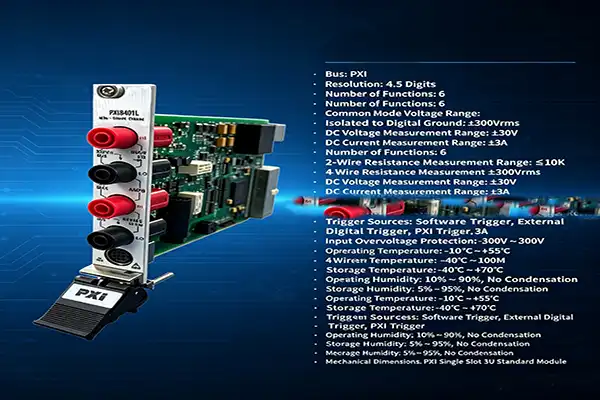
For precise measurements, a PXIe digital multimeter uses a modular method and is built to work with PXI Express systems. These devices use high-speed bus designs to provide great data transfer and synchronization abilities. This technology is shown by the PXIe3400, a six-and-a-half-digit digital multimeter that can measure DCV, ACV, DCI, resistance (both two-wire and four-wire setups), frequency, period, diode tests, and continuity checks, among other things.
These modular tools are unique because they can work as part of a bigger system of automatic test equipment. With a precision of 6½ digits, these devices offer laboratory-level accuracy in a small, rack-mountable package. They can measure DC voltage up to ±300V, DC up to ±3A, and resistance up to 100MΩ in a two-wire setup. Because they are separated, they can handle high common-mode voltages. This makes them good for harsh industrial settings where electrical noise and ground loops can affect the accuracy of measurements.
Traditional Benchtop DMM Characteristics
Over the past few decades, benchtop digital multimeters have been essential tools in factories and labs. These stand-alone tools have easy-to-use front panels with specific controls, so technicians can use them without any special training. Because they are self-contained, they don't need any extra hardware or system infrastructure. All they need to do is connect to mains power and start recording.
Benchtop models can measure things very well and often come with advanced features like data logging and trend analysis. However, they don't have the system-level integration that modular instruments do. Each benchtop unit works on its own and needs either external connections for automatic testing or manual data collection. This limitation becomes clear when test processes are scaled up or when multiple measurement places need to be coordinated at the same time.
Application Contexts for Each Technology
The choice between flexible PXI instruments and benchtop tools shows how different people think about testing. Benchtop DMMs are often more than enough for research labs that are analyzing materials or quality control labs that are doing spot checks. People who work in these places like that the device is portable and that readings can be set up quickly without having to configure the system.
On the other hand, PXIe design is very helpful for companies that use production test units, automated validation suites, or multi-parameter characterization systems. The PXIe3400 digital multimeter works well with automatic test routines because it has advanced triggering features that let it work with other instruments in perfect sync with time. More and more, industries like aircraft, car electronics, medical device manufacturing, and semiconductor fabrication depend on these skills to keep up with output and make sure measurements are correct.
Key Performance Comparison Between PXIe and Benchtop DMMs
Measurement Accuracy and Range Capabilities
When looking at how well a number works, the specs show important differences. The PXIe3400 has a resolution of 6½ digits, which makes it a good choice for measuring things precisely in difficult situations where small differences matter. Between ±300V and 300V for DC voltage measurements and up to 300V for RMS AC voltage measurements. It can measure currents up to ±3A in both DC and AC (RMS), and it can measure resistances up to 100MΩ for two wires and 10MΩ for four wires.
Benchtop DMMs usually meet these requirements when used by themselves, and many high-end types give resolutions that are the same or even better than these. The most important difference, though, comes up when you look at measurement speed and system alignment. Through shared trigger lines and system clocks, modular instruments can take readings in milliseconds and work perfectly with other devices. This feature changes how quickly tests can be done in real-world settings where every second counts.
Calibration Workflows and Maintenance Cycles
There is a secret cost called calibration that has a big effect on the total cost of ownership for the PXle digital multimeter. Traditional benchtop tools need to be physically taken out of service, sent to a calibration facility, and not be used for weeks at a time. Keeping up with multiple benchtop units spread out across a building makes this job harder and makes it harder for test engineers to manage equipment rentals.
PXIe-based measurement devices make calibration easier by controlling processes through software and having self-testing features built in. Many businesses use reference standards to do calibration methods on-site, which cuts down on response time from weeks to hours. The modular design also allows for hot-swapping, which means that if a measurement module needs to be calibrated or fixed, techs can just change it without taking the whole test station apart. This flexibility makes the system more reliable, which is a very important factor in production settings where test equipment breakdowns directly affect the ability to make things.
Safety Features and Environmental Reliability
Professional measurement tools are different from consumer-grade ones because they use industrial-grade parts. Industrial-grade parts are used in the PXIe3400 to make it more reliable and able to adapt to harsh environments like temperature changes, vibrations, and electromagnetic interference. When there are high common-mode voltages or complicated grounding situations, the separated design is very important for safety.
Safety rules cover more than just the tool itself; they also look at the whole system. Most modular systems work inside enclosed frames that protect them even more from touching live circuits by mistake. Software interlocks can stop measurement configurations that aren't safe, and built-in tracking can find strange situations before they hurt equipment or put operators at risk. In military and defense uses, where equipment failure can have very bad results, these traits become very important.
Evaluating Use Cases and Application Scenarios
When PXIe Digital Multimeters Excel
The natural environment for modular electronics is automated test tools. Imagine a company that makes semiconductors testing integrated circuits in dozens of different ways. At several test points, voltage, current, and resistance are measured on each device, and the results are compared to strict requirements. A PXI-based system puts all of this data into a single chassis and runs test routines in seconds while keeping exact timing connections between instruments.
As testing needs change, the benefits of flexibility become clear. To add measurement channels, you don't have to buy a whole new set of tools; you just have to put extra modules. On the same platform, system builders can set up mixed measurement packages that include digital multimeters, oscilloscopes, function generators, and digital I/O. The PXIe backplane has enough bandwidth for multiple high-speed measurements to be done at the same time, and software tools organize complicated test cycles that would need to be custom-integrated with stand-alone instruments.
Optimal Scenarios for Benchtop DMMs
System-level collaboration isn't always needed to solve a measurement problem. Field service workers who are trying to figure out why equipment isn't working need portable, self-contained tools that can work on their own. Moving tools from one setting to another without having to reconfigure system software is helpful for lab benches doing exploratory research.
Cost is another factor that affects the choice of technology. Benchtop tools may work well enough for organizations that don't need to automate many measurements, and they cost less to buy at first. A good benchtop DMM costs less than a PXI chassis with similar modular instruments. However, this equation changes when you look at multiple measurement spots or long-term running costs.
Return on Investment Analysis
When you figure out the total cost of ownership, you have to take into account more than just the buying price. Over the life of an instrument, the labor costs that come with taking measurements by hand, making mistakes when transcribing data, and having to fix or calibrate equipment add up a lot. Using a PXle digital multimeter in automated test equipment for production settings usually pays for itself quickly through higher output and lower worker needs.
A medium-sized electronics company switched from using benchtop tools to testing with PXI and saw a 40% drop in test time and a 60% drop in measurement mistakes. These changes directly led to more products being made and lower guarantee costs. The exact results depend on the application, but the pattern stays the same: companies that need to do a lot of tests, have a lot of measurement points, or have strict paperwork rules get a lot out of investing in modular instruments.
Comparing PXIe Digital Multimeters with Other Brands and Models
Positioning Against Industry Leaders
Fluke, Keysight, and Rohde & Schwarz are just a few of the well-known names in the measurement equipment market. Each maker has strengths that are best for certain types of applications. Fluke is known for making tough handheld and benchtop tools that field techs love. Keysight is the leader in high-frequency RF readings and has a wide range of PXI products. National Instruments was the first company to use the PXI platform, and it still offers a lot of help for the software environment.
To make sure that its PXIe digital multimeters work with NI product models, MXTD makes sure that they are compatible so that they can be easily added to existing PXI systems. This method of measuring gives purchasing managers cheaper options that don't sacrifice speed or compatibility. The PXIe3400 has the same specs as other six-and-a-half-digit digital multimeters, but it costs less, which is especially helpful for system designers and OEM makers who are building systems with multiple units.
Digital Versus Analog Measurement Technology
In some situations, analog multimeters are still useful, but in professional settings, digital measurement technology has mostly replaced analog meters. Analog meters can't compare to digital tools when it comes to accuracy, data logging, and being able to be used from afar. Analog-to-digital converters with a precision of 6½ digits are used to record measurement data on the PXI platform, which only uses digital measurement methods.
This digital base lets complex data processing, like filtering, averaging, and statistical analysis, be done in the firmware of the PXle digital multimeter. Software, instead of mechanical switches, lets users set measurement parameters. This lets automatic test routines change settings on the fly based on test results. These features are major benefits that make the switch from old analog technology to new digital measurement systems worthwhile.
Warranty and Procurement Considerations
When making B2B purchases, people look at more than just technical specs. They also consider how reliable the provider is, how well the infrastructure is for help, and the total cost of ownership. MXTD backs up all of its PXIe digital multimeter products with full support, such as remote video technical assistance, free software updates, and a normal one-year guarantee that can be extended in certain situations.
When production test equipment breaks down, response time is important. MXTD promises to answer customer questions within an hour because they know that measurement downtime directly leads to lost production capacity. This support infrastructure, along with the ability to customize through OEM/ODM, meets the many needs of system designers who want custom solutions instead of off-the-shelf goods. The company keeps standard goods in stock and can also make products to special requirements with clear production schedules.
Why PXIe Digital Multimeters Are Gaining Popularity in B2B Procurement
Strategic Advantages for Test Engineers
PXI technology's modular design gives it the flexibility that standalone instruments cannot match. By integrating a PXle digital multimeter into the system, test engineers building validation platforms can configure only the measurement functions they require without paying for unnecessary features. A chassis equipped with six measurement modules occupies far less rack space and costs significantly less than six comparable benchtop instruments.
Here are the main reasons why PXI is being used more and more in industry test applications:
System Integration and Synchronization: Timing and triggering tools for modular instruments are shared through the PXI backplane. This lets readings be coordinated within a few microseconds. This feature is very useful for describing fast changes or connecting many factors at the same time. Software frameworks offer unified programming interfaces, which makes integration easier than arranging multiple separate tools through their own communication methods.
Scalability and Reconfiguration: As goods change and standards are updated, so do testing needs. Instead of replacing all the equipment, PXI systems handle these changes by adding new modules and updating the software. By adding extra units, a test station that is set up to measure voltage can also measure current, resistance, or frequency. This freedom keeps investments in capital equipment from becoming useless over time.
Reduced Footprint and Simplified Cabling: a single PXI box can do the work of several benchtop instruments that would have needed their own rack room and connections. Instead of using external links, measurements go through the backplane. This keeps the signal strong and stops electromagnetic interference. This makes it easier to maintain and fix problems with the system while also making measurements more accurate.
These benefits take care of the problems that purchasing managers and technical directors have when they have to choose test tools. Because they are fast, flexible, and cost-effective, modular digital multimeters are the best choice for businesses that care about measurement quality and running their operations more efficiently.
Industry Certifications and Quality Assurance
In the test and measurement business, marketing claims are not enough to build credibility for the PXle digital multimeter. Compliance with international standards, ISO certificates, and traceability of calibrations are all concrete proofs of high-quality manufacturing and accurate measurements. MXTD has over 12 years of experience in the business and has developed PXIe chassis, boards, and combined testing products. This has helped them build institutional knowledge that makes their products work reliably.
The company has a skilled R&D team and an after-sales service group that gives B2B customers the technical help they need. When measurement errors or problems with integrating systems show up, being able to talk directly to engineers speeds up the process of fixing the problem. This support infrastructure differentiates professional-grade instrumentation from consumer products that may offer similar specifications but lack the backing necessary for mission-critical applications.
Future-Proofing Technology Investments
The world of testing and measuring is always changing as technology improves. Instrumentation powers are always getting better because of things like faster digital protocols, more complicated signals, and tighter measurement limits. When companies spend money on measurement equipment, they need to think about both the needs of now and how to make it ready for new standards in the future.
The PXI platform gains from development work done by many makers and end users across the industry. This environment for working together makes sure that new ideas keep coming up and that old tech can still be used. Instruments that meet the latest PXI standards can work with hardware and software that was made years ago. This protects investments even as individual modules get better. This standardization is different from proprietary systems, where equipment purchases can be lost if the seller stops supporting them.
Conclusion
When you compare PXIe digital multimeters to benchtop DMMs, you can see that "better" means different things depending on the situation. Modular PXI instrumentation, especially a PXle digital multimeter, has strong benefits for automatic test systems that need to take data on multiple channels, keep the system in sync, and build designs that can grow as needed. Adopting PXI technology pays off big for companies that use complicated validation suites, integrated measurement systems, or high-volume production tests. The PXIe3400 is a good example of this because it has a lot of measurement functions as well as features for industrial stability and system interaction. Benchtop tools, on the other hand, can still be used for measurements that need to be done by themselves, field service, and situations where simplicity is more important than automation. Instead of just looking at the original purchase price, people making procurement choices should think about the total cost of ownership, the need for growth, and the operating goals.
FAQ
Can a PXI Digital Multimeter Replace Multiple Benchtop Instruments?
When set up correctly, a PXI system can combine the features of several benchtop tools into one. A chassis with digital multimeters, oscilloscopes, and function generators can be used instead of a similar benchtop setup because it is more synchronized and takes up less space. The most important thing to think about is how to fit the modular powers to the exact measurement needs.
How Does Calibration Work for Modular Measurement Systems?
The steps for calibrating PXI devices are similar to those for calibrating benchtop equipment, but software processing makes the process easier. Technicians can use programmatic control to run calibration processes and store calibration factors in memory that doesn't lose its data. When compared to sending benchtop units to outside calibration labs, this method cuts down on calibration time and allows procedures to be done on-site using reference standards, which minimizes instrument downtime.
What Software Support Do PXIe Digital Multimeters Require?
Most PXI instruments come with driver software that works with popular programming platforms like Python, LabVIEW, and C++. MXTD offers free software updates and help to make sure that their products work with new operating systems and development tools. How much programming work is needed depends on how complicated the application is. It can be as simple as measurement scripts or as complex as test executives handling long sequences on multiple instruments.
Partner with a Trusted PXIe Digital Multimeter Supplier
Over the past 12 years, MXTD has been skilled in creating high-reliability PXIe measurement systems for tough industrial uses. As a manufacturer with a lot of experience making PXle digital multimeter products, we know how important speed is in testing settings like aerospace, semiconductors, and cars. Our PXIe3400 digital multimeter has a resolution of 6½ digits, a wide range of measurement functions, and industrial-grade dependability that is on par with top platforms. It is also much more cost-effective for system developers and original equipment makers. We offer fast customization through OEM/ODM services, keep standard setups in stock so they can be sent out right away, and offer responsive technical help with promises to answer questions within one hour. Our engineering team is ready to help you turn your testing problems into competitive benefits, whether you need NI-compatible solutions, unique measurement ranges, or help with the design of an integrated system. Get in touch with us at manager03@mxtdinfo.com to talk about how our PXIe digital multimeter tools can help your test design work better.
References
1."PXI Systems: Architecture and Advantages in Automated Test Equipment," Test & Measurement World, 2023.
2. National Instruments Corporation, "Modular Instrumentation Design Guide: Implementing PXI Express Systems," Technical White Paper, 2022.
3. Johnson, M. and Williams, R., "Total Cost of Ownership Analysis for Automated Test Equipment in Semiconductor Manufacturing," IEEE Instrumentation & Measurement Magazine, Vol. 25, No. 4, 2022.
4."Digital Multimeter Specifications and Performance Characteristics," Keysight Technologies Application Note, 2023.
5. Smith, A., "Calibration Best Practices for Modular Test Systems," Quality Magazine, September 2023.
6. International Electrotechnical Commission, "IEC 61010-1: Safety Requirements for Electrical Equipment for Measurement, Control, and Laboratory Use," 4th Edition, 2024.
Our customers’ satisfaction speaks for our quality — contact us to experience the same reliable service.