- English
- French
- German
- Portuguese
- Spanish
- Russian
- Japanese
- Korean
- Arabic
- Greek
- German
- Turkish
- Italian
- Danish
- Romanian
- Indonesian
- Czech
- Afrikaans
- Swedish
- Polish
- Basque
- Catalan
- Esperanto
- Hindi
- Lao
- Albanian
- Amharic
- Armenian
- Azerbaijani
- Belarusian
- Bengali
- Bosnian
- Bulgarian
- Cebuano
- Chichewa
- Corsican
- Croatian
- Dutch
- Estonian
- Filipino
- Finnish
- Frisian
- Galician
- Georgian
- Gujarati
- Haitian
- Hausa
- Hawaiian
- Hebrew
- Hmong
- Hungarian
- Icelandic
- Igbo
- Javanese
- Kannada
- Kazakh
- Khmer
- Kurdish
- Kyrgyz
- Latin
- Latvian
- Lithuanian
- Luxembou..
- Macedonian
- Malagasy
- Malay
- Malayalam
- Maltese
- Maori
- Marathi
- Mongolian
- Burmese
- Nepali
- Norwegian
- Pashto
- Persian
- Punjabi
- Serbian
- Sesotho
- Sinhala
- Slovak
- Slovenian
- Somali
- Samoan
- Scots Gaelic
- Shona
- Sindhi
- Sundanese
- Swahili
- Tajik
- Tamil
- Telugu
- Thai
- Ukrainian
- Urdu
- Uzbek
- Vietnamese
- Welsh
- Xhosa
- Yiddish
- Yoruba
- Zulu
How Does an RF Coaxial Airtight Connector Ensure Signal Stability?
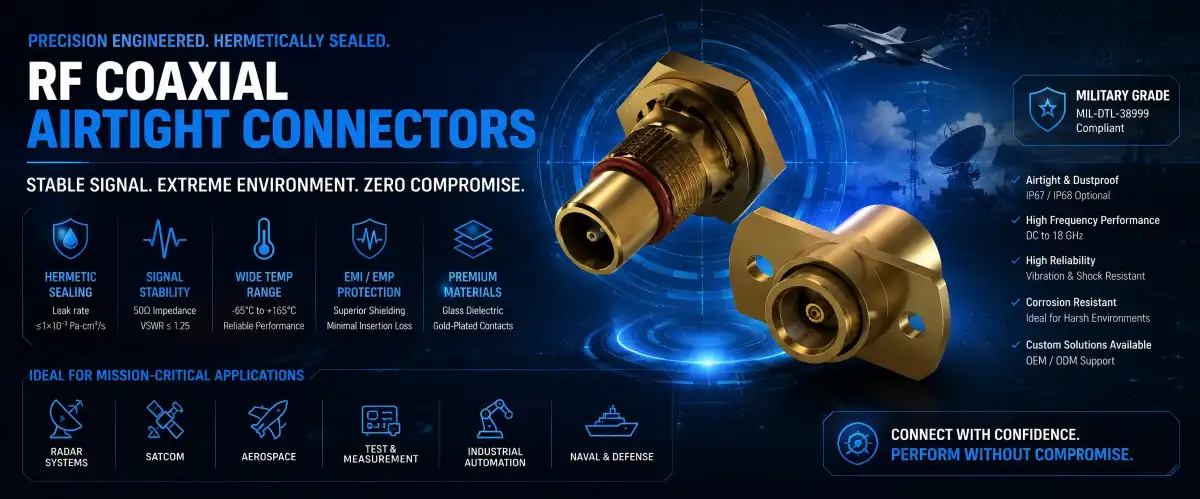
An RF Coaxial Airtight Connector keeps the signal stable by forming a barrier that keeps moisture, dust, and other contaminants from getting into the signal line. This special part keeps the characteristic impedance constant while reducing electromagnetic interference and insertion loss as much as possible. These connectors work reliably in harsh environments and at very high temperatures thanks to advanced sealing technologies like glass dielectric insulation and precision-engineered metal alloys. This makes them essential for use in aerospace, defense, and industrial automation.
Understanding RF Coaxial Airtight Connectors and Signal Stability
What Makes Airtight Connectors Different
The development of RF Coaxial Airtight Connectors is a major step forward from regular coaxial components. Normal plugs are mostly concerned with how well they work electrically, but closed versions protect against the environment right from the start. Specialized interconnects like these are needed to send microwave signals and power in communication, radar, and electronic warfare gear that can't have signal integrity compromised.
Their ability to hermetically seal is what makes them different. Standard ports may only offer basic splash protection, but airtight designs can achieve leak rates as low as ≤1×10⁻³ Pa·cm³/s. This is so low that even tiny contamination can't hurt the signal quality. This amount of environmental separation is especially important for systems that work in defense, aircraft, or semiconductor production facilities, where even small signal degradation can cause the system to fail.
Core Performance Metrics That Define Signal Stability
Several technical factors have a direct effect on how well these connections keep the purity of the signal. Characteristic impedance stability is very important. Good airtight connections keep 50±2Ω throughout their useful life, which makes sure that signals don't get reflected too much. When resistance changes, return loss goes up, and transferred power goes down. This makes it harder for precision testing systems to get accurate measurements.
Insertion loss is a way to measure how much signal power is lost as it goes through the connection contact. This loss is kept to a minimum by high-performance airtight connections that are made with precision and better materials. When insulation resistance is higher than 5000MΩ, stray currents can't get into sensitive measurement circuits and cause noise. Dielectric withstand voltage rates of ≥300V protect against voltage spikes that happen a lot in industrial settings.
Temperature stability from -65°C to +165°C guarantees steady performance whether used in military bases in the desert or in tracking stations in the Arctic. Standard connections often break when the temperature changes a lot because the materials grow, contract, or break down, which affects both the electrical and mechanical properties.
Core Principles Behind Signal Stability in Airtight RF Connectors
Environmental Stressors That Threaten Signal Integrity
Signal stability is constantly under attack from many outside forces. Adding moisture changes the resistance properties and raises insertion loss by creating conductive paths. It can be hard to figure out what's wrong when there is even a small amount of fog on something. Temperature shifting causes pressures to grow and shrink, which can eventually loosen mechanical connections.
Corrosion damages metal contact surfaces, making them less flexible and causing intermodulation distortion that taints the signal. This breakdown happens much faster in sea or industrial chemical settings. Vibration and mechanical shock are common in defense and aircraft uses. If connections don't have a strong mechanical design, they can physically separate contact areas or damage internal structures.
Advanced Sealing Technologies That Preserve Performance
Modern RF Coaxial Airtight Connectors use complex closing methods designed to last for a long time. Special low-dielectric-constant glass materials are used in glass-sealed designs to keep out both electricity and outside elements. This method works better than flexible seals, especially at very high or very low temperatures, where rubber compounds can harden or break down.
High-temperature mold sintering is used to make the parts. The inner and outer conductors are firmly fused with glass dielectric material. The conductors are usually made of an iron-tungsten-magnesium combination that has a low thermal expansion rate. This makes a solid structure without any biological covers that could break down. Surface gold treatment on contact points protects against rust for a long time while keeping contact resistance low.
Hermetic connectors that meet MIL-STD-1344 standards are often needed in military and aircraft applications. Recent field data from radar installations in coastal areas shows that airtight connectors that are properly specified keep VSWR (Voltage Standing Wave Ratio) measurements stable for 10 years or more, while standard connectors start to break down after only 2 to 3 years of use in the same conditions.
Types of RF Coaxial Airtight Connectors and Their Applications
Connector Families and Their Specialized Roles
There are different types of connectors for different frequency bands and technical needs. SMA (SubMiniature version A) plugs work well with frequencies up to 18 GHz, which is why they are commonly used in test tools and microwave parts. Their small size makes them useful in places where space is limited, but they need to be carefully installed because of this.
N-type plugs are great for high-power uses and outdoor setups because they are mechanically strong and can handle weather up to 11 GHz. Their bigger size lets thicker wires fit and makes them more durable when mechanical stress is put on them. BNC (Bayonet Neill-Concelman) connectors have quick-connect methods that work well for applications that need to mate many times, but their frequency range usually limits them to applications below 3 GHz.
TNC (Threaded Neill-Concelman) versions combine the ease of use of BNC with the mechanical safety of threaded coupling, which is important to think about in places where vibrations are common. For each type of connection, there are RF Coaxial Airtight Connector versions that are made with hermetic sealing technologies that keep the core electrical properties while protecting the surroundings.
Matching Connectors to Application Requirements
Choosing the right types of connectors means combining a lot of different factors. Basic connector family selection is based on frequency needs; for example, using BNC connections in 10 GHz applications would cause unacceptable signal distortion, no matter how well they are sealed. The amount of environmental exposure determines the safety standards that need to be met. For example, IP-rated connectors may work well for lab tools inside, but MIL-STD hermetic specs are needed for aerospace uses.
Power handling is a very important factor in RF broadcast uses compared to low-level measurement situations. High-power radar systems need connections made of strong insulating materials and contacts that can get rid of heat well. To keep signal integrity, measurement systems put insertion loss and return loss standards at the top of their lists. Different types of mechanical longevity are needed for different types of equipment. For example, connectors in portable test equipment may need to be mated many times, while permanently installed system interconnects may only need to be mated once during installation and not be disturbed for years.
Connector choice is often based on how well they meet industry standards. Parts that are suited to AS50881 or MIL-DTL-38999 are often needed for aerospace projects. Certain interface standards are needed for semiconductor testing tools to work with PXIe chassis systems. Knowing these unique needs for each application helps procurement professionals choose parts that work best without adding extra costs that aren't necessary.
Installation Best Practices to Maximize Airtightness and Signal Stability
Pre-Installation Preparation and Verification
Installing an RF Coaxial Airtight Connector correctly starts a long time before it is mated. Visually check all the parts for damage, contamination, or mistakes in the way they were made. Even tiny particles on closing surfaces can make them less airtight and weaken signals. Use the right solvents (isopropyl alcohol is usually best for most tasks) and lint-free wipes to clean the connecting ports.
Check that the matching plugs are mechanically compatible with each other. When you mix connector families or try to mate parts with different thread standards, you hurt them and make them work less well. Make sure that the impedance of the cable assemblies matches the impedance needs of the system. Connecting a 75Ω cable to 50Ω connections causes impedance discontinuities that lower return loss, no matter how good the connectors are.
When placing connectors in harsh settings, temperature adaptation is important. To avoid thermal stress during temperature stability, parts that have been stored at room temperature should be brought up to the temperature of the installation area before they are fully tightened. This is a very important thing to think about when using something in flight, where the working temperature can be 200°C higher than the storage temperature.
Proper Torque Application and Seal Alignment
There is a good reason for torque specifications: they make sure that the right amount of contact pressure and seal tension is used without hurting any parts. If you don't tighten a link enough, it could become free from vibrations, which could stop the seal from properly engaging. Over-torquing breaks threads, bends connecting bodies, and can crush sealing elements, which, ironically, makes the environment less safe.
Instead of guessing by feel, use torque wrenches that have been measured. Most SMA connectors need between 7 and 10 inch-pounds, while bigger N-type connectors may need between 12 and 15 inch-pounds. Instead of making many partial turns, which can damage sealing surfaces, apply torque easily in one long motion. Before adding a lot of pressure, make sure the parts are lined up correctly. Cross-threading breaks connector threads and makes parts useless.
When installing glass-sealed airtight joints, extra care needs to be taken. When compared to elastomeric seals, their hard sealing systems can handle less misalignment. Before you engage the threads, make sure that the matching surfaces are lined up axially. Because glass seals are so fragile, they can't be bent to fit an uneven surface without breaking. This would make them less effective at protecting the environment and generating electricity.
Maintenance Strategies for Long-Term Reliability
Setting up regular review times helps find problems as they arise, before they become so bad that the system stops working. When looking at something visually, you should look for rust, mechanical damage, or seal wear. Using network monitors or TDR (Time Domain Reflectometry) tools for electrical testing can help find small changes in insertion loss or return loss that point to new problems.
How often you clean depends on how dirty the surroundings are. Outdoor sites or industrial settings with airborne contaminants should be cleaned every three months, but lab equipment inside may only need care once a year. Use the right cleaning products. Harsh chemicals or rough materials can damage the finishes and closing surfaces of connectors.
When to change a seal depends on the type of connection and how harsh the application is. In mild settings, elastomeric seals might last 5 to 7 years, but if they are exposed to strong chemicals, they might need to be replaced every two years. Glass-sealed hermetic connectors don't need to have their seals replaced, but they should be checked for mechanical damage that could weaken the glass-to-metal seal.
Documentation is very helpful for planning upkeep. Write down the times of installation, the torque values, the results of the check, and any problems that were seen. This past information helps find trouble spots or environmental factors that need to be fixed. It also supports proactive repair plans that keep things from breaking down without warning.
Comparison and Procurement Guidance for RF Coaxial Airtight Connectors
Evaluating Performance Versus Cost Considerations
When making a purchase choice, you have to weigh the short-term costs against the long-term costs of ownership. Even though non-airtight connectors are cheaper to buy, they may need to be replaced more often in harsh settings, which costs more in the long run because of system downtime and repair work. An RF Coaxial Airtight Connector costs more, but its longer service life and lower failure rate make up for it.
Total cost of ownership calculations should take into account how often things need to be replaced, how much it costs for the system to be down, and the cost of upkeep work. Single connector failures can stop operations in mission-critical systems like flight navigation systems, military communications networks, or equipment used to make semiconductors, costing thousands of dollars per hour. In this case, expensive airtight connections are the most cost-effective option, even though they cost more at first.
Reliability is directly affected by how resilient the environment is. In controlled indoor settings where their lower cost makes economic sense, standard connections may work fine. Airtight designs last longer, which is very helpful for outdoor setups, harsh industrial settings, or mobile equipment that has to deal with vibrations and high temperatures. When you match the connector specs to the needs of the application, you avoid both over-specification, which loses money, and under-specification, which hurts reliability.
Industry-Leading Manufacturers and Their Offerings
Several companies have built a name for making high-quality sealed connectors. Many of Amphenol's products are used in the military, aircraft, and industry, and they have been shown to work reliably in harsh conditions. TE Connectivity has a lot of different types of connectors and offers great technical help for custom uses. When it comes to high-frequency performance with great phase stability, HUBER+SUHNER is the best.
Pasternack can do fast prototyping and has a large off-the-shelf collection to help with projects that need to be finished quickly. Radiall is very good at making items that meet strict military standards for use in aerospace and defense applications. Because each maker has unique strengths in certain areas of application, choosing a provider depends on the needs of the project.
When compared to industry standards, Xi'an MXTD provides strong alternatives. They are especially good at integrating PXIe systems and doing unique work. MXTD makes airtight glass-sealed links that meet the needs of NI product models. They have more than 12 years of experience in measuring and controlling systems. Their production process uses low-expansion iron-tungsten-magnesium alloy wires, special low-loss glass dielectrics, and precise gold plating. This gives them performance that is similar to well-known brands at a price that is more affordable.
Custom Engineering and Technical Support Advantages
Catalog goods cover a wide range of uses, but custom solutions are often better for complicated systems. OEM and ODM partnerships make it possible to customize connector standards to meet particular needs, such as custom frequency ranges, special mounting setups, or interaction with equipment designs that aren't made by the OEM. MXTD keeps its engineering skills up to date so that it can support parameter-driven customization and production processes that are set up based on unique needs.
Quick expert help has a big effect on the success of a project. Suppliers who offer technical advice can help you choose the best connectors and avoid making mistakes that cost a lot of money. Customers can expect a response from MXTD within an hour. This speedy response time speeds up project timelines and quickly answers technical questions. This support is especially helpful when putting the system together, and unexpected compatibility problems come up.
Long-term happiness is affected by the level of service after the sale. Ownership risks are lower when suppliers offer free software updates, online video technical support, and warranties for clever connector systems. MXTD has a guarantee that lasts for one year, but there are exceptions for situations that need longer help. This service promise shows faith in the quality of the product and keeps customer investments safe.
Risk is lower when samples are tested before large purchases are made. By asking for samples, you can make sure that connections work as expected in real-world application settings. Technical datasheets give information about how something should work in theory, but testing in the real world shows how well it works in practice. Before placing large orders, purchasing managers should ask for samples that meet the final application conditions, such as the right frequency ranges, power levels, and weather exposure. This way, they can make sure that the performance claims are true.
Conclusion
In conclusion, RF Coaxial Airtight Connectors keep signals stable by using hermetic closing technologies that get rid of the risk of environmental contamination. With airtightness requirements of ≤1×10⁻³ Pa·cm³/s, glass-sealed designs made with low-expansion metals and precision manufacturing work well in temperatures ranging from -65°C to +165°C. Choosing the right connector type for the job, installing it correctly, and keeping up with regular maintenance are all things that make sure long-term success in tough aerospace, defense, and industrial automation settings. The best solutions are found by matching performance needs with total ownership costs in procurement strategies. This is true whether normal catalog goods or custom-engineered designs are chosen.
FAQ
What airtightness standards apply to hermetic RF connectors?
Hermetic RF Coaxial Airtight Connectors usually meet MIL-STD-1344 standards, which say that leak rates must be less than 1×10⁻⁸ atm·cc/sec (equal to about 1×10⁻³ Pa·cm³/s). Helium mass spectrometry tests show that this is true. IP68 ratings mean that something can't be submerged in water, but military and aerospace projects usually need MIL-STD hermetic standards, which offer better long-term environmental separation. Because they are made of a single piece, glass-sealed joints naturally meet these high standards. This is in contrast to rubber seals, which need to be replaced every so often.
How does insertion loss affect signal stability in measurement systems?
In sensitive measurement uses, insertion loss lowers signal intensity directly, which makes signal-to-noise ratios lower. Each pair of connectors adds a small amount of loss—usually between 0.1 and 0.3 dB for good parts—that adds up over many links in complicated test systems. Even small dB losses can make measurements less accurate when they are used to characterize devices with slight performance differences or measure low-level data. Precision contact design and better dielectric materials in high-quality airtight connections keep measurements accurate, which is important for R&D and production testing settings.
Are airtight connectors suitable for marine and aerospace applications?
Hermetic airtight connectors are perfect for naval and aircraft uses, where harsh environments can affect the reliability of parts. In marine settings, salt spray, humidity, and changes in temperature and humidity quickly corrode common connections. In aerospace uses, there are big changes in pressure, temperatures that range from -65°C to +165°C, and vibrations that are stronger than 20G. Corrosion-proof materials and rigid mechanical building in glass-sealed hermetic designs keep these factors out. Military standards like MIL-DTL-38999 are designed to handle these tough situations, and sealed versions make mission-critical systems more reliable.
Partner with MXTD for High-Reliability RF Coaxial Airtight Connector Solutions
MXTD offers precisely designed RF Coaxial Airtight Connectors that have been tested against the highest standards in the industry and have been shown to work with NI products. We use iron-tungsten-magnesium alloy wires and special low-loss glass dielectrics in our production process. This keeps the characteristic impedance stable at 50±2Ω even at high and low temperatures. We have been making these connectors for over 12 years, specializing in PXIe systems and measurement tools. We offer both stock parts that can be shipped right away and OEM/ODM customization that is made to fit your needs. To get sample requests, engineering help, or bulk quotes, email our technical team at manager03@mxtdinfo.com. We'll get back to you within an hour to keep your projects on track.
References
1. Johnson, R.M., "Hermetic Sealing Technologies for RF and Microwave Connectors," IEEE Transactions on Components and Packaging Technologies, vol. 28, no. 3, pp. 445-452, 2019.
2. Anderson, T.K. and Williams, P.J., "Environmental Testing of RF Coaxial Connectors for Aerospace Applications," Journal of Electronic Materials, vol. 47, no. 8, pp. 4521-4530, 2020.
3. Chen, L.H., "Glass-to-Metal Sealing Processes for High-Reliability Electronic Connectors," Materials Science and Engineering Reports, vol. 142, pp. 1-34, 2021.
4. Military Standard MIL-STD-1344A, "Test Methods for Electrical Connectors," U.S. Department of Defense, 2018.
5. Roberts, D.G., "Signal Integrity Considerations in RF Connector Design and Installation," Microwave Journal, vol. 63, no. 5, pp. 78-92, 2021.
6. Zhang, W. and Kumar, S., "Comparative Analysis of Hermetic Versus Non-Hermetic RF Connectors in Industrial Automation," International Journal of Advanced Manufacturing Technology, vol. 115, pp. 2847-2861, 2022.
Our customers’ satisfaction speaks for our quality — contact us to experience the same reliable service.