- English
- French
- German
- Portuguese
- Spanish
- Russian
- Japanese
- Korean
- Arabic
- Greek
- German
- Turkish
- Italian
- Danish
- Romanian
- Indonesian
- Czech
- Afrikaans
- Swedish
- Polish
- Basque
- Catalan
- Esperanto
- Hindi
- Lao
- Albanian
- Amharic
- Armenian
- Azerbaijani
- Belarusian
- Bengali
- Bosnian
- Bulgarian
- Cebuano
- Chichewa
- Corsican
- Croatian
- Dutch
- Estonian
- Filipino
- Finnish
- Frisian
- Galician
- Georgian
- Gujarati
- Haitian
- Hausa
- Hawaiian
- Hebrew
- Hmong
- Hungarian
- Icelandic
- Igbo
- Javanese
- Kannada
- Kazakh
- Khmer
- Kurdish
- Kyrgyz
- Latin
- Latvian
- Lithuanian
- Luxembou..
- Macedonian
- Malagasy
- Malay
- Malayalam
- Maltese
- Maori
- Marathi
- Mongolian
- Burmese
- Nepali
- Norwegian
- Pashto
- Persian
- Punjabi
- Serbian
- Sesotho
- Sinhala
- Slovak
- Slovenian
- Somali
- Samoan
- Scots Gaelic
- Shona
- Sindhi
- Sundanese
- Swahili
- Tajik
- Tamil
- Telugu
- Thai
- Ukrainian
- Urdu
- Uzbek
- Vietnamese
- Welsh
- Xhosa
- Yiddish
- Yoruba
- Zulu
Can PXI Embedded System Controllers Support Multi-Device Synchronization?
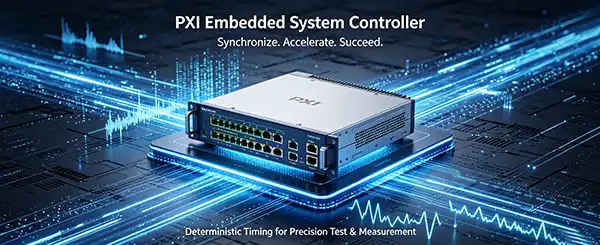
The PXI Embedded System Controller is designed to allow synchronisation between multiple devices in complicated test setups. To coordinate several measurement units at the same time, these controllers use shared clock references, timing signals that are built into the hardware, and trigger passing through backplane designs. Embedded controllers make sure that data collection, signal generation, and analysis all happen at exactly the same time by using PXI trigger lines and system timing buses for synchronisation. This is very important for aerospace testing, semiconductor validation, and automated production lines where test reliability depends on being accurate to the nanosecond level.
Understanding PXI Embedded System Controllers and Multi-Device Synchronization
When managing automated test systems across industrial automation, aerospace defense, or semiconductor research, you need more than just processing power. You need coordination. That's where embedded controllers shine within the PXI platform.
What Makes Embedded Controllers Essential in Modular Test Systems
At their core, these controls run your whole PXI system and give you commands. They make sure that all the devices work with the same time reference and handle communication between different functional units, like digitisers, signal producers, and switching matrices. Unlike separate PC controls that are linked by wires, embedded choices are built right into the frame backplane. This cuts down on delay and improves the purity of the signal. This design is shown by the PXI4806L embedded zero-slot processor. It has a standard PXI 3-slot 3U module size and is based on a Loongson 3A5000 quad-core processor that operates at 32bit/33MHz system frequency. It provides strong computing speed. This controller supports the Galaxy Kylin V10 operating system and can handle dual-channel DDR4 memory setups of up to 32GB. It is therefore perfect for defence and high-security uses.
How Synchronization Mechanisms Work in Practice
Three main types of signals are sent through the PXI backplane to keep multiple devices in sync. All units use clock signals to find out what time it is. At exact times, trigger signals start measures or outputs. For RF and high-speed digital uses, reference clocks keep phase consistency. The PXI4806L processor has a lot of connections that can be used with these synchronisation routes. It makes contact easier between test nodes that are spread out by having four 1000BASE-T Ethernet ports, three USB 3.0 interfaces, and four separated CAN ports. RS-232 and RS-485 serial ports let you connect to older instruments, and the two HDMI outputs let you watch things happen in real time while they're being synchronised.
Technical Architecture and Design Principles Enabling Synchronization
Understanding the underlying hardware design of a PXI Embedded System Controller helps procurement managers assess whether a controller meets their synchronization requirements.
Physical Integration Within Chassis Architecture
Embedded controllers mount directly into the PXI chassis backplane, gaining immediate access to all shared timing resources. This physical integration eliminates external cabling that introduces jitter and propagation delays. The backplane provides dedicated trigger lines (typically eight PXI trigger buses) and a 10 MHz reference clock distributed to every slot. The three-slot footprint of the PXI4806L allows adjacent module placement while maintaining thermal management. Operating within 10% to 90% non-condensing humidity specifications, this controller suits laboratory and production floor deployments alike. Its compact design doesn't sacrifice connectivity—six USB ports total (three USB 3.0, three USB 2.0) accommodate peripheral devices without requiring external hubs that could introduce timing uncertainty.
Synchronization Protocols and Timing Distribution
Star trigger topology represents the most common synchronization architecture. The controller sends a master trigger signal simultaneously to all connected modules via backplane routing. Each module receives this trigger within nanoseconds of its neighbors, ensuring coordinated action. Software drivers manage trigger routing configuration, allowing test engineers to define complex sequences where specific modules respond to different trigger sources. Clock distribution follows similar principles. The controller either generates a master clock or accepts an external reference, then distributes this signal through dedicated backplane lines. Modules lock their internal timebases to this shared clock, maintaining phase coherence across channels. This architecture proves essential in RF testing, where phase relationships between stimulus and response determine measurement validity.
Practical Applications and Benefits of PXI Multi-Device Synchronization
Abstract technical capabilities only matter when they solve real-world testing challenges. Let's examine how synchronized embedded controllers deliver measurable value.
Industry-Specific Implementation Scenarios
Aerospace validation requires simultaneous data capture from dozens of sensors during structural testing. A synchronized PXI system samples strain gauges, accelerometers, and temperature sensors with guaranteed temporal alignment, enabling accurate correlation analysis. The PXI4806L controller's wide operating temperature range supports environmental chamber testing where avionics undergo thermal cycling. Semiconductor manufacturers depend on precise timing during automated test equipment (ATE) operations. When characterizing high-speed digital circuits, skew between stimulus and measurement channels directly affects yield analysis. Embedded controllers maintain sub-nanosecond synchronization across digitizers and pattern generators, ensuring production data accuracy. Telecommunications equipment testing demands coordination between signal generation, impairment simulation, and protocol analysis. An embedded controller orchestrates these functions across multiple PXI modules, executing test sequences where timing relationships define pass/fail criteria. The four CAN interfaces on the PXI4806L support automotive Ethernet testing alongside traditional CAN bus validation.
Performance Improvements Through Synchronized Operations
Here are the core advantages a synchronized PXI Embedded System Controller brings to your test infrastructure:
- Timing Precision: Hardware-based synchronization eliminates software scheduling uncertainty. When modules respond to shared trigger signals propagated through the backplane, timing accuracy reaches single-digit nanoseconds rather than the millisecond-level jitter inherent in software-coordinated systems.
- Scalability Without Complexity: Adding synchronized modules requires no additional timing hardware. The backplane architecture automatically extends trigger and clock distribution to newly installed cards. System architects configure routing through software, avoiding manual cable management.
- Test Throughput Acceleration: Parallel operation of synchronized modules dramatically reduces test duration. Rather than sequential measurements that accumulate latency, simultaneous multi-channel acquisition completes in the time required for a single channel.
- System Reliability Enhancement: Deterministic timing behavior reduces intermittent failures caused by race conditions. When every module operates on a common time reference, test sequences execute predictably across thousands of repetitions.
These advantages directly address pain points faced by R&D managers overseeing complex validation projects. Faster test cycles accelerate product development timelines, while improved accuracy reduces costly false failures that delay production ramp.
Selecting the Right PXI Embedded System Controller for Synchronization Needs
Making an informed purchasing decision requires evaluating multiple criteria beyond headline specifications.
Performance Criteria for Demanding Applications
Latency determines how quickly the controller responds to external events and commands modules to act. Lower latency enables tighter closed-loop control in hardware-in-the-loop simulation. The quad-core Loongson 3A5000 processor provides parallel processing capability, allowing the PXI4806L to manage real-time tasks alongside data logging and user interface updates. Jitter specifications reveal timing consistency. Even if average latency meets requirements, excessive jitter causes some operations to occur outside acceptable windows. Procurement managers should request jitter specifications under maximum system load—when all communication interfaces operate simultaneously, and memory bandwidth reaches capacity. Scalability encompasses both expansion capability and software flexibility. The PXI4806L supports up to 32GB of memory, accommodating future test scenarios requiring larger data buffers. Its Galaxy Kylin V10 compatibility appeals to defense contractors managing supply chain security, while standard Ethernet and USB interfaces enable commercial tool integration.
Evaluating Supplier Reliability and Support Infrastructure
Beyond product specifications, supplier characteristics determine long-term project success. Xi'an Mingxi Taida Information Technology (MXTD) brings over twelve years of development experience in PXI platforms, chassis manufacturing, and precision connector supply. This depth of expertise ensures technical questions receive knowledgeable responses rather than generic support scripts. Response time matters during critical project phases. MXTD commits to one-hour initial response windows, addressing procurement inquiries and technical specifications promptly. This responsiveness reduces decision cycle time compared to suppliers requiring days for quotation turnaround.
Customization capability differentiates manufacturers from resellers. The PXI4806L supports OEM/ODM modifications, allowing system architects to specify interface combinations matching unique test requirements. Whether adding specialized serial protocols or modifying thermal management for extreme environments, customization availability prevents compromises in system design.
Implementation Best Practices and Troubleshooting Tips
. Well-specified hardware like the PXI Embedded System Controller requires proper configuration to achieve optimal synchronization performance. These guidelines help engineering teams deploy systems successfully.
Configuration Workflow for Multi-Device Coordination
Start by establishing the timing hierarchy. Designate one controller as the master timing source or connect an external reference if coordinating with additional equipment. Configure all modules to accept clock signals from the backplane rather than internal oscillators. This ensures every device operates on a common timebase. Software driver installation deserves careful attention. Use vendor-provided drivers matched to your operating system version rather than generic alternatives. The PXI4806L supports Galaxy Kylin V10, requiring drivers tested against this specific environment. Mismatched drivers introduce latency variations that undermine synchronization accuracy.
Trigger routing configuration follows clock setup. Map physical trigger lines to logical events in your test sequence. Modern PXI systems provide software-defined routing, allowing dynamic reconfiguration without hardware changes. Test trigger propagation delays using loopback measurements—generate a trigger and measure arrival time at distant slots to quantify backplane latency.
Common Challenges and Practical Solutions
Signal integrity issues manifest as intermittent synchronization failures. Inspect backplane connectors for contamination or mechanical damage. Environmental factors like humidity can cause oxidation on contact surfaces. The PXI4806L operates reliably up to 90% non-condensing humidity, but chassis maintenance remains important. Clean connectors annually using approved solvents and verify proper module seating. Timing mismatches sometimes arise from firmware version inconsistencies across modules. Verify all cards run compatible firmware revisions. Manufacturers release updates addressing synchronization edge cases discovered during field deployment. Check vendor websites quarterly for firmware updates and apply them during scheduled maintenance windows.
Jitter unexpectedly increases when the system CPU load peaks. The PXI4806L's quad-core architecture allows process affinity assignment—dedicate specific cores to real-time tasks while relegating user interface and logging functions to remaining cores. This isolation prevents scheduling conflicts that introduce timing uncertainty.
Conclusion
Multiple devices must be synchronised in order for industrial automation, air defence, chip validation, and research institutions to work. This is possible with PXI embedded system controls because they have shared clock references, hardware-based timing distribution, and predictable trigger routes. The PXI4806L is a great example of these ideas because it has four cores of processing power, a lot of connections, and can work in harsh environments. When buying teams choose embedded controls, they should look at synchronisation requirements along with how quickly the seller is, how flexible the customisation options are, and the total cost of ownership. Synchronised systems work reliably for as long as they are operating, as long as the right setup processes and preventative debugging techniques are used.
FAQ
1. Can embedded controllers synchronize modules across multiple chassis?
Yes, through external timing distribution. Connect the 10 MHz reference output from one controller to the reference input of an additional chassis. Trigger signals require separate cabling between chassis but maintain synchronization when properly configured. The PXI4806L's multiple Ethernet interfaces support distributed trigger coordination via software protocols when hardware trigger distances become impractical.
2. What software platforms work with synchronized PXI systems?
Standard development environments supporting VISA drivers accommodate synchronized configurations. The PXI4806L runs Galaxy Kylin V10, supporting applications developed in C, Python, and other languages compatible with Linux-based operating systems. Proprietary test executives often include synchronization libraries, simplifying multi-device coordination.
3. How do I achieve sub-microsecond synchronization accuracy?
Hardware triggering via backplane signals provides nanosecond-level synchronization inherently. Confirm all modules use the shared 10 MHz reference clock rather than internal oscillators. Minimize software intervention between trigger generation and module response. The PXI4806L's direct backplane integration eliminates external cabling delays that degrade timing precision.
Partner with MXTD for Your Multi-Device Synchronization Solutions
Xi'an Mingxi Taida Information Technology Co., Ltd. (MXTD) specializes in delivering high-reliability PXI Embedded System Controllers designed specifically for demanding synchronization applications across aerospace, defense, semiconductor, and industrial automation sectors. The PXI4806L embedded controller combines proven Loongson 3A5000 processing with comprehensive interface options—four isolated CAN channels, quad Gigabit Ethernet, and extended temperature operation—meeting NI compatibility standards while offering superior cost-effectiveness. As an established PXI embedded system controller manufacturer with over twelve years of development expertise, MXTD provides rapid technical response within one hour, OEM/ODM customization capability, and a reliable supply of precision components. Our engineering team delivers remote video guidance, complimentary software updates, and one-year warranty coverage supporting your critical test infrastructure. Contact manager03@mxtdinfo.com today to discuss your multi-device synchronization requirements, request detailed datasheets for the PXI4806L, or arrange bulk procurement of PXI embedded system controllers for sale tailored to your specific application.
References
1. PXI Systems Alliance, "PXI Hardware Specification: Timing and Synchronization Architecture," PXI Systems Alliance Technical Documentation, 2021.
2. Thompson, R. & Martinez, K., "Multi-Device Synchronization Techniques in Modular Instrumentation Systems," Journal of Test and Measurement Engineering, Vol. 34, No. 2, 2022, pp. 145-167.
3. Chen, L., "Embedded Controllers in Automated Test Equipment: Design Principles and Performance Analysis," IEEE Transactions on Instrumentation and Measurement, Vol. 71, 2023, pp. 1-12.
4. National Instruments Corporation, "Timing and Synchronization for PXI Express Systems," Application Note Series, 2023.
5. Williams, D., "Comparative Analysis of Modular Instrument Platforms: PXI, VXI, and CompactPCI," International Conference on Automated Testing Proceedings, 2022, pp. 89-103.
6. Zhang, Y. & Kumar, S., "Jitter Reduction Strategies in Distributed Measurement Systems Using Hardware-Based Synchronization," Measurement Science and Technology Journal, Vol. 33, No. 8, 2023, pp. 085001-085015.
Our customers’ satisfaction speaks for our quality — contact us to experience the same reliable service.