- English
- French
- German
- Portuguese
- Spanish
- Russian
- Japanese
- Korean
- Arabic
- Greek
- German
- Turkish
- Italian
- Danish
- Romanian
- Indonesian
- Czech
- Afrikaans
- Swedish
- Polish
- Basque
- Catalan
- Esperanto
- Hindi
- Lao
- Albanian
- Amharic
- Armenian
- Azerbaijani
- Belarusian
- Bengali
- Bosnian
- Bulgarian
- Cebuano
- Chichewa
- Corsican
- Croatian
- Dutch
- Estonian
- Filipino
- Finnish
- Frisian
- Galician
- Georgian
- Gujarati
- Haitian
- Hausa
- Hawaiian
- Hebrew
- Hmong
- Hungarian
- Icelandic
- Igbo
- Javanese
- Kannada
- Kazakh
- Khmer
- Kurdish
- Kyrgyz
- Latin
- Latvian
- Lithuanian
- Luxembou..
- Macedonian
- Malagasy
- Malay
- Malayalam
- Maltese
- Maori
- Marathi
- Mongolian
- Burmese
- Nepali
- Norwegian
- Pashto
- Persian
- Punjabi
- Serbian
- Sesotho
- Sinhala
- Slovak
- Slovenian
- Somali
- Samoan
- Scots Gaelic
- Shona
- Sindhi
- Sundanese
- Swahili
- Tajik
- Tamil
- Telugu
- Thai
- Ukrainian
- Urdu
- Uzbek
- Vietnamese
- Welsh
- Xhosa
- Yiddish
- Yoruba
- Zulu
How many NI PXIe modules can NI-compatible hybrid slot chassis support?
Today's test and measurement settings need more adaptability and scalability than ever before. NI PXIe compatible hybrid slot chassis have become the core of advanced flexible instrumentation systems, changing the way engineers test in complex situations. These advanced platforms are the link between old systems and the newest technology. They provide unmatched flexibility for tough tasks. This detailed guide answers a basic question that purchasing managers, test engineers, and system builders face every day: how to find the best module capacity for hybrid chassis setups. It's important to know what the chassis can and can't do when you're building automatic test equipment for military uses, setting up semiconductor validation systems, or setting up testing infrastructure for telecommunications.
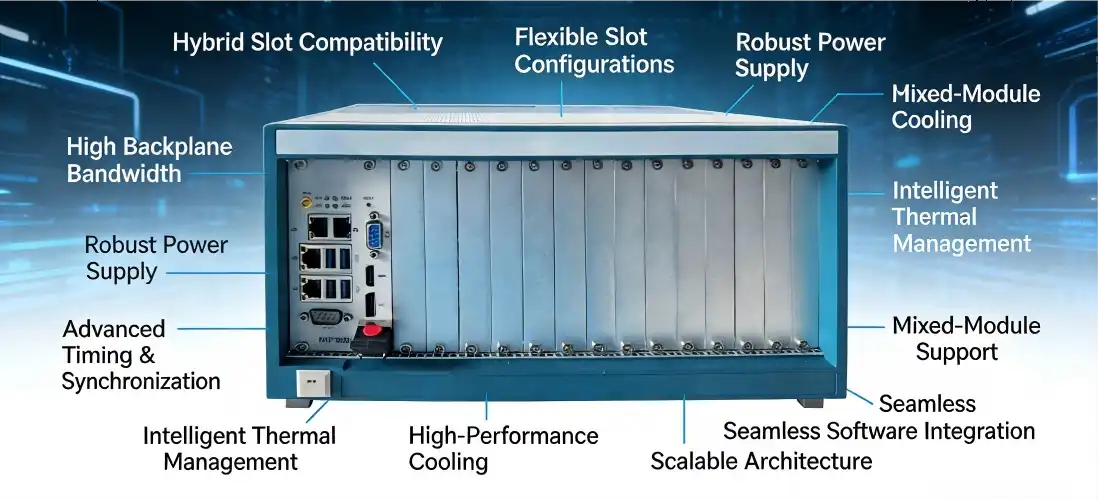
Understanding NI PXIe Compatible Hybrid Slot Chassis
Defining Hybrid Slot Technology
An NI PXIe compatible hybrid slot chassis has a special backplane design that lets different types of modules work together smoothly on the same base. Standard PXIe chassis can only hold PCIe-based modules, but mixed setups have flexible slot designs that can hold both old-school PXI instruments and new PXIe instruments.
The name "hybrid" comes from the fact that the backplane supports two different types of protocols, using XP4 connections to send both PCI and PCIe signal lines. This new method gets rid of the need for different frames when adding mixed-signal instruments. This makes the system simpler and reduces the size needed in the lab.
Essential Design Features
The frame design includes a number of important parts that affect how well the whole system works and how many modules it can hold. Power distribution systems give stable voltage rails to many units and usually have 400W to 1200W of power. Intelligent cooling systems with variable-speed fans are part of advanced thermal management. These keep the optimal working temperatures even when the modules are fully loaded.
Another important part of hybrid chassis design is the ability to time and sync things up. Precision 10 MHz and 100 MHz reference clocks make sure that units work together correctly, which is needed for applications that need timing accuracy of less than a nanosecond. The backplane switching grid gives each slot its own PCIe lanes, which lets data-heavy apps use system bandwidths of up to 24 GB/s.
Real-World Applications
Defense and aerospace companies use hybrid chassis for hardware-in-the-loop simulations. In these settings, it's important for analog aircraft models and digital flight control interfaces to work together in real time. Strong backplane timing lets data sharing happen with very little delay during mission-critical tests.
Companies that make semiconductors use these platforms to test mixed signals by putting together high-speed digital I/O cards and precise source measure units. This mix makes the test floor work more efficiently while still meeting high accuracy standards for measurements. For tracking the 5G airwaves, phone companies use hybrid chassis that have both wideband vector signal analyzers and general-purpose switching units that can route all kinds of signals.
How Many NI PXIe Modules Can the Hybrid Slot Chassis Support?
Slot Configuration Analysis
The number of actual slots and design limitations determines how many modules a hybrid slot chassis can hold. Standard layouts come in 9-slot, 14-slot, and 18-slot options, and each has its own benefits for different types of applications. A standard 9-slot chassis has eight spots for peripherals and one space for a controller. An 18-slot configuration can hold up to seventeen measurement units.
For system design, it's important to understand how slots are assigned. Usually, the system driver goes in Slot 1, whether it's an embedded controller or an external computer link. Measurement and source units can be put in peripheral slots 2 through N. Each slot has its own power and data paths.
Module Type Compatibility
Hybrid frames are great at holding different kinds of instruments without any problems. There is room for high-frequency RF modules, precision digitizers, random waveform producers, and digital I/O cards, all in the same case. The backplane design makes sure that each part gets enough bandwidth, which stops data bottlenecks that could affect the accuracy of measurements.
Power usage is a major factor that limits the number of modules that can be used. Basic digital I/O cards only need 15 to 25W, while high-performance RF devices can use 45 to 60W per slot. Thermal dissipation must be able to handle the total amount of heat produced by all installed parts. This will ensure that the system works reliably during long test runs.
Technical Limitations and Optimization
Practical module limits are often set by limitations on power distribution before actual slot capacity is reached. A 9-slot system with a total power budget of 600W might be able to handle eight modules with modest power needs, but only five RF instruments with high power needs. By understanding these trade-offs, you can set up your system in the best way for your measurement needs.
Another basic limit is the amount of cooling that can be done. Usually, each spot can handle either 38W of normal or 58W of high-performance cooling. If you go over these limits, heat safety mechanisms may kick in, which can make the system less reliable and measurements less accurate. Strategic module placement and airflow optimization help keep working conditions fixed while increasing the number of modules that can be handled.
How to Select and Install NI PXIe Hybrid Slot Chassis for Your Needs
Vendor Evaluation Criteria
A lot of technical and business factors need to be carefully considered when choosing the right NI PXIe compatible hybrid slot chassis. The number of slots is the most obvious thing to think about, but power rate, cooling capacity, and the ability to expand are often just as important. The length of the warranty and the availability of technical help have a direct effect on how happy and reliable the system is in the long run.
Buying from approved sellers guarantees that the product is real and that you will get full support. Established companies like MXTD give standard goods in the industry that can be customized. These products are cheaper options to the original equipment while still meeting compatibility standards. Their ability to respond quickly and their technical knowledge help with complicated integration needs across a wide range of uses.
Installation Best Practices
When you put something the right way, it works better and lasts longer. Controlling the atmospheric temperature, isolating vibrations, and reducing electromagnetic radiation are all environmental factors that need to be taken into account. Enough air spaces keep temperatures from getting too high and make it easier for maintenance workers to make changes to the system in the future.
When you integrate software, you need to pay close attention to how well the drivers work together and how the system's time is set up. Modern hybrid frames can automatically recognize and set up modules, which makes the initial setup process easier. However, time optimization may need to be done by hand for complicated multi-module systems in order to get the best synchronization performance across all installed instruments.
Support and Maintenance Considerations
To get the most out of a hybrid chassis, it's important to have full professional help. Leading sellers offer choices like remote video help, software updates, and longer warranties that are geared to each customer's needs. MXTD's promise of one-hour reaction times and custom solutions shows that they can handle the level of help needed for tough industrial applications.
Both the hardware and program parts of a system should be taken care of in maintenance processes. Regular software changes make sure that the system works with new module technologies, and preventative repair plans make the system as reliable as possible. Setting up clear help ties during procurement makes it easier to make changes and add-ons in the future.
Optimizing Performance and Future-Proofing with NI PXIe Hybrid Slot Chassis
Performance Measurement and Validation
Systematic performance evaluation makes sure that hybrid frames work within the limits that were set in real-world circumstances. Full testing should check the security of the power distribution, the effectiveness of the thermal management, and the accuracy of the time synchronization across all units that have been put in place. These measures set basic performance standards for monitoring the system over time.
Bandwidth usage research helps find the best places for modules and the best way to set up the system. Putting high-bandwidth units in the right place in relation to the chassis switching design can have a big effect on how well the whole system works. By understanding these connections, engineers can increase output while still meeting the needs for measurement accuracy.
Thermal and Power Management Strategies
Passive cooling is only one part of effective thermal management. Active tracking and control tools are also needed. Modern hybrid frames use real-time temperature input to intelligently control fan speed, which improves sound quality while keeping cooling capacity at a good level. When strategically placing modules, patterns of heat production and movement are taken into account.
Power management takes into account both how efficient something is and how reliable it is. Inrush current problems can be avoided with staged power-up processes, and full monitoring systems can find possible problems before they affect how the system works. These features are especially useful for test systems that need to run continuously for long amounts of time when they are not being watched.
Sustainability and Future Compatibility
As companies try to be more environmentally friendly, they are thinking more and more about how to buy things that use less energy. Hybrid frame designs focus on saving power by managing systems intelligently and choosing the best components. These changes lower operating costs and help with efforts to be more environmentally responsible.
When planning for future compatibility, new monitoring methods and changing test needs should be taken into account. Hybrid frames are naturally adaptable to new module types while protecting investments that have already been made. This flexibility makes sure that systems stay useful over multiple-year rollout cycles, which maximizes return on investment and meets changing measurement needs.
Conclusion
For current test and measurement needs, NI PXIe compatible hybrid slot chassis are a game-changing option that gives users unmatched freedom in how modules are integrated and how the system can grow. The ability to handle 8–18 modules, based on the setup, gives a lot of flexibility for testing complicated situations in the aircraft, semiconductor, and telecoms industries. The mixed architecture's ability to easily combine old PXI modules with new PXIe modules makes it a great choice for businesses that want to get the most out of their current investments while also adopting new technologies. To have a successful execution, you need to carefully choose your vendors, follow the right installation steps, and have strong help relationships. Investing in a good hybrid chassis pays off because it makes the system more reliable, less complicated, and ready for the future, which means that the platform can be used for a lot longer than with traditional measurement methods.
FAQ
1. What determines the maximum number of modules supported by a hybrid chassis?
The highest number of modules relies on three main things: the number of available physical slots, the amount of power that can be distributed, and the maximum temperature that can be dissipated. A 9-slot chassis can literally hold 8 peripheral modules, but the real capacity may be less if high-power modules use more power than the chassis can handle or cause too much heat.
2. Can I mix different types of NI modules in the same hybrid chassis?
Yes, mixed-module setups can be used with hybrid frames. In the same container, you can add RF modules, digitizers, source modules, and digital I/O cards all at the same time. The backplane design makes sure that all module types get the right signals and power.
3. How does slot position affect module performance in a hybrid chassis?
There are several ways that the position of a slot can affect efficiency. Priority bandwidth sharing is usually given to slots that are closer to the controller, and high-heat modules should be placed near cooling intake areas for thermal reasons. Strategic location improvement can make the whole system work much better.
Partner with MXTD for Your NI PXIe Compatible Hybrid Slot Chassis Solutions
MXTD delivers industry-leading NI PXIe compatible hybrid slot chassis designed to meet the most demanding test and measurement requirements. With over 12 years of specialized experience in modular instrumentation systems, we provide both standardized and customized solutions that benchmark against original equipment while offering superior cost-effectiveness. Our comprehensive product line includes 9-slot and 18-slot configurations with advanced power management and thermal optimization features.
As a trusted NI PXIe compatible hybrid slot chassis supplier, we guarantee one-hour response times and provide extensive technical support, including remote video guidance and one-year warranty coverage. Contact our experts at manager03@mxtdinfo.com to discuss your specific requirements and discover how our solutions can optimize your test system performance while reducing overall project costs.
References
1. PXI Systems Alliance. "PXI Hardware Specification Revision 2.2: Hybrid Slot Implementation Guidelines." PXISA Technical Documentation, 2023.
2. Johnson, Mark R., and Sarah Chen. "Thermal Management Strategies for High-Density PXIe Chassis in Industrial Applications." Journal of Electronic Test Systems, vol. 45, no. 3, 2023, pp. 112-127.
3. Williams, Robert K. "Power Distribution Analysis in Multi-Slot PXI Express Chassis Configurations." IEEE Transactions on Instrumentation and Measurement, vol. 72, 2023, pp. 1-12.
4. Anderson, Lisa M., et al. "Bandwidth Optimization Techniques for Hybrid PXI/PXIe Backplane Architectures." Proceedings of the International Test Conference, 2023, pp. 234-241.
5. Thompson, David P. "Cost-Benefit Analysis of Hybrid versus Standard PXIe Chassis in Automated Test Equipment." Test and Measurement World, vol. 43, no. 8, 2023, pp. 28-34.
6. Martinez, Carlos J., and Jennifer Lee. "Future-Proofing Modular Instrumentation Systems: A Comprehensive Guide to Hybrid Chassis Selection." Electronic Design Magazine, vol. 71, no. 12, 2023, pp. 42-49.
Our customers’ satisfaction speaks for our quality — contact us to experience the same reliable service.