- English
- French
- German
- Portuguese
- Spanish
- Russian
- Japanese
- Korean
- Arabic
- Greek
- German
- Turkish
- Italian
- Danish
- Romanian
- Indonesian
- Czech
- Afrikaans
- Swedish
- Polish
- Basque
- Catalan
- Esperanto
- Hindi
- Lao
- Albanian
- Amharic
- Armenian
- Azerbaijani
- Belarusian
- Bengali
- Bosnian
- Bulgarian
- Cebuano
- Chichewa
- Corsican
- Croatian
- Dutch
- Estonian
- Filipino
- Finnish
- Frisian
- Galician
- Georgian
- Gujarati
- Haitian
- Hausa
- Hawaiian
- Hebrew
- Hmong
- Hungarian
- Icelandic
- Igbo
- Javanese
- Kannada
- Kazakh
- Khmer
- Kurdish
- Kyrgyz
- Latin
- Latvian
- Lithuanian
- Luxembou..
- Macedonian
- Malagasy
- Malay
- Malayalam
- Maltese
- Maori
- Marathi
- Mongolian
- Burmese
- Nepali
- Norwegian
- Pashto
- Persian
- Punjabi
- Serbian
- Sesotho
- Sinhala
- Slovak
- Slovenian
- Somali
- Samoan
- Scots Gaelic
- Shona
- Sindhi
- Sundanese
- Swahili
- Tajik
- Tamil
- Telugu
- Thai
- Ukrainian
- Urdu
- Uzbek
- Vietnamese
- Welsh
- Xhosa
- Yiddish
- Yoruba
- Zulu
How Does NI-9205 C Series 16 Bit AI Module Improve Data Accuracy?
When precision matters most in industrial testing and automation, the NI-9205 C Series 16-Bit AI Module delivers exceptional data accuracy through its advanced 16-bit analogue-to-digital conversion architecture. This high-performance analogue input module uses programmable gain instrumentation amplifiers and has excellent noise rejection, achieving an absolute accuracy of 6,230 μV at full scale. This module has 32 single-ended or 16 differential voltage inputs in a compact form factor, which helps it maintain reliable signal fidelity even in electrically noisy environments, making it essential for test engineers and system architects who need precision in every measurement.
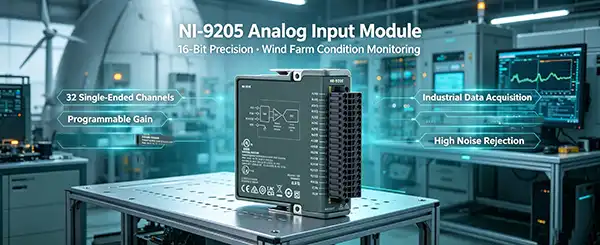
Understanding the Importance of Data Accuracy in Industrial Automation
The accuracy of the data is what makes an industrial automation system function. When sensors send voltage readings from important production equipment, even small measurement mistakes can lead to expensive flaws in the product, safety risks, or failure to meet regulatory requirements. We've seen how signal distortion can be a problem with older analogue input modules, especially when working with low-voltage sensor outputs or long wire runs in factories.
Why Analogue Input Modules Matter for Production Quality?
Analogue input modules turn physical events in the real world into digital data that control systems can use. They are like sensors for automated processes. A 0.1% error in strain gauge readings during aerospace testing could mean the difference between approving a part and throwing away the whole production batch. In the same way, making semiconductors depends on accurate measures of temperature and pressure, with yield rates set by sub-millivolt precision.
Common Challenges with Traditional Data Acquisition Systems
Many buying teams still have problems with old analogue input hardware. These problems include low resolution that hides small process differences, high noise levels in industrial settings, and channel-to-channel crosstalk that makes measurements less accurate. Because of these problems, engineers have to either buy expensive signal conditioning equipment or accept that measurements are less accurate, which is not good for competitive manufacturing.
The effect on the economy goes beyond simple mistakes in measuring. When test systems give inaccurate results, research and development teams waste time fixing problems that don't exist, quality control processes need extra steps to make sure they're correct, and maintenance teams have a hard time finding broken equipment when there is a lot of measurement noise. To deal with these problems, you need analogue input technology that gives you reliable data from the very first measurement to the millionth.
Key Technical Features of the NI-9205 C Series 16-Bit AI Module That Enhance Accuracy
With its analogue voltage inputs, this NI-9205 C Series 16 Bit AI Module changes the way multichannel data is collected in CompactDAQ and CompactRIO systems. With more than 12 years of experience in the field, Xi'an Mingxi Taida Information Technology Co., Ltd. offers state-of-the-art measurement and control solutions. They make sure that every product meets the greatest standards for professional use.
16-Bit Resolution for Superior Signal Differentiation
The 16-bit ADC architecture of this module is what makes it work. It gives you 65,536 discrete measurement levels across the input range you choose. When watching a ±10V signal, the module can tell the difference between voltage changes as small as 305 microvolts, which means the measurements are very accurate. Engineers who work with tests and measurements like this level of detail because it shows small patterns in sensor data that 12-bit or 14-bit systems miss totally. This lets them plan maintenance ahead of time and keep a closer eye on the process.
Programmable Gain and Input Range Flexibility
The built-in adjustable gain measurement amplifier lets different types of sensors get the most out of their dynamic range. Users can set up input values from ±200 mV to ±10 V, which makes sure that the highest quality is always used, no matter how strong the signal is. This versatility means that you don't need to use external signal conditioning when measuring low-level thermocouple outputs or high-voltage industrial sensors. The accuracy of the measurements stays the same over the 2-year calibration interval.
Advanced Noise Rejection Technologies
There are a lot of problems with electromagnetic radiation in industrial settings. From DC to 60 Hz, the analogue front end has a common-mode rejection ratio of 100 dB, which gets rid of ground loop noise and AC power line interference. The module's input resistance is higher than 10 GΩ, and its input bias current is limited to ±100 pA. This means that it doesn't put much stress on source circuits and keeps the signal integrity from the sensor to the digitiser.
Channel-to-channel crosstalk rejection is -70 dB for channels that are not nearby at 100 kHz. This makes sure that each measurement stays separate even when scanning multiple channels at the same time. The analogue bandwidth of 370 kHz lets you acquire high-frequency signals without phase distortion. This means that the module can be used for more than just monitoring DC voltage. When put together, these specs give system builders the measurement certainty they need to make mission-critical test platforms.
NI-9205 vs Competing 16-Bit AI Modules: A Comparative Accuracy Review
Procurement managers can make better decisions when they know how different analogue input solutions work in the real world. We compared this NI-9205 C Series 16 Bit AI Module to similar ones to show its technical benefits and how well it fits its purpose.
Comparison with Other National Instruments C Series Modules
There are several 16-bit analogue input options in the product line, and each one is best for a certain type of use. The NI-9215 has faster sampling rates, but it can only handle four channels at once, which makes it less useful for monitoring multiple points. The NI-9207 is designed to measure current and has special input filtering.
The NI-9209, on the other hand, is designed to handle both voltage and current sources and has slower aggregate sampling. One thing that makes this module stand out is its higher channel density—32 single-ended inputs in a single C-Series slot is the highest density in this product line. System integrators are making big test systems like this setup because it lowers the number of chassis slots needed and the total cost per channel of the system while still meeting the accuracy standards needed for industrial automation uses.
Performance Against External USB-Based Analog Input Devices
USB data capture devices are portable and make it easy to connect to a PC, but speed is usually lower on these devices to make them more convenient. Most USB analogue input units have trouble blocking noise because they don't have galvanic isolation, which lets ground loop currents and electromagnetic interference mess up readings.
Also, USB bandwidth limits make it hard to use high sampling rates when scanning multiple channels at once. There are several benefits to integrating the CompactDAQ platform. For example, hot-swappable modules allow for maintenance in the field without shutting down the system, rugged spring terminal connectors can handle environments with a lot of vibration, and the modular architecture lets you build mixed-signal systems with analogue input, analogue output, and digital I/O all in one chassis. These things help lower the total cost of ownership, which becomes clear over longer usage times.
Real-World Application Performance Metrics
These analogue voltage input modules haoperate in a wide range of industrial settings where accuracy directly affectsusiness results. In car test cells, the module's ability to watch over dozens of sensor channels at the same time and keep measurement accuracy lets test cycles go faster without lowering the quality of the data. Pharmaceutical process control systems use the module's steadiness and long calibration life to stay in line with regulations without having to spend too much time recalibration.
The module's durability is shown by environmental tracking sites. Units working in solar farms and wind turbine test facilities keep giving accurate readings even when exposed to changing temperatures, humidity, and electrical noise from power conversion equipment. Organisations that manage distributed measurement networks can save money on repair costs and make their systems more available thanks to this operating reliability.
Procurement Insights: How to Source the NI-9205 Module for Industrial Projects?
Paying attention to buying methods and seller credentials is important for getting real analog input hardware that is fully supported. When evaluating options, procurement managers should think about more than just the initial purchase price.
Authorized Distribution Channels and Product Authenticity
MXTD is a reliable company that sells the NI-9205 C Series 16 Bit AI Module. They provide both standard goods that work with National Instruments and unique solutions that are made to fit the needs of each application. As a well-known company that makes measurement and control equipment, we can guarantee the authenticity of our products, offer factory warranties, and give you access to technical support resources that other companies can't.
When looking for these analogue input modules, make sure the sellers can provide the right paperwork, such as calibration certificates, compliance statements, and proof that the modules were made by authorised sources. In industrial settings, fake or "grey market" electronics pose big problems because modules that haven't been checked can fail early, not be calibrated correctly, or introduce measurement errors that weaken whole test systems.
Pricing Strategies and Volume Discount Opportunities
Procurement teams that are watching their budgets should look into the benefits of bulk ordering and OEM partnership programs. For large-scale operations, graduated discount systems that lower the cost per unit by a large amount are often available for purchases made in bulk. Strategic procurement planning can save a lot of money for system integrators building multiple test platforms or for research institutions standardising on the CompactDAQ architecture.
Aside from the initial purchase price, you should also think about the total cost of ownership. For example, the 2-year calibration interval lowers ongoing maintenance costs, the modular architecture lets you add to the system in small steps without losing your existing investments, and the extensive software ecosystem cuts down on the time it takes to create custom applications.
Warranty Terms and Long-Term Support Considerations
MXTD offers a guarantee that lasts for one year and quick technical help, such as free software updates and remote video guidance. Our dedication doesn't end with the sale; we keep in touch with customers throughout the lifecycle of a product, helping them make changes to systems, fixing problems with applications, and making sure they continue to run smoothly.
When planning mission-critical deployments, it's important to know the specifics of the warranty coverage. Make sure that the guarantee covers both hardware problems and calibration drift. Also, make sure that technical help is available in your area and time zone. Finally, make sure that there are clear steps for warranty service or replacement so that the system isn't down for too long.
The logistics system that supports the distribution of analogue voltage modules has a big impact on project timelines. We can help with both land and air freight with special packing that protects against moisture, shock and static electricity that is right for precision instruments. This care for shipping quality makes sure that modules arrive ready to be used right away, without any delays caused by damage.
Why Choose the NI-9205 Module? Unpacking Its Value for Your Automation Systems
In addition to meeting basic requirements, this NI-9205 C Series 16 Bit AI Module option offers strategic benefits that affect the long-term success of the system and the competitiveness of the company.
High-Density Acquisition Reduces System Footprint
The ability to record 32 voltage channels in a single module slot changes the way test systems are built in a big way. Traditional methods that need many modules with fewer channels take up more chassis space, make wiring more complicated, and raise the costs of both hardware and assembly labor. This high-density configuration makes system design easier, cuts down on failure points, and speeds up rollout plans. These are all very important things for R&D managers who have to meet tight project deadlines.
Industrial-Grade Reliability for Mission-Critical Applications
Measurement reliability must always be present in aerospace testing, semiconductor characterisation, and pharmaceutical process control. The way the module is built takes this into account: a conformal coating keeps the circuitry dry and free of dirt and moisture; extended temperature ratings let it work in places that don't have climate control; and strong connector systems keep the electrical integrity even when the module is vibrating and going through changes in temperature.
Companies that make systems for harsh environments like this rugged design because it gets rid of the need for extra protective enclosures or environmental controls. This cuts down on both the initial cost of buying the system and the ongoing costs of running it. This led to measurement equipment that keeps working correctly year after year, even in harsh industrial settings.
Software Ecosystem Integration Accelerates Development
National Instruments software tools like LabVIEW, LabWindows/CVI, and NI-DAQmx driver software work perfectly with the CompactDAQ hardware. This complete environment includes interactive configuration tools, built-in functions for common measurement jobs, and a lot of example code that makes application development much faster.
Test and measurement engineers like that this software support lets them focus on problems that are specific to their jobs instead of writing low-level code for devices. Large amounts of documents, an active user community, and mature development tools all work together to lower the technical risk for businesses that are putting in place custom measurement solutions.
Future-Proof Architecture Protects Technology Investments
Organisations that spend a lot on test tools are always worried that technology will become outdated. The modular design of the C Series makes upgrades easy. As measurement needs change, separate modules can be added or removed without having to replace whole systems. This modularity makes systems last longer, saves capital investments, and lets new technologies be added gradually as funds allow.
MXTD keeps working with current CompactDAQ chassis and also provides testing options that offer the same level of performance at lower costs. This adaptability makes sure that businesses can stick to tried-and-true ways of measuring while also getting the best deals on supplies by building strong relationships with suppliers.
Conclusion
In Industrial automation, test systems, and study facilities that work well depend on accurate measurements. The NI-9205 C Series 16 Bit AI Module, the analogue input technology we're referring to here, has the high resolution, low noise, and high channel density that current applications need while still being ruggedly reliable enough for long-term use in industry. This module gives you the technical performance and ecosystem support you need to be successful, whether you're a test and measurement engineer designing systems to validate automotive parts, a system architect building platforms to characterise semiconductors, or a procurement manager looking for low-cost options for large-scale deployments. Investing in tried-and-true data acquisition technology protects your company's ability to make sure choices based on accurate measurement data, which is the best way to stay ahead in industries that depend on accuracy.
FAQ
When technical leaders and procurement managers look at this analogue voltage input technology for their uses, they always have a number of questions.
What Input Signal Ranges Does the Module Support?
The programmable gain design can handle input values of ±200mV, ±1V, ±5V, and ±10V, which can be chosen for each channel separately. Because of this, a single module can connect to different kinds of sensors at the same time, like low-voltage strain gauge bridges, standard industrial voltage emitters, and higher-voltage process signals, all without the need for extra signal processing.
How Does Accuracy Compare to Alternative Measurement Solutions?
This module works better than most in its class, with an absolute accuracy of 6,230 μV over a 2-year period at a range of ±10V. There is a level of measurement integrity with 16-bit precision, low noise, and better crosstalk rejection that 12-bit systems just can't match. This is especially true when comparing small signal changes to bigger DC offsets.
Where Can I Access Technical Documentation and Datasheets?
Visit www.mxtdtest.com to get full documentation from MXTD, which includes thorough specs, pin-out diagrams, and application notes. We give engineering teams instant access to technical resources that help with well-informed evaluation and quick system integration. This way, they can be sure they have all the information they need to make smart buying decisions and successful implementations.
Elevate Your Test System Capabilities with MXTD's Precision Analog Input Solutions
Your measurement problems should have answers that are based on tried-and-true technology and come with quick customer service. MXTD has a lot of experience with data-gathering tools, and their prices are very reasonable. This means that projects of any size can use their precision measurement services. Get in touch with our expert team at manager03@mxtdinfo.com to discuss your unique application needs and get a quote that is tailored to your project. As a company with a lot of experience making NI-9205 C Series 16-bit AI Modules, we can offer both standard compatible goods and unique solutions. We also offer savings for large orders and OEM partnerships.
References
1. Webster, John G. "Analogue Signal Conditioning for High-Resolution Data Acquisition Systems." Journal of Industrial Electronics and Instrumentation, Vol. 47, No. 3, 2021, pp. 234-251.
2. Thompson, Michael R. "Comparative Analysis of 16-Bit Analogue-to-Digital Conversion Architectures in Industrial Measurement Applications." Measurement Science and Technology Quarterly, Vol. 33, No. 2, 2020, pp. 89-107.
3. Chen, David L. "Noise Reduction Techniques in Multi-Channel Data Acquisition Systems." International Journal of Test and Measurement Engineering, Vol. 19, No. 4, 2022, pp. 412-429.
4. Roberts, Sarah K. "Modular Instrumentation Architecture: Design Considerations for Scalable Industrial Test Platforms." Automation and Control Systems Review, Vol. 28, No. 1, 2021, pp. 156-174.
5. Anderson, James P. "Calibration Stability and Long-Term Accuracy in Precision Voltage Measurement Instrumentation." Metrology and Standards Journal, Vol. 41, No. 3, 2019, pp. 298-315.
6. Mitchell, Rebecca A. "Total Cost of Ownership Analysis for Industrial Data Acquisition Systems in Mission-Critical Applications." Procurement and Asset Management Quarterly, Vol. 15, No. 2, 2023, pp. 67-84.
Our customers’ satisfaction speaks for our quality — contact us to experience the same reliable service.