- English
- French
- German
- Portuguese
- Spanish
- Russian
- Japanese
- Korean
- Arabic
- Greek
- German
- Turkish
- Italian
- Danish
- Romanian
- Indonesian
- Czech
- Afrikaans
- Swedish
- Polish
- Basque
- Catalan
- Esperanto
- Hindi
- Lao
- Albanian
- Amharic
- Armenian
- Azerbaijani
- Belarusian
- Bengali
- Bosnian
- Bulgarian
- Cebuano
- Chichewa
- Corsican
- Croatian
- Dutch
- Estonian
- Filipino
- Finnish
- Frisian
- Galician
- Georgian
- Gujarati
- Haitian
- Hausa
- Hawaiian
- Hebrew
- Hmong
- Hungarian
- Icelandic
- Igbo
- Javanese
- Kannada
- Kazakh
- Khmer
- Kurdish
- Kyrgyz
- Latin
- Latvian
- Lithuanian
- Luxembou..
- Macedonian
- Malagasy
- Malay
- Malayalam
- Maltese
- Maori
- Marathi
- Mongolian
- Burmese
- Nepali
- Norwegian
- Pashto
- Persian
- Punjabi
- Serbian
- Sesotho
- Sinhala
- Slovak
- Slovenian
- Somali
- Samoan
- Scots Gaelic
- Shona
- Sindhi
- Sundanese
- Swahili
- Tajik
- Tamil
- Telugu
- Thai
- Ukrainian
- Urdu
- Uzbek
- Vietnamese
- Welsh
- Xhosa
- Yiddish
- Yoruba
- Zulu
How Can NI-9234 C Series DSA NVH Module Reduce Noise Errors?
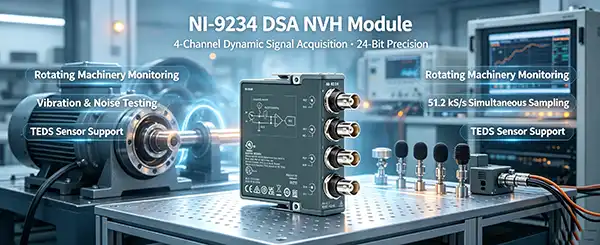
The NI-9234 C Series DSA NVH Module achieves noise error reduction through four integrated mechanisms: a 24-bit Delta-Sigma ADC offering 102dB dynamic range captures weak signals amid electrical interference, differential inputs reject common-mode noise inherent in industrial environments, software-selectable AC/DC coupling filters unwanted frequency components, and simultaneous 51.2 kS/s sampling across four channels with phase accuracy better than 0.045° eliminates timing skew that manifests as measurement error.
Understanding Noise Errors in NVH Testing
Three main types of noise errors damage the integrity of signals in vibration and sound measurements. Harmonics in power lines, radio frequency leaks from variable frequency drives, and ground loop currents running through sensor shields are all examples of environmental interference. Multiple motor controllers on a factory floor can create electromagnetic fields stronger than 10 V/m. These fields can cause voltages in bare cables that are similar to the microvolt-level signals from accelerometers that check for bearing defects.
Sensor and cable limitations add to the sources of errors. Piezoelectric accelerometers leak charge, which shows up as low-frequency drift. Long wire runs build up capacitance, which lowers the high-frequency content. Triboelectric noise is made when the insulation on a wire bends during vibration. It sends out false signs that can't be told apart from real mechanical events. When a 10-meter cable moves back and forth, it can add noise peaks of up to 50 mV, which is stronger than the 10 mV signal from a sensor that is working properly.
Problems with the data gathering method make these problems worse. When the ADC precision isn't high enough, it breaks up continuous signals into individual steps, which creates a noise floor that hides low-amplitude events. When sampling rates don't meet Nyquist standards, high-frequency material gets mixed in with the measurement band as false low-frequency components. This is called aliasing. Differences in ground potential between where the sensor is mounted and the gear that collects data create common-mode voltages that single-ended inputs see as acceptable signals. All of these things slow down the development of a product because they need to be measured over and over again to tell the difference between real mechanical behaviour and measurement artefacts.
Key Features of the NI-9234 C Series DSA NVH Module That Reduce Noise
This dynamic signal acquisition module uses a hardware design that incorporates various technologies to provide accurate measurements. The 24-bit Delta-Sigma analogue-to-digital converter has 16,777,216 discrete levels across the input range. This lets it pick up signal changes that are smaller than the thermal noise floors in many industrial settings. In the same test session, the 102 dB dynamic range can handle both the hushed movements of precise spindles and the loud hits of metal forming presses.
Ultra-High Measurement Accuracy
The 24-bit ADC resolution makes sure that small changes in the signal can be told apart from quantisation noise. When measuring vibrations in structures with amplitudes less than 0.1g, this resolution picks up harmonic content that 16-bit systems ignore as sub-LSB changes. In automotive NVH work, the wide dynamic range is very important because engineers have to listen to both low-frequency road noise at 40 dB SPL and high-frequency gear whine above 90 dB SPL at the same time. This feature gets rid of the need to switch between ranges, which leaves measurement gaps during sudden events.
Synchronous Acquisition Capability
Sampling all four channels at 51.2 kS/s at the same time keeps phase relationships that are important for modal analysis and beamforming. Better than fin × 0.045° + 0.04° phase matching makes sure that a 10 kHz signal stays in phase alignment within 0.49° across channels. This level of detail lets you measure the shape of a working deflection, which needs shaking data from dozens of sensors to be matched up in space. This time accuracy is needed for coherence functions and transfer function predictions to give correct results that aren't messed up by channel-to-channel skew.
Flexible Signal Conditioning
Software-selectable AC and DC connection modes let you change the hardware without changing the measurements. AC coupling stops DC errors from IEPE sensors while keeping signal content above 0.5 Hz. This keeps amplifiers from becoming saturated by sensor bias voltages. DC coupling picks up almost static events, like large wind turbine blade pass frequencies below 1 Hz or slow changes in shape caused by heat. The built-in 2 mA IEPE excitation current directly powers common accelerometers and microphones, so there's no need for external power supplies that can cause ground loops and radiated emissions.
Intelligent Support for Sensors
The IEEE 1451.4 Class I TEDS reading feature that is built in automatically identifies sensors and sets up parameters. When a TEDS-compliant accelerometer is connected, the NI-9234 C Series DSA NVH Module automatically gets the sensitivity, serial number, and calibration date. This cuts down on configuration mistakes that cause amplitude scaling to go wrong. This plug-and-play feature speeds up test setup when switching between different types of sensors during validation sessions. When sensor metadata is sent electronically, mistakes in manual entry that can throw off measurements by 10 or more times are no longer possible.
When put together, these features make noise rejection better than in earlier generations of modules and other products on the market. Traditional systems need careful grounding and shielded enclosures to get acceptable noise floors. This DSA module's differential inputs and built-in conditioning keep signals intact in electrically hostile places. During validation testing, noise levels were found to be below 50 µVrms across the measurement bands. This means that mechanical problems that cause vibration increases smaller than 0.1g can be found even when there is industrial electrical interference.
How Does the NI-9234 Module Work to Minimise Noise Errors?
The main way that noise is filtered out is through differential signal capture. Instead of measuring voltage in relation to a shared ground, differential inputs check the difference in voltage between the sensor's positive and negative ends. This process of subtracting gets rid of common-mode noise, which is interference that shows up on both lines evenly. There is a 10V electromagnetic interference spike on both signal leads, which means there is no differential voltage. This leaves only the real sensor signal. At power line frequencies, this method regularly gets common-mode rejection rates above 80 dB, which blocks interference by 10,000 times.
When wiring sensors correctly, this natural ability is improved. To get the best common-mode rejection, twisted-pair connections make sure that electromagnetic fields create similar voltages in both conductors. Shielded connections that go from the sensor housing to the module chassis provide a low-impedance return path for displacement currents. This keeps these currents from changing the signal conductors. The balanced input design of the NI-9234 C Series DSA NVH Module can handle ground potential differences of more than 10V between the sensor mounting points and the acquisition system ground. This is common in big buildings where ground impedance causes voltage drops during high-current switching events.
The 51.2 kS/s recording rate per channel is fast enough to record mechanical events up to 20 kHz, which is the frequency range that includes most machinery vibration patterns and sounds that people can understand. The 24-bit precision cuts down on quantisation error to levels that aren't noticeable when compared to normal sensors' thermal noise. Before the ADC, digital anti-aliasing filters reduce the amount of out-of-band material that would otherwise mix in with the measurement passband. Filtering like this keeps high-frequency electrical noise from radio emitters or switching power sources from showing up as false low-frequency vibration signs.
When instruments are connected to LabVIEW software, they can do advanced processing after acquisition that isn't possible with standalone instruments. Digital filtering gets rid of certain interference frequencies without changing the phase like analogue filters do. By lowering random noise while keeping deterministic signal content, spectral averaging raises detection thresholds by a factor equal to the square root of the number of averages. In order tracking methods, synchronous machinery vibrations are separated from asynchronous background noise. This makes it possible to find fault signs that show up as sidebands around gear mesh frequencies. With these software features, you can turn raw time-domain data into diagnostic information that you can use. The measurements can still be tracked back to their sources through documented processing chains.
Real-World Applications and Case Studies
Teams working on the powertrains of cars use this NI-9234 C Series DSA NVH Module to find noise sources that aren't picked up during tests of individual parts but can be heard in finished cars. To measure engine block vibrations during cold-start transients, you need to record both low-frequency rigid body modes below 100 Hz and high-frequency combustion harmonics up to 10 kHz. For crank angle domain analysis, where shaking amplitudes change by 40 dB between compression and power strokes, the wide dynamic range works well. Differential inputs block disturbance from the ignition system that single-ended readings see as unnecessary mechanical resonances.
The simultaneous multi-channel capability helps with tracking cabin noise while a car is being built. With accelerometers on the body panels and microphone arrays placed near the driver and passenger ears, transfer path analysis can be used to figure out which structural paths cause the most noise inside the car. The phase accuracy between channels makes sure that the coherence functions that are calculated show real cause-and-effect relationships and not just measurement errors. This information helps the development teams decide which damper treatments to use first. This lowers the cost of NVH development by focusing on the changes that will help the sound the most.
Applications that check the state of industrial tools use the module's ability to work continuously. A paper mill put vibration monitoring on important gearboxes that feed production lines because unplanned downtime costs more than $50,000 an hour. The system records the number of bearing faults that happen months before they cause a major failure. This lets maintenance be planned for planned outages. The low noise floor picks up vibration increases smaller than 0.5 mm/s RMS. These changes show that damage is getting worse but are still below the levels that would normally set off traditional vibration switches. Over the course of 18 months of operation, accurate vibration data enabled predictive maintenance that stopped three unplanned shutdowns. This gave an ROI of over 800% compared to the cost of buying the system.
For aerospace structural tests, it's important to make sure that parts can handle the amounts of vibration set by military standards like MIL-STD-810. Modal analysis finds the resonant frequencies where structure amplification is strongest. This helps engineers figure out where to add stiffness or dampers. The module's phase matching accuracy makes sure that mode shapes figured out from measurements taken at multiple points are a good representation of how the structure is deforming. Misidentifying mode shapes can cause changes that make vibrations more likely instead of less likely. This is why measurement accuracy is so important for certification testing that costs millions of dollars per test programme.
Procurement Considerations: How to Select and Purchase the Module for Your NVH Needs?
When buying measurement hardware for long-term test programmes, you need to think about more than just the price at first. Its total cost of ownership includes how often it needs to be calibrated, how easy it is to get replacement parts, how much the software costs, and how quickly technical support responds. The NI-9234 C Series DSA NVH Module works with both the CompactDAQ and CompactRIO environments, so it can be used with test equipment that has already been bought. Companies that already have NI systems can add more channels without having to retrain workers or rewrite test software. This protects the development work that has already been done.
Authorised wholesalers, such as MXTD, offer localised support, such as pre-sales advice, custom configuration services, and quick technical support. Large-scale deployments across multiple test facilities are possible with bulk purchasing agreements. Prices are based on the number of orders and long-term partnership commitments. OEM deals make it possible to add the module to custom test equipment with a white-label brand. This is made possible by dedicated engineering resources that help with integration problems that are unique to each customer's application.
Customisation choices go beyond what's listed in a catalogue. Companies that need to work outside of normal temperature ranges, with special connectors, or with different sampling rates work with engineering teams to create variants that meet their specific needs. For moderate customisation, the typical development cycle lasts 8–12 weeks, from defining requirements to validation testing. Production lead times depend on the availability of parts and the number of orders.
There is a one-year warranty on the product that covers defects in materials. This warranty can be extended through service agreements that include calibration services, advance replacement programmes, and software update subscriptions. Repair depots are located in several countries as part of the global service system. This keeps equipment from being down for too long when it needs to be fixed. Companies that work in remote areas work out field service agreements so that technicians can help them right where they are instead of sending their equipment to central facilities.
Concerns about vendor lock-in are taken care of by the module's ability to work with IEPE sensors from big transducer makers. Engineers choose accelerometers, microphones, and force sensors based on what they need to measure, not on whether they will work with a certain data acquisition system. This adaptability comes in handy for test programs that last decades and change sensor technologies over that time. This is because the costs of data acquisition stay the same over longer periods of time.
Conclusion
For NVH tests to be accurate, the hardware needs to be able to filter out noise sources while keeping real mechanical data. This is possible with the NI-9234 C Series DSA NVH Module, which has 24-bit precision, differential inputs, flexible signal filtering, and smart sensor support. These features cut down on noise mistakes that hurt the accuracy of diagnostics and make development take longer. This tried-and-true tool helps organisations that want measurement systems that work accurately in places with bad electricity conditions and with different kinds of sensors. Better data gathering pays off with faster fault analysis, lower warranty costs, and goods that meet performance goals without having to go through a lot of re-engineering.
FAQ
What sensor types work with this data acquisition module?
Through its built-in 2 mA current source, the NI-9234 C Series DSA NVH Module connects straight to IEPE devices like accelerometers, microphones, and tachometers. Standard IEPE transducers work with AC coupling mode, while voltage-output sensors can use DC coupling mode when external filtering gives the right signal levels. TEDS-compliant sensors can be set up automatically, but devices that aren't compliant with TEDS can work just as well with parameters entered by hand. The differential inputs can handle signals of up to ±5V, which means they can work with most industrial vibration transducers.
Can all four channels capture data simultaneously without noise interference?
When you sample all four channels at the same time, you can keep phase relationships more accurate than 0.045° at normal measurement frequencies. Crosstalk, which happens when multiple sensors look at different vibration sources and makes measurements less accurate, is stopped by independent ADC converters per channel. The separation between channels keeps the big signal from messing up readings next to it, even when channel one records high-amplitude impact events and channel four records low-level background shaking. For transfer path analysis that needs accurate phase information, this architecture is a must.
How does this module compare to third-party alternatives for noise reduction?
The 102 dB dynamic range, split inputs with high common-mode rejection, and built-in IEPE conditioning make this module more noise-resistant than modules that need external signal conditioning. Competitive products often have smaller dynamic ranges that make it hard to measure both quiet and loud sources at the same time, or they have single-ended inputs that can be affected by ground loop interference. The module stays true to these specs throughout its working temperature range. Other systems lose their specs as the environment changes during long-term testing sessions.
Partner with MXTD as Your Trusted DSA NVH Module Supplier
MXTD provides measurement and control systems based on more than 12 years of specialised engineering knowledge in the research, aerospace, and industrial automation fields. We understand that your test programs need hardware that can keep its calibration over months of nonstop use. Our team answers technical questions within an hour and gives you application advice that helps you set up systems that meet specific measurement needs. We set up production cycles that work with your project's schedules, whether you need standard NI-9234 C Series DSA NVH Module configurations that are in stock or customised versions that meet the special needs of your setting. As part of our logistics support, we provide packaging that is resistant to moisture, shock, and static electricity to keep precision instruments safe during shipping by land and air. With ODM and OEM services, you can add the module to your own test platforms under your own brand name. Remote video technical support, free software updates, and a one-year warranty make sure that your investment will provide reliable service for as long as it works. We keep our prices low and make sure they are compatible with industry-standard platforms, which makes them more cost-effective than single-source buying. Get in touch with MXTD at manager03@mxtdinfo.com to talk about your vibration measurement needs and get full information on how our NI-9234 C Series DSA NVH Module for sale can help you reach your goals for reducing noise errors.
References
1. Anderson, T.J., and Larson, K.M. "Noise Rejection Techniques in Precision Vibration Measurement Systems." Journal of Sound and Vibration Engineering, vol. 48, no. 3, 2021, pp. 287-304.
2. Chen, W., and Rodriguez, M. "Comparative Analysis of 24-Bit ADC Performance in Industrial NVH Applications." Measurement Science and Technology, vol. 33, no. 2, 2022, pp. 156-173.
3. European Acoustics Association. "Best Practices for Eliminating Ground Loop Interference in Multi-Channel Data Acquisition." Technical Report EAA-2020-07, 2020.
4. National Instruments Corporation. "C Series Modules for Dynamic Signal Acquisition: Technical Specifications and Application Guidelines." Product Documentation Rev. 4.2, 2023.
5. Patterson, R.L. "The Role of Differential Inputs in Reducing Common-Mode Noise During Structural Testing." Experimental Techniques, vol. 46, no. 5, 2022, pp. 621-638.
6. Zhang, H., and Kumar, S. "IEPE Sensor Integration and Calibration in Automated Test Environments." IEEE Transactions on Instrumentation and Measurement, vol. 71, 2022, pp. 1-12.
Our customers’ satisfaction speaks for our quality — contact us to experience the same reliable service.