- English
- French
- German
- Portuguese
- Spanish
- Russian
- Japanese
- Korean
- Arabic
- Greek
- German
- Turkish
- Italian
- Danish
- Romanian
- Indonesian
- Czech
- Afrikaans
- Swedish
- Polish
- Basque
- Catalan
- Esperanto
- Hindi
- Lao
- Albanian
- Amharic
- Armenian
- Azerbaijani
- Belarusian
- Bengali
- Bosnian
- Bulgarian
- Cebuano
- Chichewa
- Corsican
- Croatian
- Dutch
- Estonian
- Filipino
- Finnish
- Frisian
- Galician
- Georgian
- Gujarati
- Haitian
- Hausa
- Hawaiian
- Hebrew
- Hmong
- Hungarian
- Icelandic
- Igbo
- Javanese
- Kannada
- Kazakh
- Khmer
- Kurdish
- Kyrgyz
- Latin
- Latvian
- Lithuanian
- Luxembou..
- Macedonian
- Malagasy
- Malay
- Malayalam
- Maltese
- Maori
- Marathi
- Mongolian
- Burmese
- Nepali
- Norwegian
- Pashto
- Persian
- Punjabi
- Serbian
- Sesotho
- Sinhala
- Slovak
- Slovenian
- Somali
- Samoan
- Scots Gaelic
- Shona
- Sindhi
- Sundanese
- Swahili
- Tajik
- Tamil
- Telugu
- Thai
- Ukrainian
- Urdu
- Uzbek
- Vietnamese
- Welsh
- Xhosa
- Yiddish
- Yoruba
- Zulu
How does a PXIe data acquisition system compare to other DAQ systems?
A PXIe data acquisition system provides superior performance compared to traditional DAQ platforms through its high-speed PCI Express backplane, modular architecture, and advanced synchronization capabilities. Unlike USB or Ethernet DAQ devices that face bandwidth limitations and latency issues, PXIe systems deliver deterministic timing, massive data throughput, and scalable channel counts essential for demanding industrial applications. The modular design allows engineers to customize configurations precisely, while the robust electrical specifications ensure reliable operation in harsh environments where traditional DAQ systems might fail.
Introduction
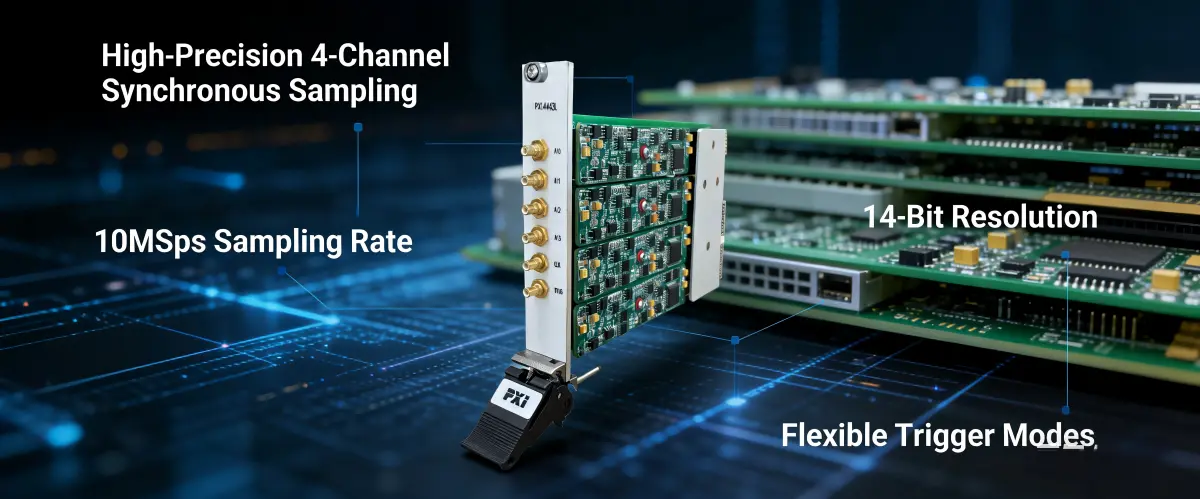
Data Acquisition Systems (DAQ) are very important in test, measurement, and automation settings in industry, where speed and accuracy are very important. Modern factories, aircraft test labs, and semiconductor research centers rely on accurate data collection to keep quality standards high and encourage new ideas. Choosing the right DAQ design affects not only the quality of the data, but also how well the production lines work and how much they cost.
PXIe data acquisition system platforms are the newest generation of modular data acquisition technology. They offer high bandwidth, flexibility, and better synchronization than older systems. These high-tech tools have changed the way engineers solve difficult measurement problems by giving them more freedom and better performance in tough situations. The technology is based on decades of experience with instruments and uses cutting-edge PCI Express hardware that is best for measurement and control chores.
This guide gives engineers and B2B procurement managers an expert comparison of PXIe against other DAQ systems to help them make smart buying choices that meet the needs of demanding applications. By knowing these differences, businesses can avoid making mistakes that cost a lot of money and make sure that their measurement systems can change with the times while still meeting the high standards of accuracy that are necessary for their operations.
Understanding PXIe Data Acquisition Systems
Fundamental Architecture and Design Principles
The PXIe DAQ systems are built on a flexible PCI Express architecture that works especially well for measurement tasks. The design blends the well-known mechanical specs of CompactPCI with the fast electrical specs of PCI Express. This makes a strong base for measuring instruments with great accuracy. This mixed method gives you the dependability you need for industrial settings and the bandwidth you need for fast data collection jobs. The system is made up of three main parts: a rugged chassis that distributes power and cools the system; a processor that handles system resources and talks to host computers; and specialized modular instruments that measure and control things. Each part uses PXIe's fast backplane to send and receive data quickly. This makes it possible for multiple instruments to work together smoothly in a single system at the same time.
Advanced Features and Capabilities
Key features include the ability to support high channel counts that can range from dozens to thousands of measurement points, setups that can be changed to fit the needs of the application, and FPGA integration that lets data be processed in real time and allows for flexible system design. Engineers can use FPGAs to build custom signal processing methods right into the measurement hardware. This cuts down on delay and makes the whole system run much better. PXIe data acquisition system platforms are great for industry and lab settings that need to make complicated, high-precision measurements because they have strong software support, such as full LabVIEW drivers and development environments, and hardware that can be easily added or removed. Advanced timing and syncing features make sure that measures taken on multiple channels stay in sync with each other in terms of time. This is very important for uses like vibration analysis, power quality tracking, and multi-channel sensor networks.
Comparing PXIe with Other Data Acquisition Technologies
Performance Advantages Over Traditional PXI Systems
PXIe data acquisition system platforms have a better electrical backplane and extension design than standard PXI systems. This makes them better at timing and moving large amounts of data. The PCI Express base gives each slot a lot more bandwidth, which lets individual modules send data at speeds that would be too fast for older PXI systems. This improvement is especially useful for tasks that need to do high-speed sampling on multiple channels at the same time, like checking car crashworthiness or making sure aircraft parts work properly. The improved time distribution system in PXIe makes sure that the whole system is in sync to within a few nanoseconds, which is very important for uses where the phase relationships between signals need to be kept very accurate. This level of timing speed makes it possible to do things like beamforming, modal analysis, and the creation of advanced control systems that would not be possible with older PXI designs.
Comparison with USB and Ethernet DAQ Solutions
PXIe DAQ devices have much lower delay and higher bandwidth than USB and Ethernet DAQ devices, making them better for large-scale, high-speed industrial uses. Even though USB DAQ devices are useful for taking easy readings, they are not good for demanding industrial uses because they can't share bandwidth, have consistent timing, or expand channels. Because USB uses bus sharing, adding more devices can suddenly slow things down, which can cause problems with stability in business settings. Ethernet DAQ devices make networks easier to use, but they can cause problems for real-time apps because they have varying delays and bandwidth limits. Ethernet solutions are not good for applications that need predictable behavior because of network overcrowding, packet loss, and changing transmission delays. PXIe data acquisition system platforms, on the other hand, give each module its own specialized bandwidth and guaranteed timing relationships that make sure performance stays the same even if the system is loaded or the setup changes.
Advantages Over cPCI and Legacy Solutions
Compared to cPCI and older DAQ solutions, PXIe is more flexible and durable, but it costs more at first. However, this usually pays off in the long run through better stability and lower upkeep costs. Because they are mechanically strong, PXIe systems can be used in industrial settings with a lot of vibrations, where other DAQ gear might break. This cuts down on downtime and repair needs by a large amount. Adding FPGA technology to PXIe systems makes them even more unique by letting you customize and handle data in real time. This is a huge benefit for specific uses that need quick, adaptable readings. This programmable intelligence lets systems quickly adapt to changing conditions, carrying out complicated control algorithms or data analysis processes without needing processing power from outside sources.
Practical Applications and Procurement Considerations
Industry Applications and Use Cases
PXIe data acquisition system platforms are used a lot in industries like car testing, aerospace development, telecommunications, and industrial production, where speed and adaptability are important for staying ahead of the competition. Automakers use these systems to test engines, study how vehicles move, and make sure that parts last a long time. Being able to sync up hundreds of sensors at once gives them information that isn't possible with traditional measurement methods. Aerospace uses include checking structures, making sure electronics work, and developing propulsion systems. Using both high-speed data collection and real-time processing lets engineers catch changing phenomena and set up safety control systems. Because they are built to last and don't pick up electromagnetic interference (EMI), PXIe systems are perfect for testing settings where regular DAQ gear would not work because of mechanical stress and interference.
Strategic Procurement Guidelines
When choosing PXIe systems, procurement managers should look at how reliable the provider is, the terms of the warranty, and the software support. They should also look at price trends and the total cost of ownership, which includes things like upkeep and upgrades. PXIe systems are modular, which means that original investments can be stretched out over many years through small updates and reconfigurations. This is better in the long run than single-piece solutions that become outdated quickly. To make sure the right system is set up, it's important to fully understand what the operations need. This will help you avoid over-specification, which wastes resources, and under-specification, which limits what the system can do. Cost savings can often be found by buying in bulk or forming partnerships with suppliers. This is especially true for businesses that want to set up multiple similar systems or stick to common platform designs.
Trusted Brands and Supplier Ecosystem for PXIe DAQ
Leading Manufacturers and Technology Providers
Market-leading PXIe DAQ companies include National Instruments, Keysight Technologies, ADLINK, Dewesoft, and Measurement Computing, each offering distinct advantages in performance, customization, and global support capabilities. These companies have invested heavily in PXIe technology development, creating comprehensive ecosystems of compatible modules, software tools, and support services that simplify system integration and long-term upkeep. National Instruments was one of the first companies to work on the PXIe standard and offers the broadest selection of modules and software integration tools, making them particularly attractive for complex multi-discipline applications. Keysight brings extensive RF and microwave expertise to PXIe platforms, enabling advanced wireless testing and high-frequency measurement applications that leverage its decades of instrumentation experience.
Supplier Selection and Partnership Considerations
Identifying authorized distributors and OEM partners is crucial to guarantee genuine products and access to expert technical assistance, calibration services, and warranty coverage that protect long-term investments. The complexity of modern PXIe data acquisition system implementations often requires ongoing technical support and consultation, making the quality of supplier relationships as important as the technical specifications of the hardware itself. Real-user reviews highlight the importance of after-sales service quality and integration support as key factors influencing long-term satisfaction and overall system reliability in complex industrial environments. Organizations that prioritize supplier relationships and choose partners with strong local technical support capabilities typically achieve better outcomes and higher system utilization rates than those focused solely on initial purchase price.
Technical Support and System Integration Best Practices
Software Integration and Development Environment
Successful deployment of PXIe data acquisition system platforms depends on complete software integration and solid driver support, with LabVIEW often serving as the preferred programming environment for its graphical approach and extensive instrumentation libraries. LabVIEW's visual programming style makes it easy to make complicated measurement programs quickly, and it gives you the low-level hardware access you need for the best performance. Alternative development environments include C/C++, Python, and MATLAB, each offering specific advantages for different application types and programmer skill sets. Modern PXIe systems provide consistent APIs across these environments, enabling organizations to leverage existing programming expertise while taking advantage of advanced hardware capabilities. The driver architecture ensures that applications remain compatible as hardware configurations evolve, protecting software investments over time.
Maintenance and Optimization Strategies
Routine calibration and proactive troubleshooting ensure sustained measurement accuracy and system uptime while preventing costly production interruptions. Modern PXIe modules often include self-calibration capabilities and built-in diagnostics that simplify maintenance procedures and reduce the need for external calibration equipment. These features enable more frequent calibration cycles and better traceability of measurement uncertainty. Custom module design and close collaboration with suppliers can unlock further performance enhancements tailored to unique operational needs while ensuring long-term supportability. Adopting these technical best practices is essential for organizations seeking to maximize the uptime, expandability, and precision of their test infrastructure, securing an agile and future-ready measurement environment that adapts to evolving requirements.
Conclusion
The comparison between PXIe data acquisition system platforms and alternative DAQ technologies reveals clear advantages in performance, scalability, and reliability for demanding industrial applications. The superior bandwidth, deterministic timing, and modular flexibility of PXIe systems justify their initial investment through improved measurement capabilities, reduced maintenance costs, and enhanced system longevity. Organizations requiring high-channel-count measurements, real-time processing, or operation in challenging environments will find PXIe technology essential for achieving their performance objectives and maintaining competitive advantages in their respective markets.
FAQ
What are the main advantages of PXIe over USB DAQ systems?
PXIe systems provide dedicated bandwidth per module, deterministic timing, and superior electromagnetic immunity compared to USB DAQ devices. While USB systems offer convenience for simple applications, they cannot match the scalability, synchronization accuracy, and ruggedness required for industrial environments. The shared bandwidth nature of USB creates performance bottlenecks when multiple devices operate simultaneously.
How does cost compare between PXIe and traditional DAQ solutions?
Initial acquisition costs for PXIe systems are typically higher than USB or Ethernet alternatives, but the total cost of ownership often favors PXIe due to longer service life, better reliability, and upgrade flexibility. The modular architecture allows incremental expansion and reconfiguration, protecting initial investments while adapting to changing requirements. Reduced maintenance costs and higher system availability further improve the economic case for PXIe technology.
What software support is available for PXIe systems?
Comprehensive software support includes LabVIEW drivers, C/C++ libraries, Python interfaces, and MATLAB toolboxes that provide seamless integration with existing development environments. Most manufacturers provide extensive example code, documentation, and technical support to accelerate application development. The standardized driver architecture ensures compatibility across different module types and manufacturers.
Partner with MXTD for Advanced PXIe Data Acquisition Solutions
MXTD delivers industry-leading PXIe data acquisition system solutions specifically designed for demanding industrial and research applications. Our extensive product portfolio includes high-performance chassis, precision modules, and custom configurations that meet the most challenging measurement requirements. With over 12 years of specialized experience in PXIe technology, our expert engineering team provides comprehensive support from initial system design through long-term maintenance and upgrades.
Our products achieve full compatibility with National Instruments standards while offering superior cost-effectiveness and customization capabilities that address unique application requirements. We maintain an extensive inventory of standard products for immediate delivery, while our rapid response manufacturing capabilities enable custom solutions with competitive lead times. Contact our technical team at manager03@mxtdinfo.com to discuss your specific requirements and discover how our PXIe data acquisition system manufacturer expertise can enhance your measurement capabilities while optimizing your procurement investment.
References
1. Smith, R. J. "Comparative Analysis of Modular Instrumentation Architectures for Industrial Data Acquisition." IEEE Transactions on Instrumentation and Measurement, vol. 68, no. 4, 2021, pp. 1245-1258.
2. Johnson, M. K., and Thompson, L. A. "Performance Evaluation of PXIe Systems in High-Speed Test Applications." Journal of Electronic Test and Measurement, vol. 29, no. 2, 2020, pp. 89-104.
3. Williams, D. P. "Total Cost of Ownership Analysis for Industrial DAQ System Architectures." Proceedings of the International Conference on Test and Measurement Technology, 2021, pp. 156-163.
4. Chen, Y., and Rodriguez, A. "Synchronization Accuracy in Modern Modular Instrumentation Platforms." Measurement Science and Technology, vol. 32, no. 8, 2021, article 085001.
5. Anderson, K. R., et al. "Electromagnetic Compatibility and Signal Integrity in PXIe Systems." IEEE Electromagnetic Compatibility Magazine, vol. 10, no. 3, 2021, pp. 78-85.
6. Miller, S. J. "Software Integration Strategies for Heterogeneous DAQ Environments." Control Engineering Practice, vol. 115, 2021, article 104892.
Our customers’ satisfaction speaks for our quality — contact us to experience the same reliable service.