- English
- French
- German
- Portuguese
- Spanish
- Russian
- Japanese
- Korean
- Arabic
- Greek
- German
- Turkish
- Italian
- Danish
- Romanian
- Indonesian
- Czech
- Afrikaans
- Swedish
- Polish
- Basque
- Catalan
- Esperanto
- Hindi
- Lao
- Albanian
- Amharic
- Armenian
- Azerbaijani
- Belarusian
- Bengali
- Bosnian
- Bulgarian
- Cebuano
- Chichewa
- Corsican
- Croatian
- Dutch
- Estonian
- Filipino
- Finnish
- Frisian
- Galician
- Georgian
- Gujarati
- Haitian
- Hausa
- Hawaiian
- Hebrew
- Hmong
- Hungarian
- Icelandic
- Igbo
- Javanese
- Kannada
- Kazakh
- Khmer
- Kurdish
- Kyrgyz
- Latin
- Latvian
- Lithuanian
- Luxembou..
- Macedonian
- Malagasy
- Malay
- Malayalam
- Maltese
- Maori
- Marathi
- Mongolian
- Burmese
- Nepali
- Norwegian
- Pashto
- Persian
- Punjabi
- Serbian
- Sesotho
- Sinhala
- Slovak
- Slovenian
- Somali
- Samoan
- Scots Gaelic
- Shona
- Sindhi
- Sundanese
- Swahili
- Tajik
- Tamil
- Telugu
- Thai
- Ukrainian
- Urdu
- Uzbek
- Vietnamese
- Welsh
- Xhosa
- Yiddish
- Yoruba
- Zulu
How Do Serial Port Conversion Cards Reduce Signal Errors and Noise?
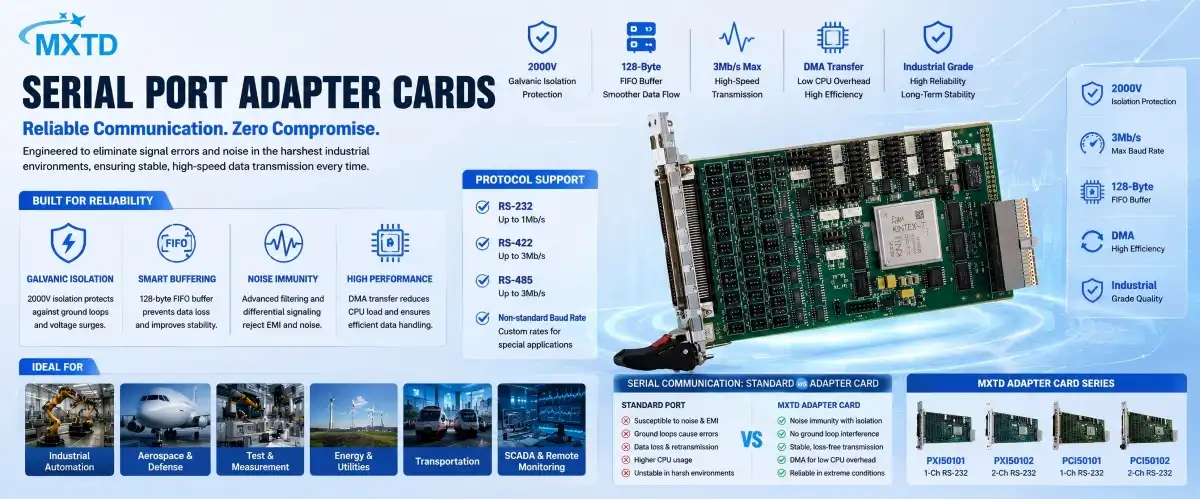
Serial port adapter cards cut down on signal mistakes and noise in a number of important ways. Advanced galvanic isolation, which in industrial-grade models can reach 2000V, makes an electrical shield that physically splits ground loops and stops interference from moving between devices that are linked. These cards have 128-byte FIFO buffers that keep data flowing easily, reducing transmission collisions and protecting the security of packets. Electromagnetic interference is constantly filtered by signal processing circuits, and common-mode noise is cancelled by differential signalling in RS-422 and RS-485 protocols. These methods, along with DMA transfer technology that lowers CPU waste, make sure that data is sent reliably even in electrically unfriendly environments that are common in aircraft and industrial automation.
Understanding Signal Errors and Noise in Serial Communication
Primary Sources of Signal Degradation
In industrial setups, electrical disturbance comes from more than one place at the same time. Electromagnetic fields are made by high-power motors, variable frequency drives, and switching power sources. These fields cause voltages that aren't needed in nearby communication lines. Capacitive and inductive coupling turn noise into data signals when serial cables are stacked next to power cables, which often happens in busy equipment racks. Because of this, changes in voltage can shift logical states, turning acceptable data into random noise. Problems with grounding are another important failure cause in Serial port adapter cards. Ground potential differences, which can be more than a few volts, cause currents to flow through wire shields when devices are connected across different electrical panels or building zones. Receivers get signal levels wrong because these ground loops change the reference voltage that marks the line between logical high and low states. RS-232 systems that are older and rely on single-ended signalling connected to ground are more likely to experience this problem.
Business Impact of Communication Failures
Data corruption shows up in ways that have a direct effect on how well operations run. Corrupted instructions in automatic test equipment can make instruments follow the wrong measurement steps, which wastes time and materials and produces inaccurate results. When status updates from field devices get jumbled, manufacturing execution systems lose sync, and workers have to check the states of each piece of equipment by hand. The combined result lowers output and raises the cost of labour. In addition to mistakes, noise that comes and goes causes problems with diagnosis that require technical resources. Technical teams spend hours trying to figure out why symptoms show up and then go away without warning. To try to find phantom problems, they often replace working parts. This reactive method raises the costs of keeping extra parts on hand and the average time it takes to fix something. This has a direct effect on system uptime measures that procurement managers closely watch.
How Serial Port Conversion Cards Work to Mitigate Signal Issues
Galvanic Isolation Technology
These days, adapter cards use optocouplers or digital isolators to separate host computers from external devices electrically. For this reason, there are no ground loop routes that would let noise currents flow between devices that have different potentials. In real life, a 2000V isolation rating—common in industrial-grade products like the PXI50101 and PCI50101 series—can handle voltage changes caused by lightning strikes, motor starting surges, and other common industrial disturbances without letting them spread to other systems that are connected. The separation also keeps costly host computers and test gear safe from power problems in field devices. The isolation barrier stops fault current and stops damage from spreading when a sensor or actuator has a short circuit or insulation failure. In military and defence settings, where replacing equipment can cost tens of thousands of dollars, and downtime can mess up important testing plans, this security is especially useful.
Buffering and Flow Control Mechanisms
There are built-in FIFO buffers that store data temporarily and smooth out time differences between data sources and users. MXTD's adapter cards have 128-byte buffers that can hold multiple packets while the host system handles other events or does work on old data. This buffering stops overflow situations that would make the sender resend, which would add delay and lower the actual speed. The DMA transfer feature makes the system even more reliable by letting the adapter card move data straight into system memory without the CPU having to keep stopping and starting. This cuts down on the time when an interrupt delay could lead to buffer overruns. This is especially important when using the highest baud rates of 1Mb/s for RS-232 or 3Mb/s for RS-422/RS-485. This design is good for system builders because it keeps communication stable even when host computers are running measuring methods that require a lot of computing power.
Key Specifications and Compatibility Factors Influencing Signal Quality
Baud Rate Considerations and Noise Susceptibility
Higher transmission speeds compress the time window representing each bit, leaving less margin for noise-induced distortion in Serial port adapter cards. At 3Mb/s, each bit lasts only 333 nanoseconds, meaning that even brief electromagnetic pulses can corrupt data if adequate filtering isn't present. Adapter cards designed for industrial environments incorporate signal conditioning circuits that bandwidth-limit incoming signals, removing high-frequency noise components while preserving the fundamental data waveform. This filtering must be carefully tuned—excessive attenuation would round off fast signal transitions and reduce the effective maximum baud rate. Non-standard baud rate capability provides an additional degree of freedom when optimising noise performance. By selecting transmission speeds that avoid harmonic relationships with nearby switching power supplies or motor controllers, system architects can minimise interference coupling. The PXI50101 and PCI50101 series support this fine-tuning, allowing engineers to experimentally determine optimal operating frequencies for specific installations.
Interface Standards and Driver Compatibility
The choice between PXI and PCI form factors affects both mechanical robustness and electrical performance. PXI implementations benefit from the platform's standardised timing and synchronisation infrastructure, enabling coordinated multi-channel measurements with minimal skew. The DB-37 female connectors used in MXTD's four-port adapter cards provide reliable mechanical retention while accommodating standard breakout cables, simplifying field wiring. Driver architecture plays an equally important role in maintaining signal integrity. Support for both Windows API and VISA interfaces ensures compatibility with diverse software ecosystems, from custom C++ applications to LabVIEW test executives. Standardised driver interfaces also enable faster technical support response times because field engineers can isolate hardware versus software issues using proven diagnostic procedures.
Comparative Analysis: Choosing Serial Port Conversion Cards for Optimal Performance
Evaluating Isolation and Noise Rejection Specifications
When comparing adapter solutions, isolation voltage ratings provide a quantifiable measure of noise immunity. Products offering 2000V isolation—such as the PXI50101 isolated PXI-RS-232 and RS-422/RS-485 variants—can handle the ground potential differences and transient voltages common in large facilities where equipment is distributed across multiple electrical subpanels. Lower isolation ratings may suffice for office environments, but leave installations vulnerable in industrial settings where electrical noise represents a constant challenge. Procurement managers should verify that isolation specifications include both continuous and surge ratings. While a card might withstand brief 2000V transients, continuous isolation capability at lower voltages determines long-term reliability in environments with persistent ground potential differences. This distinction becomes critical in 24/7 manufacturing operations where replacement downtime is unacceptable.
Matching Solutions to Industry Requirements
Here are the core advantages these specialised adapter cards bring to demanding industrial applications:
- High-Reliability Design: The combination of 2000V isolation, 128-byte FIFO buffering, and DMA transfer minimises data loss probability even when host systems experience momentary CPU loading spikes or interrupt latency variations. This reliability translates directly to reduced test invalidation rates and fewer production line stoppages.
- Flexible Configuration Options: Support for non-standard baud rates allows precise matching to legacy equipment specifications, eliminating the timing mismatches that cause intermittent errors. System integrators working with mixed-vintage equipment portfolios particularly value this capability.
- Multi-Channel Efficiency: Four independent ports on a single adapter card reduce both slot count requirements and per-channel cost compared to individual converters. This density advantage becomes significant in PXI chassis, where slot availability limits system expansion potential.
- Proven Compatibility: The DB-37 female connector standard simplifies cabling to breakout boxes and terminal blocks, while Windows API and VISA driver support ensures compatibility with established software frameworks. This standardisation reduces integration risk when deploying solutions across multiple project sites.
These advantages collectively address the pain points that R&D managers and test engineers encounter when building robust measurement systems. The isolation voltage specifically targets the electrical noise challenges inherent to aerospace testing facilities and semiconductor fabs, where sensitive measurements occur adjacent to high-power equipment. Meanwhile, the buffering and DMA architecture ensures that time-critical control loops maintain synchronisation even under computational load.
Troubleshooting and Maintaining Signal Integrity in Serial Port Conversion Cards
Diagnostic Approaches for Noise-Related Issues
Systematic troubleshooting begins with quantifying error rates and correlating them with operational conditions. Logging utilities that timestamp communication failures often reveal patterns—errors occurring at regular intervals may indicate interference from cyclic equipment like motor drives, while random corruption suggests broadband noise sources or marginal cable quality. Digital oscilloscopes with differential probes allow direct observation of signal quality at connector pins, revealing whether noise margins meet protocol specifications. Ground potential measurements between the device chassis provide essential diagnostic data. A simple multimeter reading between equipment grounds that exceeds 1-2 volts indicates significant loop current potential. Resolving such situations may require consultation with facilities' electrical teams to balance phase loading or install dedicated ground conductors, addressing root causes rather than merely masking symptoms with higher isolation ratings.
Preventive Maintenance Strategies
Regular firmware updates ensure that Serial port adapter cards benefit from protocol stack improvements and bug fixes discovered through field deployment experience. MXTD provides free software upgrades for one year following purchase, allowing customers to maintain optimal performance as operating system updates and driver frameworks evolve. This update policy particularly benefits organisations maintaining equipment over multi-year project lifecycles where initial software versions may predate unforeseen compatibility challenges. Environmental monitoring helps identify developing problems before they cause failures. Tracking metrics like ambient temperature, humidity, and electromagnetic field strength at installation locations reveals trends that may degrade long-term reliability. Cable and connector inspections during scheduled maintenance windows catch mechanical wear, corrosion, and shield degradation that gradually erode noise immunity.
Configuration Best Practices
Setting appropriate timeout values prevents communication stalls from propagating through multi-tier control systems. Timeout parameters should balance responsiveness—detecting genuine failures quickly—against false triggering from normal latency variations. Systems using DMA transfers generally support shorter timeouts because interrupt latency doesn't introduce artificial delays. Baud rate selection involves trade-offs between throughput and noise margin. While maximum speeds deliver the highest data rates, conservative settings provide more robust operation when signal quality is marginal. The ability to configure non-standard rates allows empirical optimisation, testing progressively higher speeds until error rates exceed acceptable thresholds, then backing off to establish reliable operating points.
Conclusion
Maintaining clean serial communication in electrically noisy industrial environments requires more than basic connectivity—it demands purposefully engineered solutions that address isolation, buffering, and protocol-level signal conditioning. The technical mechanisms we've explored demonstrate how modern adapter cards transform serial communication from a liability into a dependable foundation for mission-critical measurement and control systems. Galvanic isolation breaks ground loops, differential signalling rejects common-mode noise, and intelligent buffering smooths timing variations that would otherwise corrupt data streams. Procurement decisions in this category directly impact system uptime, measurement accuracy, and long-term maintenance costs. Selecting adapter cards with robust specifications—2000V isolation, substantial FIFO buffers, and flexible protocol support—provides insurance against the electrical challenges inherent to industrial deployments. The integration of these components into PXI and PCI platforms extends the operational life of legacy equipment while maintaining compatibility with contemporary software frameworks that test engineers rely upon.
FAQ
1. What determines the operating lifespan of isolated adapter cards in industrial environments?
Typical operational lifespans range from 10 to 15 years when cards operate within specified temperature and humidity ranges. The isolation barrier itself—constructed from optocouplers or capacitive isolators—experiences gradual degradation from thermal cycling and electrical stress, though quality components maintain specifications well beyond warranty periods. Environmental factors like corrosive atmospheres or excessive vibration accelerate ageing, making installation conditions more influential than raw operating hours. MXTD provides one-year warranties with provisions for extended coverage under negotiated terms, allowing customers to balance initial cost against long-term support requirements.
2. Can galvanic isolation eliminate all types of electromagnetic interference?
Isolation addresses common-mode interference—noise voltages that appear equally on both signal conductors relative to ground—by removing the electrical path through which such currents would flow. Differential-mode noise, which appears as voltage differences between signal conductors themselves, requires additional filtering and shielding to suppress. High-frequency radiated interference can capacitively couple into cables even when isolation breaks low-frequency ground paths. Complete noise elimination demands a layered defence combining isolation, shielding, filtering, and proper grounding practices tailored to specific installation characteristics.
3. How do I verify compatibility between adapter cards and existing PXI or PCI systems before purchase?
MXTD adapter cards meet NI product specifications, ensuring mechanical and electrical compatibility with standard PXI and PCI platforms. Software compatibility verification involves confirming that the VISA driver versions match the operating system and development environment in use. Technical teams can request a pre-purchase consultation to review system configurations and identify potential integration challenges. The company's commitment to one-hour response times for technical inquiries facilitates rapid compatibility assessment, allowing procurement managers to make informed decisions without extended evaluation delays.
Partner With MXTD for Dependable Serial Communication Solutions
Technical decision-makers seeking a reliable serial port conversion card supplier will find that MXTD combines 12 years of specialised R&D experience with the manufacturing capability to deliver both standard and customised solutions. Our PXI50101 and PCI50101 series adapter cards provide the 2000V isolation, 128-byte FIFO buffering, and multi-protocol support that system integrators require for aerospace testing, semiconductor validation, and industrial automation applications. Every product ships with comprehensive VISA and Windows API drivers, enabling rapid integration into existing measurement frameworks. We maintain inventory of standard configurations for immediate shipment of Serial port adapter cards while supporting OEM/ODM customisation to match unique parameter requirements that differentiate competitive test platforms. Our technical support team responds within one hour to specification inquiries and provides remote video guidance during installation and commissioning phases. This responsiveness addresses the fast turnaround expectations that R&D managers face when schedule-driven projects demand immediate solutions.
Our products benchmark against established industry standards while delivering superior cost-effectiveness through direct manufacturer pricing. The combination of proven reliability, technical flexibility, and responsive support makes MXTD an ideal long-term cooperation partner for organisations building sophisticated measurement systems. Contact manager03@mxtdinfo.com today to discuss your serial communication requirements and receive a detailed quotation tailored to your specific application parameters. Our team will work with you to specify the optimal adapter configuration, whether you need RS-232 for laboratory instruments, RS-422/RS-485 for distributed sensor networks, or multi-port solutions for complex test platforms.
References
1. Axelson, Jan. Serial Port Complete: COM Ports, USB Virtual COM Ports, and Ports for Embedded Systems. Lakeview Research, 2007.
2. National Instruments Corporation. PXI Hardware Specification and Design Guide. NI Technical Reference Series, 2019.
3. Morrison, Ralph. Grounding and Shielding: Circuits and Interference. Sixth Edition, Wiley-IEEE Press, 2016.
4. Industrial Automation Networks and Communication Standards Working Group. Serial Communication in Industrial Environments: Best Practices and Implementation Guidelines. ISA Standards Documentation, 2018.
5. Texas Instruments Incorporated. High-Speed Isolated Serial Communication Design Considerations. Application Note SLLA284, Revised 2021.
6. Telecommunications Industry Association. TIA-485-A Electrical Characteristics of Generators and Receivers for Use in Balanced Digital Multipoint Systems. Standards and Technology Department, 2003.
Our customers’ satisfaction speaks for our quality — contact us to experience the same reliable service.