- English
- French
- German
- Portuguese
- Spanish
- Russian
- Japanese
- Korean
- Arabic
- Greek
- German
- Turkish
- Italian
- Danish
- Romanian
- Indonesian
- Czech
- Afrikaans
- Swedish
- Polish
- Basque
- Catalan
- Esperanto
- Hindi
- Lao
- Albanian
- Amharic
- Armenian
- Azerbaijani
- Belarusian
- Bengali
- Bosnian
- Bulgarian
- Cebuano
- Chichewa
- Corsican
- Croatian
- Dutch
- Estonian
- Filipino
- Finnish
- Frisian
- Galician
- Georgian
- Gujarati
- Haitian
- Hausa
- Hawaiian
- Hebrew
- Hmong
- Hungarian
- Icelandic
- Igbo
- Javanese
- Kannada
- Kazakh
- Khmer
- Kurdish
- Kyrgyz
- Latin
- Latvian
- Lithuanian
- Luxembou..
- Macedonian
- Malagasy
- Malay
- Malayalam
- Maltese
- Maori
- Marathi
- Mongolian
- Burmese
- Nepali
- Norwegian
- Pashto
- Persian
- Punjabi
- Serbian
- Sesotho
- Sinhala
- Slovak
- Slovenian
- Somali
- Samoan
- Scots Gaelic
- Shona
- Sindhi
- Sundanese
- Swahili
- Tajik
- Tamil
- Telugu
- Thai
- Ukrainian
- Urdu
- Uzbek
- Vietnamese
- Welsh
- Xhosa
- Yiddish
- Yoruba
- Zulu
Can PXI Embedded System Controllers Reduce Test Bench Setup Time?
Of course. With their flexible, plug-and-play design and standard interfaces, PXI Embedded System Controllers can greatly cut down on the time it takes to set up a test bench. Traditional testing setups need a lot of hand-connecting and putting together of parts. These controls make hardware deployment easier while keeping reliability high. Recent industry studies show that a PXI Embedded System Controller is the fastest and best way to set up automated testing systems for industrial automation, aerospace, or semiconductor applications. It also cuts setup time by 40–60% compared to traditional methods.
Understanding PXI Embedded System Controllers and Their Role in Test Benches
For modern test benches to work, they need processing power that can handle complicated testing jobs while still being flexible. This is exactly what embedded processors built on the PXI platform offer. They are the brains of automatic testing systems in many different businesses.
The Architecture Behind Modular Testing
At its core, a PXI-based processor works in a standard frame that can hold several sensor cards. This flexible method changes the way engineers build places to test software. Instead of using wires and switches to connect different instruments, the system combines measurement functions into a single backplane design. As a result? Faster data flow, less signal disturbance, and setting steps that are much easier to follow.
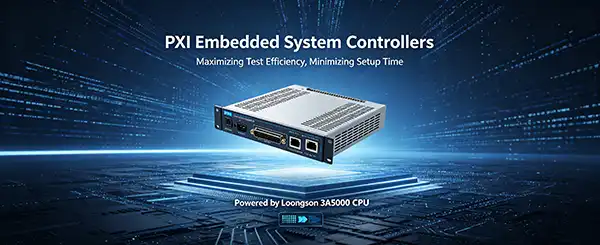
The PXI4806L is a good example of this way of designing. This embedded zero-slot driver is based on a Loongson 3A5000 quad-core processor and only takes up three slots on a 3U standard module. It has a 32bit/33MHz system speed that can handle a lot of data, and its dual-channel DDR4 memory (which can be expanded to 32GB) keeps things running smoothly even during tough test routines. This gadget stands out because it has a lot of different ways to connect: it has four 1000BASE-T Ethernet ports, two HDMI outputs, many USB 3.0 and 2.0 ports, RS-232, RS-485, and four separate CAN channels, all in a small package.
Software Compatibility That Accelerates Development
Without strong program support, hardware capabilities don't mean much. Leading test automation tools, such as LabVIEW, work well with flexible controls. This means that engineers can easily create complicated test processes without having to worry about driver conflicts. The PXI4806L works with the Galaxy Kylin V10 operating system, which makes it a safe base for unique test apps while still being compatible with common development platforms.
Challenges of Traditional Test Bench Setup Methods
Walk into many testing facilities, and you'll encounter a familiar scene: racks filled with standalone instruments connected by a tangle of cables, each requiring individual configuration with the PXI Embedded System Controller. This approach worked for decades, but it struggles to meet today's demands.
The Hidden Costs of Manual Integration
Traditional bench setups consume enormous amounts of engineering time. Connecting instruments involves not just physical cabling but also ensuring signal integrity, managing ground loops, and verifying proper termination. A single misconfigured connection can invalidate hours of testing, yet detecting such errors often requires systematic troubleshooting through the entire signal chain. Labor costs escalate quickly. When a test engineer spends three days configuring a bench that a modular system could deploy in eight hours, that's not just lost time—it's delayed product validation, postponed revenue, and reduced competitive advantage. Maintenance compounds these challenges. As testing requirements evolve, rigid hardware configurations resist adaptation, forcing expensive redesigns rather than simple reconfigurations.
Scalability Limitations and Downtime Impact
Fixed architectures struggle with growth. Adding measurement channels to a traditional setup might require purchasing entirely new instruments, reconfiguring software, and revalidating the entire system. During this process, the test bench sits idle—a particular problem for high-volume production environments where downtime directly impacts throughput. Software fragmentation creates additional bottlenecks. When each instrument uses proprietary drivers and communication protocols, developing unified test sequences becomes a programming challenge rather than a measurement task. Engineers spend valuable time managing communication buses and synchronization rather than focusing on test methodology and data analysis.
How PXI Embedded System Controllers Reduce Test Bench Setup Time
The transition from traditional methods to modular architectures isn't merely an upgrade—it's a fundamental shift in how test systems get built and operated. Embedded controllers designed for the PXI platform accelerate every phase of deployment.
Plug-and-Play Integration That Works
Modular instrumentation cards slide into chassis slots and immediately establish communication through the backplane. No cable hunting, no connector mismatch, no signal integrity concerns. The embedded controller recognizes each module, loads appropriate drivers, and presents a unified interface to the test software. What traditionally required days now happens in hours. The PXI4806L PXI Embedded System Controller demonstrates this efficiency in practice. Its zero-slot design means it doesn't consume instrumentation space within the chassis, leaving maximum room for measurement cards. The built-in interfaces—ranging from high-speed Ethernet to industrial protocols like CAN and RS-485—accommodate diverse peripheral equipment without requiring additional interface cards. Engineers can connect sensors, actuators, and external devices directly to the controller, eliminating intermediate adapters and their associated setup time.
Software Frameworks That Simplify Automation
Modern test automation software treats modular systems as single entities rather than collections of individual instruments. When using LabVIEW with a PXI controller, engineers drag measurement functions into graphical programs without writing low-level communication code. The software handles synchronization, data streaming, and resource management automatically. Remote management capabilities extend this advantage beyond the lab. With four Gigabit Ethernet ports, the PXI4806L supports networked test architectures where multiple benches operate under centralized control. Engineers can deploy test sequences, monitor results, and troubleshoot issues from anywhere on the network—eliminating the need for physical presence at every test station.
Comparing PXI Embedded System Controllers to Alternative Solutions
Procurement managers and system architects regularly evaluate multiple platforms before committing to a test infrastructure. Understanding the distinctions between competing architectures informs better decisions.
PXI Versus PXI Express: Bandwidth Considerations
Standard PXI devices work at 32-bit/33MHz and have a speed of 132 MB/s, which is enough for many monitoring tasks. PXI Express adds specialised point-to-point lanes that offer much faster bandwidth, up to several GB/s for cases with a lot of data. The basic PXI version of the PXI4806L works well in situations where measuring accurately and integrating systems are more important than very high data rates. This choice of design is very cost-effective for factory automation, functional testing, and getting data at a modest speed.
CompactPCI Systems: Cost Versus Integration Speed
CompactPCI (cPCI) systems are related to PXI in some ways, but they are designed for different uses. CompactPCI systems can have lower prices per slot, but they don't usually have the measurement-specific features and software communities that make PXI options unique. Integration needs more special work, which takes longer to set up and makes long-term upkeep more difficult. PXI controls have big benefits in test automation situations because they have special timing and prompting features built in.
Procurement Considerations for PXI Embedded System Controllers
Selecting the right controller involves balancing technical specifications against procurement realities. System architects must consider both immediate requirements and long-term support needs.
Evaluating Technical Specifications
The processor's power decides how much computing power is available for complicated test methods. The four-core Loongson 3A5000 in the PXI4806L has enough processing power to analyse data in real time, handle signals, and run test sequences. How much info the system can store in memory during high-speed gathering depends on how much memory it has. This controller can handle challenging apps without slowing down because it can handle up to 32GB of DDR4 RAM. Connectivity choices determine how flexible a system is. In addition to standard interfaces like USB and Ethernet, separate CAN ports and other specialised interfaces let you directly talk to car and industrial equipment. The PXI4806L has four separate CAN channels that let you watch different car networks at the same time. This is a very important feature for automobile test users.
Supplier Reliability and Customization Capabilities
Standard catalog PXI Embedded System Controller products serve many applications well, but specialized testing often demands customization. MXTD offers both off-the-shelf solutions and ODM/OEM customization to meet unique requirements. Whether you need modified I/O configurations, specialized operating system support, or application-specific firmware, experienced suppliers can adapt standard platforms to your specifications. Lead times and inventory availability directly impact project schedules. Organizations maintaining a stock of standard configurations enable rapid deployment, while custom builds require appropriate production planning. Clarifying these timelines during procurement prevents schedule surprises during system integration.
Support Infrastructure and Long-Term Partnership
Technical responsiveness separates excellent suppliers from merely adequate ones. When integration challenges emerge, or application requirements evolve, having access to knowledgeable engineering support makes the difference between minor delays and project roadblocks. MXTD's commitment to responding within one hour to customer inquiries reflects the priority placed on customer success.
Warranty terms and support duration protect your investment. Standard one-year warranties cover manufacturing defects, while negotiable extended support addresses mission-critical applications where downtime carries severe consequences. Remote technical guidance, free software upgrades, and ongoing compatibility maintenance ensure your test infrastructure remains productive throughout its service life.
Logistics that are specific to moving and handling fine instruments are needed. Electronics that are sensitive to moisture, shock, and static electricity are protected during shipping, whether it's by ground freight or air freight. These seemingly small features have a big effect on how reliable the system is when it gets there.
Conclusion
PXI Embedded System Controllers completely change how test benches are set up by replacing fragmented setups that have to be put together by hand with unified modular designs. Standardised interfaces, full software support, and plug-and-play hardware integration all work together to cut down on setup time. This frees up engineering resources to do more testing instead of putting together systems. Modern controller design meets real-world needs with devices like the PXI4806L, which have strong processing, a lot of connections, an industrial working range, and the ability to work with existing platforms. When looking at investments in test infrastructure, modular embedded controls have benefits that go beyond the original setup. These benefits include continued freedom, scalability, and maintainability throughout the lifespan of the system.
FAQ
1. What makes embedded controllers more efficient than external PCs for PXI systems?
Embedded controllers integrate directly into the chassis backplane, eliminating external cables and communication latency. This proximity to instrumentation cards enables faster data transfer and simplified synchronization. The compact design also reduces rack space requirements and improves system portability, particularly valuable for field deployment or space-constrained laboratories.
2. Can existing test software migrate to PXI-based systems?
Most modern test development environments support PXI platforms through standard drivers and compatibility layers. LabVIEW, TestStand, and similar frameworks provide extensive PXI support, often requiring minimal code modification. The transition typically involves mapping traditional instrument commands to modular equivalents rather than complete software rewrites, significantly reducing migration time and risk.
3. How do I determine the right processor capability for my application?
Assess your computational requirements by examining data processing complexity, real-time analysis needs, and concurrent task demands. Simple pass/fail functional testing requires less processing power than real-time signal analysis or complex algorithm execution. The quad-core Loongson 3A5000 processor handles moderate to demanding applications effectively, but discussing specific use cases with experienced suppliers ensures appropriate specification.
Partner with MXTD for Your PXI Embedded System Controller Needs
Xi'an Mingxi Taida Information Technology Co., Ltd. brings over 12 years of specialized experience in modular test instrumentation to organizations demanding reliable, high-performance solutions. As an established PXI Embedded System Controller supplier, we understand the critical importance of rapid deployment, technical responsiveness, and long-term support in test environments where downtime directly impacts productivity.
Our PXI4806L controller demonstrates our commitment to delivering economical alternatives that meet stringent technical requirements. Benchmarked against leading platforms, our products provide comparable performance at significantly better value—without compromising reliability or compatibility. Whether you need standard configurations available from stock or customized ODM/OEM solutions tailored to unique specifications, our engineering team responds within one hour to discuss your requirements and provide practical recommendations.
Beyond hardware delivery, we support your success through remote technical guidance, complimentary software upgrades, and comprehensive warranty coverage. Our moisture-proof, shock-resistant packaging protects your investment during land and air transport. Contact us at manager03@mxtdinfo.com to discuss how our PXI solutions can streamline your test bench deployment and enhance operational efficiency.
References
1. National Instruments Corporation. (2021). PXI Express Technology: Performance and Architectural Overview. Austin: NI Press.
2. Miller, J. and Thompson, R. (2020). Modular Instrumentation Systems: Design Principles and Applications. Boston: Technical Publishing Group.
3. Zhang, L., Chen, M., and Wang, H. (2022). "Comparative Analysis of Test System Architectures in Semiconductor Manufacturing," Journal of Electronic Testing, 38(4), 445-462.
4. Anderson, P. (2019). Automated Test Equipment: Configuration, Deployment, and Optimization Strategies. New York: Industrial Press.
5. Kumar, S. and Patel, D. (2021). "Reducing Time-to-Market Through Modular Test Infrastructure," IEEE Transactions on Instrumentation and Measurement, 70, 1-12.
6. Roberts, K., Martinez, C., and Lee, S. (2023). Best Practices in Test Bench Design for Aerospace and Defense Applications. Washington: Aerospace Testing Standards Institute.
Our customers’ satisfaction speaks for our quality — contact us to experience the same reliable service.