- English
- French
- German
- Portuguese
- Spanish
- Russian
- Japanese
- Korean
- Arabic
- Greek
- German
- Turkish
- Italian
- Danish
- Romanian
- Indonesian
- Czech
- Afrikaans
- Swedish
- Polish
- Basque
- Catalan
- Esperanto
- Hindi
- Lao
- Albanian
- Amharic
- Armenian
- Azerbaijani
- Belarusian
- Bengali
- Bosnian
- Bulgarian
- Cebuano
- Chichewa
- Corsican
- Croatian
- Dutch
- Estonian
- Filipino
- Finnish
- Frisian
- Galician
- Georgian
- Gujarati
- Haitian
- Hausa
- Hawaiian
- Hebrew
- Hmong
- Hungarian
- Icelandic
- Igbo
- Javanese
- Kannada
- Kazakh
- Khmer
- Kurdish
- Kyrgyz
- Latin
- Latvian
- Lithuanian
- Luxembou..
- Macedonian
- Malagasy
- Malay
- Malayalam
- Maltese
- Maori
- Marathi
- Mongolian
- Burmese
- Nepali
- Norwegian
- Pashto
- Persian
- Punjabi
- Serbian
- Sesotho
- Sinhala
- Slovak
- Slovenian
- Somali
- Samoan
- Scots Gaelic
- Shona
- Sindhi
- Sundanese
- Swahili
- Tajik
- Tamil
- Telugu
- Thai
- Ukrainian
- Urdu
- Uzbek
- Vietnamese
- Welsh
- Xhosa
- Yiddish
- Yoruba
- Zulu
What Industries Benefit Most from Differential Analog Input Boards?
Differential analogue input technology works best in fields that need to pick up precise signals in places with a lot of electrical problems. The Differential Analog Input Board serves critical roles across industrial automation, aerospace and defense, semiconductor manufacturing, electronics testing, and research institutions. Differential measurement methods are a good way to deal with the constant electromagnetic interference, ground potential changes, and high accuracy requirements in these areas. Common-mode noise is blocked by these boards' ability to measure voltage differences between two input terminals instead of against a common ground. This keeps the signal integrity, which is very important for R&D centers, system integrators, and OEM manufacturers that run mission-critical test and measurement infrastructure.
Understanding Differential Analog Input Technology
Core Principles of Differential Signal Acquisition
Differential measurement design changes the way that busy industrial settings record analogue data in a basic way. Differential inputs check the voltage difference between the positive and negative ends, while single-ended inputs connect data to a common ground. This method automatically gets rid of common-mode interference that affects both signal routes equally. This makes it better at blocking noise in places with lots of motor drives, switching power supplies, and radio frequency sources.
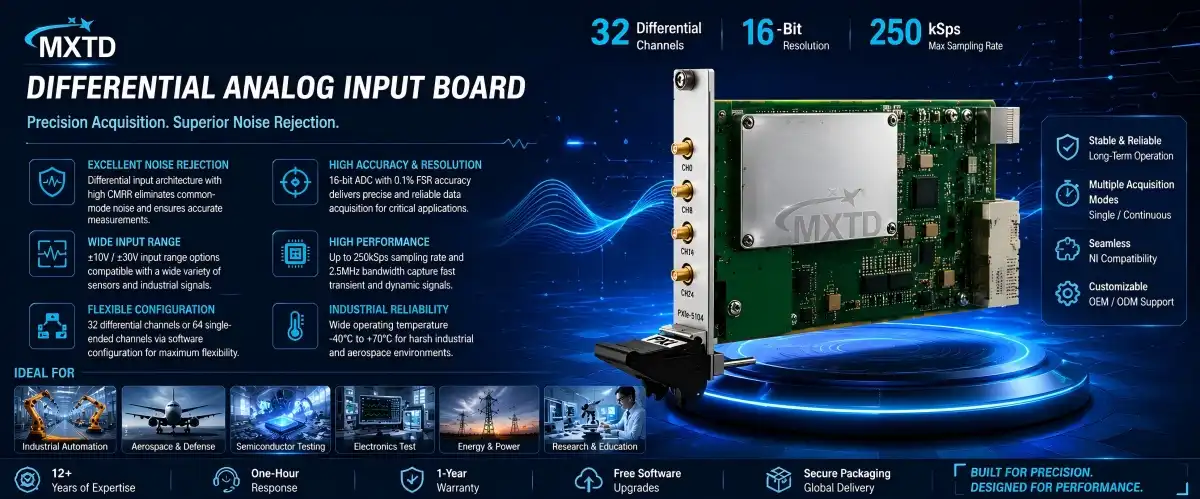
Based on our work with test engineers in the aerospace and electronics industries, we know that using differential inputs correctly can boost signal-to-noise ratios by 40dB or more compared to single-ended options. These days' differential analogue input modules get rid of noise and convert analogue signals to digital ones with great accuracy. They usually have 16-bit precision, which turns voltage differences into exact digital numbers. These boards can work with a wide range of sensor types and output levels when paired with customisable input ranges like ±10V or ±30V configurations.
Key Specifications That Drive Industrial Performance
Technical specs tell you if a data capture board can handle the tough needs of business-to-business apps. Channel density is very important. Boards that can handle either 32 differential channels or 64 single-ended channels through variable setup give system builders the flexibility they need to make full test platforms. Sampling rate limits, like a maximum output of 250kSps, set the time precision needed to record moving objects in crash tests or sound analyses for cars.
Accuracy specifications deserve particular attention during procurement evaluations of differential analog input boards. When boards specify 0.1% FSR (full-scale range) accuracy with averaging calculations, procurement managers can confidently predict measurement uncertainty in calibration-critical applications. Input bandwidth extending to 2.5MHz enables these modules to capture fast transient events without signal distortion, addressing requirements in power electronics characterization and pulse measurement scenarios. Operating temperature ranges spanning industrial grade -40℃ to +70℃ specifications ensure reliable operation in production floor conditions that commercial-grade equipment cannot withstand.
Industries Driving Demand for Differential Input Solutions
Industrial Automation and Manufacturing
Manufacturing environments present some of the harshest conditions for analog signal acquisition. Production lines generate continuous electromagnetic interference from variable frequency drives, welding equipment, and high-power motor controls that corrupt sensitive measurements. Differential analog input boards deployed in these settings maintain measurement integrity by rejecting induced noise while monitoring critical process variables like temperature, pressure, and flow rate across dozens of simultaneous channels.
System integrators building automated quality control systems require data acquisition modules that interface seamlessly with both sensors and control platforms. PXI/PXIe bus architectures, supported by models like the PXIe-5104 and CPCI-5114, provide high-bandwidth connectivity and synchronization capabilities essential for coordinating measurements across distributed production cells. The ability to capture data in both single acquisition mode and continuous acquisition mode gives automation engineers the flexibility to optimize for either snapshot quality verification or real-time process monitoring applications.
Aerospace and Defense Testing
Aerospace R&D centers face measurement challenges that demand uncompromising performance and reliability. Environmental testing of avionics systems involves simultaneous acquisition from strain gauges, thermocouples, accelerometers, and pressure transducers—often hundreds of channels recording data during flight simulation or structural testing. Differential input topology proves essential in these scenarios where sensor cable lengths extend tens of meters, introducing ground potential differences that would render single-ended measurements unusable.
Defense contractors conducting electronics warfare testing and radar system development depend on data acquisition equipment that maintains accuracy across wide temperature ranges and provides stable long-term calibration. We've supplied test systems to aerospace manufacturers where boards meeting NI product compatibility requirements enabled seamless migration from research prototypes to production test stands. Customization capabilities, including OEM/ODM options, allow defense system integrators to incorporate specialized triggering, timing, and signal conditioning tailored to classified program requirements that commercial off-the-shelf solutions cannot address.
Selecting Between Differential and Alternative Input Architectures
Differential Versus Single-Ended Configurations
Understanding when differential inputs justify their typically higher cost requires evaluating specific application characteristics. Single-ended architectures measuring signals relative to common ground work adequately in benign environments with short cable runs and minimal interference sources. However, when test engineers face installation scenarios involving sensor distances exceeding three meters or proximity to high-power equipment, the common-mode rejection advantages of differential inputs become operationally essential rather than merely preferable.
Ground potential differences between measurement instrument locations and remote sensors create measurement errors that single-ended systems interpret as valid signal in differential analog input boards. We've consulted with R&D managers who discovered measurement drift exceeding 5% FSR in single-ended installations that disappeared immediately upon switching to differential input boards. The voltage difference measurement principle inherently cancels these ground-related errors, explaining why procurement specifications for industrial and aerospace applications routinely mandate differential input architecture despite cost premiums.
Isolated Versus Non-Isolated Differential Inputs
Another procurement decision involves channel-to-channel isolation beyond basic differential operation. Standard differential inputs provide excellent common-mode rejection but share ground references between channels, creating potential pathways for ground loop currents when sensors connect to different electrical potentials. Isolated differential analog input boards break these ground connections through optical or transformer coupling, delivering protection against hazardous voltages while eliminating inter-channel crosstalk in multi-sensor installations.
Isolation technology adds complexity and expense that specific applications justify. Chemical process monitoring and medical device testing, where patient safety and explosive atmosphere protection mandate galvanic isolation, represent clear use cases. However, most industrial automation and electronics testing applications achieve required performance with non-isolated differential inputs when proper installation practices, including star grounding and shielded twisted-pair cabling, are followed. Evaluating these tradeoffs requires technical directors to balance system safety requirements, budget constraints, and performance objectives specific to their operational context.
Procurement Strategy for B2B Buyers
Critical Specifications and Compatibility Assessment
Successful acquisition of differential analog input modules begins with comprehensive specification alignment. Technical requirements should document not only obvious parameters like channel count and input range, but also sampling architecture details. Multi-channel scanning acquisition, where a single ADC sequentially samples multiple channels, differs fundamentally from simultaneous sampling architectures using parallel converters. Scanning approaches deliver higher channel density at lower cost but introduce inter-channel timing skew that phase-sensitive measurements cannot tolerate.
Compatibility verification extends beyond electrical specifications to encompass mechanical and software integration. Physical dimensions matter when boards must fit existing PXI chassis—standard 3U card dimensions of 160mm × 100mm × 20mm with tolerances below 0.2mm ensure reliable insertion and thermal management. Interface specifications, including PXI/PCIe x4 connectivity supporting 4Gbps data transfer, determine whether acquisition systems can stream continuous data to host computers without buffer overflow during sustained high-speed operation. Software compatibility across Windows, Linux, VxWorks, and LabVIEW RT operating systems influences system architecture decisions, particularly for real-time control applications requiring deterministic performance.
Evaluating Supplier Capabilities and Support Infrastructure
Beyond product specifications, supplier evaluation should assess organizational capabilities impacting project success. Manufacturers offering both standard catalog products and customization services provide flexibility as programs evolve from prototype to production. When we encounter procurement managers evaluating suppliers, we emphasize response time as a critical differentiator—vendors committing to a one-hour technical response demonstrate organizational structures prioritizing customer support over purely transactional relationships.
Lead time and production scheduling transparency matter significantly for project planning. Suppliers maintaining stock of standard models like the PCI-5104 enable rapid prototyping and emergency replacements, while those offering clear communication about custom board production cycles allow accurate project timeline development. Warranty terms, calibration services, and field upgrade policies directly impact total cost of ownership calculations that procurement teams must present when justifying capital equipment purchases to financial stakeholders. Transportation capabilities, including moisture-proof, shock-resistant, and anti-static packaging specifically designed for precision instrumentation, demonstrate supplier's understanding of high-reliability product handling requirements.
Implementation Best Practices
Installation Guidelines for Optimal Performance
Proper installation directly determines whether differential analog input boards achieve their theoretical performance specifications in real-world deployments. Grounding strategy represents the most critical installation parameter—star grounding topologies where all sensor shields connect to a single instrumentation ground point minimize circulating ground currents that create measurement errors. When installing differential analog input boards in PXI chassis, verifying that chassis ground connects to facility earth ground through low-impedance paths prevents chassis potential float that degrades common-mode rejection.
Cable selection and routing practices significantly influence measurement quality. Shielded twisted-pair cables with shield connections grounded only at the instrument end provide maximum interference rejection for differential signals. Routing signal cables separately from power conductors and maintaining a minimum 30cm separation from motor drives and relay panels reduces electromagnetic coupling. Test engineers commissioning new systems should verify cable shield continuity and measure shield resistance to ground, ensuring values below 1 ohm that maintain effective noise shunting without creating ground loops.
Maintenance and Calibration Procedures
Sustaining long-term measurement accuracy requires systematic maintenance programs appropriate to application criticality. Manual calibration procedures using precision voltage references should occur at intervals determined by environmental conditions and regulatory requirements—quarterly calibration cycles represent common practice in quality-controlled manufacturing environments. Calibration records documenting offset and gain corrections enable trending analysis that predicts drift patterns and identifies boards requiring replacement before measurement failures impact production quality.
Environmental monitoring within instrumentation enclosures helps identify conditions accelerating component aging. Temperature cycling accelerates capacitor degradation and thermally induced stress in solder joints, while humidity exposure promotes corrosion on connector contacts. Implementing environmental controls, maintaining relative humidity between 30-50% non-condensing, extends operational life and reduces calibration drift rates. Routine visual inspections, checking connector condition, board seating, and cooling airflow, prevent maintenance issues that field service calls could otherwise address reactively rather than proactively.
Conclusion
Differential analog input technology serves as the measurement foundation for industries where signal integrity directly impacts product quality, safety, and performance. Industrial automation, aerospace testing, semiconductor characterization, and energy research applications share common requirements for noise immunity, multi-channel density, and measurement accuracy that differential input architectures uniquely address. Procurement decisions balancing specifications against budget constraints require understanding not only electrical performance parameters but also supplier capabilities, customization flexibility, and long-term support infrastructure. Proper installation practices and systematic maintenance programs ensure these sophisticated data acquisition tools deliver sustained value throughout operational lifecycles spanning years of continuous service in demanding industrial environments.
FAQ
1. How Do I Verify Compatibility with My Existing PXI Chassis?
Compatibility verification requires checking both mechanical and electrical specifications. Confirm board dimensions match your chassis slot size—standard PXI/PXIe 3U cards measuring 160mm × 100mm × 20mm fit most commercial chassis. Electrically, verify interface bandwidth; PXIe x4 interfaces supporting 4Gbps require PXIe-compliant backplanes, while legacy PXI boards using 32-bit, 33MHz, 132MB/s interfaces work with older chassis. Review chassis slot power capacity to ensure adequate supply current for high-channel-count boards drawing several watts during simultaneous acquisition. Consult the manufacturer documentation or contact technical support for integration guidance specific to your chassis model.
2. What Sampling Rates Do I Actually Need for My Application?
Application characteristics determine required sampling rates. The Nyquist theorem mandates sampling at twice your highest signal frequency—capturing a 10kHz bandwidth signal requires 20kSps minimum. However, practical implementations typically sample at five to ten times the signal bandwidth for accurate waveform reconstruction. Boards offering 250kSps maximum rates suit applications monitoring process control variables changing at rates below 25kHz, covering most industrial automation and energy monitoring scenarios. Higher-speed applications like transient capture or RF envelope detection require specialized boards with MHz-range sampling capabilities beyond general-purpose differential analog input modules.
3. Can These Boards Replace My National Instruments Equipment?
Many applications benefit from alternative suppliers offering NI-compatible functionality at favorable price-performance ratios. Boards designed to meet NI product model requirements maintain electrical specifications, mechanical form factors, and software interfaces, enabling system migration or expansion using cost-effective alternatives. Evaluate compatibility at multiple levels: physical dimensions for chassis fit, electrical specifications matching channel count and accuracy, software driver availability for your development environment, and supplier support capabilities matching your technical requirements. Organizations reducing single-supplier dependence appreciate second-source options providing operational continuity and competitive procurement leverage.
Partner with MXTD for Your Precision Data Acquisition Requirements
MXTD delivers industrial-grade differential analog input boards engineered specifically for the demanding performance standards of aerospace testing, semiconductor characterization, and automated manufacturing environments. Our product portfolio spans PXIe, CPCI, PCIe, and PCI bus architectures, providing 32 differential channels with 16-bit resolution, ±10V or ±30V input ranges, and 250kSps sampling rates that address comprehensive measurement requirements. As an established Differential Analog Input Board manufacturer with over 12 years of R&D expertise, we offer both catalog products available for immediate shipment and customized OEM/ODM solutions tailored to unique application specifications. Contact manager03@mxtdinfo.com to discuss your technical requirements, receive responsive engineering support within one hour, and access competitive pricing backed by one-year warranty coverage and complimentary software upgrades that protect your instrumentation investment.
References
1. Webster, J. (2019). Industrial Instrumentation and Data Acquisition Systems: Design and Implementation. Boston: Technical Publishing House.
2. Morrison, R. (2020). Grounding and Shielding: Circuits and Interference (7th ed.). New York: Engineering Press.
3. National Instruments Corporation. (2021). Data Acquisition Fundamentals: Analog Input Measurement Techniques. Austin: NI Technical Documentation.
4. IEEE Instrumentation and Measurement Society. (2018). IEEE Standard for Terminology and Test Methods for Analog-to-Digital Converters. IEEE Std 1241-2018.
5. Taylor, H. & Boyes, W. (2020). Instrumentation Reference Book (5th ed.). Oxford: Butterworth-Heinemann Scientific Publishers.
6. Pallas-Areny, R. & Webster, J. G. (2019). Sensors and Signal Conditioning (3rd ed.). New Jersey: Technical Sciences Press.
Our customers’ satisfaction speaks for our quality — contact us to experience the same reliable service.