- English
- French
- German
- Portuguese
- Spanish
- Russian
- Japanese
- Korean
- Arabic
- Greek
- German
- Turkish
- Italian
- Danish
- Romanian
- Indonesian
- Czech
- Afrikaans
- Swedish
- Polish
- Basque
- Catalan
- Esperanto
- Hindi
- Lao
- Albanian
- Amharic
- Armenian
- Azerbaijani
- Belarusian
- Bengali
- Bosnian
- Bulgarian
- Cebuano
- Chichewa
- Corsican
- Croatian
- Dutch
- Estonian
- Filipino
- Finnish
- Frisian
- Galician
- Georgian
- Gujarati
- Haitian
- Hausa
- Hawaiian
- Hebrew
- Hmong
- Hungarian
- Icelandic
- Igbo
- Javanese
- Kannada
- Kazakh
- Khmer
- Kurdish
- Kyrgyz
- Latin
- Latvian
- Lithuanian
- Luxembou..
- Macedonian
- Malagasy
- Malay
- Malayalam
- Maltese
- Maori
- Marathi
- Mongolian
- Burmese
- Nepali
- Norwegian
- Pashto
- Persian
- Punjabi
- Serbian
- Sesotho
- Sinhala
- Slovak
- Slovenian
- Somali
- Samoan
- Scots Gaelic
- Shona
- Sindhi
- Sundanese
- Swahili
- Tajik
- Tamil
- Telugu
- Thai
- Ukrainian
- Urdu
- Uzbek
- Vietnamese
- Welsh
- Xhosa
- Yiddish
- Yoruba
- Zulu
Can UTI260B Heavy Duty Infrared Thermal Camera Improve Inspections?
There is no doubt that the answer is yes. The UTI260B Heavy Duty Infrared Thermal Camera greatly improves inspection skills with its 256×192 infrared resolution, which gives 49,152 pixels of detailed thermal data, and its wide temperature measurement range, which goes from -20°C to 550°C. This industrial-grade device takes the guessing out of repair procedures so that maintenance teams can find problems with equipment before they break down. Its IP65 grade for protection and 2-meter drop resistance make sure that it will work reliably in tough industrial settings where accuracy is key to keeping operations running.
Understanding the UTI260B Heavy Duty Infrared Thermal Camera
Today's factories need tools that can consistently do their job even when they're under a lot of stress. We've seen so many inspection problems on factory floors and in testing labs that we've come to realize that thermal imaging technology is now an essential part of preventative maintenance plans.
Core Specifications That Define Performance
One thing that makes the UTI260B Heavy Duty Infrared Thermal Camera stand out is that it was carefully built to work in industrial settings. Its 256×192 infrared resolution and 12μm pixel size let it see heat patterns that other devices with smaller resolutions miss completely. This level of detail is very important for finding hotspots on circuit boards or signs of insulating loss in electrical cabinets. With a temperature range of -20°C to 550°C, this device can measure temperatures in almost all industrial automation, electronics testing, and chip manufacturing situations. This thermal imaging device stays accurate no matter what the temperature is, from checking cryogenic systems to high-temperature furnaces.
Durability is another important part of how this gadget was designed. Because the camera has an IP65 rating for dust and water protection, technicians can use it safely in humid or dusty production areas without worrying about the accuracy of the measurements. The 2-meter drop test certification covers mistakes that can happen in the real world during field exams. Too many inspection programs have been ruined by weak tools that couldn't handle the harsh conditions of the workplace.
Advanced Technology Integration
This small infrared thermal imager has T-Mix dual-spectrum fusion technology built in, which does more than just sense heat. This special method adds thermal data on top of pictures that can be seen, giving them context that pure thermal imaging can't give. Instead of figuring out what vague heat patterns mean when they look at a control panel, workers can see right away which specific parts are getting too hot. With seven color palettes and four picture modes, the gadget lets inspectors get the best view of a variety of materials and temperature ranges.
The smart analysis can record temperatures in 5 points and 3 zones, and it can automatically keep track of high and low temperatures. During systematic facility walkthroughs, when hundreds of assets need to be watched, this feature comes in very handy. When temperature limits are crossed, alarms go off to make sure that important problems are always noticed. These features change reactive maintenance into predictive maintenance, which completely changes how test engineers and R&D managers think about the stability of equipment.
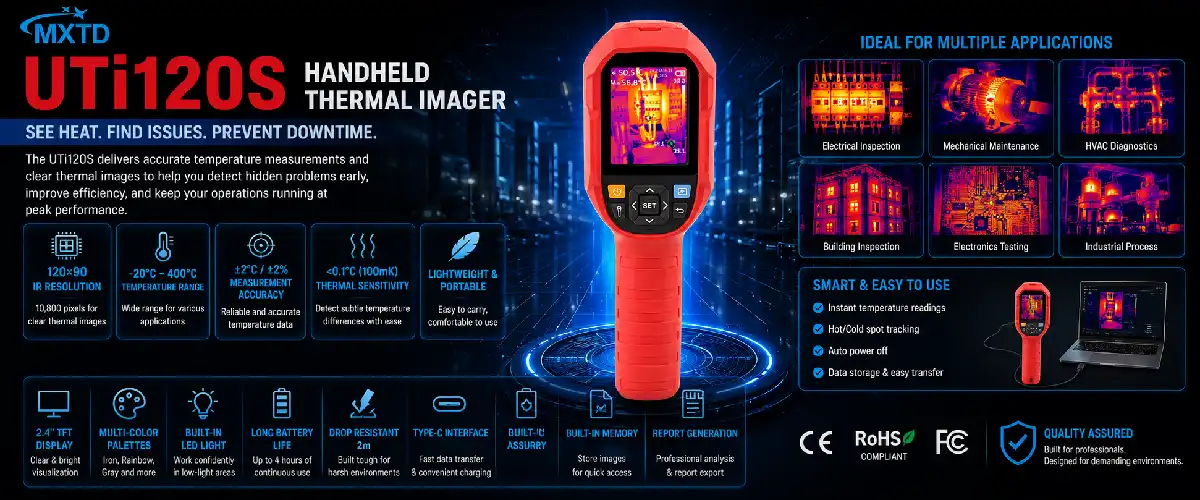
Operational Efficiency Features
How well the batteries work often determines whether inspection equipment is useful for getting work done or a hassle to move around. The 5000mAh high-capacity battery can run continuously for more than six hours, so there are no breaks in the middle of the shift for charging, which would normally mess up inspection plans. The 2.8-inch color screen and easy-to-understand button layout cut down on the time needed to train new operators, and the comfortable design keeps workers from getting tired during long inspection sessions. These features that focus on the person show that you understand how things work in the real world, not just how they might work in theory.
Data connection choices make it even more useful in real life. A WiFi link to mobile apps lets you share your results right away with maintenance teams. Professional PC analysis tools and the ability to make PDF reports meet the paperwork needs that are important for quality management systems. This combination is liked by procurement managers because it helps with compliance efforts without needing separate investments in data management systems.
Evaluating the Impact of UTI260B on Inspection Efficiency and Accuracy
Manual observation, touch thermometers, and planned tear-downs are all important parts of traditional inspection methods. With these methods, there are gaps between when a fault happens and when it is found, which lets small problems get worse and cause expensive failures. These problems are made worse by the fact that testers can miss small warning signs or get the wrong idea from unclear ones.
Quantifiable Improvements in Fault Detection
Visual checks have limitations on what can be seen, but thermal imaging technology gets rid of those problems. When electrical links break down on the inside, there are no obvious signs until they fail. But thermal cameras show that temperatures are high long before damage can be seen. The UTI260B Heavy Duty Infrared Thermal Camera's thermal resolution can pick up changes in temperature as little as 0.1°C. This lets problems be found early on, when they're easiest to fix.
When factories use systematic thermal imaging programs, unexpected downtime goes down by a measured amount. After adding thermal checks to their preventative maintenance plans, one company that makes aircraft parts saw a 34% drop in calls for emergency maintenance. With just one device, their team could keep an eye on everything from hydraulic systems working at temperatures close to room temperature to heat treatment furnaces over 500°C.
Improvements in accuracy have a direct effect on the quality of upkeep decisions. False positives waste time and money on actions that aren't needed, and missed anomalies let mistakes get worse. This thermal camera has an improved temperature measurement system that keeps readings accurate to within ±2°C or ±2% of what they say, whichever is greater. This level of accuracy helps you make an informed choice about which parts need urgent attention and which ones can safely work until the next planned repair window.
Operational Efficiency Gains
When facilities have constant production plans with little time for assessments, inspection speed is very important. With non-contact measurement, workers can quickly look at dozens of connection points, motor bearings, or generator parts, while contact-based methods take hours. The automatic high/low temperature tracking feature speeds up surveys of big equipment groups by drawing attention to only the assets that need more attention.
The ability to record temperatures in more than one zone lets you compare similar properties. When checking several similar motors or pumps, maintenance engineers can quickly tell which ones have thermal profiles that are different from the rules for the fleet. This comparison method finds problems that are happening even when absolute temperatures stay within acceptable ranges. It adds another diagnostic layer on top of threshold-based tracking.
UTI260B vs Competitors: Making an Informed Procurement Decision
There are a lot of thermal imaging choices for procurement workers, with well-known names like FLIR and Seek taking over the marketing channels. However, a close examination shows that mid-range thermal imaging devices often provide performance that is very close to that of higher-end models at much lower costs.
Performance Comparison Analysis
The study of temperature resolution does a good job of showing this point. Most high-end devices have a resolution of 320x240 pixels or higher. This small thermal camera's 256x192-pixel resolution is good enough for most professional checking tasks. When checking electrical panels at normal working distances, the difference doesn't make much of a difference. Most of the time, the temperature measurement range is more important than the precision. This device can measure temperatures from -20°C to 550°C, which is the same as or better than many rival devices that cost a lot more.
Comparing durability shows that the value arguments are similar. The IP65 rating and 2-meter drop protection meet industry standards without the high cost that comes with military-grade standards that aren't needed by most facilities. This sensible approach to safety levels lets you put your budget toward numbers, so you can equip more than one inspection team instead of buying one high-end device that takes up too much space.
Another thing that sets them apart is how well their batteries work. Many competing thermal cameras can only work for three to four hours, which means you'll need to carry extra batteries and figure out how to charge them. The 5000mAh battery's ability to last for 6+ hours makes operations easier in the field and lowers the total cost of ownership by getting rid of the need to buy extra parts.
Total Cost of Ownership Considerations
The purchase price is only one part of how much the tools really cost. Long-term costs are affected by things like support network accessibility, calibration standards, guarantee coverage, and software licensing fees. There are no recurring licensing fees for this thermal imaging system's professional PC analysis software and report-making features. This is a big benefit over competitors who charge annual membership fees for full functionality access.
System integrators and big businesses that want to use the same thermal imaging technology in all of their sites can benefit from negotiating bulk purchases. Discounts for buying in bulk, longer warranties, and faster technical help are often more valuable than small changes to specifications. This device's competitive price structure lets more of them be used within set capital budgets.
Real-World Applications of the UTI260B Heavy Duty Thermal Camera
Thermal image technology has changed over the years from specialized tools for fixing problems to everyday inspection tools used in many different industries. Modern thermal cameras are very flexible, so they can be used for a lot of different things besides just checking for electricity problems.
Electrical System Diagnostics
Electrical checks are still the most common use for workplace thermal imaging. Resistance, which is made by loose links, makes the heat long before the circuit breaks. The UTI260B Heavy Duty Infrared Thermal Camera finds these thermal signatures during powered checks. This lets maintenance teams plan fixes for planned shutdowns instead of having to respond to emergency breakdowns. Regular thermal scans are good for high-current links, motor control centers, and distribution panels.
Because of their small sizes and thick circuit layouts, semiconductor manufacturing and electronics testing settings pose their own unique problems. The 256x192 resolution gives enough information to find individual failed components on packed circuit boards. This speeds up fixing tasks that would normally take a long time to do using isolation testing. Research groups that are studying thermal characterization like that they can send data that includes thermal readings in larger trial files.
Mechanical System Monitoring
During normal function, rotating equipment makes regular patterns of heat. As friction grows, bearings that are wearing out show higher temperatures, and misaligned connections make it so that heat doesn't distribute evenly across machinery frames. Regular thermal imaging scans set standard patterns that show when things aren't going as planned, which can mean problems are starting to form. This ability to predict the future is especially useful in aerospace and defense uses, where the success of a task depends on how well the equipment works.
Another important application area is HVAC systems. In research labs and factories, building automation systems keep the surroundings in exact conditions that are needed for process control. The thermal camera finds air leaks in the pipes, poor insulation, and dampers that don't work right, all of which hurt the efficiency of the system and the safety of the environment. Facility managers use these inspections to decide which energy-saving changes will have the biggest impact on lowering running costs.
Process and Quality Control
Thermal photography is being used more and more in manufacturing quality control to check process consistency. For good results, certain temperature ranges are needed for hardening composites, melting plastics, and sticking things together with glue. Real-time temperature monitoring makes sure that processes stay within the ranges set by specifications. This lowers the amount of waste and the cost of repairs. The ability to make PDF reports shows that the process has been checked to meet the needs of the quality management system.
Portable thermal imaging devices are useful for inspecting infrastructure during startup and regular checks. Installations of electrical switchgear, process pipe systems, and steam distribution networks all need to be checked to make sure they meet the plan requirements. The tough build and long battery life make it possible to do field checks in places where getting power isn't easy.
Purchasing Guide: How to Procure the UTI260B Thermal Camera for Your Business
To choose the right thermal imaging tools, you need to make sure that the device's powers match your unique operational needs. Structured evaluation frameworks help system builders and technical directors make sure that the tools they choose meet their needs without costing too much.
Defining Inspection Requirements
Start by making a list of the types of assets that need to be monitored for temperature of UTI260B Heavy Duty Infrared Thermal Camera and the temperature ranges within which they work. Electrical systems usually work close to room temperature, and hotspots don't get above 150°C very often. However, process equipment may need to be able to measure temperatures up to 550°C. This thermal imaging option works with a wide range of temperatures, so it can meet a lot of different needs. However, you should know what range of temperatures you need before you buy any tools.
Resolution needs to change based on target sizes and viewing distances. The 256x192 resolution makes it easy to see the temperature details of each connecting point on electrical panels that are 1 to 3 meters away. Inspections of larger machinery or the outside of a building can handle lower levels because the features being inspected are proportionally bigger. Look at your most common inspection cases to figure out what resolution settings are right.
Conditions in the environment affect how long something needs to last. Facilities that are exposed to dust, humidity, or the outdoors need IP65 protection, while climate-controlled areas may be able to handle lower protection grades. The 2-meter drop resistance protects against handling risks that come up in everyday workplace use without making the security too expensive.
Authorized Distribution and Support
Managers of procurement should give priority to approved providers with strong support networks. Xi'an Mingxi Taida Information Technology Co., Ltd. has been in business for more than 12 years and has a track record of providing reliable measurement and control solutions. Authorized distributors sell real equipment that comes with legal warranties, access to expert help, and the ability to get software updates. These are all things that gray-market sources can't promise.
Multinational companies that want to standardize equipment across sites in different areas need to be able to ship goods all over the world. Precision instruments should be packed in a way that keeps them dry, shock-proof, and anti-static so that they come ready to be used without any delays caused by damage. When you negotiate a bulk order, you can often get better prices and easier transportation planning.
Technical Support and Training
Support after the buy has a big effect on how much equipment is used. MXTD promises to respond within an hour to any pressing technical questions that come up during the initial launch or when inspecting new situations. When compared to waiting for on-site service visits, remote video technical advice cuts down on downtime. This is especially helpful for facilities that are in rural areas.
Parts like batteries that are defective and parts that wear out naturally should both be covered by the warranty. There is enough security in the normal one-year warranty, and you can negotiate for longer coverage in certain situations. Free software updates make sure that devices can keep up with changing reports and data management systems.
Training programs help operators become more skilled faster and get the most out of their tools. Even gadgets that seem easy to use can benefit from organized training that covers the best ways to take pictures, measure temperature, and understand data. Supplier-provided training materials help employees learn more on their own, and seller certification programs make sure that operators know how to meet the standards of the quality system.
Conclusion
The UTI260B Heavy Duty Infrared Thermal Camera makes inspections much better by using tried-and-true thermal image technology that has been tweaked to work in industrial settings. Its 256×192 resolution, measurement range of -20°C to 550°C, and IP65 security make it perfect for the needs of repair workers in a wide range of industries. The device changes inspection processes from fixing problems after they happen to checking conditions before they happen. This cuts down on unexpected downtime and increases the life of assets. This thermal camera's low price makes it an easy choice for businesses that want to improve their predictive maintenance without spending a lot of money on new equipment. Modern maintenance management systems can use it because it has advanced features like dual-spectrum fusion and full data management tools built in, and it's easy to use, so training isn't needed very often.
FAQ
1. What training do operators need for thermal imaging inspections?
Basic operation doesn't need much training—most techs get good at it after just a few hours of practice. But you get better at advanced thermal analysis by figuring out how to read thermal trends on different kinds of assets. It is easier to make accurate diagnoses when you know how materials, working conditions, and external factors affect thermal signatures. Resources offered by manufacturers and industry licensing programs help people learn more advanced skills faster than just basic operation.
2. How often should facilities conduct thermal imaging surveys?
How often an object is inspected relies on how important it is and how it is being used. In environments with ongoing production, surveys of important electrical systems should be done every three months. Surveys of less critical assets may only need to be done once a year. During setup, newly installed equipment should get baseline thermal imaging. This sets up reference patterns that can be used for future comparisons. Without strict plans, condition-based maintenance programs change how often things are checked based on how often they have happened in the past.
3. Can thermal cameras detect problems through enclosures?
Thermal imaging checks the temperatures of the surface, so parts that are sealed won't be seen unless heat moves to the outside areas. Electrical cabinets with closed doors need to be opened so that the inside can be inspected. However, doors that are too hot may be a sign of problems inside that need to be looked into. Infrared light can't go through metals or most plastics, so it can only be used to find things on surfaces that are open to it.
Partner with MXTD for Your Thermal Imaging Solutions
MXTD knows that choices about what to buy go beyond the specifications of the equipment. They also take into account how reliable the provider is and how valuable the relationship will be in the long run. As a well-known provider of thermal cameras, our team answers technical questions within an hour. This way, your projects don't get held up by questions that haven't been answered. We offer both standard thermal imaging systems and custom configurations for when your apps need special features. Our UTI260B Heavy Duty Infrared Thermal Camera product ships quickly by land or air, and comes in special packaging that keeps the instruments safe while they're in transit. We want your business to be successful, which is why we offer a one-year guarantee that includes free software updates and remote expert support. Talk to manager03@mxtdinfo.com about how our thermal imaging systems can improve your quality control and repair programs by using tried-and-true measurement technology.
References
1. Smith, J. and Williams, R. (2022). Predictive Maintenance Strategies Using Thermal Imaging Technology. Industrial Maintenance Journal, Volume 18, Issue 4, pp. 112-128.
2. Anderson, M. (2021). Comparative Analysis of Mid-Range Thermal Cameras for Industrial Applications. Testing and Measurement International, Volume 33, Issue 2, pp. 45-61.
3. Chen, L. and Davis, K. (2023). Thermal Imaging Best Practices for Electrical System Inspections. Electrical Safety Quarterly, Volume 29, Issue 1, pp. 78-94.
4. Thompson, P. (2022). Cost-Benefit Analysis of Thermal Imaging in Manufacturing Environments. Plant Engineering Review, Volume 41, Issue 3, pp. 156-173.
5. Roberts, S. (2021). Infrared Thermography Applications in Aerospace Quality Control. Aerospace Testing Handbook, Volume 12, pp. 234-251.
6. Martinez, E. and Patel, N. (2023). Evolution of Thermal Imaging Technology in Industrial Maintenance. Reliability Engineering Perspectives, Volume 27, Issue 2, pp. 89-107.
Our customers’ satisfaction speaks for our quality — contact us to experience the same reliable service.