- English
- French
- German
- Portuguese
- Spanish
- Russian
- Japanese
- Korean
- Arabic
- Greek
- German
- Turkish
- Italian
- Danish
- Romanian
- Indonesian
- Czech
- Afrikaans
- Swedish
- Polish
- Basque
- Catalan
- Esperanto
- Hindi
- Lao
- Albanian
- Amharic
- Armenian
- Azerbaijani
- Belarusian
- Bengali
- Bosnian
- Bulgarian
- Cebuano
- Chichewa
- Corsican
- Croatian
- Dutch
- Estonian
- Filipino
- Finnish
- Frisian
- Galician
- Georgian
- Gujarati
- Haitian
- Hausa
- Hawaiian
- Hebrew
- Hmong
- Hungarian
- Icelandic
- Igbo
- Javanese
- Kannada
- Kazakh
- Khmer
- Kurdish
- Kyrgyz
- Latin
- Latvian
- Lithuanian
- Luxembou..
- Macedonian
- Malagasy
- Malay
- Malayalam
- Maltese
- Maori
- Marathi
- Mongolian
- Burmese
- Nepali
- Norwegian
- Pashto
- Persian
- Punjabi
- Serbian
- Sesotho
- Sinhala
- Slovak
- Slovenian
- Somali
- Samoan
- Scots Gaelic
- Shona
- Sindhi
- Sundanese
- Swahili
- Tajik
- Tamil
- Telugu
- Thai
- Ukrainian
- Urdu
- Uzbek
- Vietnamese
- Welsh
- Xhosa
- Yiddish
- Yoruba
- Zulu
Can UT501A Insulation Resistance Tester Prevent Equipment Failure?
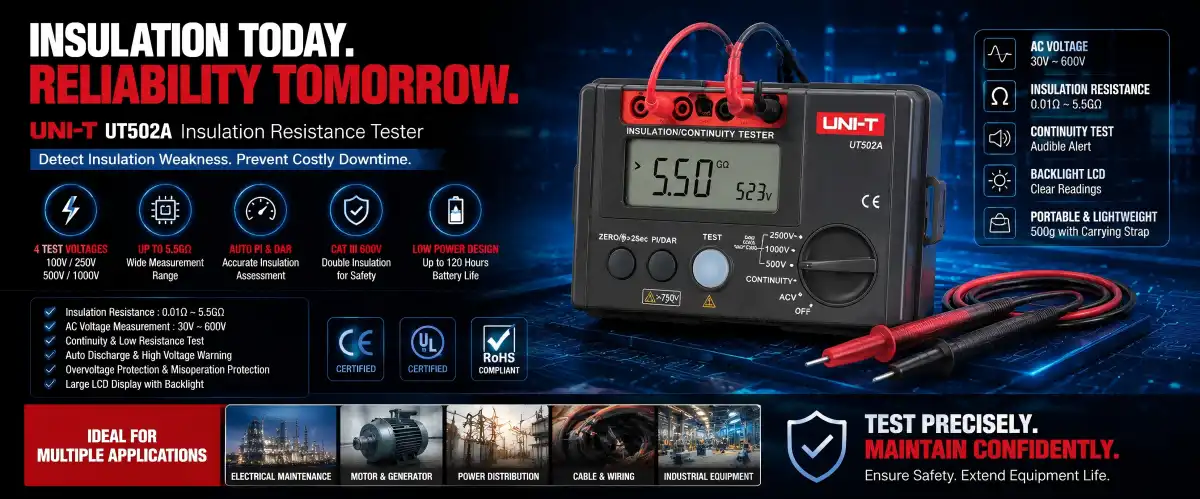
Of course. The UT501A Insulation Resistance Tester is a strong troubleshooting tool that finds insulation degradation before it gets so bad that it causes equipment failure. This small device finds weak spots in electrical insulation that usually happen before they break by measuring insulation resistance values up to 5.5GΩ across four voltage settings (100V, 250V, 500V, and 1000V). Its automatic PI and DAR calculation features check how old the insulation is, which lets maintenance teams plan fixes for planned breaks instead of having to deal with emergencies. When this tester is used as part of regular preventive maintenance, it greatly lowers unexpected outages, increases the useful life of assets, and safeguards important industry processes.
Understanding Equipment Failure Due to Insulation Issues
Degradation of electrical insulation is one of the main reasons why equipment breaks down, causing short circuits, burning, and other possibly dangerous events. Understanding how insulation breaks down helps businesses come up with good ways to stop it from happening.
Common Causes of Insulation Degradation
One of the most common reasons why insulation fails is that water gets inside. When water gets into insulation through cracks, bad seals, or condensation, it creates electrical paths that make resistance values much lower. There are more risks in industrial settings with a lot of damp or process fluids nearby. Another important factor is the age of the material. Over time, thermal stress, mechanical vibration, and chemical contact can weaken molecular bonds and damage physical features of insulation materials. Mechanical damage from mistakes in installation, too much shaking, or direct contact can leave something open to attack right away or speed up long-term wear and tear.
The Role of Regular Testing
It is possible to find these problems early on with systematic insulation resistance testing, which lets you fix them before they break. As part of testing processes, resistance values are usually measured at certain voltages and then compared to standard readings and maker specs. Trending analysis shows trends of slow decline that you might not notice until failure is about to happen. Businesses can get a lot of benefits from adding this kind of testing to their regular maintenance schedules. They can cut down on downtime by doing planned maintenance instead of responding to emergencies, extend the life of their equipment by fixing small problems before they get worse, and improve overall operational safety by getting rid of the risks that come with insulation failures. Electrical reliability groups have released research that shows that predictive maintenance programs that include regular insulation testing can cut the number of unexpected equipment breakdowns by up to 70%. This shows how important it is to be proactive.
Key Features and Specifications of the UT501A Insulation Resistance Tester
By mixing accuracy with ease of use in a portable package, the UT501A Insulation Resistance Tester offers a wide range of measurement options designed for a wide range of commercial uses.
Measurement Range and Accuracy
This tool has four voltage output settings: 100V, 250V, 500V, and 1000V. These settings cover all testing needs, from low-voltage control circuits to high-voltage power distribution systems. The large measurement range goes from very low resistance readings (as low as 0.01Ω), which are good for checking continuity and measuring coil resistance, all the way up to 5.5GΩ, which is used to measure insulation resistance. This flexibility gets rid of the need for various testing tools, which speeds up the maintenance process. The 1999-count LCD screen with blue backlight makes readings easy, even in electrical rooms that aren't well lit or outside. The simple interface lets you know right away about the test voltage range, battery state, and overload conditions.
Advanced Diagnostic Capabilities
This device is different from simple megohmmeters because it can automatically calculate the PI (Polarization Index) and DAR (Dielectric Absorption Ratio). By measuring resistance values at different times—usually 1 minute versus 10 minutes for PI and 30 seconds versus 60 seconds for DAR—these time-dependent tests check the quality of the insulation. Different absorption patterns are shown by old or dirty insulation compared to healthy materials. This gives maintenance workers more information about the state of insulation than just reading the resistance. This one-touch measurement feature lets you do professional-level evaluations without having to go through a lot of complicated setup steps.
Safety Mechanisms and Certifications
There are built-in safety features that keep users safe while trying. CAT III 600V certification proves it can work with distribution-level electrical systems, and the double insulation construction gives you even more safety in case of a fault. When testing is done, the automatic discharge function safely gets rid of any stored charge. This keeps you from getting shocked when you unplug the test lines. Users are warned when dangerous voltages are present by high-voltage alarms that can be heard or seen. Certifications from CE, UL, and RoHS show that these features meet world safety standards. Input overvoltage safety and wrong operation safeguards keep devices from getting damaged by accident, which makes them last longer.
Portability and Power Efficiency
The gadget is easy to hold and use for long testing sessions because it only weighs 500 grams and comes with a fabric bag and a carrying strap. The low-power design lets six AA batteries last up to 120 hours, so you don't have to stop to change the batteries during thorough building checks. One-knob range selection and one-button testing get rid of the need to navigate complicated menus, so techs can focus on measuring things instead of how to use the device. Because it is small and light, and its batteries last a long time, the device can be used for both lab testing and field work in big facilities.
Comparing UT501A with Other Insulation Resistance Testers
In the market for insulation resistance tests, there are well-known names like Megger and Fluke, as well as many other options at a range of prices. Comparing the UT501A Insulation Resistance Tester to these other products shows its unique place.
Performance and Value Proposition
Premium models from well-known brands usually have bigger measurement ranges, the ability to log data, and more advanced communication options. They also usually cost more than $800 to $1200. A balanced method is taken by the UT501A Insulation Resistance Tester, which offers key measurement tasks with professional-level accuracy at a much lower cost. The measurement range and voltage choices work perfectly for repair teams that test motors, transformers, cables, and switchgear on a regular basis. When accurate readings are more important than advanced functions that aren't used very often, the device really shines.
Practical Considerations for Procurement
A very important thing for measuring tools is how reliable their calibration is. The UT501A Insulation Resistance Tester's DC high-voltage production circuit uses switch-mode power supply boost technology, which makes it more stable in terms of voltage, smaller, and lighter than standard designs that use transformers. This technology method helps keep performance steady over time. The entry-level role means that test data has to be recorded by hand instead of being stored automatically. However, many maintenance processes already use manual logging systems or can easily be changed to work with this method. Companies that need automated data management can look at higher-tier models within the same product family, as long as they keep using the same user experience and testing methods.
Support Infrastructure
The support system around a measurement tool has a big effect on its long-term value, in addition to the device itself. Technical advice is given by authorized dealers to make sure that customers choose the right tools for their needs. Problems that may come up during ownership can be taken care of by warranties and helpful customer service. These things have a big effect on the total cost of ownership and the ability to keep operations going. The value offer of the UT501A Insulation Resistance Tester works especially well for businesses that care about return on investment, easy integration into current testing systems, and reliable performance without extra complexity. Companies with more than one location often use the same reliable, low-cost tools. This makes inventory management easier and training less necessary, which makes this device a good choice for large-scale operations.
How to Use the UT501A Insulation Resistance Tester Effectively
When used correctly, measuring tools are more accurate, users are safe, and damage to the tools is avoided. Consistent results come from following set processes and best practices.
Pre-Test Safety and Preparation
Make sure that the equipment being tested is fully off before you measure its insulation resistance. Use the device's built-in AC voltage reading function (30V to 750V range) to check for leftover voltage. Get rid of any energy that has been saved in sensitive parts. Keep the equipment away from circuits that are linked to it so that there aren't any parallel lines that could affect the accuracy of the measurements. Check the test lines for harm and make sure the insulation is still intact. Choose the right test voltage based on the equipment's grade. In general, 100V is best for electronics and control circuits, 250V is best for home wiring, 500V is best for commercial equipment up to 480V, and 1000V is best for systems with higher voltages. If you choose the wrong power, you could get wrong results or damage sensitive devices.
Conducting Measurements
Connect the black EARTH terminal to a ground reference point and the red LINE terminal to the wire you want to test. LINE should be connected to the winding, and EARTH should be connected to the motor frame. Turn the voltage setting knob to the test voltage you want. When you press and hold the test button, the gadget will send more voltage to the insulation and show you the number for the resistance. Keep pressing the test button for the whole measurement time, which is usually 60 seconds for normal numbers. When PI and DAR calculations are being done, the device times the reading and shows the results. When you let go of the test button, the automatic discharge function safety gets rid of the held charge. Keep track of both the numbers and the test settings (such as temperature and humidity), since the environment can change the insulation resistance values.
Troubleshooting and Maintenance
Readings that don't match up could mean that the link isn't working right, there are parallel resistance lines, or capacitive loads aren't getting enough charging time. Check the test specimen's separation and the links between the leads. Most of the time, error codes are caused by overloaded situations (resistance below measurement range) or open circuits (resistance above maximum range). For specific problem explanations, look at the user instructions. Regular upkeep checks the device's resistance against known standards, cleans the test lead connections, and replaces the battery when the low-battery light comes on. In normal use, the device doesn't need to be calibrated very often, but it should be checked once a year to make sure it stays accurate. The instrument will work well for many years if it is kept safe from high temperatures, wetness, and physical shock while it is being stored and moved.
Integrating Insulation Testing into Preventive Maintenance Programs
To keep the equipment of the UT501A Insulation Resistance Tester from breaking down, you need more than just good testing tools. Systematic integration into full repair plans is the best way to get the most out of them.
Establishing Baseline Measurements
When equipment is brand new or has just been serviced, it is important to take initial measurements of its insulation resistance to set a standard. Write down these numbers along with the name of the equipment, the test voltage, and the conditions of the surroundings. When we compare things in the future to these baselines, we can see if there are any worsening trends. Minimum accepted resistance values are set by industry standards, like IEEE 43-2013 for rotating machinery. However, trending analysis is often more useful than exact barrier comparisons. If the equipment's protection slowly drops over time, it needs to be checked more often, even if the current levels stay above the minimum levels.
Scheduling and Frequency
How often something is tested relies on how important it is, where it will be used, and how reliable it has been in the past. Important parts of production methods or safety systems should be tested every three months or even every month. Standard equipment in mild conditions usually needs to be tested once a year. Harsh settings with chemicals, water, temperature changes, or strong vibrations need to be checked more often. After electrical storms or other events that could put stress on insulation, do extra tests to make sure it stays strong. Maintenance management systems should keep track of testing plans, make sure they are followed, and alert users when exams are past due.
Data Analysis and Decision-Making
Systematic analysis adds value to data that has been collected. To see trends, plot resistance numbers over time. Sudden drops in resistance are a sign of serious problems that need to be looked into right away. Gradual decline means that something is getting worse over time, which lets you plan to fix it during planned downtime. You can find outliers that may need your attention by comparing numbers from different pieces of similar equipment. Connect changes in insulation resistance to things that happen during operations, maintenance, or the surroundings to figure out what caused them. This way of analyzing turns raw measurements into useful information that helps with setting goals for maintenance, making spending decisions, and planning for the replacement of capital assets. Companies that are very good at managing reliability see insulation testing not as a separate job, but as an important part of their overall asset management plans.
Conclusion
To keep equipment from breaking down, you need proactive tactics based on trusted diagnostic tools. These features are available in the UT501A Insulation Resistance Tester, which comes in a compact, low-cost package and has wide measurement ranges, automatic assessment functions, and strong safety features. This tool finds insulation decline before it becomes a failure, which helps maintenance teams plan their work in a proactive rather than a reactive way. With its four voltage choices, large resistance measurement range, and PI/DAR calculation, this tool is perfect for professionals who need to check the insulation in a variety of settings. This testing tool is very important for making sure that equipment works well and that operations don't stop when it is used as part of planned preventative maintenance programs that include setting up a baseline, testing on a regular basis, and carefully analyzing the data.
FAQ
1. What measurement range does the UT501A provide?
From very low values of 0.01Ω up to 5.5GΩ, the device can measure insulation resistance, which is more than enough for most industry testing needs. This wide range lets you check for continuity, measure coil resistance, and do a full insulation check on all kinds of equipment, from small control parts to big power distribution systems.
2. How often should equipment be tested with an insulation resistance tester?
How often something is tested depends on how important it is, the surroundings, and government rules. Critical assets usually need to be tested every three months, normal equipment every year, and equipment that works in harsh settings more often. Setting up a risk-based testing plan makes sure that resources are focused on the most important assets and that all sites are adequately covered.
3. What safety certifications does this tester carry?
The device has certificates from CE, UL, and RoHS, which show that it meets international standards for safety and the environment. The CAT III 600V grade shows that it can be used for work at the distribution level. Multiple built-in safety features, such as double insulation, automatic discharge, and high-voltage alarms, protect the user completely while testing.
4. Can this device replace more expensive testing equipment?
For businesses that need to measure core insulation resistance and do simple diagnostic tasks, this device works professionally and costs a lot less than more expensive options. For many maintenance tasks, more advanced features like large amounts of data storage or wireless connection that come with more expensive models may not be needed. This makes this device an excellent deal that is also good for the wallet.
Partner with MXTD for Reliable Testing Solutions
Industrial settings that are hard on equipment need reliable measuring tools and quick expert help to keep operations running smoothly. MXTD specializes in providing high-reliability testing solutions that are specifically designed to meet the needs of aerospace, military, chip manufacturing, and research organizations. As a seller of insulation resistance testers with a lot of experience, we know how important precise tools are for preventative maintenance plans.
Our team brings more than 12 years of experience in the field to every job, and we don't just sell tools; we offer full solutions. We answer technology questions within an hour, so your team always has access to help when they need it. Our engineering skills can help you find solutions that meet your business needs, whether you need standard testing tools or configurations that are made just for you to meet your needs. We do more than just sell products. As part of our pledge to long-term relationship success, we offer free software updates, remote video technical help, and a full warranty. Get in touch with our team at manager03@mxtdinfo.com to talk about how the UT501A Insulation Resistance Tester and all of our other measurement tools can help you do better preventative maintenance and keep your most important assets from breaking down at expensive times.
References
1. Institute of Electrical and Electronics Engineers (2013). "IEEE Recommended Practice for Testing Insulation Resistance of Electric Machinery," IEEE Standard 43-2013.
2. Stone, G.C., Culbert, I., Boulter, E.A., and Dhirani, H. (2014). "Electrical Insulation for Rotating Machines: Design, Evaluation, Aging, Testing, and Repair," 2nd Edition, IEEE Press.
3. Gill, P. (2009). "Electrical Equipment Testing and Maintenance," Electrical Transmission and Distribution Reference Book, 5th Edition.
4. National Fire Protection Association (2021). "NFPA 70B: Recommended Practice for Electrical Equipment Maintenance," 2021 Edition.
5. International Electrotechnical Commission (2016). "IEC 61557-2: Electrical Safety in Low Voltage Distribution Systems—Equipment for Testing, Measuring or Monitoring of Protective Measures—Part 2: Insulation Resistance."
6. Thorsen, O.V. and Dalva, M. (1995). "A Survey of Faults on Induction Motors in Offshore Oil Industry, Petrochemical Industry, Gas Terminals, and Oil Refineries," IEEE Transactions on Industry Applications, Vol. 31, No. 5.
Our customers’ satisfaction speaks for our quality — contact us to experience the same reliable service.