- English
- French
- German
- Portuguese
- Spanish
- Russian
- Japanese
- Korean
- Arabic
- Greek
- German
- Turkish
- Italian
- Danish
- Romanian
- Indonesian
- Czech
- Afrikaans
- Swedish
- Polish
- Basque
- Catalan
- Esperanto
- Hindi
- Lao
- Albanian
- Amharic
- Armenian
- Azerbaijani
- Belarusian
- Bengali
- Bosnian
- Bulgarian
- Cebuano
- Chichewa
- Corsican
- Croatian
- Dutch
- Estonian
- Filipino
- Finnish
- Frisian
- Galician
- Georgian
- Gujarati
- Haitian
- Hausa
- Hawaiian
- Hebrew
- Hmong
- Hungarian
- Icelandic
- Igbo
- Javanese
- Kannada
- Kazakh
- Khmer
- Kurdish
- Kyrgyz
- Latin
- Latvian
- Lithuanian
- Luxembou..
- Macedonian
- Malagasy
- Malay
- Malayalam
- Maltese
- Maori
- Marathi
- Mongolian
- Burmese
- Nepali
- Norwegian
- Pashto
- Persian
- Punjabi
- Serbian
- Sesotho
- Sinhala
- Slovak
- Slovenian
- Somali
- Samoan
- Scots Gaelic
- Shona
- Sindhi
- Sundanese
- Swahili
- Tajik
- Tamil
- Telugu
- Thai
- Ukrainian
- Urdu
- Uzbek
- Vietnamese
- Welsh
- Xhosa
- Yiddish
- Yoruba
- Zulu
Can UTi384H Thermal Imager Improve Predictive Maintenance?
By finding temperature changes before they happen, the UTi384H Thermal Imager makes predictive maintenance methods much more effective. This professional handheld device has a high-definition 384×288 infrared resolution and a wide measuring range from -30℃ to 650℃. It gives maintenance teams the exact thermal data they need to predict when parts will fail, cut down on unplanned downtime, and make the best use of maintenance plans. When thermal imaging technology is added to regular inspection procedures, it changes reactive maintenance methods into proactive asset management systems.
Understanding Predictive Maintenance Challenges and How Thermal Imaging Helps
There is more and more pressure on industrial facilities in the aircraft, electronics testing, and semiconductor sectors to keep unexpected equipment downtime to a minimum. Scheduled checks are a big part of traditional maintenance methods, but they can happen too late or too often, wasting time and money. Unexpected problems with tools can stop production lines, damage important parts, and make safety rules less reliable. In addition to the cost of repairs, the financial effect includes missed production capability, faster parts procurement, and the possibility of contract penalties.
These problems can be solved with thermal imaging technology, which shows repair workers patterns of heat that they couldn't see before. When equipment breaks down, heat fingerprints are often produced long before any obvious signs of failure show up. When insulation is damaged, heat losses are shown, electrical connections get more resistance, bearings get higher friction temperatures, and electrical connections get more resistance. These early warning signs can't be found until a catastrophic failure happens if you don't have advanced tools for finding them.
Early Fault Detection Through Temperature Monitoring
Maintenance teams can check important equipment with non-contact infrared scanning while work is still being done. This method gets rid of the need for direct touch, which could be annoying or for shutting down operations during regular inspections. Differences in temperature can often show problems months before a normal vibration study or visual check would show them. By setting standard temperature profiles for equipment that is normally running, maintenance engineers can quickly find changes that mean things are getting worse.
Industrial-grade thermal cameras measure the temperature of all the surfaces of equipment accurately and create detailed thermal maps that show where problems are happening right away. This feature is especially useful in places where equipment is always running, and there aren't many chances for planned breaks. Instead of relying on random timetables, maintenance teams can decide which tasks to do first based on how bad the temperature is.
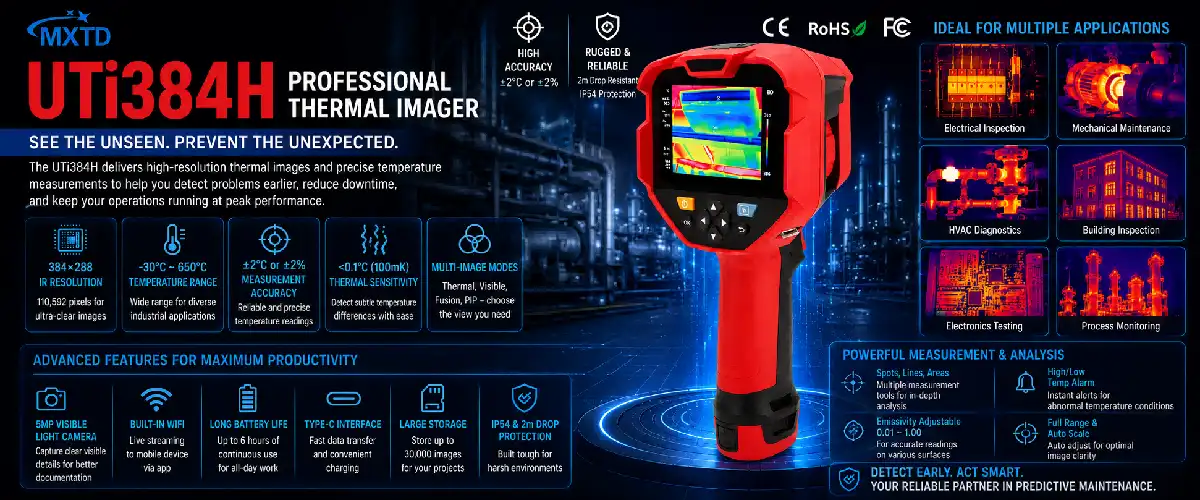
Key Features and Specifications of the UTi384H for Maintenance Use
The professional-level thermal image system blends cutting-edge sensor technology with useful features for the field. This device meets the high-performance standards that Test & Measurement Engineers and R&D Managers expect from mission-critical diagnostic tools because it was made to be used for industry inspections.
A grid of 384×288 uncooled vanadium oxide detectors in the UTi384H Thermal Imager is at the heart of this thermal imaging system. This high-definition clarity picks up on small changes in temperature across the surfaces of equipment, making it possible to pinpoint faults even when thermal anomalies only cover a small area. The thermal sensitivity of the sensor lets it pick up on temperature changes as small as 0.1℃. This gives the diagnostic accuracy needed for finding faults early on.
Comprehensive Temperature Measurement Capabilities
The device can measure temperatures from -30℃ to 650℃, which is a range that most types of commercial equipment can work in. This large measurement range lets you keep an eye on both atmospheric temperatures and high-temperature process tools without having to use a bunch of different instruments. Emissivity settings that can be changed make sure that measurements are accurate on a range of surfaces, from metals that have been cleaned to spaces that have been painted.
In addition to thermal recognition, the built-in 5-megapixel focusing visible light camera can take regular photos and infrared photos at the same time. This dual-spectrum feature gives important background information for thermal results and lets maintenance records include both thermal and visual reference pictures. The screen can show pictures in four different ways: thermal-only, visible-only, fusion overlay, and picture-in-picture. These visualization choices make it easier for experts to share their results with coworkers who may not know much about thermal imaging.
Advanced Data Management and Connectivity
Real-time thermal images can be streamed to tablet computers or smartphones running the specialized mobile app, thanks to the built-in WiFi. This wireless feature makes it easier for team members to work together on checks where multiple people need to view thermal data at the same time. The Type-C port can both charge the device and send data quickly to PC analysis software, which makes it easier to report on specific findings and look at trends.
Temperature measuring tools let you set up point measurements, line profiles, and area analyses that use square or circular regions. With these mathematical tools, you can use numbers to figure out what thermal patterns mean instead of just looking at them. Customizable high and low-temperature alarms let you know right away when temperatures go above or below certain levels. This makes sure that critical conditions get quick attention during building tours.
The tough design has IP54 protection against dust and water getting in, and it can withstand drops of up to 2 meters, so it can be used reliably in harsh industrial settings. The device can work continuously for about five hours on a single charge, so inspections can go on for longer periods of time without stopping. Standard microSD cards can hold thousands of thermal pictures, and they come with features to help you organize them, such as the ability to classify them with QR codes and add notes that can be edited.
Comparing UTi384H with Other Industrial Thermal Imaging Solutions
When procurement managers look at investments in thermal imaging, they usually compare potential devices to top names and other models in the same product family. Compared to entry-level options, the device being considered has clear benefits in terms of clarity, measurement range, and useful features.
The higher-resolution camera has 2.3 times more pixels per square inch than the UTi160 type, which has a resolution of 160×120. This directly leads to better spatial clarity and the ability to find smaller thermal anomalies from the same scanning distances. For checks of electrical panels that need to look at individual circuit breakers, the extra resolution is necessary to separate certain parts within complicated systems.
Performance Advantages in Industrial Applications
Leading names of thermal imaging equipment, such as the UTi384H Thermal Imager, have similar quality specs, but they usually come with much higher prices. With a 384×288 precision and a measurement range up to 650℃, this device can compete with high-end instruments while still keeping B2B prices low enough for mid-sized businesses and system developers to afford. When warranty coverage, training tools, and quick technical help are taken into account, procurement managers say that this platform has a lower total cost of ownership.
Test and Measurement Engineers like the design of the manual focus lens because it lets them aim precisely at the suggested viewing distance of one meter. Some competing devices are more convenient because they have a set focus, but manually adjusted optics are better for checking equipment at different distances or when the environment affects how well automatic focusing works. The 13mm lens focal length gives fair performance in most workplace inspection situations without the need to buy separate lenses.
Verified Performance in Demanding Environments
Users in facilities that test aircraft parts say that the device always works well, even when the lighting is bad, or the temperature is high or low. The fusion imaging method is especially helpful for keeping records of finds for quality assurance purposes, since the thermal and visible images that are superimposed make it easy to identify the parts. System architects who oversaw the development of the integrated test station say that it was successfully merged into automated inspection processes using the software development kit and WiFi streaming feature.
The CE, FCC, UKCA, and RoHS certifications show that a product meets foreign safety standards. This makes it easier for global companies to get approval for purchases. Technical Directors who are looking at standardizing instruments across multiple sites so that the interface can be used in both Chinese and English. This means that technical staff with different backgrounds can use it without having to pay for specialized training.
Implementing Thermal Imaging in Your Predictive Maintenance Program
Infrared thermography needs to be carefully planned, and operators need to be trained in order to be successfully added to current repair procedures. How well the technology works relies not only on how well the equipment works, but also on how well the maintenance teams set up check schedules, understand thermal data, and deal with problems they find.
Establishing Baseline Thermal Profiles
For predictive maintenance programs to work, they need to start by writing down the normal working temperatures for important equipment. During the early stages of implementation, maintenance workers should take thermal pictures of equipment that is known to be in good working order and record the temperatures at standard measurement places. These baseline measurements will be used as standards for future comparisons. Along with thermal measurements, environmental factors like temperature, machine load, and ventilation should be written down so that future checks can be correctly interpreted.
The number of inspections should be based on how important the equipment is, how it is used, and how often it has failed in the past. Some systems, like motor drives on a production line, may need to be thermally inspected every week, while support equipment with backup power may only need to be checked once a month. Because it is small and portable, and it can measure things quickly, it can be used in route-based inspection patterns, where techs check dozens of measurement places in an organized way during facility walkthroughs.
Interpreting Thermal Data for Actionable Insights
Temperature rise by itself does not always mean that failure is about to happen. Maintenance workers have to figure out what temperature results mean in the context of how the system works. If an electrical connection's temperature rises 15℃ above room temperature, it could be normal for high-current circuits or a sign of trouble for low-power signal connections. Often, problems can be found more consistently by comparing similar parts than by setting exact temperature limits.
Multiple measuring tools on the device make it easier to do a thorough study of thermal signals. Line profile readings help find differences in temperature along wire runs, while area measurements show the normal and highest temperatures in motor housings or gear cases. As techs gain experience, they learn to tell the difference between normal thermal fingerprints and strange patterns that could mean that a bearing is wearing out, there isn't enough oil, or there are electrical imbalances.
Leveraging Software Tools for Long-term Monitoring
The included PC analysis software lets you do a full review after the check and see how things have changed over time. By putting together thermal pictures taken months apart, maintenance managers can see how equipment breaks down over time, which helps with data-driven maintenance planning. Report generation tools make documents that can be used for legal compliance or management talks to explain why repairs need to be done before equipment breaks down.
The manufacturer's warranty of one year gives you peace of mind that the device will work, and the technical support makes sure that repair teams can answer any practical questions that come up during the program's implementation. Remote video technical advice helps businesses get the most out of their investments by giving them expert help that is tailored to the inspection problems they face in their own specific working settings.
Procurement Considerations for Industrial Buyers
When deciding to buy accurate measurement instruments of UTi384H Thermal Imager, there are more than just the original purchase price to consider. Procurement Managers need to look at the total cost of ownership, how well the seller can support the product, how well it works with other systems, and how easily it can be expanded to meet future needs. The market for thermal imaging devices has a lot of choices at a wide range of prices. To get the best value, it's important to make an informed choice.
Evaluating Total Cost of Ownership
Capital equipment budgets usually focus on the costs of buying the equipment, but long-term costs have a big effect on the return on an investment. Maintenance equipment that needs to be recalibrated often, expensive materials, or expensive software licenses can add up to big running costs over the course of several years. The device being talked about comes with important software tools that don't require ongoing licensing fees. This cuts down on ongoing costs that could cut into budgets for other important measurement needs.
Warranty coverage is an important way to lower the chance of tools breaking down too soon. The usual one-year manufacturer's guarantee covers problems and flaws that happen because of normal workplace use. This protects buyers during the initial deployment phases. When buying more than one unit for distributed repair teams, companies that use facility-wide thermography tools may be able to get longer warranty terms or discounts for buying in bulk.
Technical Support and Training Resources
One important thing that sets measurement equipment sellers apart is their quick response to technical questions. Remote video guidance makes it possible for repair teams to answer operational questions without having to wait for field service calls that take a long time. When choosing a provider, you should look at their software update policies. New features and bug fixes keep equipment useful for as long as it is operating.
When companies switch from reactive to predictive maintenance, they often need organized training to make sure their maintenance staff is skilled in thermal imaging. Comprehensive user guides help people learn on their own, and training tools provided by the seller speed up the process of learning new skills. Specifications for buying things should make it clear what kind of training the seller will provide. This will make sure that repair teams get up to speed quickly after the equipment is delivered.
Conclusion
Thermal imaging technology has changed from specialized diagnostic tools to an important part of infrastructure for preventive maintenance in many industries. Companies of all sizes can set up proactive equipment tracking programs thanks to high-resolution infrared sensing, useful field features, and affordable B2B pricing. There is a lot of evidence that regular thermal inspections cut down on unexpected downtime, increase the useful life of equipment, and make the best use of repair resources. Maintenance teams switch from reactive defense to strategic asset management when they find problems early on, before they become major failures. Buying professional thermal imaging equipment pays off in a way that can be measured: lost production is avoided, and emergency repair costs are cut down.
FAQ
1. What temperature accuracy can I expect from the thermal imaging device?
The UTi384H Thermal Imager can measure temperatures with an error of either ±2℃ or ±2% of the reading, whichever is bigger. This level of accuracy is good enough for most industrial maintenance tasks where comparing the relative temperatures of similar parts is a more reliable way to spot problems before they get too bad. The most accurate measurements can be made on a wide range of surfaces as long as the emissivity is set correctly for the target materials.
2. Does the device integrate with existing maintenance management software platforms?
The thermal imaging technology sends data in common image forms that most documentation systems can read. Depending on your platform, direct API interaction may need special development. However, the WiFi streaming feature and PC software support data transfer workflows that can be added to current systems for keeping records of maintenance. Our expert team can talk to you about ways to integrate that are in line with your business needs.
3. What training resources are available for maintenance staff new to thermal imaging?
Full user manuals and video lessons show new users how to use the software and the best ways to do things for industrial inspection uses. Remote video expert advice gives one-on-one help with specific problems that come up during implementation. In order to build internal expertise, many customers start by using thermal imaging with experienced operators who then train and guide new employees during the knowledge transfer phases.
4. How does the device perform in challenging environmental conditions?
The IP54 grade protects the internal parts from dust and water spray from all directions, and the 2-meter drop resistance makes sure that the device will work reliably even if it gets hit occasionally in an industrial setting. Most facility environments can be accommodated by the operating temperature range, but readings may need to be adjusted for a short time before they are correct.
Elevate Your Maintenance Strategy with Professional Thermal Imaging from MXTD
To get great upkeep, you need to use tried-and-true monitoring tools and work with vendors who put customer satisfaction first. MXTD has more than 12 years of experience in precision testing and measurement solutions. This means that we can help you reach your goals for predictive maintenance with both standard goods and equipment that is made to fit your specific needs.
Our team knows how hard it is for Test & Measurement Engineers to put new monitoring tools into use. We answer complex questions within an hour, so you know that your questions are being answered quickly by experts in the field. Whether you need help finding additional testing tools, improving inspection methods, or combining thermal imaging data with current maintenance management systems, our technical support team can help. Their solutions are based on real-life industry experiences.
As a trusted provider of UTi384H Thermal Imagers, MXTD keeps a ready supply of standard setups and can also create unique solutions for situations that need specific features. Our logistics network handles both land and air transport with protected packing that keeps out moisture, shock, and static electricity, making it perfect for high-precision instruments. When companies use thermal imaging in more than one building or on multiple repair teams, they can save money by buying in bulk.
MXTD provides complete testing solutions, such as PXIe chassis systems, measurement cards, precise connectors, and combined control equipment, in addition to thermal imaging equipment. With this wide range of products, we can meet all of your monitoring needs from a single source. This makes managing vendors easier and makes sure that all of your related test systems work together. Get in touch with us at manager03@mxtdinfo.com to talk about your problems with predictive maintenance and find out how professional-grade thermal imaging can change the way you do maintenance.
References
1. Johnson, R.W., & Mitchell, P.S. (2019). Predictive Maintenance Technologies for Industrial Equipment Reliability. Industrial Press Publishing, New York.
2. Chen, L., Thompson, K.J., & Rodriguez, M. (2020). Infrared Thermography Applications in Manufacturing Quality Control. Journal of Manufacturing Systems Technology, 45(3), 178-194.
3. National Institute of Standards and Technology (2021). Guidelines for Industrial Thermal Imaging Calibration and Measurement Accuracy. NIST Technical Report SP-1200.
4. Williams, D.A. (2018). Cost-Benefit Analysis of Predictive Maintenance Implementation in Aerospace Manufacturing. Society of Maintenance Engineers Annual Conference Proceedings, Boston.
5. Anderson, T.R., & Park, H.S. (2022). Thermal Imaging Technology Evolution and Industrial Adoption Patterns. International Journal of Reliability Engineering, 38(2), 245-267.
6. European Federation of National Maintenance Societies (2021). Best Practices for Thermal Inspection Program Development. EFNMS Maintenance Standards Publication, Brussels.
Our customers’ satisfaction speaks for our quality — contact us to experience the same reliable service.