- English
- French
- German
- Portuguese
- Spanish
- Russian
- Japanese
- Korean
- Arabic
- Greek
- German
- Turkish
- Italian
- Danish
- Romanian
- Indonesian
- Czech
- Afrikaans
- Swedish
- Polish
- Basque
- Catalan
- Esperanto
- Hindi
- Lao
- Albanian
- Amharic
- Armenian
- Azerbaijani
- Belarusian
- Bengali
- Bosnian
- Bulgarian
- Cebuano
- Chichewa
- Corsican
- Croatian
- Dutch
- Estonian
- Filipino
- Finnish
- Frisian
- Galician
- Georgian
- Gujarati
- Haitian
- Hausa
- Hawaiian
- Hebrew
- Hmong
- Hungarian
- Icelandic
- Igbo
- Javanese
- Kannada
- Kazakh
- Khmer
- Kurdish
- Kyrgyz
- Latin
- Latvian
- Lithuanian
- Luxembou..
- Macedonian
- Malagasy
- Malay
- Malayalam
- Maltese
- Maori
- Marathi
- Mongolian
- Burmese
- Nepali
- Norwegian
- Pashto
- Persian
- Punjabi
- Serbian
- Sesotho
- Sinhala
- Slovak
- Slovenian
- Somali
- Samoan
- Scots Gaelic
- Shona
- Sindhi
- Sundanese
- Swahili
- Tajik
- Tamil
- Telugu
- Thai
- Ukrainian
- Urdu
- Uzbek
- Vietnamese
- Welsh
- Xhosa
- Yiddish
- Yoruba
- Zulu
UTi384H Thermal Imager Features Every Technician Should Know
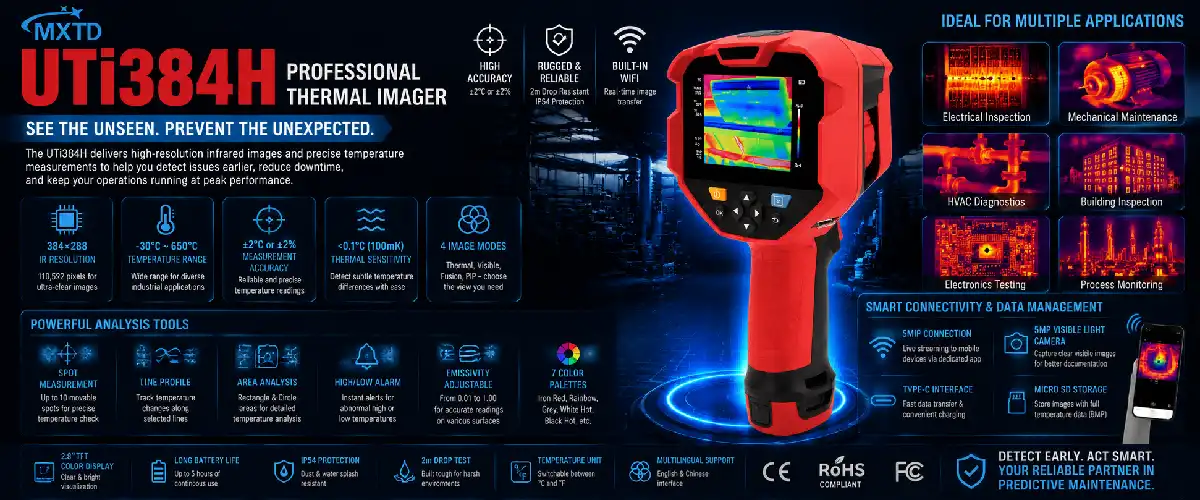
In current workplace settings, it's important to find temperature problems early on, before they become costly failures. The UTi384H Thermal Imager meets this important need by blending a 384×288 VOx infrared detector with useful features that are ready to use in the field. This thermal imaging device gives accurate non-contact temperature readings from -30℃ to 650℃ and is made for workers who work with electrical problems, HVAC systems, and mechanical repair. This tool is made to last with an IP54 rating, built-in WiFi, and the ability to take pictures in two different wavelengths. It helps technicians and purchasing managers who need reliable thermal diagnostic solutions for tough industrial settings where accuracy and dependability are key to success.
Overview of UTi384H Thermal Imager Specifications and Core Features
High-Resolution Infrared Detection Capability
The high-tech 384×288 pixel uncooled vanadium oxide detector is what this thermal imaging device is built on. This precision is better than that of basic thermal cameras, so techs can see small changes in temperature that could mean electrical problems or wear on the machine. The infrared sensor works in a wide range of temperatures, from -30℃ to 650℃, so it can be used for a wide range of inspection tasks, from checking cold storage facilities to high-temperature industrial processes. This large measurement range is helpful for checking overheated transformers, motor windings, or bearing systems, where accurate temperature information helps with maintenance choices.
The 13mm lens can be adjusted by hand, so it can be used at a range of viewing distances. For best accuracy, it should be used about one meter from the target surface. This focal setup strikes a good mix between thermal sensitivity and the actual working distance needs that come up when inspecting things like electrical cabinets, HVAC systems, and production equipment.
Dual-Spectrum Imaging and Display Modes
The device does more than just detect heat; it also has a 5-megapixel focusing visible light camera that can take regular pictures as well as infrared data. This dual-spectrum feature lets you choose from four different show styles that make diagnostics clearer:
Thermal Mode lets you see only infrared images with temperature-based color schemes. This makes it easy to find hot spots in machinery or electrical panels. Visible Mode changes to normal photographic recording when thermal data isn't needed right away. Fusion Mode adds thermal information on top of pictures that can be seen. This makes paperwork that is full of context and shows exactly where temperature differences exist in complicated equipment assemblies. Picture-in-Picture (PIP) Mode inserts a thermal window into a visible light picture. This lets technicians show their results with easy-to-understand visual cues for people who aren't technical.
With these imaging choices, raw temperature data is turned into information that can be used. The fusion feature helps engineers connect heat signatures to specific parts or structural elements when they are recording thermal patterns in building shells or distribution systems. This speeds up fixing and makes it easier to decide which repairs to do first.
Comprehensive Temperature Analysis Tools
For a professional thermal check in the UTi384H Thermal Imager, you need more than just information from a single point. The thermal imager has advanced measurement tools, such as the ability to analyze points, make line profiles, and measure areas through rectangular and circular areas of interest. Technicians can use these tools to keep an eye on temperature differences along wire runs, contrast the thermal performance of similar parts, or set standard temperature profiles for preventative maintenance programs.
Users can change important measurement factors like emissivity values to take into account different surface materials. This way, users can get accurate readings whether they are looking at oxidized copper wires, painted steel enclosures, or metal heat sinks. The gadget saves pictures in the BMP format on Micro SD cards that also contain full measurement data. This makes lasting records that can be used to show compliance and look at trends. There are seven color schemes that can be chosen to make rendering better for different types of inspections. For example, iron-red gradients show very high temperatures, while rainbow spectrums show small changes in temperature.
Connectivity and Data Management
For modern temperature diagnostics to work, they need to be easily integrated with processes for analysis. Built-in WiFi lets you stream wirelessly to smartphones or tablets through special apps. This lets experts from far away help workers on-site with difficult diagnostic tasks. The Type-C port can charge the internal battery so that it can work continuously for about five hours, and it can also be used to move stored pictures to computers so that they can be analyzed in more detail using PC software that is compatible.
This connection design lets people work together to diagnose problems in real time and make reports when they're not online. Maintenance teams can quickly share thermal results with engineering staff, and procurement managers can look at recorded equipment states to decide whether to fix or replace something. The Chinese and English interfaces make it possible to do business with people from other countries, and the switchable temperature numbers (℃/℉) make sure that everything works everywhere.
Rugged Construction for Industrial Environments
Measuring precision is important, but field dependability is even more important. The IP54 grade protects the electronics inside from dust and water splashes that are common in industrial areas. Also, the device can handle being dropped two meters onto concrete, which is something that can happen when working on stairs, scaffolding, or crowded production floors. Because it is so durable, it will keep working well even during busy inspection times, without needing to be fixed or re-calibrated all the time.
The gadget has certificates from CE, FCC, UKCA, and RoHS, which show that it meets international safety and environmental standards. These licenses are important for procurement teams that are in charge of operations in multiple regions where equipment needs to meet different legal standards. The one-year manufacturer guarantee that comes with the diagnostic equipment gives groups that are spending a lot of money on it extra peace of mind.
Application Areas and Practical Benefits for Industrial Use
Electrical System Inspection and Fault Prevention
Electrical problems are still one of the most expensive reasons why factories have to shut down. Thermal imaging changes electricity upkeep from fixing problems after they happen to preventing them before they happen. Technicians can find weak connections, overloaded circuits, and failed parts with this tool long before they cause major problems. When cable terminations are hotter than the connections next to them, it means that the resistance is going up, which is often the first sign of hardware that is coming loose or rusting. When circuit breakers get hotter than their standards say they should, it means they are overloaded or breaking down internally, which needs instant attention.
In transformer substations in UTi384H Thermal Imager, temperature patterns show issues with the cooling system, hot spots on the windings, or problems with the tap switch. Regular temperature scans help motor control centers find problems like broken control relays, contactor pitting, or bus bar overheating. When stages have very different thermal profiles, distribution screens show that the load is not balanced. With these early signs, maintenance crews can plan fixes for planned downtime instead of having to respond to emergency outages. This protects both worker safety and production schedules.
HVAC System Diagnostics and Energy Efficiency
Thermal imaging is used by building systems experts to find problems with heating, ventilation, and air conditioning that can't be fixed with other methods. Unusual temperature patterns in underfloor heating systems show where there are blockages or leaks that can't be seen with the naked eye. Leaks in air conditioning refrigerant show up as cold spots on evaporator coils or suction lines. This makes it easy to find places to fix without having to do time-consuming pressure tests. Problems with the heat pump's performance become clear when you compare the temperatures inside the compressor case to the manufacturer's recommendations.
When duct systems find places where air is leaking or where thermal signs are different from those around them, they can find efficiency losses that drive up running costs. Uneven temperature spread on radiant heating panels can mean that the airflow isn't working right or that the heating elements have failed. The imager can work with both chilled water systems that are close to freezing and steam heating parts that are above 100℃ because it can handle a wide range of temperatures. Energy inspectors keep track of thermal performance before and after system updates. This gives investors a way to measure the return on their investments in efficiency improvements.
Building Envelope and Moisture Detection
Thermal imaging is becoming more and more common in construction quality review and building envelope testing. Thermal studies that are done with the right difference in temperature between inside and outside show clearly where insulation problems, thermal bridges, and air infiltration tracks are. When there isn't enough insulation in wall spaces or when frame members conduct heat through insulated panels, different thermal patterns are created. When windows and doors are installed, they show that air is leaking around the frames. When the roof is inspected, wet insulation keeps heat in differently than dry insulation.
When water gets in through plumbing leaks, roof damage, or condensation, it leaves behind unique thermal fingerprints. This is because water evaporation cools things down, and wet materials change how well they carry heat. These features help site managers fix problems with how buildings work that make people less comfortable and use more energy. For system programmers and building automation workers, thermal documentation helps with commissioning records that check the quality of the installation and the system's performance against the design specs.
Mechanical Equipment Condition Monitoring
The health of production tools has a direct effect on how well it works and the quality of the products that are made. Machines that spin produce heat fingerprints that show signs of bearing wear, imbalance, not enough lubrication, or problems with the connection. When bearings work at temperatures above usual, it means they are about to break. This lets maintenance teams change parts during planned shutdowns. Inspections of gearboxes show that the temperatures of the individual gears can point to problems with lubricant or tooth wear patterns. When there is misalignment in a belt drive system, the uneven temperature spread across the pulley sides shows it.
Thermal tracking can help find problems with hydraulic and pneumatic systems, like pump cavitation, valve leaks, or cylinder seal degradation. The thermal profiles of process equipment set the standard working conditions that allow predictive maintenance systems to extend the life of parts and reduce the number of unexpected failures. The device can run continuously for five hours, which lets you do long machinery surveys across big sites without having to stop to change batteries. This keeps the surveys consistent and cuts down on the time needed for inspections.
UTi384H Thermal Imager vs Competitors: Informed Decision-Making for Buyers
Performance Comparison Against Leading Thermal Imaging Brands
When expert decision-makers compare new thermal diagnostic tools to well-known names, they look at things like resolution, measurement accuracy, feature sets, and total ownership costs. With a size of 384×288 pixels, this device is in the middle of the performance range. It takes much better pictures than basic 160×120 or 256×192 cameras, and it's still affordable enough for professional use. When comparing infrared clarity, competing models from high-end manufacturers often come with big price tags. This can be good for buying teams that are watching their budgets.
Another thing that sets them apart is the temperature reading range. The temperature range of -30℃ to 650℃ covers most workplace electrical and mechanical needs without the need for multiple specialized devices. Some rival models don't go below a certain temperature, which makes them less useful for cold storage or diagnosing problems with cooling. Other models go above 1000℃, but they cost more and aren't usually needed in places like foundries or glass factories. The useful temperature range works for most facilities' major uses, which are electrical distribution, HVAC, and general industrial repair.
Feature Comparison and Practical Value Assessment
How useful and informative something is depends on how many features it has. The built-in 5MP visible light camera sets this model apart from cheaper options that don't have dual-spectrum support, while meeting or beating the specs of more expensive options' visible cameras. The four display modes—thermal, visible, fusion, and PIP—offer a level of viewing freedom that cheaper devices simply can't match. WiFi connectivity is still not common in cheaper thermal cameras, but it is becoming more and more important for joint diagnosis and online expert advice.
The IP54 grade for environmental protection and 2-meter drop resistance are the same as or better than the usual protection levels for this type of product. This means that it will last as long in the field as more expensive options. The battery's runtime of about five hours is longer than what other companies offer, which means that operations won't have to be interrupted during thorough facility surveys. The Type-C charge and data transfer is more up-to-date than the older micro-USB ports that are still on rival models. This protects the investment for the future as Type-C becomes standard.
Model Differentiation Within Product Line
Knowing the differences in what similar models can do helps buyers match the right specs to their needs. For professional industrial use, the UTi384H strikes a good mix between resolution and functions. Other models with 480×360 or higher resolutions offer better picture clarity, which is helpful when checking electrical terminals that are close together or objects that are far away, but they cost more to buy. On the other hand, lower-resolution options cost less at first, but the images are less clear, which is often necessary to tell individual parts of complex systems apart.
For most industrial repair tasks, differences in resolution and features are more important than changes in temperature range. Companies that mostly do electrical checks rarely come across temperatures above 400℃, so the extra cost of extended range skills isn't required. On the other hand, places that use high-temperature methods should make sure that the measurement ranges meet their needs. Comparing the real application needs to the technical specs keeps you from both buying too little equipment or paying for features that you won't use.
Purchasing and Procurement Guide for UTi384H Thermal Imager
Procurement Channels and Verification Procedures
Corporate purchasing teams need reliable ways to get products that are real, come with legal warranties, and can be backed up after the sale. Authorized wholesaler networks set up official supply chains that link makers to end users. This makes sure that customers get real goods that are backed by official warranties. When looking at thermal imaging suppliers, checks should be made to make sure they are authorized. This will stop fake goods or illegal imports that don't have maker's backing.
When companies buy in bulk to equip multiple maintenance teams or regional sites, they should talk about volume prices, choices for longer warranties, and what training packages come with the purchase. A lot of sellers set their prices in a way that rewards big contracts while still allowing for staged deployments across fiscal periods. When you buy something from another country, you have to think about shipping details, like how to handle customs paperwork, import taxes, and transport insurance for fragile instruments that need to be handled carefully.
Integration Support and Training Resources
Buying equipment is only the first step in the rollout process. For it to go smoothly, users must be trained, and the company must be integrated. Complete procurement packages should include initial training that covers how to measure, how to change the emissivity, how to analyze images, and how to handle data. With remote video technical advice, maintenance teams can figure out what's wrong with strange results or find the best measurement parameters for a given application without having to pay for expensive on-site service calls.
Long-term business costs and skills are affected by software licensing issues. PC research programs and mobile apps let you do more than just use your device to make reports, look at trends, and keep track of documents. Total ownership costs are affected by whether software changes cost a subscription fee or are free for the life of the gadget. How smooth integration is depends on the data export formats and how well they work with current maintenance management systems. This affects how quickly thermal diagnostics become commonplace instead of rare.
Warranty Coverage and After-Sales Support Framework
Standard one-year maker guarantees cover flaws in the materials and the work for the UTi384H Thermal Imager, but they don't usually cover damage from accidents, misuse, or standard wear and tear. Making warranty terms clearer, like how long it takes to fix something, whether loaner equipment is available during service periods, and how to buy an additional warranty, helps buying teams figure out how much risk there is and set the right budget. Companies that run important facilities where thermal diagnostic tools could affect safety or production should look into extended service agreements that offer faster repair services and options for early replacement.
International help is important for global companies or system integrators that work with customers in a lot of different areas. Making sure there are local service centers, expert help available in multiple languages, and cross-border warranty acceptance stops support gaps that leave equipment idle while manufacturers take a long time to process returns. Users can ship equipment directly to service centers through depot repair services from some sellers, while others run regional service networks with faster response times through local facilities.
About UTi Thermal Imager Brand and Manufacturer Insights
Company Background and Market Positioning
UNI-T is well-known in the markets for test and measurement instruments because it consistently improves product quality and technology. The company's thermal imaging line is aimed at professionals who need reliable testing tools but don't want to pay the high prices of luxury brands. This standing in the market brings in maintenance companies, property management teams, and technical service providers who are more interested in maximizing performance to cost than in building a reputation with a well-known brand.
The company's dedication to foreign approval standards, shown by their compliance with CE, FCC, UKCA, and RoHS, shows that they care about quality control and following the rules that professional buyers expect. For these certificates, independent lab tests and checks of the manufacturing process are needed. This gives procurement teams proof that the products are safe and good for the environment. Companies that run ISO-certified businesses or serve regulated industries find that these certifications make it easier to qualify tools and answer audit questions.
Authorized Distribution and Support Networks
Reliable delivery networks make sure that products are available, that customers can get professional help, and that guarantee services are provided. Authorized partners have direct ties with manufacturers, which lets them give correct information about products, valid warranty coverage, and expert advice using resources from manufacturers. This structure for approved channels shields buyers from fake goods, used equipment that is sold as new, and illegal imports that don't have the right infrastructure for support in the buyer's region.
When purchasing managers look at thermal imaging providers, they should ask about permission paperwork, service capabilities, and the qualifications of expert staff. Distributors who give application advice, test equipment, and training after the sale are more valuable than those who only sell products. As an organization's thermal diagnostic tools get better and its needs change for more complex uses or bigger lines of equipment, long-term relationships with skilled distribution partners continue to pay off.
Conclusion
Professional temperature tests have gone from being used only in certain situations to being an important part of care in all fields. The features we looked at in this analysis—high-resolution infrared detection, dual-spectrum recording, complete measurement tools, and tough construction that is ready for the field—work together to make diagnostic solutions that solve real operational problems. Thermal imaging has real benefits, such as preventing electrical faults, improving safety, and extending the life of equipment. It can also be used to make HVAC systems more efficient and keep an eye on mechanical conditions. Technical leaders who have to balance performance needs with limited budgets can get a lot of value from mid-range thermal imaging devices that offer professional features without the high cost. Companies that use thermal diagnostic tools set themselves up for preventative maintenance cultures that stop problems before they happen, instead of just responding to situations. This protects both business continuity and financial success in the long run.
FAQ
1. What temperature measurement accuracy should I expect from thermal imaging devices?
Professional thermal cameras usually have an exact range of ±2℃ or ±2% of the reading, whichever is greater. The precision of the measurement rests a lot on the right emissivity settings for the target materials, the right measuring distance, and the conditions in the surroundings. To get accurate readings, you have to carefully change the parameters or prepare the surface of shiny metals with low emissivity. On the other hand, painted or rusted surfaces usually give accurate readings with the default settings.
2. Can thermal imagers detect electrical problems before they cause failures?
Electrical resistance problems produce heat before they lead to full failures, which is why thermal imaging is so good at finding faults early on. Temperature rises can be seen weeks or months before a catastrophic failure happens because of loose connections, corroded leads, and overloaded wires. When maintenance teams do regular thermal scans, they can plan fixes for planned downtime instead of having to wait for unplanned breakdowns to happen.
3. How does environmental rating affect thermal imager reliability?
The IP54 grade means that the device is safe from dust and water splashes from all directions, so it can be used in most workplace settings. This amount of protection doesn't make it waterproof, but it can handle light rain, humid conditions, and dusty workplaces without any problems. The 2-meter drop standard covers accidental impacts that can happen when working on stairs or in crowded equipment rooms. This makes sure that operations can continue even when normal mistakes happen in the field.
4. What file formats and storage options support documentation requirements?
Images are saved to Micro SD cards in BMP format, along with measurement data that is inserted. This makes lasting records that can be used to show compliance and look at trends. The WiFi and Type-C data sharing make it easy to send pictures to computers or mobile phones so they can be used in inspection reports, maintenance management systems, or databases that track the state of assets to help with predictive maintenance programs.
Partner With a Reliable Industrial Diagnostic Equipment Provider
At MXTD, we know that procurement workers looking for UTi384H Thermal Imager thermal imaging solutions need more than just product specs. They also need relationships that are responsive and support long-term business success. We can help you set up your temperature diagnostic program because we have over 12 years of experience working with precision testing and measurement tools in the aerospace, defense, semiconductor, and industrial automation industries. We mostly work with PXIe chassis systems and integrated measurement solutions, but we also keep a lot of partner networks that connect purchasing teams with high-quality thermal imaging devices that fit the needs of each application.
We answer questions within an hour and offer technical advice that helps you match specs with your real operational needs. Our engineering team gives application-specific advice based on years of experience in the field, whether they are looking at thermal imagers or unique testing solutions. When sending internationally, we can use packaging that is resistant to moisture, shock, and static electricity to keep precise tools safe during travel. Get in touch with us at manager03@mxtdinfo.com to talk about your thermal diagnostic needs or to look into your bulk purchasing options for professional-grade equipment that supports important industrial uses.
References
1. Vollmer, M. and Möllmann, K. (2017). Infrared Thermal Imaging: Fundamentals, Research and Applications. Wiley-VCH, Weinheim, Germany.
2. Meola, C. and Carlomagno, G.M. (2019). Recent Advances in Non-Destructive Inspection Using Infrared Thermography. Nova Science Publishers, New York.
3. Snell, J. and Spring, J. (2018). Maintenance and Reliability Best Practices: Industrial Equipment Diagnostics. Industrial Press, South Norwalk, Connecticut.
4. Bagavathiappan, S., Lahiri, B.B., Saravanan, T., Philip, J., and Jayakumar, T. (2013). "Infrared thermography for condition monitoring: A review." Infrared Physics & Technology, 60: 35-55.
5. Gaussorgues, G. and Chomet, S. (2020). Infrared Thermography: Industrial and Scientific Applications. Springer International Publishing, Cham, Switzerland.
6. Usamentiaga, R., Venegas, P., Guerediaga, J., Vega, L., Molleda, J., and Bulnes, F.G. (2014). "Infrared Thermography for Temperature Measurement and Non-Destructive Testing." Sensors, 14(7): 12305-12348.
Our customers’ satisfaction speaks for our quality — contact us to experience the same reliable service.