- English
- French
- German
- Portuguese
- Spanish
- Russian
- Japanese
- Korean
- Arabic
- Greek
- German
- Turkish
- Italian
- Danish
- Romanian
- Indonesian
- Czech
- Afrikaans
- Swedish
- Polish
- Basque
- Catalan
- Esperanto
- Hindi
- Lao
- Albanian
- Amharic
- Armenian
- Azerbaijani
- Belarusian
- Bengali
- Bosnian
- Bulgarian
- Cebuano
- Chichewa
- Corsican
- Croatian
- Dutch
- Estonian
- Filipino
- Finnish
- Frisian
- Galician
- Georgian
- Gujarati
- Haitian
- Hausa
- Hawaiian
- Hebrew
- Hmong
- Hungarian
- Icelandic
- Igbo
- Javanese
- Kannada
- Kazakh
- Khmer
- Kurdish
- Kyrgyz
- Latin
- Latvian
- Lithuanian
- Luxembou..
- Macedonian
- Malagasy
- Malay
- Malayalam
- Maltese
- Maori
- Marathi
- Mongolian
- Burmese
- Nepali
- Norwegian
- Pashto
- Persian
- Punjabi
- Serbian
- Sesotho
- Sinhala
- Slovak
- Slovenian
- Somali
- Samoan
- Scots Gaelic
- Shona
- Sindhi
- Sundanese
- Swahili
- Tajik
- Tamil
- Telugu
- Thai
- Ukrainian
- Urdu
- Uzbek
- Vietnamese
- Welsh
- Xhosa
- Yiddish
- Yoruba
- Zulu
Can NI-9213 C-Series Thermocouple Input Module Optimize Temperature Data?
The NI-9213 C-Series Thermocouple Input Module can significantly optimize temperature data through its sophisticated design features. This 16-channel thermocouple input device leverages a 24-bit analogue-to-digital converter combined with automatic zeroing and cold junction compensation to deliver exceptional measurement accuracy. The module's channel-ground isolation reduces electrical noise interference, and its integrated anti-aliasing filter makes the system architecture simpler. With NIST-traceable calibration and open-circuit thermocouple detection capabilities, the NI-9213 ensures reliable, precise temperature readings essential for critical industrial processes requiring strict performance standards and regulatory compliance.
Understanding the NI-9213 C-Series Thermocouple Input Module
Core Architecture and Signal Processing Capabilities
The measurement system combines multiple high-precision technologies to achieve industrial-level accuracy. At its core, the 24-bit ADC has enough resolution to pick up on small changes in temperature that are important in processes that depend on quality. The dual timing mode meets different sampling needs. The aggregate mode combines data from all channels to get system-level thermal profiles, while the individual mode lets you set timing for each channel for focused tracking.
Cold junction compensation automatically fixes temperature changes at the terminal connections. This gets rid of a common source of measurement error in thermocouple systems. The specialised auto-zero channel constantly compensates for offset drift, maintaining accuracy over long periods of operation without the need for human calibration. This mix solves the main problem that high-channel-count systems have, which is keeping the accuracy the same across all sources at the same time.
Thermocouple Compatibility and Input Range
The hardware works with J, K, T, and E thermocouple types, so it can be used for a wide range of measurements, from freezing environments to industrial processes that need to be very hot. This flexibility is important when test systems monitor parts that operate over a range of temperatures. It's easier to wire dense instrumentation panels with spring terminal connections, and the electrical contact stays strong even when the panel shakes, which is useful for mobile test rigs or installations on the factory floor.
Channel-ground isolation security stops ground loop interference that lowers signal quality in places with a lot of electrical noise. Each input keeps a 250V separation, which protects the accuracy of measurements when sensors are connected to equipment that has a different ground potential. When thermocouples or wires are disconnected or broken, open-circuit detection immediately signals an alarm. This keeps wrong data from affecting test results.
Installation Framework and System Integration
The NI-9213 C-Series Thermocouple Input Module is compatible with existing National Instruments measurement environments and is designed for use with CompactDAQ and CompactRIO hardware platforms. Because current software frameworks, drivers, and programming examples can be used directly in new apps, this compatibility cuts down on engineering time during the system design steps. The C-series form factor makes the best use of panel space, which is especially helpful when instrument rack room limits system growth.
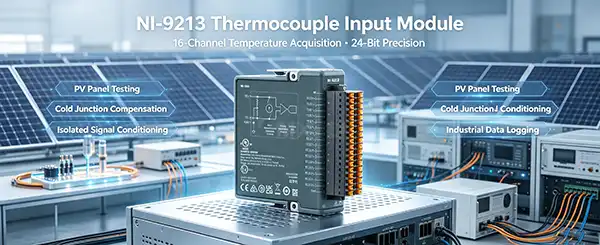
NIST traceable calibration documentation gives measurements the accuracy needed in aerospace, defence, and pharmaceutical settings where rules require accurate calibration records that can be checked. The calibration certificates set the uncertainty levels for measurements, which lets engineers figure out the accuracy requirements for the whole system that are needed for validation protocols.
Evaluating NI-9213 Against Market Alternatives
Comparative Analysis Within NI Product Line
Knowing the differences between modules that do similar things helps match the hardware's skills to the needs of the program. The NI-9214 has 16 channels, just like the NI-9213 C-Series Thermocouple Input Module, but it also supports more thermocouple types, such as R, S, and B. These are expensive noble metal sensors that are used in environments with temperatures above 1500°C. The NI-9213 C-Series Thermocouple Input Module has the same number of channels as base metal thermocouples, but it costs less per channel. This is because it works in the same measurement range.
Differences in sampling rates should be taken into account when designing a system. The aggregate sampling method improves throughput when checking the stability of temperatures in steady-state processes, while the individual channel timing method works best for applications that need to track sudden changes in temperature. By comparing your measurement speed needs to the module's specs, you can avoid over-specification, which raises project costs without improving performance.
Third-Party Module Considerations
Different thermocouple input modules from different companies have different levels of performance and cost. Some devices have lower starting prices, but when you figure out the total cost of ownership, you have to take into account things like the time it takes to create software, how quickly you can get help from expert support, and how long you can get parts. The established National Instruments support infrastructure offers a lot of documentation, help with application engineering, and management of the whole product lifecycle, all of which lower the risk of a project.
For temperature measurement systems, there are two options: Modbus and analogue input. Each has pros and cons when it comes to integration. Modbus-based temperature transmitters can handle signal conditioning from afar, but they add extra communication work and possible failure points. Direct analogue input units need signal processing from outside the system, which makes it more complicated. Using dedicated thermocouple input units together makes the system design simpler while keeping the accuracy of the measurements.
Procurement Considerations for NI-9213
Sourcing Channels and Supplier Selection
Finding trusted suppliers affects project timelines and the ability to keep systems over time. Authorised distributors sell original hardware that comes with valid warranties and access to technical resources from the manufacturer. When looking at different NI-9213 C-Series Thermocouple Input Module suppliers, you should check to see if they offer technical support, if they have the modules you need in stock, and if they have worked on similar industrial automation projects before.
System integrators who build a lot of similar test systems can benefit from OEM ties and bulk buying agreements. When you make a volume commitment, you usually get access to better pricing and faster distribution during shortages of parts. Managing lead times is very important when production plans depend on delivery of measurement systems. Keeping in touch with suppliers who keep supplies on hand keeps projects from being held up.
Total Cost Analysis and Warranty Considerations
Pricing should look at more than just the unit price; it should also look at the economics of the whole system. The 16-channel density cuts down on the number of chassis slots needed, which could mean that you don't need any extra growth chassis for uses with a lot of channels. When you look at the cost per measurement channel, you can see that this option is cheaper than lower-density options that need more units and equipment.
Standard warranty coverage protects against problems with the way the product was made, and knowing how to return and fix it cuts down on downtime if hardware problems happen. We keep a lot of technical information, like datasheets, notes on firmware updates, and application samples, that engineers can use throughout the duration of a product. Firmware changes sometimes add new features or fix behaviour issues that only happen in rare cases. Having access to these tools makes a product last longer in real life.
Alternative Solutions from MXTD
Compatible thermocouple input units with similar technical specs and reasonable prices are made by Xi'an Mingxi Taida Information Technology Co., Ltd. We offer high-reliability solutions that are compared to standard goods in the industry after specialising for more than 12 years in PXIe frames, measurement cards, and integrated testing systems. Our modules work with CompactDAQ chassis platforms and have the same number of channels, ADC resolution, and cold junction compensation.
We make sure that every module meets the strict performance standards needed for use in aircraft, semiconductors, and research by using quality control procedures. Standard products are shipped from stock, while customised configurations are made to fit specific parameter needs after an engineering review. This adaptability solves the usual procurement problem of finding a balance between standard hardware availability and application-specific optimisation.
How does NI-9213 optimise temperature data for Industrial Applications?
Measurement Accuracy Enhancement Mechanisms
The first step in optimising temperature data is to condition the signals so that the accuracy of the measurements is maintained from the sensor to the computer. Before the analogue-to-digital change, the built-in anti-aliasing filter reduces high-frequency noise. This stops aliasing artefacts that damage data. This hardware filtering method works better than software-only ones because it gets rid of clutter before it gets to the digital world.
Automatic zeroing fixes any offset voltage drift that happens because of changes in temperature in the measurement electronics. This constant self-calibration keeps the accuracy levels within the NI-9213 C-Series Thermocouple Input Module working temperature range without any help from the user. When you add cold junction compensation to the triple-protection architecture, you get measurement uncertainty specifications that meet the needs of quality documentation and process validation.
Practical Implementation Advantages
During release, system designers and test engineers get the following real benefits:
- Channel Density Economics: The 16-channel setup makes it much easier to use slots in applications with a lot of channels. Instead of spreading out lower-density hardware, a 128-channel temperature monitoring system only needs eight modules and a single 8-slot chassis. This makes wiring easier, takes up less space on panels, and lowers the total cost of the system by making the infrastructure more efficient.
- Installation Time Reduction: Screw terminals are not needed with spring terminal connections, which speed up installation in areas with a lot of wire. Each channel can take thermocouple wire directly, so you don't need to use crimped terminals or special tools. This seemingly small detail saves a lot of work during system commissioning when making test fixtures with dozens of temperature measurement points.
- Diagnostic Capability: Open-circuit detection lets you know right away if thermocouples fail or wires come loose during operation. This real-time fault identification stops bad data from messing up test results and lets maintenance happen before failures affect production schedules. The isolation safety keeps the accuracy of the measurements safe even when tracking equipment is used in places with strong electrical currents.
These benefits for implementation directly lead to shorter project timelines and lower operating costs over the lifecycle of the measurement system.
Application-Specific Performance Validation
Real-life application examples show how optimisation can be used in a wide range of businesses. When instrumenting climate rooms with large sensor arrays that watch how air moves, the high channel density helps with testing temperature management in cars. When the compressor cycles, the simultaneous sampling picks up temperature changes that measurements taken one at a time might miss.
Aerospace engine compartment monitoring needs measurements that can be trusted even when there is a lot of vibration and changes in temperature. The tough design and channel separation keep the data safe during flying test areas where electrical interference can be a problem for other instruments. Controlling the temperature during semiconductor wafer processing uses the accuracy requirements to keep the thermal limits very tight, which is important for getting the best return.
Monitoring the temperature of the battery pack in electric vehicles is a good example of a safety-critical application where the accuracy of the measurements has a direct effect on the safety of the product. The NIST traceable testing gives proof of compliance with regulations, and the fault detection features let you respond right away to temperature anomalies that could mean a failure is happening.
Conclusion
The NI-9213 C-Series Thermocouple Input Module is a complete temperature measurement system that solves the main problems that high-channel-count industrial applications face. Its 16-channel design with 24-bit resolution, automatic zeroing, and cold junction compensation gives it the accuracy and dependability needed for quality control, process control, and compliance. The module works with well-known CompactDAQ and CompactRIO platforms, which makes system integration easier and gives you more options for different types of thermocouples. When choosing measurement tools for aerospace testing, semiconductor manufacturing, or car validation, it's important to know about these technical skills and procurement issues. This way, you can make smart choices that improve performance and project costs.
FAQ
What thermocouple types does the NI-9213 support?
The NI-9213 C-Series Thermocouple Input Module can hold thermocouples of the J, K, T, and E types, which cover a wide range of temperatures useful for most commercial and study uses. This means that you don't need to buy a bunch of different input modules to do everything from measuring at cryogenic temperatures to keeping an eye on processes at high temperatures.
Can the NI-9213 integrate with existing Modbus-based control systems?
The NI-9213 C-Series Thermocouple Input Module talks to the host chassis using CompactDAQ or CompactRIO protocols instead of native Modbus. However, the host chassis platforms can talk to each other using Modbus if the right software is set up. Standard industrial protocols can then be used to connect temperature data to larger building control systems.
How do I access firmware updates for the module?
Firmware updates for the NI-9213 C-Series Thermocouple Input Module can be downloaded separately or through the National Instruments driver package that comes with LabVIEW. The update process is done through the measurement setup software. This makes sure that modules always have the most up-to-date features and speed improvements.
What isolation voltage protection does the module provide?
Each channel keeps a 250V channel-to-ground isolation, which keeps measurements accurate even when there are differences in ground potential that are common in industrial electrical settings. This separation stops ground loop interference that lowers signal quality in test setups with more than one piece of equipment.
Optimize Your Temperature Measurement Systems with MXTD Solutions
Choosing the right NI-9213 C-Series thermocouple input module provider is crucial for the success of your project, from the time you first purchase it until you use it for many years. MXTD sells suitable high-density thermocouple modules at low prices and with quick technical help backed by 12 years of experience in measurement hardware. Our standard products are shipped from stock, and we can also make products that are customised to fit specific application needs that standard catalogue items can't meet. We support both standard CompactDAQ designs and custom PXIe chassis setups, which lets us make integrated solutions for test systems with a lot of different instruments. Get in touch with our technical team at manager03@mxtdinfo.com to discuss your temperature measurement needs and find out how our NI-9213 C-Series Thermocouple Input Module manufacturer services can help you save money on your purchases while still meeting the performance standards your applications need.
References
1. Webster, J. G. (2018). The Measurement, Instrumentation and Sensors Handbook: Spatial, Mechanical, Thermal and Radiation Measurement. CRC Press, Boca Raton, FL.
2. Bentley, R. E. (2017). Theory and Practice of Thermoelectric Thermometry: Handbook of Temperature Measurement Vol. 2. 3. Springer Science & Business Media, Singapore.
3. Figliola, R. S., & Beasley, D. E. (2020). Theory and Design for Mechanical Measurements (7th ed.). John Wiley & Sons, Hoboken, NJ.
44. National Instruments Corporation. (2019). CompactDAQ Chassis and C Series I/O Modules: Technical Overview and Selection Guide. National Instruments White Paper, Austin, TX.
5. Pallas-Areny, R., & Webster, J. G. (2021). Sensors and Signal Conditioning (3rd ed.). Wiley-IEEE Press, New York, NY.
6. Burns, G. W., Scroger, M. G., & Strouse, G. F. (2016). Temperature-Electromotive Force Reference Functions and Tables for the Letter-Designated Thermocouple Types. NIST Monograph 175, National Institute of Standards and Technology, Gaithersburg, MD.
Our customers’ satisfaction speaks for our quality — contact us to experience the same reliable service.