- English
- French
- German
- Portuguese
- Spanish
- Russian
- Japanese
- Korean
- Arabic
- Greek
- German
- Turkish
- Italian
- Danish
- Romanian
- Indonesian
- Czech
- Afrikaans
- Swedish
- Polish
- Basque
- Catalan
- Esperanto
- Hindi
- Lao
- Albanian
- Amharic
- Armenian
- Azerbaijani
- Belarusian
- Bengali
- Bosnian
- Bulgarian
- Cebuano
- Chichewa
- Corsican
- Croatian
- Dutch
- Estonian
- Filipino
- Finnish
- Frisian
- Galician
- Georgian
- Gujarati
- Haitian
- Hausa
- Hawaiian
- Hebrew
- Hmong
- Hungarian
- Icelandic
- Igbo
- Javanese
- Kannada
- Kazakh
- Khmer
- Kurdish
- Kyrgyz
- Latin
- Latvian
- Lithuanian
- Luxembou..
- Macedonian
- Malagasy
- Malay
- Malayalam
- Maltese
- Maori
- Marathi
- Mongolian
- Burmese
- Nepali
- Norwegian
- Pashto
- Persian
- Punjabi
- Serbian
- Sesotho
- Sinhala
- Slovak
- Slovenian
- Somali
- Samoan
- Scots Gaelic
- Shona
- Sindhi
- Sundanese
- Swahili
- Tajik
- Tamil
- Telugu
- Thai
- Ukrainian
- Urdu
- Uzbek
- Vietnamese
- Welsh
- Xhosa
- Yiddish
- Yoruba
- Zulu
What Makes the UT181A Multimeter Dual Temperature Ideal for Professionals?
When I look at measuring tools for tough industrial settings, the UT181A Multimeter Dual Temperature always stands out as a game-changer. The UNI-T flagship device has an extremely accurate DC voltage range of ±(0.025%+5) and can monitor two temperatures at the same time, from -40°C to 1000°C. This multimeter really stands out because it has an intelligent data logging system that can store 20,000 measurement sets and analyse trends in real time. All of these features are contained in an IP65-rated case that is certified for CAT III 1000V/CAT IV 600V environments. As someone who has worked with measuring tools in the aerospace and semiconductor industries, I think this combination of accuracy, longevity, and smart features is especially useful for workers who need to rely on their tools in harsh circumstances.
Comprehensive Overview of UT181A Multimeter Dual Temperature Features
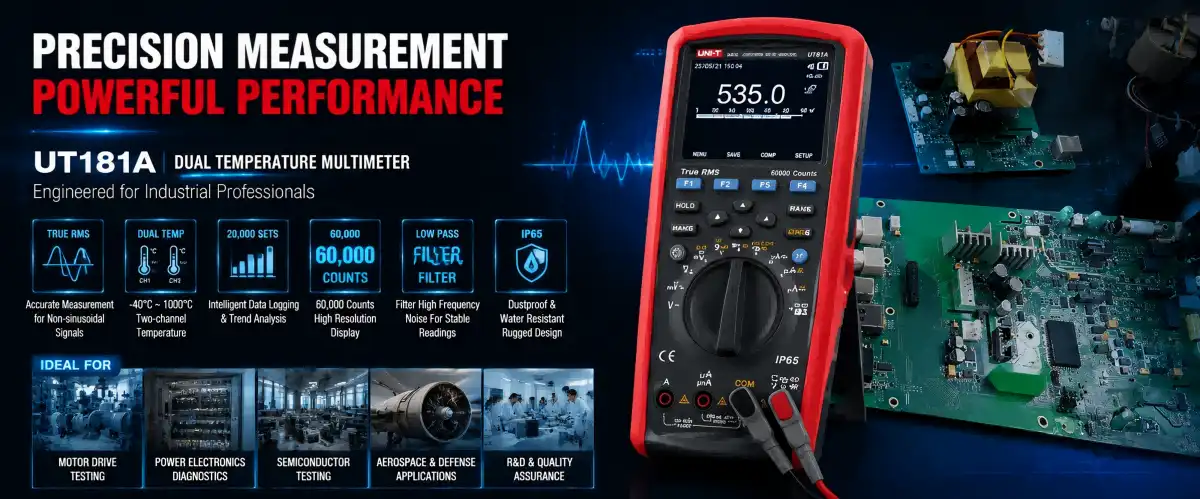
Industry 4.0 has completely changed how we make industrial measurements. Today's test engineers have to manage signals that are getting more complicated, waveforms that are warped by varying frequency drives, and the need to be able to track all of their data. Standard handheld meters just can't handle these problems well enough.
Advanced Dual Temperature Measurement Architecture
The ability to measure two temperatures at the same time is a big step forward in voltmeter technology. This device can monitor two separate temperature points at the same time and works with K-type thermocouples over a huge temperature range of -40°C to 1000°C. The design lets experts keep an eye on differences in temperatures in real time, which is critical for tasks like testing the efficiency of heat exchangers, analysing thermal cycling in the making of semiconductors, or keeping an eye on temperature differences in power distribution systems. The 60,000-count display resolution makes sure that even small temperature changes are seen right away so that maintenance decisions can be made before equipment breaks down.
True RMS Measurement and Signal Conditioning
Sinusoidal signals are rarely clean in industrial settings. Modern circuits, motor drives, and switching power sources all make waveforms that are hard for average-responding meters to understand. This device's true RMS measurement engine accurately measures these distorted signals, giving readings that show how much power is being used and how much heat is being produced. The built-in low-pass filter protects measurements even more by getting rid of high-frequency noise that can mess up voltage and current readings in systems that use an inverter. All of these features work together to make sure that measurements are accurate enough to meet strict industrial standards.
Intelligent Data Management System
With the built-in data logging feature, this multimeter goes from being a simple measuring tool to a full diagnostic system. The device can store up to 20,000 time-stamped data points and create automatic trend charts. It can be used for hours or days without being watched. I've used similar features to describe how batteries discharge in new-energy car systems. Being able to record short-term events and find long-term drift trends is very helpful. The real-time clock makes sure that there is exact temporal correlation, which makes it easier to figure out what went wrong when equipment stops working normally.
Professional-Grade Display Technology
Despite the dim lighting common in industrial settings, the 3.5-inch 64k colour TFT LCD screen is easy to see. The high-resolution screen shows many readings, trend graphs, and status indicators at the same time without making the interface too crowded. This makes it easier to see, which keeps operators from getting tired during long measurement sessions and cuts down on reading mistakes that could hurt quality control.
How to Utilize UT181A Dual Temperature Mode Effectively?
To get the most from advanced measuring tools, understand how they work and apply the best practices you've learned on the job. When used properly, the dual temperature feature opens up a lot of troubleshooting options.
Setting Up Dual Temperature Monitoring
To use dual temperature measurement, connect K-type thermocouples to the correct input wires, ensuring the connections are safe and the right way around. Use the rotary selector to get to the temperature function, and then use the menu system to turn on dual-channel monitoring at the same time. The colour screen shows both readings at the same time, and the device updates quickly enough for most industrial uses. Verifying the calibration against known reference temperatures protects the accuracy of the measurements, and I suggest doing this before important test sessions.
Optimizing Measurement Accuracy
There are several things that affect how accurate temperature measurements are. The accuracy is directly affected by the state of the thermocouples; sensors that are broken or dirty cause mistakes that can't be fixed by the meter. It's also very important that the thermocouple junction and the surface being measured have effective thermal coupling. If they don't, measurement lag and false temperature readings happen. Electromagnetic radiation from the environment can also mess up readings. The built-in filtering helps, but you should stay away from high-power equipment. Keeping track of the temperature of the area around the measurements helps with analysis later on, especially when thermal drift could change the results.
Troubleshooting Common Issues
Systematic troubleshooting quickly finds problems when readings don't seem to make sense. Temperature displays that don't stay the same often mean that thermocouples or connections are loose. You can usually fix most problems by visually inspecting and testing for continuity. If both channels show the same readings even though they are measuring different points, check that the thermocouple wires are not accidentally shorted. The device has open-thermocouple detection that lets operators know when a sensor isn't working, which cuts down on wasted measurement time.
Real-World Application Scenarios
In HVAC testing, the UT181A Multimeter Dual Temperature allows you to monitor both the supply air and return air temperatures simultaneously, helping you determine efficiency right away without needing to write things down by hand. Thermal profiling is helpful in electronics manufacturing during reflow processes because the UT181A Multimeter Dual Temperature keeps track of both the component and board temperatures at the same time. Differential temperature tracking with the UT181A Multimeter Dual Temperature is used in power system diagnostics to identify links that are heating in unusual ways before they fail.
UT181A Multimeter vs. Competitors – A Decision-Making Guide
When making a procurement decision, you need to compare alternatives objectively based on certain performance criteria and budget limits. There are a lot of different measurement instruments on the market, and each one has its pros and cons.
Performance Comparison Against Industry Standards
When put up against high-end products from well-known brands, this UNI-T model has specifications that are competitive in key areas. The 60,000-count accuracy is better than that of many other devices in this price range, and the DC voltage accuracy standard is the same as or better than that of instruments that cost a lot more. The wide temperature range and ability to work at two different temperatures give this UNI-T model features usually found only in specialised thermal instruments. When checking modern electronics, being able to use true RMS measurement across all AC bands is important.
Feature Set Analysis
This voltmeter is different from basic types because it can send data both wirelessly and through wires. Bluetooth connectivity lets you monitor and control things from afar using apps on your smartphone, and USB connectivity lets quality management systems collect data automatically. The 20,000-point data logging capacity is ten times that of most competitors, allowing for longer monitoring without the need for extra recording gear. IP65 ratings for protection against the environment and CAT III/CAT IV ratings for safety show that design priorities are in line with professional needs.
Cost-Value Assessment
Every purchase decision depends on budget, but it's especially important to consider budget when buying multiple instruments for team deployment. The way this device is priced makes it competitive in the professional market, and it offers features that were only available in higher-end products before. When figuring out the total cost of ownership, you should look at the features that come with the device so you don't have to buy different data loggers, temperature meters, and Wi-Fi adapters. Compared to disposable battery designs, the rechargeable lithium battery lowers the ongoing costs of running the device.
User Experience Considerations
Everyday use has an effect on efficiency through interface design and operating ergonomics. New workers don't have to spend as much time learning how to use the menus and colour display. The dual-injection-moulded housing gives you a good grip and good resistance to impact, which are both important in the field. Workflow efficiency is affected by measurement speed and how auto-ranging works. For example, faster update rates and smart range selection cut down on waiting time during repeated testing processes.
Procurement Insights: Buying UT181A Multimeter Dual Temperature for Business Needs
Strategic procurement includes more than just the initial purchase decision. It also includes the reliability of the supply chain, the infrastructure for support, and the total value over the lifecycle. By understanding these dimensions, you can make sure that your measurement tools meet the needs of your organisation.
Sourcing and Distribution Channels
Customers can buy professional measuring tools in a number of ways, each with its own benefits. Working directly with companies like Xi'an Mingxi Taida Information Technology Co., Ltd. provides you with access to professional know-how and lets you make changes to fit your needs. Authorised distributors keep stock in their own areas, allowing them to deliver quickly and offer support services to local customers. Online industrial providers are convenient and offer low prices, especially for common configurations. Checking the supplier's credentials and customer references can help you find dependable partners for your long-term tool needs.
Support Infrastructure and Warranty Provisions
Professional instrument sellers are different from commodity sellers because they offer full after-sales support. The warranty covers parts and labour for at least one year and includes checks for calibration and firmware updates. When troubleshooting complicated measurement problems, it's important to be able to get quick technical support. Suppliers who offer remote video guidance and quick response times are especially helpful. MXTD's promise to answer customer questions within an hour shows that they meet the standards of service that professionals expect.
Recommended Accessories and Consumables
To keep measuring accurately, you need to use the right tools and replace worn-out parts on a regular basis. Extra K-type thermocouples give you more operational options and backups for sensors that get damaged. Protective packing cases keep tools and wires in order while you move them. Between official calibration rounds, calibration reference standards let you check things in-house. Having extra test leads and adapters on hand cuts down on the time that you have to wait when links wear out or break in the field.
Volume Procurement Advantages
Organisations that use more than one measuring tool can save money by using volume pricing structures and standardising. When you buy in bulk, you can often get better payment terms and lower costs per unit, which helps you make better use of your budget. Standardising on certain types makes training easier, reduces the need for extra parts, and makes it easier for teams to share instruments. By negotiating service agreements for fleet calibration, you can be sure of accurate measurements and know exactly how much they cost.
Building Trust: Why Professionals Rely on the Uni-Trend UT181A for Dual Temperature Measurement?
Professional reputations rely on the accuracy of measurements and the dependability of tools. The performance, safety, and quality of our products all depend on the instruments we choose.
Manufacturing Quality and Standards Compliance
Over many years, UNI-T has improved its algorithms, hardware design, and manufacturing processes to make precision measuring instruments. The UT181A Multimeter Dual Temperature uses advanced measurement methods, such as true RMS sampling and clever filtering, to show off this built-up knowledge. Following the safety rules set out in EN61010-1 and using strong overvoltage protection shows that you care about the safety of your operators in dangerous electrical environments. These certifications show that the instruments meet safety standards that are known all over the world.
Customer Support Excellence
Long-term satisfaction with measurement equipment is often based on the quality of the technical support. Having access to applications engineers who are informed and understand the problems that arise in a certain business speeds up the process of solving problems and improving measurement methods. Software updates that add new features or improve the instrument's performance extend its usefulness beyond the original specifications. Operators can get the most out of an instrument's features by having access to specific materials like user manuals and application notes.
Field Performance Validation
Real-world performance under tough conditions is the best way to make sure that an instrument design works. Professionals who work in clean rooms for semiconductors, test facilities for aerospace, and maintenance shops for factories have said that this multimeter platform is always reliable. The IP65 rating means that it can handle dust, water, and chemical vapours that are typical in industrial settings. Its tough build means it can handle drops and hits that would break consumer-grade instruments.
Long-Term Value Proposition
When buying equipment, decisions should be based on operational horizons that span more than one year. The design of rechargeable batteries gets rid of ongoing costs and allows for longer operations in the field. The many measurement functions mean you don't need as many specialised instruments, making it easier to manage your inventory. Firmware updates via USB connectivity ensure the device works with new measurement standards and communication protocols.
Conclusion
The UT181A Multimeter Dual Temperature is a big step forward in professional measurement technology. It gives you the accuracy and intelligence that you could only get from much more expensive tools. It can measure DC voltage very accurately, check two temperatures at the same time, store a lot of data, and protect itself from the environment well, so it can handle the tough needs of current industrial uses. The built-in wired and wireless connectivity options make it easy to connect to modern quality management systems, and the IP65 rating makes sure it works well in harsh conditions. People who work in industrial automation, aerospace, electronics testing, and research institutions will find that this instrument's features perfectly match their needs for accuracy and efficiency.
FAQ
What thermocouple types does the UT181A support?
It can work with K-type thermocouples from -40°C to 1000°C, which is its full temperature range. This choice of thermocouples works very well and stays stable in most industrial settings, especially those that need to measure temperatures for general purposes. The dual-channel architecture allows you to monitor two separate measurement points at the same time.
How does measurement accuracy compare to premium brands?
The UT181A Multimeter Dual Temperature can measure DC voltage with a resolution of 60,000 counts and an accuracy of ±(0.025% + 5), which is on par with instruments that cost a lot more. True RMS measurement ensures that readings of distorted waveforms, which are common in modern electronics, are correct. The built-in low-pass filtering makes measurements more stable in places with a lot of electrical noise, like factories.
Where can I access user manuals and technical documentation?
There is a lot of information available from MXTD and from authorised distributors. Digital forms make it easy to quickly look something up during measurements, and thorough debugging guides help solve problems efficiently. You can download software for data analysis and wireless communication so that you can use all of the advanced features of the instrument.
Partner with MXTD for Your Professional Measurement Solutions
MXTD has been delivering high-reliability measuring and testing equipment to demanding industrial sectors for more than 12 years. In addition to multimeters, we also sell PXIe chassis, precision plugs, and combined testing systems that meet very high performance standards. MXTD is a reliable UT181A Multimeter Dual Temperature seller with a history of excellent technical support. They offer low prices, bulk discounts, and quick response times. Get in touch with our team at manager03@mxtdinfo.com to discuss your specific measurement needs, look into your customisation options, or set up a product demonstration. We answer questions within an hour, offer both standard and custom solutions, and offer full after-sales support, including remote technical guidance.
References
1. International Electrotechnical Commission. (2010). Safety requirements for electrical equipment for measurement, control, and laboratory use – Part 1: General requirements. IEC 61010-1:2010.
2. Webster, J.G. (Ed.). (2016). The Measurement, Instrumentation and Sensors Handbook on CD-ROM (2nd ed.). CRC Press.
3. Morris, A.S., & Langari, R. (2020). Measurement and Instrumentation: Theory and Application (3rd ed.). Academic Press.
4. Nicholas, J.V., & White, D.R. (2001). Traceable Temperatures: An Introduction to Temperature Measurement and Calibration (2nd ed.). John Wiley & Sons.
5. Pallas-Areny, R., & Webster, J.G. (2001). Sensors and Signal Conditioning (2nd ed.). Wiley-Interscience.
6. Bentley, J.P. (2004). Principles of Measurement Systems (4th ed.). Pearson Education Limited.
Our customers’ satisfaction speaks for our quality — contact us to experience the same reliable service.