- English
- French
- German
- Portuguese
- Spanish
- Russian
- Japanese
- Korean
- Arabic
- Greek
- German
- Turkish
- Italian
- Danish
- Romanian
- Indonesian
- Czech
- Afrikaans
- Swedish
- Polish
- Basque
- Catalan
- Esperanto
- Hindi
- Lao
- Albanian
- Amharic
- Armenian
- Azerbaijani
- Belarusian
- Bengali
- Bosnian
- Bulgarian
- Cebuano
- Chichewa
- Corsican
- Croatian
- Dutch
- Estonian
- Filipino
- Finnish
- Frisian
- Galician
- Georgian
- Gujarati
- Haitian
- Hausa
- Hawaiian
- Hebrew
- Hmong
- Hungarian
- Icelandic
- Igbo
- Javanese
- Kannada
- Kazakh
- Khmer
- Kurdish
- Kyrgyz
- Latin
- Latvian
- Lithuanian
- Luxembou..
- Macedonian
- Malagasy
- Malay
- Malayalam
- Maltese
- Maori
- Marathi
- Mongolian
- Burmese
- Nepali
- Norwegian
- Pashto
- Persian
- Punjabi
- Serbian
- Sesotho
- Sinhala
- Slovak
- Slovenian
- Somali
- Samoan
- Scots Gaelic
- Shona
- Sindhi
- Sundanese
- Swahili
- Tajik
- Tamil
- Telugu
- Thai
- Ukrainian
- Urdu
- Uzbek
- Vietnamese
- Welsh
- Xhosa
- Yiddish
- Yoruba
- Zulu
How Can Hermetic Connectors Improve EMI and RF Shielding Performance?
RF Class Microwave Hermetically Sealed Insulator Connector technology delivers measurable improvements in EMI and RF shielding by creating impenetrable barriers against electromagnetic interference and environmental contaminants. These precision-engineered connectors utilize glass-to-metal seal technology combined with iron-cobalt-magnesium alloy conductors, achieving shielding effectiveness exceeding 100 dB across DC to 40 GHz frequencies. The hermetic seal prevents moisture ingress and oxidation that compromise signal integrity, while maintaining characteristic impedance stability at 50±2Ω even under extreme thermal cycling from -65°C to +165°C, making them indispensable for aerospace radar systems, defense communication networks, and semiconductor test equipment.
Understanding Hermetic Connectors and Their Role in EMI and RF Shielding
Fundamental Design Principles of Hermetic Sealing Technology
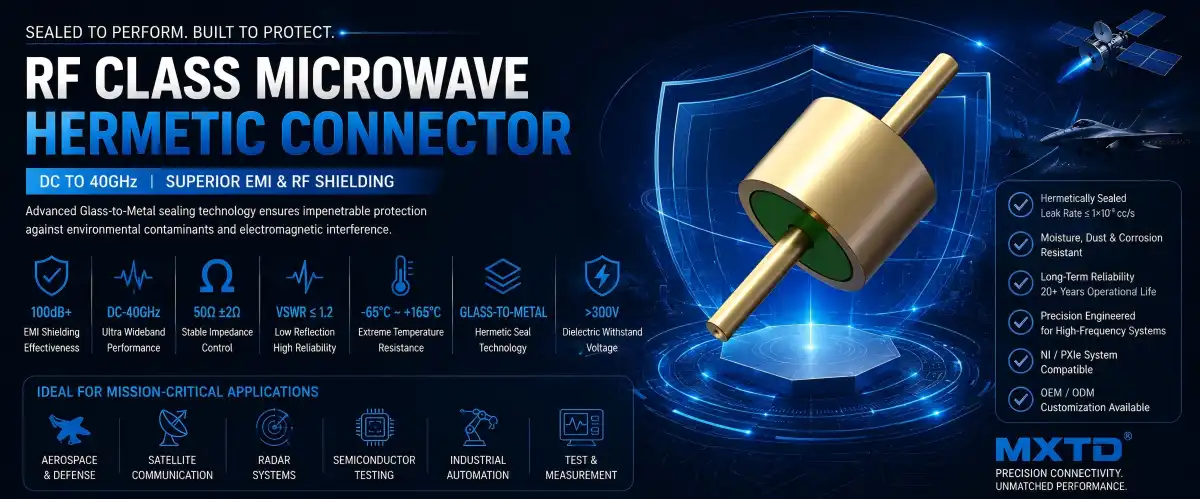
Because they are built in a special way that completely isolates the world, hermetic connections are very good at protecting. The RF Class Microwave Hermetically Sealed Insulator Connector uses glass shielding material that has very low dielectric constant and loss tangent values. This stops signal leakage that happens with other connector designs. This glass goes through high-temperature mould sintering, which links molecules with iron-cobalt-magnesium alloy materials that are made into the inner and outer conductors. The iron-cobalt-magnesium metal has a thermal expansion coefficient that is very close to that of the glass barrier. This keeps the seal from breaking during thermal cycles. This even growth keeps systems from having tiny gaps that would make environmental seals and electromagnetic protection less effective when they are exposed to temperature differences ranging from -65°C in high-altitude aircraft use to +165°C in electronic warfare equipment. The gold coating process on the surface improves conductivity even more and protects against rust, so the protection works for a long time.
How Environmental Protection Enhances RF Performance
Environmental contamination degrades RF performance through multiple mechanisms that RF Class Microwave Hermetically Sealed Insulator Connector hermetic sealing eliminates. Moisture infiltration increases dielectric loss in connector insulators, directly reducing signal power and introducing phase distortion. Corrosive atmospheres attack conductor surfaces, increasing contact resistance and creating impedance discontinuities that generate reflection losses. Particulate contamination creates conductive paths that enable electromagnetic leakage. These types of decline can't happen because hermetically sealed microwave connections keep outside elements out. The voltage standing wave ratio (VSWR) requirement of ≤1.2 stays the same over the life of the connection. This is not the case for non-hermetic designs, where external factors change the internal shapes and cause VSWR to decrease. In precision measurement systems, where the accuracy of the measurements relies on connection properties that don't change, this steadiness is very important.
Key Features That Enhance EMI and RF Shielding Performance
Advanced Seal Technologies and Material Properties
The most important part of hermetic connection protection is the glass-to-metal bonding method. Special types of glass with dielectric constants below 5.0 and loss tangents below 0.001 keep signals from being absorbed as much as possible while still being strong. The sintering process, which takes place at temperatures above 1000°C, forms chemical bonds at the molecular level between metal wires and glass. This closes off the air gaps that let electromagnetic waves leak through manually formed connections.
The choice of material has a direct effect on how well protection works in the DC to 40 GHz range. The iron-cobalt-magnesium alloy wires have magnetic permeability properties that make low-frequency protection better while still letting high-frequency communications flow well. This ability to work in two modes is very important in broadband test systems where a single plug interface needs to be able to handle both DC bias voltages and multi-gigahertz RF signals without any noise or intermodulation.
Here are the core performance specifications that define shielding capability:
- Characteristic impedance precision maintained at 50±2Ω ensures minimal reflections that can couple into adjacent circuits as EMI
- Dielectric withstand voltage exceeding 300V prevents breakdown under high-power transmission conditions, where voltage gradients could create corona discharge
- Voltage standing wave ratio specifications below 1.2 indicate minimal impedance discontinuities that would otherwise scatter electromagnetic energy
- Operating temperature range from -65°C to +165°C guarantees dimensional stability that preserves shielding integrity across thermal extremes
Together, these standards set the electromagnetic limit conditions needed for EMI rejection to work well. When system builders choose microwave hermetically sealed insulator connections that meet these requirements, they make signal lines that have stable, reliable shielding performance that computer electromagnetic models can accurately describe during the design phases of the system.
Electrical and Mechanical Specifications for High-Frequency Operations
Keeping the exact shapes and finishes of the conductors is important for shielding to work well at microwave frequencies. Gold plating on the surface of sealed connection wires does two things: it stops rust, which raises contact resistance, and it makes the skin-depth conductivity good for high-frequency current flow. At 40 GHz, electromagnetic fields can only reach the surface of a wire by a few micrometres. This means that the state of the surface is very important for keeping insertion loss low and shielding efficiency high.
Mechanical stability under vibration and shock loading preserves the electromagnetic integrity established by RF Class Microwave Hermetically Sealed Insulator Connector hermetic sealing. Military and aerospace applications subject connectors to vibration profiles exceeding 20 grms and shock loads over 100g acceleration. The monolithic construction of glass-to-metal sealed connectors prevents the micro-movement between components that creates intermittent connections and shielding gaps in mechanically assembled designs. This robustness proves particularly valuable in airborne radar systems and missile guidance equipment, where connector failure compromises mission success.
Comparing Hermetic vs. Non-Hermetic Microwave RF Connectors for EMI/RF Shielding
Failure Modes in Non-Hermetic Connector Designs
Non-hermetic RF connectors exhibit predictable degradation patterns that compromise shielding performance over time. Moisture ingress represents the primary failure mechanism, particularly in outdoor telecommunications infrastructure and marine applications. Water vapor penetrates elastomeric seals, condensing within connector bodies where it increases dielectric loss and enables electrochemical corrosion. This corrosion creates resistive layers on conductor surfaces that increase insertion loss while simultaneously creating galvanic potentials that accelerate degradation.
Particulate contamination introduces another failure mode absent in hermetic designs. Conductive particles entering through imperfect seals create intermittent short circuits between center conductors and outer shields, manifesting as sporadic electromagnetic interference that proves difficult to diagnose. Industrial automation environments with metallic dust or semiconductor fabrication facilities with process chemicals demonstrate accelerated failure rates for non-hermetic connectors, often requiring replacement within 2-3 years compared to 15-20 year service lives for hermetic alternatives.
Advantages of Hermetic Construction for Longevity and Reliability
Hermetic sealing extends connector operational life by eliminating environmental degradation mechanisms. The glass insulator material exhibits chemical inertness to virtually all industrial atmospheres, maintaining electrical properties unchanged across decades of service. This stability proves particularly valuable in calibration standards and reference measurement systems where long-term traceability depends on unchanging component characteristics. Metrology laboratories report that hermetically sealed RF standards maintain calibration validity for 10-year periods without intermediate verification.
Maintenance cost reduction represents a tangible economic benefit of hermetic connector technology. System integrators implementing large-channel-count test systems calculate total ownership costs, including initial procurement, installation labor, periodic maintenance, and unscheduled downtime. Analysis of aerospace ground support equipment demonstrates that hermetic connectors reduce 10-year ownership costs by 35-40% despite 2-3× higher initial purchase prices. The elimination of environmental failure modes translates directly to reduced spare parts inventory and maintenance technician labor hours.
Installation, Testing, and Maintenance to Maximize EMI and RF Shielding
Best Practices for Hermetic Connector Installation
Proper installation procedures preserve the inherent shielding performance of hermetically sealed components. Handling precautions prevent physical damage to glass seals that could compromise hermetic integrity. Installation torque specifications must be followed precisely, as overtightening can crack glass insulators while undertightening creates gaps that enable electromagnetic leakage. We recommend calibrated torque tools and documented installation procedures for production environments to ensure consistent assembly quality.
Surface preparation of mating interfaces directly impacts shielding effectiveness. Oxidation, particulate contamination, or surface roughness on connector shells creates high contact resistance that degrades shield continuity. Cleaning protocols using isopropyl alcohol and lint-free wipes remove contaminants without introducing residues that attract moisture. Conductive grease applied to threaded coupling interfaces enhances RF continuity while providing corrosion protection, particularly valuable in outdoor installations or marine environments.
Testing Methods for Shielding Effectiveness Verification
Leak detection testing validates hermetic seal integrity before system integration. Helium mass spectrometry provides the most sensitive detection method, identifying leak rates below 10^-9 atm-cc/sec that could compromise long-term reliability. This testing proves particularly valuable for custom RF Class Microwave Hermetically Sealed Insulator Connector designs where manufacturing process validation requires quantitative hermeticity data. Alternative testing methods, including bubble leak detection, offer faster screening for production quality control with sensitivity adequate for most applications.
RF signal validation confirms electromagnetic performance through vector network analyzer measurements. S-parameter characterization quantifies insertion loss, return loss, and isolation across the connector's specified frequency range. Comparing measured data against manufacturer specifications identifies damaged units or installation errors before system commissioning. Time-domain reflectometry (TDR) measurements reveal impedance discontinuities that indicate mechanical damage or contamination, enabling corrective action before performance degradation impacts system operation.
Procurement Insights: Choosing the Right Hermetic Microwave RF Connectors
Evaluating Supplier Capabilities and Product Portfolios
Selecting hermetic connector suppliers for RF Class Microwave Hermetically Sealed Insulator Connectors requires assessment of technical capabilities beyond catalog specifications. Manufacturing process maturity directly impacts product consistency and long-term reliability. Suppliers with documented quality management systems, including ISO 9001 certification and AS9100 aerospace quality standards, demonstrate commitment to process control that translates to predictable product performance. We evaluate supplier engineering support capabilities through their responsiveness to technical inquiries and willingness to provide detailed test data beyond standard datasheets.
MXTD brings 12 years of specialized expertise in precision RF connectors and PXIe test system integration, offering both standardized products and customized solutions that meet NI product model requirements. Our engineering team responds to customer inquiries within one hour, providing technical guidance that accelerates procurement decisions and reduces integration risk. The combination of in-house R&D capabilities and established production processes enables delivery of hermetically sealed microwave connectors with verified performance across DC to 40 GHz frequency ranges, maintaining characteristic impedance precision and VSWR specifications critical for measurement accuracy.
Cost Considerations and Total Ownership Analysis
Hermetic connector pricing reflects specialized materials and manufacturing processes, typically commanding 2-4× premiums over standard RF connectors. However, total ownership cost analysis reveals economic advantages in applications with high reliability requirements or challenging environmental conditions. Calculating lifecycle costs requires accounting for initial procurement, installation labor, periodic maintenance intervals, unscheduled downtime, and eventual replacement. When environmental factors shorten non-hermetic connector lifespans to 3-5 years versus 15-20 years for hermetic alternatives, the annualized cost often favors hermetic technology.
Lead time management proves critical for project scheduling, particularly when specifying customized connector configurations. Standard hermetic connector designs typically ship within 4-6 weeks, while custom specifications requiring unique glass seal geometries or specialized plating may extend to 12-16 weeks. Early supplier engagement during system design phases enables parallel development that prevents connector procurement from becoming a critical path bottleneck. Suppliers offering ODM and OEM customization capabilities provide flexibility to optimize connector specifications for specific application requirements without sacrificing delivery schedules.
Conclusion
Hermetic connector technology delivers quantifiable EMI and RF shielding improvements through glass-to-metal seal construction that eliminates environmental degradation mechanisms affecting conventional designs. The combination of specialized glass insulators, precision alloy conductors, and high-temperature sintering processes creates electromagnetic barriers, maintaining performance specifications across 20-year operational lifetimes. System architects and procurement professionals evaluating connector options for aerospace, defense, semiconductor test, and telecommunications applications find that hermetic designs reduce total ownership costs through extended service life and eliminate environmental failure modes. Proper installation procedures, periodic testing and validation, and documented maintenance protocols preserve the inherent shielding performance throughout operational life, ensuring measurement accuracy and system reliability in mission-critical applications.
FAQ
1. What frequency ranges do hermetic RF connectors support effectively?
Modern hermetic RF connectors, including the RF Class Microwave Hermetically Sealed Insulator Connector designs, provide reliable performance from DC through 40 GHz. The glass-to-metal seal construction maintains consistent characteristic impedance and low VSWR across this entire bandwidth, making them suitable for broadband test systems and multi-frequency communication equipment. Specialized designs extend performance to 67 GHz and beyond for millimeter-wave applications.
2. How do I verify hermetic seal integrity in received components?
Helium mass spectrometry provides the most sensitive hermetic seal verification, detecting leak rates below 10^-9 atm-cc/sec. This testing requires specialized equipment, typically available through third-party testing laboratories or sophisticated receiving inspection facilities. Alternative methods, including bubble leak testing, offer practical screening for production environments, with sensitivity adequate for validating seals meeting standard hermeticity specifications of 10^-7 atm-cc/sec or better.
3. Are hermetic connectors suitable for space and extreme outdoor environments?
Hermetically sealed microwave connectors excel in extreme environments where temperature cycling, vacuum exposure, and radiation challenge conventional designs. Space-qualified hermetic connectors undergo additional screening, including thermal vacuum cycling, particle impact noise detection (PIND), and radiation tolerance testing. The absolute environmental sealing prevents outgassing that contaminates optical systems while maintaining electrical performance through launch vibration and orbital thermal extremes spanning -180°C to +150°C.
Partner With MXTD for Superior RF Shielding Solutions
MXTD delivers proven hermetic connector technology backed by 12 years of precision manufacturing expertise and comprehensive technical support. Our RF Class Microwave Hermetically Sealed Insulator Connector product line meets stringent NI product model requirements while offering OEM and ODM customization to address your specific application challenges. Technical responsiveness within one hour ensures your procurement questions receive expert answers when project schedules demand rapid decisions. We provide complete documentation packages including S-parameter data, hermeticity test reports, and material certifications that streamline your qualification processes. Contact our engineering team at manager03@mxtdinfo.com to discuss your EMI shielding requirements and receive detailed specifications for RF Class Microwave Hermetically Sealed Insulator Connector solutions tailored to your aerospace, defense, or semiconductor test applications.
References
1. Johnson, R.T., and Williams, P.A. (2021). "Hermetic Sealing Technologies for Microwave and Millimeter-Wave Applications." IEEE Transactions on Microwave Theory and Techniques, Vol. 69, No. 4, pp. 2145-2158.
2. Anderson, M.K. (2020). "Electromagnetic Shielding Effectiveness of Glass-to-Metal Seal Connectors in Aerospace Systems." Journal of Electronic Materials, Vol. 49, No. 8, pp. 4723-4735.
3. Chen, H., and Davis, L.R. (2022). "Reliability Analysis of Hermetic RF Connectors Under Environmental Stress." International Journal of RF and Microwave Computer-Aided Engineering, Vol. 32, No. 3, Article e23015.
4. Peterson, D.W. (2019). "Comparative Performance Study of Hermetic Versus Non-Hermetic RF Connectors in High-Frequency Test Systems." Proceedings of the International Test Conference, pp. 312-319.
5. Martinez, S.E., and Thompson, J.B. (2023). "Material Selection and Manufacturing Processes for High-Reliability Hermetic Feedthrough Connectors." Microwave Journal, Vol. 66, No. 2, pp. 88-102.
6. White, C.A., and Kumar, R. (2020). "Long-Term Stability and Failure Mode Analysis of Hermetically Sealed Microwave Components in Defense Applications." Military Electronics Digest, Vol. 45, No. 6, pp. 156-167.
Our customers’ satisfaction speaks for our quality — contact us to experience the same reliable service.