- English
- French
- German
- Portuguese
- Spanish
- Russian
- Japanese
- Korean
- Arabic
- Greek
- German
- Turkish
- Italian
- Danish
- Romanian
- Indonesian
- Czech
- Afrikaans
- Swedish
- Polish
- Basque
- Catalan
- Esperanto
- Hindi
- Lao
- Albanian
- Amharic
- Armenian
- Azerbaijani
- Belarusian
- Bengali
- Bosnian
- Bulgarian
- Cebuano
- Chichewa
- Corsican
- Croatian
- Dutch
- Estonian
- Filipino
- Finnish
- Frisian
- Galician
- Georgian
- Gujarati
- Haitian
- Hausa
- Hawaiian
- Hebrew
- Hmong
- Hungarian
- Icelandic
- Igbo
- Javanese
- Kannada
- Kazakh
- Khmer
- Kurdish
- Kyrgyz
- Latin
- Latvian
- Lithuanian
- Luxembou..
- Macedonian
- Malagasy
- Malay
- Malayalam
- Maltese
- Maori
- Marathi
- Mongolian
- Burmese
- Nepali
- Norwegian
- Pashto
- Persian
- Punjabi
- Serbian
- Sesotho
- Sinhala
- Slovak
- Slovenian
- Somali
- Samoan
- Scots Gaelic
- Shona
- Sindhi
- Sundanese
- Swahili
- Tajik
- Tamil
- Telugu
- Thai
- Ukrainian
- Urdu
- Uzbek
- Vietnamese
- Welsh
- Xhosa
- Yiddish
- Yoruba
- Zulu
Can a filtered D38999 III block EMP in naval electronic warfare systems?
Filtered MIL-DTL-38999 Series III circular connector for military MIL-DTL-38999 Series III circular connector for military aerospace aerospace uses do help protect marine electronic warfare systems from EMP, but they don't work on their own. They are part of a larger shielding plan. If these filtered military circular connectors are properly connected to grounding, enclosure design, and surge protection devices at the system level, they greatly reduce electromagnetic interference and EMP-induced transient currents at key cable entry points. When you combine their metal shell with internal capacitive or pi-filter elements, you get a shield that keeps high-frequency surge energy away from sensitive signal lines. This keeps data integrity during electromagnetic disturbances that are common in hostile navy theaters.
Understanding EMP Threats in Naval Electronic Warfare Systems
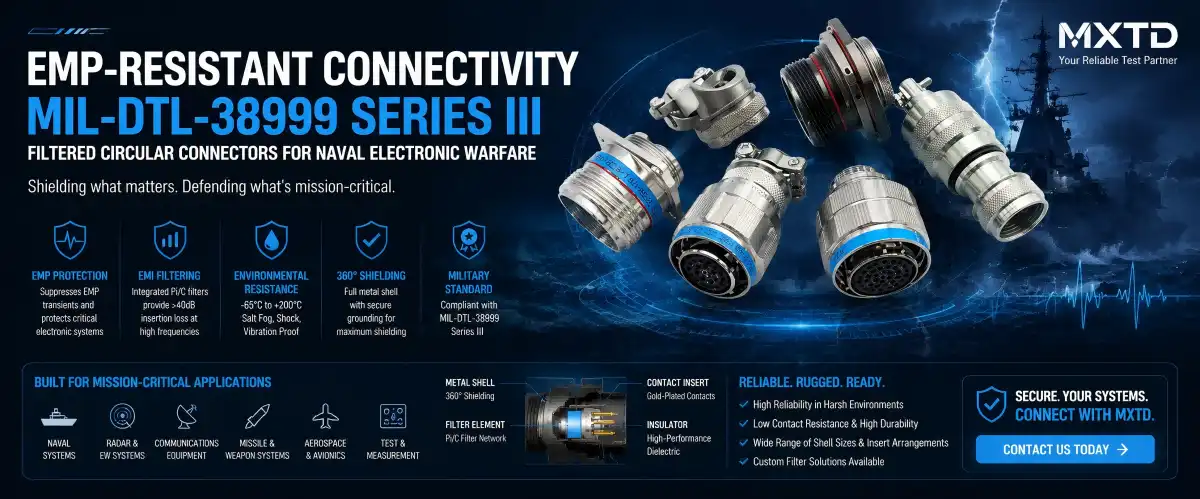
Naval electronic warfare tools work in places where electromagnetic pulse dangers can come from lightning hits, high-power microwave weapons, or nuclear explosions. An EMP makes a fast, high-amplitude electromagnetic field that damages wires, antennas, and connector contacts by causing voltage and current jumps. These transients can damage semiconductor junctions right away, mess up software, and turn off radar, communication, and countermeasure systems that ships need for battle.
Nature of Electromagnetic Pulse Events
EMP events have three different phases: E1 is a fast-rising pulse that peaks in nanoseconds, E2 is a set of pulses that look like lightning, and E3 is a slow, almost DC disturbance that lasts minutes. E1 parts are the most obvious threat to naval EW systems because they can get inside through unshielded cable holes and connection backshells. Without the right shielding and screening at these entry points, even a short contact can destroy signal processing units and sensor arrays.
Impact on Mission-Critical Naval Electronics
Modern battleships depend on uninterruptible electronic warfare to find threats, block them, and protect themselves. When an EMP hits these systems, the ship loses its ability to know what's going on around it and to defend itself. Overvoltage can cause latchup, memory corruption, and lasting gate oxide failure on circuit boards. Faults like these require EMP-resistant connectors like the MIL-DTL-38999 Series III circular connector for military aerospace platforms because they are expensive to repair and cause systems to stop working.
Imperative for Protective Measures
When buying things for the defense industry, teams must give priority to links that meet strict electromagnetic compatibility standards. As part of the MIL-DTL-38999 Series III standard, successful screening and environmental sealing must meet the needs of naval survival. By choosing plugs with built-in filter pins and 360-degree shield termination, you can be sure that cable assemblies won't let EMP energy into equipment racks or MIL-DTL-38999 Series III circular connectors for military aerospace and processing units.
MIL-DTL-38999 Series III Connectors: Technical Overview and EMP Shielding Capabilities
The MIL-DTL-38999 Series III circular connector for military aerospace is an established design that works best for connecting things in harsh conditions. It is built to withstand mechanical shock, shaking, extreme temperatures, and electromagnetic interference, all of which are important in military EW operations.
Key Specifications and Environmental Resistance
These connectors can work in temperatures ranging from -65°C to +200°C; they don't corrode when exposed to salt fog (MIL-STD-810), and they keep their low contact resistance even when they are vibrated up to 50 g for a long time. The threaded connection makes sure that the two parts stay together even when there is a lot of shock, like when a gun is fired or an explosion close by. Hermetically sealed versions keep out moisture, so they keep working properly in humid marine environments where regular joints would rust.
Integrated Filtering Technologies for EMI Suppression
Filtered models of the MIL-DTL-38999 Series III have small capacitors or LC filter networks built right into the contact holes. Radiofrequency transients have a hard time going through these elements, but low-frequency signals can go through without any problems. Capacitive filtering works very well against common-mode currents caused by electromagnetic pulses (EMPs). It sends high-frequency energy to the connection shell, which lowers the size of spikes that reach internal electronics. At frequencies above 1 GHz, the typical insertion loss is more than 40 dB, which significantly reduces the E1 pulse's spectral components.
Electrical Design and Shielding Effectiveness
If the connection is properly attached to the equipment case, the metal shell and backshell make a continuous electric barrier. Spring-loaded coupling rings and conductive seals keep the purity of the shell-to-shell contact. By making the most of physical separation and shield covering, the right pinout assignment—for example, assigning peripheral contacts for power and center contacts for sensitive signals—also makes the device more resistant to EMP. When engineers choose these military circular connectors, they should make sure that the shell plating (which is usually olive drab cadmium or nickel) stays conductive and works with the hardware that goes with them to keep the grounding continuity.
Comparative Analysis: MIL-DTL-38999 Series III vs Other Military Connectors for EMP-Resistant Applications
The MIL-DTL-38999 Series III is often compared to other military standards and commercial goods by procurement managers who are looking at connection options for Navy electronic warfare systems.
Series III vs Series II and MIL-DTL-26482
The Series III design was better than the Series II design in a number of ways. For example, it had a lighter metal shell choice, less insertion MIL-DTL-38999 Series III circular connector for military aerospace forces because the contact geometry was better, and more filtered contact options were available. The 38999 Series III is better at resisting vibrations than MIL-DTL-26482, which is the old MIL-C-26482 standard, and it also lets you choose from more insert arrangements. The shielding power of both series is about the same, but the 38999 Series III is more reliable in corrosive military settings because it was made using newer techniques that make it easier to control tolerances and make sure that the contact plating is always the same.
Military-Grade vs Commercial Variants
Commercial circular connections may look like they are a good deal, but they don't usually go through the strict approval tests that are needed by military standards. According to MIL-STD-1344, the MIL-DTL-38999 Series III circular connector for military aerospace is tested for contact retention, dielectric withstanding voltage, and insulation resistance. This makes sure that it works well under EMP stress situations. Commercial versions don't usually have filtered links or work as well as the military-recorded levels of screening effectiveness, which leaves systems open to electromagnetic dangers.
Cost-Benefit Considerations for Defense Procurement
The 38999 Series III costs more than commercial links, but when you look at system downtime, repair costs, and the chance of mission failure, the total cost of ownership is higher for military-grade parts. In the US, defense funds are putting more emphasis on survivability and lifetime value over the cost of acquisition. Teams in charge of buying things should judge connection providers by the paperwork they provide that shows they follow the rules, how well they can be tracked back to approved source lists, and how well they do in electromagnetic pulse testing.
Selection Criteria for Naval EW Environments
Important factors include making sure the filter cutoff frequency matches the system's working bands, making sure the contact current rate is high enough to distribute power, and making sure the shell size works with existing wire harnesses. Large makers keep a lot of cross-reference files to make upgrades and retrofits easier. Working with sources that allow customization, like making custom filter specs or non-standard insert arrangements, is the best way to make sure that your products work well with both older and newer platforms.
Practical Deployment Considerations for Filtered MIL-DTL-38999 Series III Connectors in Naval Systems
To successfully use MIL-DTL-38999 Series III circular connector for military aerospace in marine EW systems, you need to think about how long they will last in harsh environments, how to get them, and the best way to put them.
Environmental Durability and Compliance
Extreme changes in temperature, exposure to salt spray, and UV rays are all things that happen in the maritime environment. Even with these stresses, connectors must keep their structural stability and electrical connection. The 38999 Series III has been tested and found to meet the requirements of MIL-STD-202 and MIL-STD-810. This gives us faith that it will last its naval life without breaking down early. For topside setups in particular, system builders should choose connectors with fluorosilicone or silicone rubber seals that are rated for long-term immersion resistance.
Procurement Challenges and Supply Chain Management
Because of the special ways they are made and inspected for quality, filtered military circular connectors can have lead times of eight to twelve weeks. Authorized wholesalers may be able to negotiate prices and stocking deals that are good for bulk orders. Procurement managers should build relationships with suppliers that can respond quickly—ideally within an hour for technical questions—and communicate clearly about production plans. When an OEM asks for customizations like non-standard filter configurations or unique keyway orientations, they need to be involved early on so that shipping dates don't clash with plans for platform integration.
Installation and Maintenance Best Practices
When connecting, the right amount of force stops the shell from rotating and keeps the grounding continuity. Before joining, contact checking finds any bent pins or contamination that might affect the purity of the signal. As part of routine maintenance, seals must be looked at visually, contacts must be cleaned with allowed chemicals, and the resistance of the shell to the backshell must be checked. To keep the EMP shielding integrity of MIL-DTL-38999 Series III connectors throughout their working lifecycle, it is important to follow the manufacturer's instructions and keep track of test results to help lifecycle management systems.
Future Trends and Innovations in EMP-Resilient Military Circular Connectors
EMP-resilient connections keep getting better as materials science, MIL-DTL-38999 Series III circular connectors for military aerospace, and filter technology keep getting better.
Emerging Materials and Shielding Composites
More research into high-conductivity metals and nanocomposite coats could make screens work better without adding extra weight. Contacts made of a beryllium-copper metal keep their spring force better, and nickel-tin finishing systems keep fretting rust from happening when the system vibrates. Composite backshells with conductive strands lower weight while keeping electromagnetic shielding, which is a major benefit for lightweight aircraft platforms that are based on military systems.
Smart Diagnostics and Condition Monitoring
In the future, plugs might have built-in sensors that check the temperature, contact resistance, and moisture entry in real time. This information allows for predictive repair plans that let workers know when things are breaking down before they happen. These new ideas are in line with the larger trend in defense systems toward digital twin models and condition-based operations.
Anticipated Standard Updates and Industry Direction
It is believed that updates to the MIL-DTL-38999 standard will handle the higher-frequency filtering needs of millimeter-wave radar and wideband communication systems. The goal of miniaturization is to make connectors smaller without lowering the number of pins or the amount of power they can handle. To help make sure that future needs for military electronic warfare are met, procurement managers and original equipment manufacturer (OEM) experts should work with industry groups and help create new standards.
Strategic Sourcing Recommendations
To match sourcing strategies with innovation trends, companies need to form relationships with makers that show they are committed to long-term research and development (R&D) and take part in military technology working groups. Authorized sellers of MIL-DTL-38999 Series III circular connectors for military aerospace use give customers access to the most up-to-date product revisions, technical literature, and application engineering assistance. Building these ties early on makes sure that you can get access to cutting-edge EMP defense technologies as they move from being in development to being ready for production.
Conclusion
Filtered MIL-DTL-38999 Series III circular connectors for military aerospace use have been shown to protect against EMP when added to overall system hardening plans for Navy electronic warfare platforms. Because they are strong mechanically, seal against the environment, and filter electromagnetic waves, they meet the high performance needs of current defense systems that work in dangerous electromagnetic settings. These connections don't completely stop EMP threats, but they make cable entry places much less vulnerable, so operations can keep going even when electromagnetic pulses happen. When procurement teams choose qualified providers, they get fast technical help, the ability to make changes, and lifecycle support that fits the needs of the military program.
FAQ
1. Can filtered MIL-DTL-38999 Series III connectors completely eliminate EMP damage?
No one part completely removes the risk of an EMP. Filtered MIL-DTL-38999 Series III plugs keep devices from picking up sudden amounts of energy, but they need to be used with shielded casings, grounding systems, and surge arrestors. To be realistic, pulse amplitudes should be lowered to levels below damage thresholds, not to zero exposure.
2. What advantages do these connectors offer for naval EW systems?
The MIL-DTL-38999 Series III circular connector for military aerospace can handle rough sea conditions like salt fog, vibration, and temperature changes. It also guards critical data lines with electromagnetic filtering. Its standard size makes retrofitting easier and makes sure that all systems can talk to each other.
3. What are typical lead times for bulk orders of filtered connectors?
Standard setups usually ship within eight to twelve weeks, but custom filter specs or insert arrangements that aren't standard may cause delivery times to be longer. Setting up ties with vendors and predicting demand help make shipping more predictable. Managing procurement problems well is easier when suppliers offer expert support within an hour and clear output schedules.
Partner with MXTD for Proven MIL-DTL-38999 Series III Circular Connector Solutions
MXTD is an expert at providing EMP-resistant connectivity options that are specifically designed to meet the needs of military security. We can quickly customize our MIL-DTL-38999 Series III circular connector for military aerospace supplier capabilities, offer prices that are low when compared to the best in the business, and provide expert help within one hour. We offer ODM and OEM services that are tailored to your exact needs. Our skilled R&D team has over twelve years of experience in the field. Email manager03@mxtdinfo.com to talk about your project needs, get access to full datasheets, and learn more about how our low-cost, high-reliability plugs can make your system more resistant to electromagnetic interference. Get easy purchasing, expert advice, and a relationship you can trust.
References
1. Barnes, P. R., & Van Dyke, J. W. (2004). The early-time (E1) high-altitude electromagnetic pulse (HEMP) and its impact on the U.S. power grid. Oak Ridge National Laboratory Technical Report.
2. Hoad, R., Carter, N. J., Herke, D., & Watkins, S. P. (2013). Electromagnetic compatibility design for protecting critical naval systems. Naval Surface Warfare Center Dahlgren Division.
3. Radasky, W. A., Baum, C. E., & Wik, M. W. (2004). Introduction to the special issue on high-power electromagnetics (HPEM) and intentional electromagnetic interference (IEMI). IEEE Transactions on Electromagnetic Compatibility, 46(3), 314-321.
4. U.S. Department of Defense. (2015). MIL-DTL-38999: Detail specification for connectors, electrical, circular, miniature, high density, quick disconnect (bayonet, threaded, and breech coupling), environment resistant, removable crimp and hermetic solder contacts.
5. Vance, E. F. (2009). Coupling to shielded cables (2nd ed.). Krieger Publishing Company.
6. Wik, M. W., Radasky, W. A., & Hoad, R. (2013). Development of high-altitude electromagnetic pulse (HEMP) protection for ground-based C4I facilities: A systems approach. IEEE Transactions on Electromagnetic Compatibility, 55(2), 260-270.
Our customers’ satisfaction speaks for our quality — contact us to experience the same reliable service.