- English
- French
- German
- Portuguese
- Spanish
- Russian
- Japanese
- Korean
- Arabic
- Greek
- German
- Turkish
- Italian
- Danish
- Romanian
- Indonesian
- Czech
- Afrikaans
- Swedish
- Polish
- Basque
- Catalan
- Esperanto
- Hindi
- Lao
- Albanian
- Amharic
- Armenian
- Azerbaijani
- Belarusian
- Bengali
- Bosnian
- Bulgarian
- Cebuano
- Chichewa
- Corsican
- Croatian
- Dutch
- Estonian
- Filipino
- Finnish
- Frisian
- Galician
- Georgian
- Gujarati
- Haitian
- Hausa
- Hawaiian
- Hebrew
- Hmong
- Hungarian
- Icelandic
- Igbo
- Javanese
- Kannada
- Kazakh
- Khmer
- Kurdish
- Kyrgyz
- Latin
- Latvian
- Lithuanian
- Luxembou..
- Macedonian
- Malagasy
- Malay
- Malayalam
- Maltese
- Maori
- Marathi
- Mongolian
- Burmese
- Nepali
- Norwegian
- Pashto
- Persian
- Punjabi
- Serbian
- Sesotho
- Sinhala
- Slovak
- Slovenian
- Somali
- Samoan
- Scots Gaelic
- Shona
- Sindhi
- Sundanese
- Swahili
- Tajik
- Tamil
- Telugu
- Thai
- Ukrainian
- Urdu
- Uzbek
- Vietnamese
- Welsh
- Xhosa
- Yiddish
- Yoruba
- Zulu
Why choose an NI PXIe hybrid slot chassis over a standard PXI chassis?
When you pick an NI PXIe-compatible hybrid slot chassis over a normal PXI chassis, you get real benefits in terms of speed, future-proofing, and modular freedom. Due to the hybrid design, engineers can use both high-speed PXIe modules and traditional PXI sensors in the same box, which means they don't have to buy multiple chassis. This dual flexibility cuts down on capital costs and meets the needs of advanced testing in the aircraft, semiconductor, and industrial automation industries. Backplane data rates of up to 8 GB/s per slot are possible with hybrid slot designs, which is faster than the usual 132 MB/s for regular PXI. This makes sure that measurements are accurate in high-throughput situations. Adopting a hybrid chassis lets test systems add next-generation modules without having to rebuild their infrastructure. This makes it a smart choice for buying teams that want to be ahead of the curve.
Understanding the Basics: What is an NI PXIe Hybrid Slot Chassis?
An NI PXIe compatible hybrid slot chassis is a test platform with multiple modules that can use both PXI Express and older PXI modules in the same frame. This way of designing came about because of the need to connect two waves of instrumentation standards. This way of designing lets businesses protect their current hardware investments while gradually improving test capabilities. The hybrid slot chassis combines PXIe high-speed serial design with parallel PXI slots. This makes sure that older devices can still be used without limiting performance.
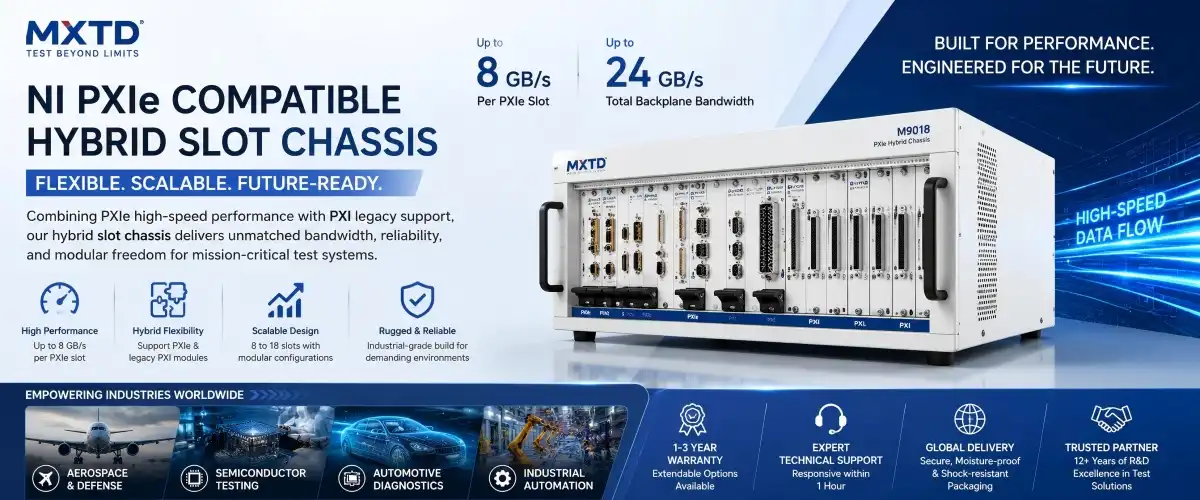
Architectural Framework and Hybrid Slot Design
The chassis is built around a dual-signaling backplane that lets two different transmission methods work. PXIe slots use PCI Express lanes, which can provide bandwidths of 1 GB/s or more per slot, based on how the lanes are set up. At the same time, PXI slots use the same CompactPCI messaging system and can handle 132 MB/s per slot. Engineers can mix high-bandwidth data acquisition cards with old switching or digitizer modules depending on the needs of the project. This is made possible by clever backplane routing and slot distribution. A hybrid slot chassis usually has a slot for the system driver, several PXIe slots, and a layout with several PXI slots that are spaced out. Cooling systems are designed to handle the higher power levels that PXIe modules bring. For extreme-duty cycles, liquid cooling or forced-air airflow can be used. The power sources in these chassis are designed to provide stable voltages across a variety of module types. They often have more than 500 watts of power to handle fully populated setups. Leading models have backplane bandwidths that can go over 24 GB/s combined. This makes sure that data streams from multiple high-speed units don't get slowed down.
Industrial Applications Across Critical Sectors
Hybrid slot frames are useful for testing in a variety of situations where old and new instruments need to work together. Engineers put PXIe digitizers for getting RF signals and PXI relay units for routing stimuli together in one chassis to make automatic test tools for defense uses. To do parametric testing, semiconductor characterization labs use mixed platforms that have both high-resolution source-measure units and older pattern makers. These systems are used for engine validation in automotive diagnostics. PXIe modules record fast transients, and PXI modules handle slow-scan sensor inputs. For testing electronics in harsh conditions that need stable multi-module synchronization, aerospace R&D centers use hybrid chassis. Being able to use both PXIe timing units and old PXI communication ports makes building test racks easier and simplifies the wiring. Industrial automation engineers can make prototypes of control systems using PXI modules that are already in stock. As production testing needs to get more intense, they can add more PXIe modules to boost performance.
PXIe Hybrid Slot Chassis vs. Standard PXI Chassis: A Comprehensive Comparison
To make smart purchasing choices, you need to know the technical and financial differences between hybrid slot and normal PXI chassis. The comparison looks at signaling methods, system throughput, slot design, and total cost of ownership. This gives you a way to figure out which platform fits your business goals.
Slot Architecture and Signaling Protocols
Standard PXI chassis only work with the CompactPCI standard, which uses parallel bus signals and a maximum speed of 132 MB/s per slot. For moderate-speed measurements like temperature tracking, making low-frequency waveforms, or switching relays without touching them, this design works fine. The backplane, on the other hand, gets full very fast when wideband RF capture, high-speed digital pattern generation, or real-time streaming to host controls are used. In hybrid slot frames, PXIe slots are added that use PCI Express serial lanes. Each slot can handle up to 8 GB/s of data, or 1 GB/s for single-lane setups. This tenfold or greater rise in throughput makes it possible to handle tests that require a lot of data in real time. There are also more advanced features that the PXIe slots can handle, like peer-to-peer streaming between modules, which lowers latency and CPU involvement in closed-loop test situations. Hybrid frames still have standard PXI slots, so current modules can continue to work without any changes. This protects NI PXIe-compatible hybrid slot chassis previous capital investments.
System Throughput and Performance Metrics
When looking at the total system output, hybrid chassis are clearly better for high-rate, multichannel apps. When all 18 spots in a normal PXI chassis are filled, the backplane bandwidth is about 2.4 GB/s, which is shared by all the modules. A combined frame with ten PXI slots and eight PXIe slots can provide over 12 GB/s of total bandwidth, with most of that going to fast modules. In tasks like multi-channel oscilloscope simulation, where continuous data rates are higher than gigasamples per second, this extra space is very important. Latency and time accuracy get better on mixed systems as well. With star-trigger architectures and specialized clock distribution circuits, PXIe modules can achieve inter-module skew below 1 nanosecond. Standard PXI frames are fine for many jobs, but they have more time jitter because they share the bus. The better synchronization that hybrid systems offer is important for aerospace test projects that need to take readings that are phase-coherent across multiple frequency bands.
Pricing and Return on Investment Considerations
Standard PXI frames are less expensive to buy at first, with entry-level units costing between $2,000 and $5,000. Prices for hybrid slot chassis are higher than average, running from $6,000 to $15,000 based on the number of slots and the power capacity. But this difference in starting costs needs to be weighed against the ability to grow and reuse modules in the future. Companies that slowly switch to PXIe modules while keeping their old PXI stock save a lot of money because they don't have to update their whole chassis as often. Hybrid systems make modules last five to ten years longer, which means that new instruments don't have to be bought right away. When figuring out the total cost of ownership, you should include upkeep, downtime, and the work that goes into putting the system together. Hybrid chassis get rid of the need for extra casings or external interface converters. This makes system design easier to understand and lowers the maintenance costs over time. For medium to large businesses with test plans that span several years, the adaptability of hybrid systems leads to a measured return on investment through lower risk of obsolescence and easier inventory management.
Key Benefits of Choosing an NI PXIe Compatible Hybrid Slot Chassis
When you use an NI PXIe compatible hybrid slot chassis, you get strategic and tactical benefits that directly help R&D managers, test engineers, and buying teams with their problems. The reasons why hybrid systems have become the best choice in tough industry settings are shown below.
Superior Flexibility and Diverse Module Integration
Engineers can use hybrid frames to set up test systems that exactly meet the needs of an application without having too much or too little gear. Mixed-module setups allow for cost-effective solutions. High-bandwidth PXIe modules are used for important measurement paths, while legacy PXI modules handle tasks like controlling the power source or digital I/O. This adaptability lowers the cost per channel while keeping the system's performance high, which is a huge benefit for projects that need to stick to a budget. Being able to combine different types of modules also speeds up the testing process. By switching modules, test builders can quickly test different combos of instruments without having to redesign rack layouts or rewrite big chunks of test code. This flexibility is very helpful in R&D centers where project requirements change a lot and having to get a product to market quickly means making quick changes.
Scalability and Future-Proofing Technology Investments
Because of the need for faster data rates and real-time processing, technology roadmaps in electronics testing are moving more and more toward PXIe as the norm. Hybrid chassis offer a way to move that saves current PXI investments and sets up systems for future improvements. When better PXIe modules hit the market, companies can slowly replace old cards without affecting their test systems that are already running. Scalability includes both the hardware and the software. These days, hybrid platforms can work with more complex timing protocols. This lets multiple chassis work together as a single mental instrument in distributed test systems. For large-scale production testing in semiconductor fabs or multi-axis aircraft test cells, where hundreds of measurement channels need to work together with nanosecond accuracy, this feature is a must.
Enhanced System Performance and Reliability
In the aerospace, military, and automobile industries, mission-critical uses need measurement tools that work accurately even when conditions are rough. Hybrid chassis have toughened backplanes, multiple power sources, and improved thermal control to make sure they can keep running even during long test runs. Because PXIe slots have a higher speed, they don't need as much data buffering, which lowers the risk of sample loss during times of high traffic. Better signal quality is also good for reliability. When compared to parallel PXI buses, PXIe serial communication is better at blocking crosstalk and electromagnetic interference. This is a very important benefit in production settings with a lot of electrical noise. The measurement data is cleaner, there are fewer false fails, and the test output is higher.
Comprehensive Manufacturer Support and Warranty Programs
If you buy your hybrid chassis from a well-known company, you can be sure that you will get good professional help and warranty coverage. Leading makers offer guarantees that last for more than one year, on-site calibration services, and quick repair programs that keep downtime to a minimum. Technical support teams help engineers improve slot allocation, set up power budgets, and fix complicated system-level problems by giving them application-specific advice. This level of care lowers the total cost of ownership and builds trust over time, which is very important for companies that manage big fleets of test equipment at sites around the world.
How to Select the Best NI PXIe Hybrid Slot Chassis for Your Business Needs
To choose the best NI PXIe compatible hybrid slot chassis, you need to carefully look at the technical specs, the needs of the project, and the vendor's skills. Procurement teams can use the following strategy to help them make decisions that are in line with practical goals and budgetary limits.
Evaluating Core Specifications: Slot Count, Power, Cooling, and Bandwidth
The number of slots in a frame determines how many modules it can hold at most, which directly affects the system's capacity and its ability to grow. Most combination systems have between 8 and 18 slots, with different numbers of PXIe and PXI slots. Organizations should look at their current module stocks and their expected growth to make sure they don't under-size, which leads to expensive mid-project increases, or over-size, which raises the cost of starting capital. Another important factor is power delivery. Each part uses power, and the total load must stay within the supply limit of the chassis. For high-performance digitizers or RF signal generators, an NI PXIe-compatible hybrid slot chassis, each slot may need 30 to 50 watts of power, so frames with 600-watt or more power sources are needed. For example, forced-air cooling systems work well for tabletop uses, while liquid cooling systems are only used for rack-mounted, high-density setups. To keep things from getting crowded during busy hours, the backplane bandwidth should be at least 30% higher than the total data rate of all the units that are installed.
Matching Chassis Specifications to Project Requirements
Different types of tests put different demands on the frame design. For high-speed data gathering projects, the number of PXIe slots and the bandwidth of the backplane are the most important factors. On the other hand, equal PXI and PXIe slot distributions are good for mixed-signal test systems. For aerospace projects, rugged frames with wide temperature ranges and vibration protection are often needed. On the other hand, semiconductor labs focus on ultra-low noise floors and high-density layouts to get the most work done per rack unit. System developers should also think about the needs for time and synchronization. Chassis with built-in star-trigger buses and clock distribution networks are needed for applications that need phase-coherent readings across multiple modules. Because older systems may use external timing sources, being able to work with standard PXI timing methods is an important factor in choosing a timing solution.
Top-Rated Hybrid Slot Chassis Models and User Feedback
There are a number of well-reviewed hybrid frame models on the market, and each one is best for a certain type of use. Models with 8 PXIe slots and 10 PXI slots are a good compromise between speed and legacy support, making them popular with companies that are moving away from normal PXI systems. Higher-density models with 14 PXIe slots are designed for uses that need to handle a lot of data, like multichannel oscilloscope systems or wideband signal intelligence. Feedback from users in professional journals and industry sites shows how important thermal efficiency and build quality are. Engineers say that frames with cooling fans and power sources that are too big have lower failure rates and need less upkeep. People always say that quick technical help and warranty terms that last between one and three years make buyers more confident and speed up the approval process for purchases.
Bulk Purchasing Strategies and Long-Term Supply Considerations
Businesses that use a lot of test systems on production lines or in R&D labs should look into getting big discounts from providers. Strategic relationships often have benefits like volume savings, longer payment terms, and first choice when supplies are low. Procurement managers should talk to suppliers about service-level agreements that promise fast fixes, access to firmware changes, and training programs for their own tech teams. Long-term supply issues include checking the vendor's product lifecycle plan to make sure that suitable modules and replacement parts will still be available for as long as the test system is expected to last. Suppliers with strong global transportation networks and regional service centers can better guarantee that operations will not be halted. This is especially true for multinational companies with sites in different parts of the world.
Procurement and Supplier Insights: Where and How to Buy NI PXIe Hybrid Slot Chassis
To buy an NI PXIe compatible hybrid slot chassis, you need to know about the approved channels, the skills of the suppliers, and the contractual issues that come up. The tips below give buying managers ways to get high-quality goods while minimizing costs and speeding up delivery times.
Identifying Authorized Dealers and Certified Global Vendors
When you buy from approved sellers and qualified NI PXIe compatible hybrid slot chassis vendors, you can be sure that the product is real, that the guarantee is valid, and that you can get real expert help. Established distributors have direct ties with makers, which lets them give accurate lead-time estimates, specs that have been checked, and proof of compliance. As part of certification programs, sellers often have to meet strict quality standards. These standards can include ISO certifications and traceability methods, which lower the risk of fake or low-quality parts. Global sellers with stores in different regions can save you time and money on shipping and customs fees. Businesses that do business in more than one country need providers that can manage export permits, coordinate deliveries to multiple locations, and provide localized customer service in original languages.
Streamlined Ordering Process and Pricing Transparency
Clear prices and well-defined buying processes are the first steps to efficient procurement. Suppliers you can trust will give you thorough quotes that break down the costs of the chassis, any extra parts you might want, any guarantee extensions, and the shipping costs. Online configurators let buyers change the specs of the chassis, see how the slots will be assigned, and get real-time price information, which speeds up the decision-making process. When buying big things, it's easier to control your cash flow when you can choose from different payment plans, like net-30 or net-60. Volume-based tiering systems give discounts for large orders, and framework deals lock in prices for multi-year procurement cycles, which protects against changes in the market.
Delivery Options and After-Sales Support Services
Handling precision test equipment in a way that keeps it from breaking during transport requires special skills. Leading providers protect fragile gadgets with shock-proof packing, climate-controlled shipping, and anti-static enclosures. When time is of the essence, air freight choices speed up delivery, while consolidated sea shipments lower costs for less important projects. As part of after-sales support, end users can get professional training, help with installation, and testing services. When gear breaks, suppliers with field service teams can fix it quickly, keeping project plans and minimizing downtime. Suppliers can fix problems remotely through network links, which cuts down on the need for expensive on-site trips and speeds up the resolution process.
Building Long-Term Partnerships with Suppliers
Strategic relationships with suppliers go beyond individual deals and encourage working together in a way that is good for everyone. Regular business reviews help sellers predict buying patterns, keep the right amount of goods on hand, and let customers know about product updates or when a product is no longer available. Preferred customer programs give customers early access to new products, chances to test them out, and custom development services that are made to fit the needs of each application. Partnerships that work together also make the supply chain more resilient. When there aren't enough parts or when production is interrupted, favorite customers get priority, which keeps operations going even when the market gets tight. These relationships are based on trust and open communication, which sets both the customer and the seller up for long-term success.
Conclusion
If you choose an NI PXIe compatible hybrid slot chassis over a normal PXI chassis, you are making a smart investment that balances your current performance needs with your ability to grow in the future. The hybrid design improves bandwidth, module flexibility, and system dependability, meeting the complicated needs of the semiconductor, aerospace, and industrial automation industries. Hybrid platforms make current instruments last longer by supporting both legacy PXI and newer PXIe modules. They also set up test systems for future technology advances. Cost savings for businesses come from shorter rounds for capital expenditures, easier system integration, and less upkeep work. Hybrid chassis are a key part of reliable, high-performance test equipment when they are bought from reputable providers that offer full support.
FAQ
1. Are all PXI modules compatible with an NI PXIe-compatible hybrid slot chassis?
Standard PXI modules can be used with hybrid chassis' PXI slots without the need for software changes or adapter cards. This means that the systems can still work with older systems. To use high-speed serial connections, PXIe units must be put in slots that are designed for PXIe. The frame backplane cleverly sends signals to the right type of slot, making sure that they work together without any problems. Manufacturers provide module compatibility lists that show which tools have been tested to work with hybrid systems. This helps engineers avoid problems with integration while designing the systems.
2. Can existing standard PXI chassis be upgraded to hybrid configurations?
Due to basic changes in backplane design and signaling infrastructure, it is usually not possible to physically update a normal PXI chassis to a hybrid architecture. Moving to a new hybrid chassis and using compatible PXI modules in old slots is the most sensible way to update. Companies can make this change slowly, using hybrid frames for brand-new projects and standard PXI systems for old programs until they are no longer supported. Some sellers have trade-in programs that help pay for upgrades, which shortens the time it takes to make the switch.
3. What warranty and technical support terms apply to hybrid slot chassis?
Manufacturers usually offer guarantees that cover flaws in the materials and work for one to three years. Service contracts can be used to expand the coverage. Technical support includes help over the phone or email, remote tests, and the ability to get software changes. Premier support levels ensure reaction times, on-site service, and loaner gear while repairs are being done. Carefully reading the warranty terms is important to know what they don't cover, like damage caused by bad handling or unauthorized changes. This will help make sure that service standards are in line with business needs.
Partner with MXTD for High-Performance Hybrid Slot Chassis Solutions
MXTD makes the best NI PXIe compatible hybrid slot chassis that are made to handle the toughest testing needs of aircraft, semiconductor, and industrial automation. Our engineering team has been doing research and development for over 12 years and creates adjustable frame solutions that meet or beat the highest standards in the industry while also being the most cost-effective. Our hybrid platforms have high-bandwidth backplanes, flexible slot setups, and strong thermal control to keep your test systems competitive as technology changes.MXTD answers buying questions within one hour, whether you need standard models that can be shipped right away or custom designs that are made to fit your specific needs. We work with both original equipment manufacturers (OEMs) and distributors (ODMs). We offer full after-sales service, including remote technical help, software updates, and a one-year guarantee that can be extended in some cases. As a reliable NI PXIe compatible hybrid slot chassis supplier, MXTD simplifies global logistics with moisture-proof, shock-resistant packaging optimized for precision instrumentation. Contact manager03@mxtdinfo.com today to discuss your requirements and discover how our hybrid chassis solutions can optimize your test infrastructure.
References
1. National Instruments Corporation. "PXI Express Technology: High-Performance Modular Instrumentation." Technical White Paper Series, 2022.
2. IEEE Standards Association. "IEEE 1588 Precision Time Protocol for Networked Measurement and Control Systems." Standard Specification Document, 2019.
3. Frost & Sullivan. "Global Test and Measurement Equipment Market: Strategic Analysis of Growth Opportunities." Industry Research Report, 2023.
4. ASTM International. "ASTM E1112-20: Standard Specification for Electronic Test Equipment Calibration and Performance Verification." Standards Publication, 2020.
5. VXI Technology Inc. "Modular Instrumentation Architectures: Design Considerations for Hybrid PXI/PXIe Systems." Engineering Application Note, 2021.
6. Society of Automotive Engineers (SAE). "SAE J2534-1: Recommended Practice for Pass-Thru Vehicle Programming." Technical Standard, 2020.
Our customers’ satisfaction speaks for our quality — contact us to experience the same reliable service.