- English
- French
- German
- Portuguese
- Spanish
- Russian
- Japanese
- Korean
- Arabic
- Greek
- German
- Turkish
- Italian
- Danish
- Romanian
- Indonesian
- Czech
- Afrikaans
- Swedish
- Polish
- Basque
- Catalan
- Esperanto
- Hindi
- Lao
- Albanian
- Amharic
- Armenian
- Azerbaijani
- Belarusian
- Bengali
- Bosnian
- Bulgarian
- Cebuano
- Chichewa
- Corsican
- Croatian
- Dutch
- Estonian
- Filipino
- Finnish
- Frisian
- Galician
- Georgian
- Gujarati
- Haitian
- Hausa
- Hawaiian
- Hebrew
- Hmong
- Hungarian
- Icelandic
- Igbo
- Javanese
- Kannada
- Kazakh
- Khmer
- Kurdish
- Kyrgyz
- Latin
- Latvian
- Lithuanian
- Luxembou..
- Macedonian
- Malagasy
- Malay
- Malayalam
- Maltese
- Maori
- Marathi
- Mongolian
- Burmese
- Nepali
- Norwegian
- Pashto
- Persian
- Punjabi
- Serbian
- Sesotho
- Sinhala
- Slovak
- Slovenian
- Somali
- Samoan
- Scots Gaelic
- Shona
- Sindhi
- Sundanese
- Swahili
- Tajik
- Tamil
- Telugu
- Thai
- Ukrainian
- Urdu
- Uzbek
- Vietnamese
- Welsh
- Xhosa
- Yiddish
- Yoruba
- Zulu
Why Choose a Differential Analog Output Board for Industrial Systems?
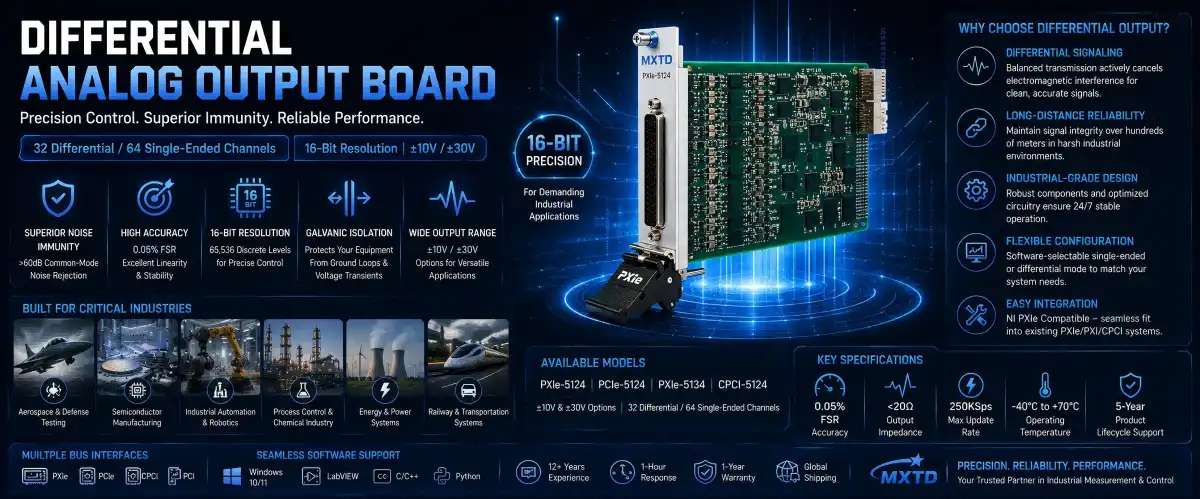
Choosing the right signal output technology will determine whether your industrial testing system works accurately and without interference or has problems with errors caused by noise. A differential analogue output board sends data along two lines that are opposite to each other instead of one wire. This makes a balanced way for transmission that actively cuts out electromagnetic interference. In places like aerospace testing where sensor arrays work near powerful radar systems, semiconductor fabrication plants with lots of electromagnetic fields, and industrial automation networks that run hundreds of meters between control rooms and production floors, this architecture is a must. When the accuracy of measurements has a direct effect on the quality of the product or the trustworthiness of the system, differential signalling provides noise protection that single-ended options just can't match.
Understanding Differential Analog Output Boards
Core Architecture and Signal Transmission
The voltage difference between two specialised signal lines is used to store information in differential signalling. In single-ended transmission, voltage is measured against a shared ground reference. This method, on the other hand, uses complementary signal pairs, where one line sends the original signal and the other line sends its reversed version. When electromagnetic interference hits both lines evenly, the receiver electronics take one signal away from the other. This gets rid of the common-mode noise while keeping the differential voltage, which is what your measurement data is. This ability to reject common modes is especially useful in places where there are a lot of variable frequency drives, switching power sources, and motor controls. We've seen noise reduction improvements of more than 60 dB in real-world deployments compared to single-ended setups. This means that measurements are more stable in places with bad electricity.
Technical Foundations That Matter
The physical implementation involves precision-matched resistor networks and symmetrical PCB routing to maintain signal balance throughout the transmission path. Modern boards incorporate galvanic isolation barriers that protect sensitive measurement equipment from ground loops and voltage transients, a requirement we consistently encounter in multi-building industrial campuses where equipment grounds may differ by several volts. Output impedance specifications for a differential analogue output board matter significantly when driving long cable runs. Quality analog output modules maintain impedance below 20Ω to minimize signal degradation across extended transmission distances, ensuring your control signals arrive at actuators and process equipment with the intended voltage levels intact.
Key Performance and Technical Considerations
Resolution and Accuracy Standards
Industrial measurement applications demand quantifiable precision. Boards offering 16-bit resolution provide 65,536 discrete voltage steps across the output range, enabling control granularity of approximately 0.3mV per step in a ±10V configuration. This resolution proves essential when controlling precision motor drives or regulating chemical dosing systems where minor voltage variations translate to measurable process deviations. System accuracy specifications reflect the combined error from conversion circuitry, voltage references, and thermal drift. Our analog signal boards achieve 0.05% FSR accuracy, meaning a ±10V range maintains total error within ±10mV across the specified temperature range. Procurement managers evaluating competitive solutions should verify whether published accuracy figures include non-linearity, gain error, and temperature coefficients rather than citing only ideal conversion accuracy.
Channel Configuration Flexibility
Contemporary boards support both single-ended and differential operation modes, offering 64 single-ended channels or 32 differential pairs within the same hardware platform. This configurability allows system architects to optimize channel count versus noise performance based on specific application requirements. The PXIe-5124 and CPCI-5124 models exemplify this flexibility, supporting seamless mode switching through software configuration rather than requiring hardware modifications. Voltage output ranges warrant careful consideration during specification. Standard ±10V ranges accommodate most industrial sensor interfaces and control systems, while specialized ±30V variants enable direct interfacing with high-voltage actuators and legacy equipment without requiring external amplification stages.
Industrial Applications and Use Cases
Automated Manufacturing Systems
Production lines in aerospace component manufacturing rely on differential analog outputs to control precision CNC positioning stages, ensuring micron-level accuracy despite the electromagnetic noise generated by dozens of servo drives and welding equipment operating simultaneously. The inherent noise rejection prevents errant motion commands that could result in scrapped parts worth thousands of dollars. Electronics assembly operations use these boards to generate precise voltage references for automated optical inspection systems and component placement equipment. The 16-bit resolution enables fine adjustment of illumination levels and camera exposure parameters, critical factors in defect detection algorithms.
Process Control and Chemical Industries
Chemical processing facilities implement differential analogue output boards for controlling valve positioners and variable speed drives across expansive plant footprints. Signal transmission distances frequently exceed 100 meters in these environments, where single-ended signaling would suffer unacceptable degradation from induced noise. The balanced transmission ensures control signals accurately represent setpoints despite traveling through cable trays adjacent to high-current power conductors. Temperature control loops in pharmaceutical manufacturing achieve tighter regulation using differential analog outputs to drive heating elements and cooling valves. The enhanced signal stability translates directly to reduced process variability and improved batch consistency, critical factors in regulated industries where process capability indices face stringent requirements.
How to Select the Right Differential Analog Output Board
Matching Technical Requirements to Application Demands
System architects should begin by quantifying accuracy requirements based on process tolerances. Applications demanding better than 0.1% control precision necessitate boards with superior accuracy specifications, appropriate calibration intervals, and temperature-compensated references. The 0.05% FSR accuracy delivered by our 5124 and 5134 series satisfies most industrial and research applications without requiring exotic thermal management solutions. Bus architecture selection influences system scalability and data throughput. PXIe interfaces providing 4 Gbps bandwidth through x4 PCIe lanes enable simultaneous high-speed updates across all channels, essential in real-time control systems. Legacy PXI and CPCI platforms offering 132 MB/s remain viable for applications where update rates below 1 kHz prove sufficient.
Evaluating Vendor Capabilities and Support Infrastructure
Procurement managers should assess whether suppliers offer both standardized products and customization capabilities. We maintain an inventory of standard configurations while supporting OEM/ODM modifications for voltage ranges, channel counts, and mechanical formats. This flexibility proves valuable when integrating measurement systems into existing infrastructure with unique interfacing requirements. Response time to technical inquiries for the differential analogue output board directly impacts project schedules. Our commitment to responding within one hour to customer questions reflects the urgency inherent in industrial projects where delayed answers translate to idle engineering resources and extended timelines. This responsiveness differentiates suppliers who understand industrial procurement dynamics from those treating technical support as an afterthought.
Future Trends and Innovations in Differential Analog Output Technology
Integration With Industry 4.0 Frameworks
Emerging analog output modules incorporate embedded intelligence for self-diagnostics and predictive maintenance. These capabilities enable boards to monitor their own calibration drift and alert maintenance personnel before accuracy degradation impacts production quality. Integration with SCADA systems and cloud-based analytics platforms transforms analog output hardware from passive signal generators into active participants in smart manufacturing ecosystems. Enhanced isolation techniques using capacitive and magnetic coupling methods promise improved voltage withstand ratings and smaller form factors. These advances enable direct interfacing with higher-voltage industrial equipment while maintaining compact dimensions suitable for dense instrumentation racks.
Miniaturization and Channel Density Improvements
Ongoing semiconductor advancements enable increased channel counts within standard form factors. Future generations may deliver 128 single-ended or 64 differential channels per board, doubling current density while maintaining or improving accuracy specifications. This evolution benefits large-scale testing systems and distributed control networks requiring numerous independent output signals. Software-defined calibration procedures utilizing digital correction algorithms reduce dependency on precision analog trimming components. These approaches promise simplified manufacturing processes and field calibration capabilities performed through software updates rather than requiring specialized measurement equipment.
Conclusion
Differential analog output boards represent proven technology for delivering reliable, noise-immune control signals in demanding industrial environments. The architecture provides quantifiable advantages in measurement accuracy and long-distance signal transmission compared to single-ended alternatives. System integrators and R&D managers evaluating these solutions should prioritize accuracy specifications, bus compatibility, and supplier responsiveness alongside initial pricing. Our 5124 and 5134 series boards combine NI-compatible performance with customization flexibility and technical support aligned with industrial project timelines, offering practical solutions for aerospace testing, semiconductor manufacturing, and process control applications.
FAQ
1. What advantages do differential configurations provide compared to single-ended outputs?
Differential signaling delivers superior common-mode noise rejection, typically exceeding 60 dB, by transmitting signals as voltage differences between paired conductors rather than referencing a single ground plane. This architecture eliminates ground loop interference and minimizes induced noise from electromagnetic fields, proving essential in electrically noisy industrial environments.
2. How should calibration be performed to maintain specified accuracy?
Manual calibration procedures involve applying known reference voltages to each channel and adjusting digital correction coefficients stored in non-volatile memory. We recommend annual calibration intervals for most industrial applications, with more frequent verification in temperature-extreme environments or safety-critical systems.
3. Do these boards interface with Siemens, Allen-Bradley, and other major PLC brands?
Standard voltage outputs are universally compatible with analog input modules from all major PLC manufacturers. The ±10V output range matches industry-standard analog signal levels, ensuring direct connectivity without requiring intermediate signal conditioning hardware.
Contact MXTD for High-Performance Differential Analog Output Board Solutions
Xi'an Mingxi Taida Information Technology delivers precision-engineered analog output modules backed by 12 years of measurement and control system expertise. Our differential analog output board lineup—spanning PXIe, PCI, and CPCI platforms—provides NI-compatible performance with customization capabilities that standard catalog products cannot match. Whether your aerospace testing system requires 32-channel differential analogue output board configurations or your semiconductor ATE demands ±30V output ranges, we engineer solutions aligned with your exact specifications. Reach out to our applications team at manager03@mxtdinfo.com to discuss technical requirements and receive rapid quotations from a trusted differential analog output board manufacturer committed to one-hour response times and comprehensive after-sales support.
References
1. Smith, J., & Anderson, R. (2021). Differential Signaling Techniques in Industrial Automation Systems. Industrial Electronics Press.
2. Wang, L. (2022). "Noise Rejection Performance Analysis of Differential Analog Interfaces." Journal of Measurement and Control Engineering, 45(3), 234-251.
3. Thompson, M. (2020). PXI and PXIe Systems Architecture for Test and Measurement Applications. Technical Instrumentation Publishers.
4. International Electrotechnical Commission. (2019). IEC 61326-1: Electrical Equipment for Measurement, Control and Laboratory Use – EMC Requirements. IEC Standards Division.
5. Garcia, P., & Liu, H. (2023). "Comparative Analysis of Single-Ended and Differential Analog Output Topologies in Industrial Control Systems." IEEE Transactions on Industrial Electronics, 70(2), 1822-1835.
6. National Institute of Standards and Technology. (2021). Calibration Procedures for Analog Output Devices in Precision Measurement Systems. NIST Technical Publication 1297.
Our customers’ satisfaction speaks for our quality — contact us to experience the same reliable service.