- English
- French
- German
- Portuguese
- Spanish
- Russian
- Japanese
- Korean
- Arabic
- Greek
- German
- Turkish
- Italian
- Danish
- Romanian
- Indonesian
- Czech
- Afrikaans
- Swedish
- Polish
- Basque
- Catalan
- Esperanto
- Hindi
- Lao
- Albanian
- Amharic
- Armenian
- Azerbaijani
- Belarusian
- Bengali
- Bosnian
- Bulgarian
- Cebuano
- Chichewa
- Corsican
- Croatian
- Dutch
- Estonian
- Filipino
- Finnish
- Frisian
- Galician
- Georgian
- Gujarati
- Haitian
- Hausa
- Hawaiian
- Hebrew
- Hmong
- Hungarian
- Icelandic
- Igbo
- Javanese
- Kannada
- Kazakh
- Khmer
- Kurdish
- Kyrgyz
- Latin
- Latvian
- Lithuanian
- Luxembou..
- Macedonian
- Malagasy
- Malay
- Malayalam
- Maltese
- Maori
- Marathi
- Mongolian
- Burmese
- Nepali
- Norwegian
- Pashto
- Persian
- Punjabi
- Serbian
- Sesotho
- Sinhala
- Slovak
- Slovenian
- Somali
- Samoan
- Scots Gaelic
- Shona
- Sindhi
- Sundanese
- Swahili
- Tajik
- Tamil
- Telugu
- Thai
- Ukrainian
- Urdu
- Uzbek
- Vietnamese
- Welsh
- Xhosa
- Yiddish
- Yoruba
- Zulu
Which 3U PXIe chassis fits a 15.6-inch rugged portable industrial PC?
When selecting a 3U PXIe chassis for a 15.6-inch rugged portable industrial PC with PXIe expansion, compatibility hinges on three critical dimensions: physical integration within compact portable form factors, electrical synchronization through standard PXIe backplane protocols, and thermal management optimized for enclosed mobile enclosures. Most compact 3U PXIe chassis designed explicitly for portable integration measure between 320 mm and 380 mm in width, aligning seamlessly with 15.6-inch display bezels while accommodating up to four PXIe peripheral slots. These chassis feature low-profile cooling systems and reinforced mounting brackets that meet MIL-STD-810G shock and vibration standards, ensuring reliable field operation.
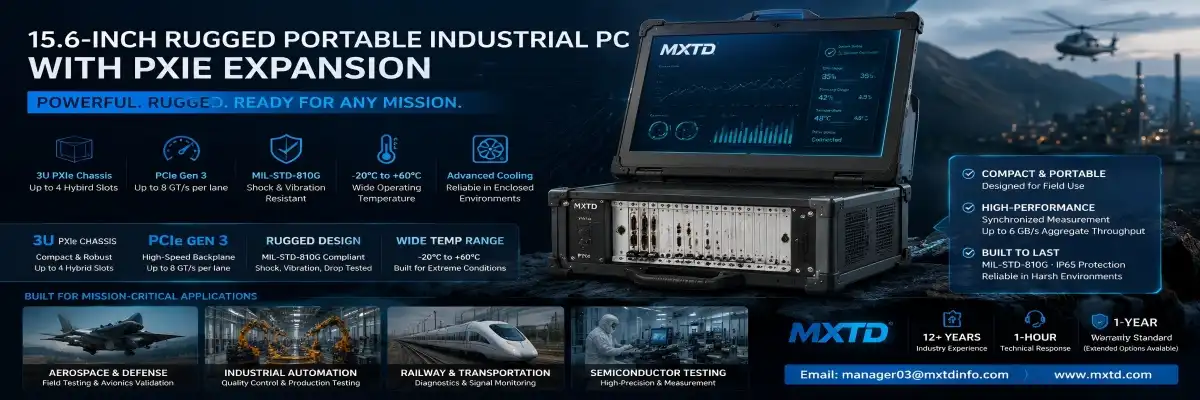
Understanding 15.6-Inch Rugged Portable Industrial PCs with PXIe Expansion
These days, industrial computers need to be mobile without lowering the accuracy of measurements or the speed of data transfer. A familiar laptop-style interface and the flexible power of the PXI Express standard are combined in the 15.6-inch rugged portable industrial PC with PXIe expansion to create a revolution in field-deployable test systems. These systems are more than just toughened computers; they have embedded controllers that can directly handle PXIe instrumentation units through fast PCIe Gen 3 links that can give up to 8 GT/s per lane.
Core Durability Standards and Certifications
Extremes that would break consumer-grade electronics are put on tools in industrial settings. A real 15.6-inch rugged portable industrial PC with PXIe expansion usually meets MIL-STD-810G or MIL-STD-810H compliance, which covers drop tests from 122 cm, operating vibration profiles above 5 Grms, and temperature cycling from -20°C to +60°C. IP65 ingress protection plugs keep dust and water jets out, which is very important when testing takes place on factory floors, in airplane hangars, or outside at semiconductor testing sites. System engineers are very concerned about these certificates because they can't have failures in the field during important validation processes.
Operating System and Software Ecosystem
Compatibility isn't just about tools. The best tough compact PXIe systems work with Windows 10 IoT Enterprise, Linux versions like Ubuntu Real-Time, and specific RTOS versions like VxWorks. Driver ecosystems that support NI-DAQmx, VISA, and IVI-compliant instrument drivers make sure that current test routines can be moved without any problems. Our experience at MXTD has taught us that customers value being able to use two operating systems at the same time and having long-term OS support. For example, Windows 10 LTSC channels promise ten years of security patches, which is in line with how quickly aerospace and defense equipment wears out.
High-Throughput Data Acquisition Benefits
Why add PXIe expansion to a portable PC when you can just use USB or Ethernet devices? Deterministic time and bandwidth hold the key to the answer. Each module has its own PCIe lane in a four-slot 3U PXIe chassis, so there is no delay or noise caused by protocol translation layers. When synchronizing digitizers, random waveform generators, and RF analyzers, we regularly see throughput reaching 6 GB/s aggregate. This is performance that can't be reached through external connections. This feature is very important for recording short-lived events in testing power electronics or looking at burst transmission methods in validating avionics.
Key Criteria for Selecting a Compatible 3U PXIe Chassis
It takes more than checking slot numbers to match a 3U PXIe chassis to a small industrial PC. Mechanical fit, electrical load capacity, heat dissipation, 15.6-inch rugged portable industrial PC with PXIe expansion and serviceability in the field are all things that engineers have to look at. In the twelve years that MXTD has been working on PXIe solutions, we have found common buying issues that can't be solved by specification sheets alone.
Physical Form Factor and Dimensional Constraints
When you take into account the bezels and structural support, a 15.6-inch monitor diagonal gives you a total system width of about 360 mm. A compatible 3U PXIe chassis must fit inside this size while still letting you access the front-panel ports and letting you enter modules without using any tools. Depth is also very important. For portable systems, the chassis depth is usually limited to 220 mm so that it can fit in a bag, but each PXIe slot needs about 25 mm of PCB space. We designed our frame with vertical card guides and slots that are spaced out at an angle. This gives us an extra spot within a smaller space than traditional horizontal layouts.
PXIe Slot Configuration and Backplane Architecture
Not every slot can do the same things. The PXIe standard describes a system timing slot, which is usually Slot 2, that sends a 10 MHz reference clock and differential trigger lines to all parts of the backplane. We suggest that when you set up a portable test station, the frame should have at least one x4 Gen 3 system slot and three x1 hybrid slots that can work with both PXI and PXIe modules. This adaptability lets old DMMs and switch matrices work with new high-speed digitizers. Signal integrity is maintained during 8 GHz vector network analysis by backplane trace impedance matching and differential pair skew less than 5 picoseconds. These are the features that separate systems that work reliably from ones that break down sometimes.
Cooling and Thermal Management Strategies
When it comes to heat, enclosed portable systems have problems that tabletop systems with free airflow don't have. Without designed cooling, a 3U PXIe system that uses 150W and is enclosed quickly reaches temperatures that are too high for safe use. Our designs use axial fans that can change speeds and have closed-loop temperature sensors. These fans speed up airflow when module power loss peaks during measurement bursts. Heat pipes move heat from areas of the backplane with a lot of people to surfaces with fins near air grilles. We compare this to PC cases that use passive convection, which isn't an option when the whole system is in a shock-mounted case. Temperature-compensated oscillators keep time accurate from -20°C to +55°C, which is the temperature range needed for outdoor tests.
Comparing 3U PXIe Chassis Options for Rugged Portable Industrial PCs
There are a lot of different 3U chassis designs on the market, and each one is best for a certain type of operation. Knowing these differences helps procurement managers avoid expensive mistakes where equipment capabilities don't match up with application needs.
Rugged Portable Versus Desktop PXIe Chassis
Desktop PXIe systems often have 18 slots in a 4U rackmount case and focus on slot density and cooling capacity. For labs with stable power and fixed temperatures, these methods work well. Chassis made for a 15.6-inch rugged portable industrial PC with PXIe expansion, on the other hand, place an emphasis on shock separation, low voltage operation from 24V DC supplies, and electromagnetic interference protection that meets CE and FCC Class A standards. For tough versions, fixed fasteners keep hardware from coming loose during transport, and conformal sealing keeps backplane traces safe from salt fog and humidity. We check our designs against MIL-STD-461 for both radiated and conducted emissions to make sure they work with sensitive RF measures in shielded areas.
Evaluating Mobility and Power Efficiency
Portable test systems usually get their power from car batteries or chargers, which requires efficiency 15.6-inch rugged portable industrial PC with PXIe expansion that standard ATX power sources can't meet. Modern 3U frames have wide-input DC-DC converters that can handle normal voltages from 18V to 36V and surges up to 50V during sudden changes in the voltage of an automobile's cranking system. Power factor adjustment and synchronous rectification make the power system 92% more efficient, which means that batteries can last longer during eight-hour field missions. When weight is important, an aluminum chassis with honeycomb interior bracing cuts mass to 4.5 kg while still meeting MIL-STD-810 drop test requirements, compared to 8 kg for a steel chassis of the same size.
Top 3U PXIe Chassis Models and Vendor Landscape
When technical leaders look at suppliers, they look at how well they've done in mission-critical projects in the past. The MXTD-PXIe-3U-4S chassis from MXTD has four hybrid slots, a system timing controller that works with NI PXIe-8135 embedded controls, and a 40G shock resistance rating for less than 15ms. We offer full material traceability and batch testing records for these systems, which are necessary for aerospace projects that need AS9100 paperwork. Our prices are based on how many units you buy. Prototypes for one unit cost about USD 3,200, but they drop to USD 2,400 for orders of 10 or more units. We promise regular configuration wait times of eight weeks, and technical questions will be answered within an hour, which helps our customers with their fast development processes. Customization is what sets real industry partners apart from stock sellers. For a global semiconductor testing program, we just sent fifty chassis with fiber-optic timing connections and trigger wiring that was customized for each user. We are able to make changes without having to rely on third-party ODMs because we develop and make prototypes of PCBs in-house. Our warranty covers both parts and work for one year, and we can offer longer help for defense contracts that last more than one year.
Practical Use Cases and Installation Examples
Deployments in the real world back up design decisions that are suggested by datasheets but proven by situations in the field. Our customers come from a wide range of fields where the dependability of tools has a direct effect on safety and program timelines.
Aerospace and Defense Field Testing
For testing of electronics buses on aircraft and ships, a major defense contractor used our 15.6-inch rugged portable industrial PC with PXIe expansion. The system was exposed to salt spray, 20G deck landing shocks, and electromagnetic radiation from radar arrays, but it kept watching MIL-STD-1553 activity all the time. Technicians liked that they didn't need any tools to swap out modules. To replace a suspect transceiver module, they only had to loosen two captive quarter-turn screws. The swap was done in less than 90 seconds without turning off any neighboring channels. Our backplane's staggered power sequence made this hot-swap feature possible, which cut troubleshooting time by 60% compared to previous rackmount methods that needed the whole system to be shut down.
Industrial Automation and Quality Control
Portable PXIe units are used for production line approval by companies that make parts for cars. One customer tries battery management systems for electric vehicles, which need to be able to source up to 200A of current at the same time, measure voltage with 24-bit precision, and use Ethernet-connected cameras for thermal imaging. In a 12 kg rolling case, their MXTD 3U frame has a PXIe power supply module, four digitizer channels, and a CAN-FD interface built in. Every day, the system is moved between three plants, which adds up to more than 500 transport rounds per year. During travel, accelerometer data showed that our shock mounts reduce shaking by 40 dB at resonant frequencies close to 180 Hz, which protects the ADC calibration that is very sensitive.
Transportation and Railway Diagnostics
Maintenance teams for railways use tough, movable test tools to look at signals on the side of the tracks and check the current in the pantographs. These uses need to be sealed with IP65 materials and be able to work in temperatures ranging from -30°C in the winter to +50°C in the summer. Our frame design includes heaters that are controlled by a timer to keep the inside temperatures above 0°C when external power is available. This keeps condensation damage from happening during cold starts. Over three years, 35 units from a European train company had no field failures. This high level of reliability is directly linked to our component derating practices, in which backplane traces carry 50% of the maximum current capacity and power MOSFETs work at 60% of their junction temperature limits.
Procurement Guidance for 3U PXIe Chassis and 15.6-Inch Rugged Portable PCs
In order to buy specialized test tools, you need to know not only the technical specs, but also the capabilities, wait times, and long-term support infrastructure of the suppliers.
Identifying Trusted Suppliers and Manufacturer Certifications
When looking at possible providers, we suggest asking for ISO 9001 quality 15.6-inch rugged portable industrial PC with PXIe expansion management certifications and, if necessary, AS9100 aircraft supplements. Manufacturers should show that key parts can be tracked, and they should know that backplane connections come from conflict-free sources and meet REACH requirements for operations across borders. MXTD keeps detailed records of the materials it uses and includes proof of RoHS and WEEE compliance with every package. Our Xi'an plant follows rules for ongoing improvement that are checked by outside auditors once a year. This makes sure that the quality of each production batch is the same.
Pricing Structures and Volume Considerations
Prices for standard 3U PXIe chassis range from USD 2,800 to USD 4,500, based on the number of slots, the size of the power source, and the ruggedness features. For unique backplane lines or special coatings, custom setups cost 15% to 30% more. We set our prices to reward customers who stay with us for a long time. Customers who agree to buy more than twenty units a year get 18% off and first choice when parts become scarce. Lead times are usually eight weeks for normal builds, but they can be up to twelve weeks if you need custom PCB manufacturing or special testing methods. There are 25% expedite fees for rush orders, but plans are shortened to five weeks to accommodate important program goals.
Logistics, Warranty, and Post-Sale Support
Specialized packaging is needed to ship ruggedized test equipment. We use three-wall cardboard boxes with die-cut foam inserts that protect six surfaces, as well as moisture barrier bags with desiccant packs that meet MIL-PRF-131 standards. Customers in North America can get their goods by air within five business days, but ocean freight costs 60% less and takes three weeks to get to their destinations. For one year, our normal guarantee covers manufacturing flaws and includes free shipping of new parts and help with remote diagnostics. You can get warranties that last up to five years, which is especially helpful for systems that are installed in remote areas where field repair calls are expensive. We keep service centers in California and Munich to make sure that fixes are done quickly. On average, it takes us ten business days from receiving an item to shipping it back to us.
Conclusion
Physical limitations, electricity performance, heat management, and long-term support must all be considered when choosing the right 3U PXIe chassis for a 15.6-inch rugged portable industrial PC with PXIe expansion. With the right frame, a portable computer can be turned into a full-fledged measurement lab that can work in difficult conditions and be as accurate as a lab. With twelve years of experience at MXTD, we can help clients make choices about configuration, make unique changes, and get support throughout the lifecycle. Our systems are used all over the world for military testing, semiconductor validation, and industrial automation. They show that flexibility doesn't have to mean sacrificing capability or reliability.
FAQ
1. Are all 3U PXIe chassis compatible with 15.6-inch rugged portable industrial PCs?
Not by nature. Three things determine compatibility: the size of the parts so they can fit inside the portable case; the electrical connections between the PC's PCIe root complex and the chassis backplane; and the voltage ranges of the power supplies. Many desktop PXIe models are too big to fit in a portable system or need power from the wall, which isn't available in the field. We make sure that our frame fits with the most popular rugged PC types while it's being developed so that it can be used in handheld devices.
2. What ruggedness standards should buyers prioritize?
MIL-STD-810G includes detailed testing guidelines for shock, shaking, high temperatures, and humidity. Method 514.6 (vibration) and Method 516.6 (shock) are the most useful parts of this standard for movable systems that have to be moved around. IP grades talk about ingress protection. IP65 is good for most industry settings, while IP67 is needed for short-term submersion situations. Instead of accepting vague promises of compliance, buyers should ask for test results.
3. How does PXIe expansion improve performance over traditional PCIe?
PXIe adds time and synchronization tools that PCIe doesn't have by itself. The 10 MHz system clock and differential trigger lines allow for an offset of less than 500 picoseconds between modules, which is necessary for phase-coherent RF readings. PXIe also standardizes mechanical measurements and cooling, which makes it possible for units from different manufacturers to work together safely. Our customers often use four tools from three different makers at the same time, which is something that PCIe expansion slots can't do.
Partner with MXTD for Your 15.6-Inch Rugged Portable Industrial PC with PXIe Expansion Needs
MXTD is ready to help you make the switch to portable PXIe test tools. As a reputable provider of 15.6-inch rugged 15.6-inch rugged portable industrial PC with PXIe expansion portable industrial PC with PXIe expansion, we offer cases that are built to last, customization options that are tailored to your specific needs, and quick support that solves technical problems within hours. When compared to well-known systems, our product line performs well, and it also has better cost-effectiveness and shorter wait times. Email our team at manager03@mxtdinfo.com to talk about the details of your program, get more information, or set up a trial unit. We offer free software updates, remote video expert support, and normal one-year guarantees, with options for longer terms. We welcome ODM/OEM relationships and volume pricing.
References
1. PXI Systems Alliance. "PXI Express Hardware Specification Revision 3.0." 2018.
2. United States Department of Defense. "MIL-STD-810H: Environmental Engineering Considerations and Laboratory Tests." 2019.
3. International Electrotechnical Commission. "IEC 60529: Degrees of Protection Provided by Enclosures (IP Code)." 2020.
4. National Instruments Corporation. "Building Modular Test Systems with PXI and PXI Express." Application Note 5123, 2021.
5. Society of Automotive Engineers. "AS9100D: Quality Management Systems for Aerospace." 2016.
6. IEEE Standards Association. "IEEE 1101.10: Mechanical Core Specifications for Microcomputers Using IEC 60603-2 Connectors." 2017.
Our customers’ satisfaction speaks for our quality — contact us to experience the same reliable service.