- English
- French
- German
- Portuguese
- Spanish
- Russian
- Japanese
- Korean
- Arabic
- Greek
- German
- Turkish
- Italian
- Danish
- Romanian
- Indonesian
- Czech
- Afrikaans
- Swedish
- Polish
- Basque
- Catalan
- Esperanto
- Hindi
- Lao
- Albanian
- Amharic
- Armenian
- Azerbaijani
- Belarusian
- Bengali
- Bosnian
- Bulgarian
- Cebuano
- Chichewa
- Corsican
- Croatian
- Dutch
- Estonian
- Filipino
- Finnish
- Frisian
- Galician
- Georgian
- Gujarati
- Haitian
- Hausa
- Hawaiian
- Hebrew
- Hmong
- Hungarian
- Icelandic
- Igbo
- Javanese
- Kannada
- Kazakh
- Khmer
- Kurdish
- Kyrgyz
- Latin
- Latvian
- Lithuanian
- Luxembou..
- Macedonian
- Malagasy
- Malay
- Malayalam
- Maltese
- Maori
- Marathi
- Mongolian
- Burmese
- Nepali
- Norwegian
- Pashto
- Persian
- Punjabi
- Serbian
- Sesotho
- Sinhala
- Slovak
- Slovenian
- Somali
- Samoan
- Scots Gaelic
- Shona
- Sindhi
- Sundanese
- Swahili
- Tajik
- Tamil
- Telugu
- Thai
- Ukrainian
- Urdu
- Uzbek
- Vietnamese
- Welsh
- Xhosa
- Yiddish
- Yoruba
- Zulu
What Industries Benefit Most from PXIe Test Systems?
Automatic validation is based on PXIe test devices and PXIe test systems, which are used in aerospace, defence, automotive, telecommunications, semiconductor, and industrial automation. These modular platforms give R&D centers and system designers the accuracy, speed, and ability to grow that they need to test everything from 5G RF circuits to avionics parts. PXIe architecture is used by companies in these fields to take complicated measurements across multiple domains while keeping everything in sync and achieving high throughput. Because a PXIe test system is flexible, technical teams can quickly adapt to changing product standards without having to rebuild whole test infrastructures. This makes it a smart investment for medium to large businesses that care about quality and efficiency.
Understanding PXIe Test Systems
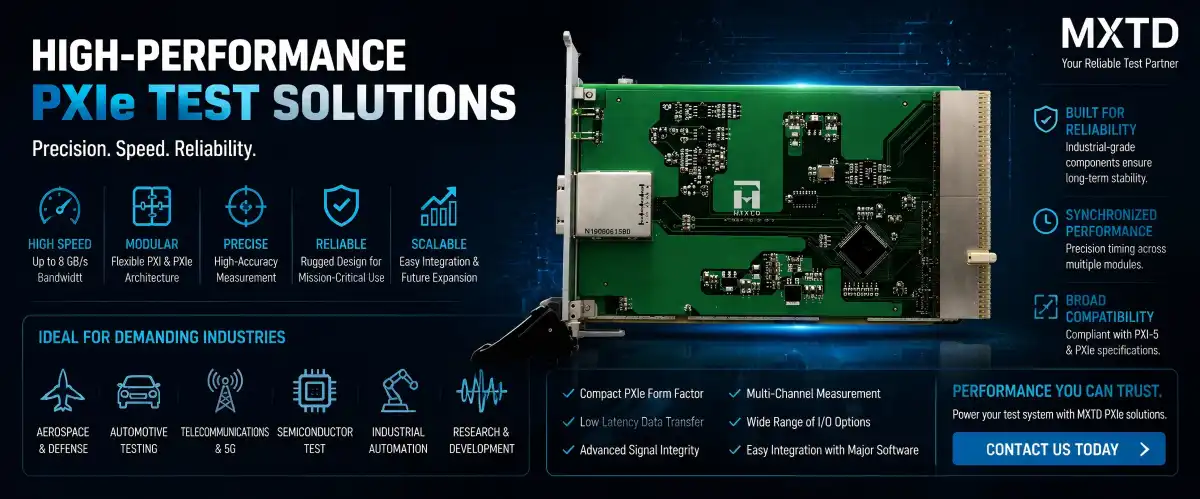
Core Architecture and Components
PXIe test systems build upon the proven PXI specification while incorporating PCI Express technology for dramatically faster data throughput. The architecture centers on a rugged chassis that houses multiple instrument modules—digitizers, arbitrary waveform generators, digital multimeters, RF analyzers, and specialized cards tailored to specific measurement needs. Each module communicates via a high-speed backplane that supports up to 8 GB/s per slot, enabling real-time processing of multiple signal streams simultaneously.
Modular Advantages Over Traditional Platforms
A PXIe test system's modular design gives real benefits that stand-alone bench tools just can't match. Engineers can set up systems exactly how the application needs them, choosing only the measurement features they need right now and leaving room for growth for later. This method is very different from standard boxed instruments, which only have a few ways to connect and work together. When testing needs change, which they always do, adding potential means adding a new module instead of buying all new equipment. Traditional measurement platforms like VXI were created decades ago with different design goals. When you look at current alternatives, you can see why PXI and its improved version, PXIe, have become industry standards. AXIe focuses on the highest-performance niche with bigger form factors, LXI on network-based distributed testing, and PXIe finds the best mix between performance, density, PXIe test system, and cost-effectiveness.
Key Industries Leveraging PXIe Test Systems
Aerospace and Defense Applications
Some of the strictest testing rules in any business are found in the aerospace and defence sectors. Extreme temperature ranges, vibration patterns, and electromagnetic conditions are all places where avionics systems have to work perfectly. A PXIe test system can synchronise multiple channels, which is needed to check complex radar arrays. The success of the system depends on how well the transmit and receive paths work together in terms of timing. Defence companies also use these platforms to test secure communications, simulate electronic warfare, and see how susceptible they are to jamming. Radar cross-section measurement facilities use PXIe-based systems to figure out how the structures of aircraft reflect RF energy. PXIe is perfect for these uses because it can handle multiple signal generators and record reflected waveforms across wide frequency bands at the same time. Recent studies have shown that modular instrumentation lowers the size of test racks by 60% compared to older methods. This is a big benefit in facilities that have to put together aeroplanes but don't have a lot of room.
Automotive and Electric Vehicle Testing
The shift in the auto business toward electric vehicles and self-driving systems has made testing more difficult than ever. To make good battery management systems, cell voltages, currents, and temperatures must be precisely measured across hundreds of lines at the same time. This level of complexity is easily handled by a PXIe test system, which has high-density analogue input units that keep measurements accurate while scanning across many cells. Automotive makers depend on this feature to make sure that battery packs work well under real-life load conditions. PXIe also does great work when it comes to testing advanced driver assistance systems (ADAS). To test sensor fusion algorithms, radar, lidar, and camera inputs must be stimulated at the same time while vehicle control reactions are watched. PXIe backplane triggers allow for tight timing correlation, which makes sure that test scenarios exactly reflect real-life driving conditions. Major automakers have chosen PXI-based hardware-in-the-loop systems because they can be used for everything from testing individual parts to validating the whole car.
Telecommunications and 5G Development
Telecommunications infrastructure development drives continuous innovation in test capabilities. The rollout of 5G networks demands validation of millimeter-wave RF performance, massive MIMO antenna arrays, and complex modulation schemes. A PXIe test system accommodates these requirements through specialized RF modules that cover frequencies up to 50 GHz and beyond. Engineers developing base station equipment particularly value the ability to generate and analyze wideband signals exceeding 1 GHz instantaneous bandwidth. Protocol testing for 5G devices requires emulating network behavior with precise timing accuracy. PXIe-based test solutions integrate signal generation, analysis, and protocol processing within unified software frameworks. This integration reduces test development time while improving measurement repeatability. Network equipment manufacturers report that migrating to PXI platforms shortened their validation cycles by 40%, accelerating product launches in a highly competitive market.
Semiconductor Manufacturing and Validation
Semiconductor manufacturers face relentless pressure to improve yields while shrinking device geometries. Mixed-signal testing of analog-to-digital converters, power management ICs, and RF transceivers requires instrumentation that delivers both high precision and high throughput. A PXIe test system meets these demands through specialized semiconductor modules that execute parametric measurements at production speeds. The platform's synchronization capabilities enable complex test sequences that alternate between DC characterization and high-frequency performance validation without manual intervention. Wafer-level testing environments benefit from PXI's compact footprint, which fits naturally into probe stations and automated handlers. The ability to deploy multiple independent test systems that share common software architectures streamlines production scaling. Fabless semiconductor PXIe test system companies appreciate that PXIe configurations adapt easily to different device types, protecting their capital equipment investments as product portfolios evolve.
Industrial Automation and Energy Systems
Smart grid development and industrial IoT deployments require extensive validation of control systems, communication protocols, and power electronics. A PXIe test system supports these applications through modules that interface directly with industrial fieldbus standards like EtherCAT, PROFINET, and Modbus. Energy companies use PXI platforms to characterize inverter performance, test protective relay response times, and validate renewable energy integration systems. Battery energy storage systems undergo rigorous testing that spans months of simulated charge-discharge cycling. The modular architecture of PXIe enables cost-effective scaling to hundreds of test channels while maintaining centralized control and data management. Utility providers have documented significant reliability improvements after implementing automated PXI-based validation during commissioning.
How to Choose the Right PXIe Test System for Your Industry
Assessing Testing Scope and Requirements
Selecting an appropriate PXI configuration begins with a clear understanding of your measurement challenges. R&D managers should catalog the signal types they need to generate and acquire—consider voltage ranges, frequency content, sample rates, and channel counts. The testing scope extends beyond immediate needs to anticipated future requirements. A properly specified PXIe test system accommodates expansion without architectural changes, protecting your investment as product lines evolve. Organizations evaluating platforms often overlook integration complexity. A test system comprises not just hardware but also software drivers, application development environments, and calibration procedures. Procurement managers should assess vendor support for common programming languages like Python, C++, and LabVIEW, as this determines how quickly engineering teams can become productive. The availability of reference designs and application examples accelerates development, particularly for teams new to modular instrumentation.
Comparing Costs and Performance Metrics
Budget considerations naturally influence platform selection, yet focusing solely on initial purchase price proves shortsighted. A comprehensive cost analysis accounts for system lifecycle expenses, including maintenance, calibration, software updates, and potential reconfiguration. PXIe test systems typically demonstrate lower total cost of ownership than equivalent traditional instrument collections because modules share common infrastructure—one chassis serves multiple measurement functions. Performance metrics deserve scrutiny beyond headline specifications. Resolution, accuracy, bandwidth, and timing specifications must align with actual application requirements. Over-specifying instruments wastes budget, while under-specifying creates measurement bottlenecks. Technical directors should request detailed datasheets and, when possible, benchmark performance using representative signals from their products. Vendors offering evaluation programs provide valuable opportunities to validate system capabilities before committing to large-scale procurement.
Evaluating Vendors and Integration Partners
The PXI ecosystem includes multiple hardware vendors, each with distinct strengths. While one manufacturer might excel in RF instrumentation, another may offer superior digital I/O density. Many successful deployments combine modules from multiple sources within a single chassis, leveraging best-in-class capabilities for each measurement domain. This approach requires careful attention to interoperability, particularly around trigger routing and timing synchronization. Working with experienced system integrators adds significant value, especially for complex custom applications. These partners bring deep application knowledge and established relationships with component suppliers. An integrator familiar with your industry understands the subtle requirements that distinguish adequate test coverage from comprehensive validation. They also provide integration services that bridge the gap between off-the-shelf modules and PXIe test system application-ready test systems, reducing internal engineering burden.
Optimizing PXIe Test System Deployment
System Configuration Best Practices
Successful PXI deployment starts with thoughtful system architecture. Chassis selection balances slot count, cooling capacity, and power budget against physical size constraints. Larger chassis accommodate more instruments but consume more rack space and generate additional heat. Understanding the power requirements of each module prevents overloading the chassis supply, which can cause intermittent failures that prove difficult to diagnose. Module placement within the chassis affects performance. High-speed digitizers benefit from positions near the system timing slot, minimizing trigger latency. RF instruments generating significant heat should be spaced apart or positioned near cooling fans. Many experienced engineers create detailed slot maps before installation, documenting which measurement functions occupy which positions. This planning simplifies troubleshooting and future modifications.
Software Integration and Automation
Measurement hardware delivers value only when paired with effective software. Modern PXIe test systems integrate with diverse development environments, from graphical programming platforms to compiled languages. Selecting the right software architecture impacts development speed, maintenance costs, and system scalability. Test executives provide frameworks for managing complex sequences, logging data, and generating reports. Organizations supporting multiple product lines particularly value software architectures that promote code reuse across different hardware configurations. Automation extends beyond individual measurements to entire test workflows. Leading implementations leverage database integration for test plan management, revision control for measurement sequences, and statistical analysis for yield monitoring. These capabilities transform raw instrumentation into strategic assets that inform design decisions and predict field reliability.
Maintenance and Long-Term Scalability
Preventive repair keeps measurements accurate and systems up and running. Traceability to national standards is made possible by regular calibration schedules. This is necessary in regulated industries like medical devices and aircraft. Many businesses don't realise how important it is to keep their software up to date, which usually includes fixes for bugs and better performance. Setting up routines for regular updates stops breaks in capabilities and keeps the system stable. Scalability planning takes into account the fact that testing needs increase as products get more complicated. A well-thought-out PXIe test system can adapt to new measurement methods, channel counts, and bandwidths in the future. Buying plans with extra chassis slots and planned growth space helps keep things running smoothly without having to go through the trouble of redesigning the architecture. Technical teams should carefully write down how systems are set up, including wiring diagrams, records of testing, and lists of software that needs to be used with other systems. This documentation is very helpful when tasks need to be scaled up or problems need to be fixed quickly.
Conclusion
PXIe test systems have completely changed how companies in many different businesses handle validation problems. When you put together modular hardware, fast data sharing, and full software support, you get features that separate instruments can't match. The versatility and accuracy of these systems are useful in many fields, including aerospace, automotive, telecommunications, semiconductors, and industrial automation. When organisations make choices about what to buy based on scalability, vendor support, and total cost of ownership, they are better able to meet both current and future testing needs. As products get more complicated, performance requirements get stricter, and development processes get shorter, PXIe architecture becomes more important for technical teams that want to stay ahead of the competition by testing their products better.
FAQ
1. Which industries use PXIe test systems most extensively?
Aerospace and defense organizations represent major adopters due to stringent reliability requirements for avionics and radar systems. Semiconductor manufacturers deploy PXI platforms extensively for mixed-signal device characterization and production testing. Telecommunications companies developing 5G infrastructure rely on PXIe for RF validation, while automotive suppliers use these systems for electric vehicle battery testing and ADAS validation. Industrial automation and energy sectors also implement PXI solutions for control system verification and smart grid testing.
2. How does PXIe compare with traditional bench instruments regarding cost and performance?
A PXIe test system typically demonstrates lower total ownership costs than equivalent collections of standalone instruments because multiple measurement functions share common chassis, power supplies, and control infrastructure. Performance advantages include superior timing synchronization across instruments, faster data transfer rates, and a smaller footprint. The modular approach enables incremental capability additions without replacing entire test setups, protecting capital investments as requirements evolve.
3. Can PXIe systems be customized for specialized applications?
Customization represents a core strength of PXI architecture. Organizations can select specific modules matching their exact measurement requirements and work with vendors offering ODM and OEM services to develop specialized chassis configurations, unique connectors, or application-specific instrument cards. This flexibility allows technical teams to address unique validation challenges while maintaining compatibility with standard platforms.
Partner with MXTD for Your Advanced PXIe Test System Requirements
MXTD specializes in delivering high-reliability PXIe test system solutions tailored to demanding industrial applications. With over 12 years of R&D expertise, we provide both standardized products benchmarked against industry leaders and fully customized configurations designed to your exact specifications. Our technical team responds within one hour to inquiries and offers comprehensive support, including remote guidance, free software updates, and one-year warranties. Whether you need precision PXIe chassis, specialized instrument modules, or complete integrated testing solutions, we deliver performance comparable to premium brands at competitive pricing. Reach out to manager03@mxtdinfo.com today to discuss your measurement challenges with an experienced PXIe test system supplier who understands the unique demands of aerospace, semiconductor, telecommunications, and industrial automation sectors.
References
1. National Instruments Corporation. "PXI Express Technology Overview and Specifications." Technical White Paper Series on Modular Instrumentation Architectures, 2022.
2. IEEE Standards Association. "IEEE Standard for PCI eXtensions for Instrumentation: Electrical and Mechanical Specifications." IEEE Std 1615-2019 Revision Document, 2020.
3. Frost & Sullivan Market Research. "Global Automated Test Equipment Market Analysis: PXI Platform Adoption Trends in Defense and Aerospace." Industrial Test and Measurement Market Report, 2023.
4. SAE International. "Recommended Practices for Battery Management System Testing in Electric Vehicles." Surface Vehicle Information Report J2929, 2021.
5. Semiconductor Equipment and Materials International. "Test and Measurement Best Practices for Advanced IC Characterization." SEMI E142 Technical Guidelines for ATE Systems, 2022.
6. International Telecommunications Union. "Testing Methodologies for 5G NR Base Station Conformance Validation." ITU-R M.2412 Technical Specifications, 2023.
Our customers’ satisfaction speaks for our quality — contact us to experience the same reliable service.