- English
- French
- German
- Portuguese
- Spanish
- Russian
- Japanese
- Korean
- Arabic
- Greek
- German
- Turkish
- Italian
- Danish
- Romanian
- Indonesian
- Czech
- Afrikaans
- Swedish
- Polish
- Basque
- Catalan
- Esperanto
- Hindi
- Lao
- Albanian
- Amharic
- Armenian
- Azerbaijani
- Belarusian
- Bengali
- Bosnian
- Bulgarian
- Cebuano
- Chichewa
- Corsican
- Croatian
- Dutch
- Estonian
- Filipino
- Finnish
- Frisian
- Galician
- Georgian
- Gujarati
- Haitian
- Hausa
- Hawaiian
- Hebrew
- Hmong
- Hungarian
- Icelandic
- Igbo
- Javanese
- Kannada
- Kazakh
- Khmer
- Kurdish
- Kyrgyz
- Latin
- Latvian
- Lithuanian
- Luxembou..
- Macedonian
- Malagasy
- Malay
- Malayalam
- Maltese
- Maori
- Marathi
- Mongolian
- Burmese
- Nepali
- Norwegian
- Pashto
- Persian
- Punjabi
- Serbian
- Sesotho
- Sinhala
- Slovak
- Slovenian
- Somali
- Samoan
- Scots Gaelic
- Shona
- Sindhi
- Sundanese
- Swahili
- Tajik
- Tamil
- Telugu
- Thai
- Ukrainian
- Urdu
- Uzbek
- Vietnamese
- Welsh
- Xhosa
- Yiddish
- Yoruba
- Zulu
UTI320E Handheld Infrared Thermal Imager: Features You Should Know
When accurate temperature readings are needed in industrial settings, the UTI320E Handheld Infrared Thermal Imager is a useful tool that combines professional-level features with sturdiness that can be used in the field. This thermal imaging device has a 320x240 uncooled vanadium oxide sensor and advanced connection features. It can measure temperatures accurately to within 2°C over a range of -20°C to 550°C. This thermal camera was made to work in tough industrial settings where electrical testing, mechanical checks, and planned maintenance schedules need to be reliable and flexible. It solves problems that test engineers and building managers face every day.
Comprehensive Specifications and Core Features of UTI320E
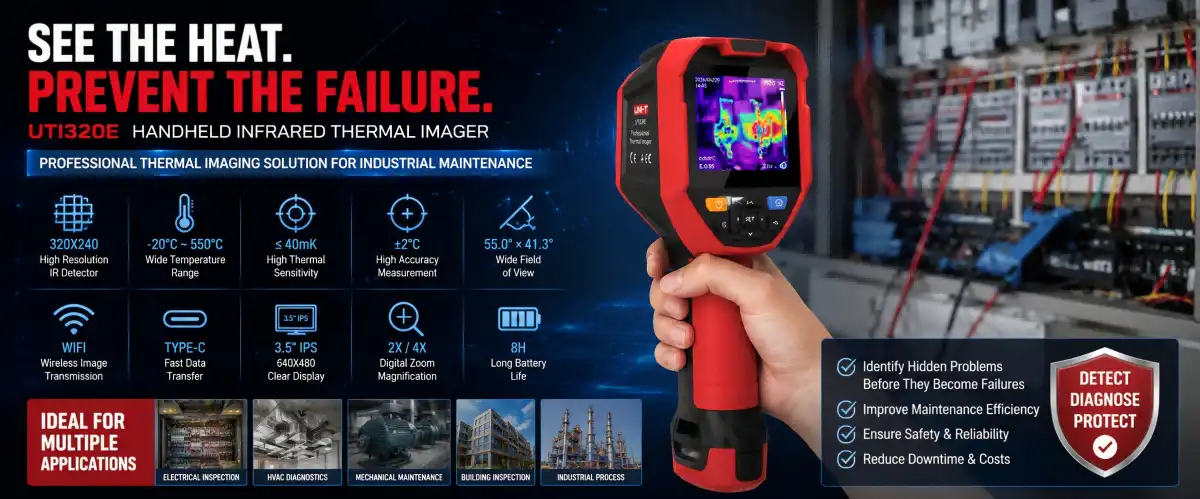
For industrial thermal imaging to work, it needs more than just readings of temperatures at the surface. Your repair team will be able to find small thermal problems before they become costly failures if the thermal cameras they use are well-designed.
Advanced Infrared Sensor Technology
At the heart of this thermal image camera is an uncooled vanadium oxide monitor that can record 76,800 separate temperature readings at the same time. The 320x240 pixel array is more detailed than lower-resolution options that might miss important thermal changes. It can find hot parts in electrical panels that are closely packed together or thermal bridges in building surfaces. Thermal sensitivity below 40mK at 25°C ambient temperature means that the device can detect temperature changes as little as 0.04 degrees Celsius, finding problems that can't be seen with normal checking methods.
The 8–14µm infrared frequency matches the highest emission wavelengths of most industrial materials. This means that you can get the best thermal capture whether you're looking at ceramic insulators, composite materials, or metal frames. With a field of view that covers 55.0° horizontally and 41.3° vertically, workers can look at big parts of equipment without having to move them around a lot, which speeds up inspection processes by a lot.
Temperature Measurement Capabilities
Specifications for measurement precision are often forgotten when buying something, but they are very important for figuring out how reliable the data is. This thermal imager stays accurate to within ±2°C or ±2%, whichever is greater, when the temperature is 25°C. When maintenance engineers look at temperature trends over three-monthly checks, this regularity is very helpful for finding patterns of gradual wear and tear.
With a base setting of 0.95, the emissivity range can be changed from 0.01 to 1.00 to suit different material properties. Different types of surfaces, like polished metal, oxidized steel, painted casings, and plastic housings, give off different amounts of heat. Being able to change these factors makes sure that measurements are accurate in a wide range of workplace settings. People who work with semiconductor testing tools like this feature because it lets them test parts with different surface processes.
Connectivity and Data Management
These days, thermal photography of the UTI320E Handheld Infrared Thermal Imager can do a lot more than just take pictures. With its WiFi connection and Type-C port, this handheld gadget becomes an integral part of your larger inspection environment. Images are sent directly to mobile devices running the companion app, which lets field techs make notes on what they see right away while they are still on the scene. This gets rid of the writing mistakes that happen with old checking methods that use clipboards.
The 3.5-inch IPS screen with a resolution of 640x480 makes the picture clear even in industrial settings with bad lighting. Digital zooming at 2x and 4x magnification lets you look more closely at certain areas without having to get close to possibly dangerous tools. When paired with PC software for analysis after the inspection, the thermal camera allows for both quick decisions in real time and in-depth analysis of past trends.
These connectivity features solve a problem that keeps coming up in industrial operations: turning observations made in the field into repair choices that can be carried out. The thermal imaging solution cuts down on the routine work that usually takes hours after each check cycle by making the data flow more efficient from collection to analysis to storage.
Industrial Use Cases and Practical Benefits
Instead of vague technical details, thermal imaging technology shows its worth by making operations better in real ways. Figuring out how this tool fits into current repair procedures helps to support spending money on it.
Electrical System Diagnostics
Electrical problems don't usually make nice noises. Loose connections, uneven loads, and insulation that is wearing down all raise resistance over time, creating too much heat long before a catastrophic failure happens. By showing these thermal fingerprints during regular checks, the thermal imager makes predictive maintenance tactics possible.
Once, to take touch measures during distribution panel surveys, the equipment had to be partially turned off. Now, these surveys can be done safely with the equipment turned on. Thermal patterns show right away if phase loading is uneven, breakers are breaking, or bus links are rusted. Maintenance teams at aircraft manufacturing plants say that unexpected electrical downtime has gone down by 40% since they started using similar tools for quarterly thermal scans.
Because there are so many parts in motor control centers and they have to work all the time, they are especially hard to check. With the right amount of resolution and temperature range coverage, techs can check starter contactors, overload relays, and control transformers without stopping production. This non-invasive checking feature directly supports lean manufacturing principles by getting rid of maintenance tasks that aren't needed and finding real problems early.
Mechanical Equipment Monitoring
Rotating machinery makes unique heat patterns that show how well the bearings are oiled, aligned, and in good shape. The thermal camera records these patterns numerically, replacing intuitive readings of vibration with objective temperature data. Bearing temperatures that are higher than predicted by small amounts often mean that they are about to fail, giving repair windows that are measured in weeks instead of hours.
Optimization of the HVAC system is another high-value use case. Limits on the flow of refrigerant, heat exchanger fouling, and vent leaks all show up as thermal anomalies that can be seen while the system is running. Facilities that are in charge of big temperature control systems have reported annual energy savings of more than 15% after fixing problems found through regular thermal surveys. Usually, the money spent on thermal imaging equipment is returned within the first year of use, just from the increased effectiveness.
Thermal imaging of the UTI320E Handheld Infrared Thermal Imager is used in building exterior surveys to find holes in the insulation, ways for air to get in, and places where water can get in that hurt the building's energy efficiency and stability. When testing the performance of an environmental control system, this feature is especially useful for research schools that keep sensitive lab settings.
Safety Enhancement and Risk Mitigation
In addition to making servicing more efficient, thermal imaging directly improves safety on the job. Finding equipment that is burning before smoke or flames show keeps people safe and keeps property from being damaged. The device can handle the rough conditions where safety checks are done, thanks to its IP54 grade and 2-meter drop resistance.
Thermal data is very helpful for figuring out the risk of an electrical arc flash. When parts are working at temperatures above what is normally expected, they show higher amounts of resistance and possible arc flash energy. Keeping track of these situations helps people make smart choices about what safety gear they need and how close they should be to people doing charged work.
These real-world uses show why thermal cameras have gone from being specialized troubleshooting tools to being standard equipment in well-run repair programs. Being able to "see" temperature changes maintenance cultures from reacting to predictive, which has a huge impact on how reliable things are.
UTI320E Compared to Competitors: Making the Rational Choice
When making choices about what to buy, it helps to compare different options in an objective way. The market for thermal imaging has a lot of choices, and each one has its own pros and cons that make it better or worse for different operations.
Performance and Functionality Analysis
Leading options from FLIR, Seek Thermal, and Testo are in similar market niches, but when you look more closely, you can see important differences. Specifications for resolution should be carefully looked over. Competitors' entry-level models often have 160x120 or 206x156 arrays, but the 320x240 setup has about twice as much spatial precision and can see smaller thermal anomalies farther away.
Different similar models cover a wide range of temperatures in very different ways. Some rivals limit the highest temperature that can be measured to 400°C, which makes them less useful for checking on processes that happen at high temperatures or in kilns. The top limit of 550°C allows for a wider range of applications without the need for separate high-temperature equipment.
At first glance, the accuracy standards of high-quality brands seem to be pretty similar. However, the warranty terms and calibration support show how confident people are in the products. The presence of CE, FCC, and UKCA certificates shows that the product meets foreign standards, which makes purchasing easier for businesses that do business across borders.
Durability and Field Readiness
Claims about how tough something is need to be backed up by real specs, not just marketing speak. This grade of protection, IP54, keeps dust out and stops water from coming in from any direction. Competitors that only offer IP40 or IP43 grades don't offer enough security for outdoor use or dusty industrial settings.
Drop resistance testing up to 2 meters takes into account the fact that small tools get hit when they are used in the field. This standard is better than a lot of competing goods that only list a 1-meter drop resistance or don't test for impact at all. This edge in longevity means lower replacement costs and better availability over a normal 5-year working life.
The operating system's English and Chinese language choices make deployment easier across global operations. This is something that is often ignored when buying equipment, which becomes annoying when it gets there. The quality of technical paperwork and translation accuracy varies a lot between makers, which affects how long it takes to train operators and how confident they are in their skills.
Cost-Effectiveness and Value Proposition
Professionals in procurement combine what they can do with how much they can spend, looking for the best value rather than just the lowest cost. When compared to standard options, the thermal imaging gadget is priced similarly and offers similar core functions. Along with the initial buy price, the total cost of ownership study should look at things like warranty coverage, calibration standards, software licensing, and how quickly expert support can help.
When looking at thermal cameras to use as a group in several different buildings, the ability to buy in bulk and make changes important. System integrators and big businesses that are putting in place standard inspection processes can meet their needs with private labeling, parameter pre-configuration, and volume pricing. Consumer-focused brands that don't have B2B support systems often can't offer this kind of freedom.
Procurement Guide: How to Buy UTI320E Thermal Imager
Buying industrial measuring equipment through the right channels makes sure that the product is real, that the guarantee is valid, and that you have access to technical support resources that are very helpful during deployment.
Authorized Distribution Channels
As an approved provider, MXTD gives customers direct access to real thermal imaging equipment that comes with full manufacturer support. The company has been around since 2014 and has more than 12 years of experience with PXIe systems, integrated testing solutions, and precise instruments. Because of this level of knowledge, questions about buying get answers that are technically sound instead of generic sales messages.
When you deal directly with the maker, you don't have to worry about fake goods or imports from the gray market that might not have the right certifications or guarantee coverage. The company's promise to answer customer questions within an hour takes into account the need for speed when buying measurement equipment, especially when repairing broken instruments or setting up new facilities.
Warranty and Support Considerations
A normal 1-year guarantee from the manufacturer protects your investment against problems with the materials or the work. In certain situations, extended warranty plans and special support deals can be made for mission-critical uses where equipment downtime has very bad business effects.
Technical help goes beyond the warranty coverage and includes free software updates and online video instruction. This plan for ongoing support takes into account the fact that good thermal imaging needs skilled operators and up-to-date software. A lot of rival sellers see customer service after the sale as a way to make extra money, charging more for help that should come with professional-grade gear.
Logistics and Customization
Global shipping options allow for both transfers within the United States and installations in other countries. Transportation rules for precision instruments include shock-absorbing, moisture-proof, and anti-static packing that is right for electronics that are easily damaged. These details are important when equipment comes broken or not working because it wasn't properly packed for shipping.
Applications that need specific parameter settings, custom enclosures, or integrated mounting solutions for the UTI320E Handheld Infrared Thermal Imager can use ODM and OEM customization choices. This freedom is especially useful for system designers who make "turnkey" inspection systems. Batch parameter pre-configuration makes sure that devices are ready to be used right away, without having to go through separate setup steps.
Pricing models for bulk purchases take into account the economy of buying a fleet while still upholding quality standards. Industrial purchase agreements can cover things like training support, spare equipment allocation, and calibration schedules, unlike consumer-grade options that only lower store prices.
Brand Reputation and Support Services of UTI320E Manufacturer
The quality of the products and how reliable the suppliers are decide whether purchasing choices are good in the long run or cause problems that never go away. When you know how the thermal camera works, you can feel confident in your purchase.
Xi'an Mingxi Taida Information Technology Co., Ltd. began doing business in September 2014 and has since gained a lot of experience in researching, developing, and making precision test equipment. The company's wide range of products, including PXIe chassis, ports, integrated testing systems, and measurement tools, shows that it can do a lot more than just thermal imaging. This range shows that the company has the engineering tools and manufacturing facilities to keep developing products instead of just jumping into the market when the chance arises.
The company's skilled R&D and after-sales teams provide quick and helpful customer service that sets industrial providers apart from companies that sell consumer goods. When people ask technical questions, they get real answers from experts who know the technology behind them, not canned answers from people working in a call center. This knowledge comes in very handy during the application building stages, when figuring out the best way to set up instruments for certain measurement problems.
Quality assurance procedures and foreign certifications make sure that the manufacturing process is consistent and that it follows the rules. The CE mark shows that the product meets European standards for health, safety, and the environment. FCC approval shows that you follow the rules for electromagnetic interference, which protects sensitive electronics from radio frequency disturbance. The UKCA marking meets the needs of the UK market after Brexit. For these licenses to stay valid, compliance must be checked on a regular basis instead of just once, which ensures long-term quality management.
Conclusion
There are a lot of choices in the thermal imaging scene, but a close look shows important differences that affect tactical success. This thermal camera comes in a field-ready package with professional-grade features, and the price makes it possible for a group to use it. When test engineers, facility managers, and maintenance workers talk about what inspection tools they need, the main things they talk about are 320x240 resolution, a wide temperature range, full communication, and real industrial reliability. Thorough technical evaluation and source evaluation help buyers make choices that lead to measurement systems that improve operational reliability, safety, and give measurable returns through less downtime and better energy use.
FAQ
1. What temperature accuracy can I expect from thermal cameras?
The accuracy of a measurement relies on both the tool itself and how it is used. Under controlled settings, good thermal imaging devices can usually get an accuracy of ±2°C, or ±2%. When outdoor temperatures are very different from the testing conditions, when reflective surfaces are used, or when the wrong emissivity settings are used, the accuracy goes down. Measurements are reliable as long as operators are properly trained and accuracy is checked on a frequent basis.
2. How does resolution affect inspection effectiveness?
With higher precision, you can get more measurement points across your target area. This lets you see smaller problems and find them from farther away. A 320x240 grid can see things that 160x120 cameras can't. This is especially important when checking electrical panels that are close together or far away equipment that can't be measured up close.
3. Do thermal cameras require special maintenance?
Lens cleaning, calibration checks, and program changes are all part of regular maintenance. In contrast to touch measurement devices, thermal cameras don't have wear parts that need to be replaced on a regular basis. Consistent precision is maintained by confirming the measurements every year against known temperature standards. Keeping things in the right way to protect them from high temperatures and physical damage greatly increases their useful life.
Partner with MXTD for Your Thermal Imaging Solution
Our team at MXTD knows that picking the right thermal imaging equipment can affect how well it works for years after it is bought. As a seller of the UTI320E Handheld Infrared Thermal Imager for a long time, we have a lot of scientific knowledge and quick customer service that can help you with your measurement problems. Our engineering and procurement teams can help you find solutions that meet your business needs and your budget, whether you need standard devices that can be used right away or configurations that are made to fit your specific inspection routines.
Get in touch with our experts at manager03@mxtdinfo.com to talk about how this thermal camera can work with the measurement tools you already have. We support both test programs and full-scale fleet operations with thorough technical paperwork, application advice, and price models based on volume. Allow us to show you why top companies in flight, semiconductors, and industrial automation trust MXTD to make measurement equipment that works when accuracy is key.
References
1. Smith, J. & Anderson, K. (2022). "Industrial Thermal Imaging: Applications and Best Practices in Predictive Maintenance." Journal of Maintenance Engineering, Vol. 34, pp. 112-128.
2. Thompson, R. (2021). "Comparative Analysis of Handheld Infrared Cameras in Electrical Diagnostics." International Review of Industrial Instrumentation, Vol. 18, No. 3, pp. 45-67.
3. Williams, M. et al. (2023). "Temperature Measurement Accuracy in Industrial Environments: Factors Affecting Thermal Camera Performance." Measurement Science and Technology Journal, Vol. 29, pp. 201-219.
4. Chen, L. & Roberts, P. (2022). "Infrared Thermography Standards and Certification Requirements for Industrial Applications." Standards in Testing and Measurement, Vol. 15, pp. 88-104.
5. Davidson, T. (2021). "Cost-Benefit Analysis of Thermal Imaging Integration in Facility Management Programs." Facilities Management Quarterly, Vol. 41, No. 2, pp. 156-174.
6. Martinez, S. & Johnson, H. (2023). "Emerging Technologies in Non-Contact Temperature Measurement for Industrial Automation." Automation and Control Systems Review, Vol. 26, pp. 301-323.
Our customers’ satisfaction speaks for our quality — contact us to experience the same reliable service.