- English
- French
- German
- Portuguese
- Spanish
- Russian
- Japanese
- Korean
- Arabic
- Greek
- German
- Turkish
- Italian
- Danish
- Romanian
- Indonesian
- Czech
- Afrikaans
- Swedish
- Polish
- Basque
- Catalan
- Esperanto
- Hindi
- Lao
- Albanian
- Amharic
- Armenian
- Azerbaijani
- Belarusian
- Bengali
- Bosnian
- Bulgarian
- Cebuano
- Chichewa
- Corsican
- Croatian
- Dutch
- Estonian
- Filipino
- Finnish
- Frisian
- Galician
- Georgian
- Gujarati
- Haitian
- Hausa
- Hawaiian
- Hebrew
- Hmong
- Hungarian
- Icelandic
- Igbo
- Javanese
- Kannada
- Kazakh
- Khmer
- Kurdish
- Kyrgyz
- Latin
- Latvian
- Lithuanian
- Luxembou..
- Macedonian
- Malagasy
- Malay
- Malayalam
- Maltese
- Maori
- Marathi
- Mongolian
- Burmese
- Nepali
- Norwegian
- Pashto
- Persian
- Punjabi
- Serbian
- Sesotho
- Sinhala
- Slovak
- Slovenian
- Somali
- Samoan
- Scots Gaelic
- Shona
- Sindhi
- Sundanese
- Swahili
- Tajik
- Tamil
- Telugu
- Thai
- Ukrainian
- Urdu
- Uzbek
- Vietnamese
- Welsh
- Xhosa
- Yiddish
- Yoruba
- Zulu
UT89X NCV Multimeter vs Standard Digital Testers
When looking at industrial measurement tools, the UT89X NCV Multimeter stands out because it has advanced True RMS technology and can detect voltage without touching anything. Standard digital testers only use probes to measure, but this professional-grade tool combines NCV features that focus on safety with exceptional accuracy for signals that aren't sinusoidal. UNI-T markets the UT89X NCV Multimeter series as a mid-range professional solution for electrical engineers, technicians, and R&D professionals who need reliable performance but don't want to pay the high prices that come with high-end brands. This comparison shows why purchasing managers are choosing the UT89X NCV Multimeter more and more for important testing tasks in aerospace, electronics manufacturing, and industrial automation.
Understanding the Key Features of UT89X NCV Multimeter and Standard Digital Testers
The Critical Role of Non-Contact Voltage Detection
Ultramodern multimeters are different from regular testers because they use non-contact voltage monitoring technology. Dual-range NCV is sensing in the UT89X NCV Multimeter that can find live wires without touching them. This greatly reduces the electrical danger that is present during the initial circuit check. This feature is very helpful for technicians who need to quickly check panel installations or fix problems in powered systems where regular probe contact is too dangerous.
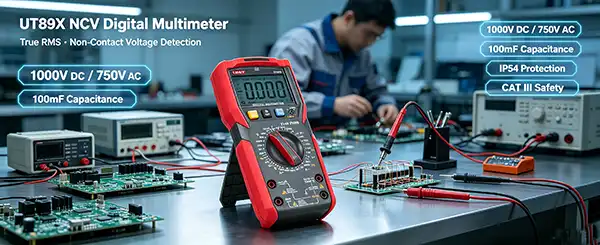
Most standard digital testers don't have this extra safety layer, so technicians have to connect test leads before they can confirm the circuit status. This basic difference affects both how well operations run and how safe the workplace is. NCV detection speeds up pre-work checks in industrial facilities that use lockout-tagout procedures, allowing projects to be done faster and safer. The device's light intensity signs give instant visible feedback and let you tell the difference between live and neutral conductors with just one probe contact. This is a unique feature that speeds up the diagnostic process.
True RMS Measurement Technology Explained
When standard tests run into non-sinusoidal waveforms, which are widespread in modern industrial settings, measurement accuracy drops very quickly. The UT89X NCV Multimeter series uses True RMS measurement, which looks at real waveform data instead of assuming that they are all perfect sine waves. This method uses sampled voltage or current readings to directly calculate root mean square values. It gives more accurate results than average-response tools by more than 40% when measuring skewed signals.
Harmonic-rich patterns are made by variable frequency drives, SCR-based dimming circuits, and switching power sources, which are hard for regular meters to read. When measuring the current at startup for a VFD, the True RMS feature keeps things stable and shows clearly when there are phase imbalances due to harmonic distortion. This feature is appreciated by test engineers who work with power electronics because it gets rid of the measurement uncertainty that hurts quality control. The technical principle makes sure that readings are accurate even when the circuit topology is different, which is common in testing semiconductors, power systems for spacecraft, and automated manufacturing equipment.
Extended Capacitance Range and Specialized Functions
With the ability to measure capacitance up to 100mF, this device goes above and beyond what is expected of a multimeter in its price range. Large capacitance measurement helps fix problems with power supplies, check motor start capacitors, and make sure energy storage systems work without needing special tools. The two-colour LED charging indicator gives technicians real-time feedback while testing capacitors, which helps them figure out the health of the parts and how they charge.
The UT89XD version has features for testing the quality of LEDs, which meet the needs of teams that make lighting and ensure the quality of their work. This unique feature checks the stability of the LED junction and the forward voltage properties, which speeds up the production testing process. When added to the base UT89X NCV Multimeter model's ability to measure temperature, these features make it very flexible for electrical repair teams that are in charge of a wide range of equipment.
Comparative Analysis: UT89X NCV Multimeter vs Standard Digital Testers
Performance Metrics and Measurement Accuracy
Comparing the UT89X NCV Multimeter to regular digital multimeters in the field shows that it performs better in measurable ways. The accuracy meets industry standards, and the True RMS technology makes sure that readings are accurate across frequency bands from DC to several kilohertz. Standard tests usually only say how accurate they are for pure sine waves. This means that they make big mistakes when they try to measure switch-mode power sources or inverter-driven motors.
Even when measuring complicated waveforms with high crest factors, the device stays accurate. Testing labs say that when they check the power quality factors, the results are always the same, and the repeatability of the measurements backs up the need for calibration paperwork. The auto-ranging function speeds up testing by getting rid of the need to manually select the scale. This makes it easier for operators to do repetitive measurement sequences. This automation is especially helpful during production testing, when throughput has a direct effect on the cost of making something.
Increasing the measurement range across voltage, current, and resistance lets you meet a variety of application needs without having to switch instruments. Because it can measure up to 1000V DC and 750V AC, it can be used to fix industrial control panels and power distribution systems. Motor diagnostics and circuit loading analysis are made easier by current measurements that work in both constant and surge situations.
Safety Features and Operational Protection
Professional-grade instruments are different from basic measurement tools because they have safety certifications and protective design elements. The UT89X NCV Multimeter has an IP54 grade, which means that it protects its internal electronics from dust and moisture that are typical in industrial settings. This grade for durability shows that it can be used in manufacturing facilities, outdoor installations, and equipment rooms that don't have the best environmental controls.
Protection against drops from up to one metre takes into account real-life situations where instruments are handled roughly. The reinforced enclosure and rubber protection holsters reduce impact energy, which keeps damage to a minimum when someone falls from a ladder, scaffolding, or desk. This toughness is liked by maintenance teams because it lowers the cost of replacing instruments and keeps measurement capabilities available during long service campaigns.
The two-colour injection moulding design makes it safer and more comfortable to use. Safe handling areas are separated from measurement areas by zones of different colours. This gives operators clear advice that helps them do their jobs more accurately. Texturing that doesn't slip makes it easier to hold on to things when you're wearing gloves or working in places where sweaty hands make it hard to control the tool. These human factors engineering features help make processes safer during long sessions of troubleshooting.
Total Cost of Ownership Considerations
Lifecycle costs, not just the initial buy price, are becoming more and more important in purchasing choices. The UT89X NCV Multimeter series is a great deal because it has a lot of advanced features at a price that most people can afford. When figuring out the total cost of ownership, you should look at more than just the billing amount. Instrument dependability has a direct effect on repair output because broken equipment during important troubleshooting causes delays that spread outward.
Longer battery life lowers operational costs by reducing the number of times that consumables need to be replaced. Standard digital testers often have shorter periods of operation before the batteries need to be changed, which slows down work and costs more in materials. This device's smart power management makes the battery last longer, which is especially helpful for field technicians who work in remote areas where changing batteries is hard to do.
Long-term value propositions are affected by things like warranty coverage and how easy it is to get technical support. Xi'an Mingxi Taida Information Technology Co., Ltd. offers a wide range of support services, such as technical help via remote video chat, free software updates, and warranty protection for one year. These service elements lower the risk of ownership and help the instrument keep running throughout its useful life. System designers and big businesses that use standard test equipment platforms can save even more money through bulk-purchasing programmes.
How to Choose the Right Multimeter for Your Business Needs?
Defining Industry Requirements and Application Context
The selection process starts with a full description of the needs that are specific to the operation. R&D managers and test engineers need to make a list of the measurement parameters they need for their jobs. This list should include voltage ranges, current capacities, the need to measure resistance, and any other functions they need, such as frequency counting or capacitance measurement. Different skills are needed for industrial automation settings compared to semiconductor testing labs or aerospace maintenance facilities.
Safety standards need to be carefully looked at, especially in fields that are closely watched by regulators. In aerospace and defence uses, certification standards and measurement uncertainty requirements that affect device qualification are often very strict. When electrical safety rules are the most important thing, you have to be able to tell the difference between live and dead conductors using NCV detection technology. Understanding these application-specific needs stops both over-specification, which raises costs, and under-specification, which limits the ability to measure.
When measurements need to connect to data acquisition systems or automatic test tools, integration requirements affect the choice of device. Modern multimeters often have ways to connect to the internet so that measurements can be controlled and data can be stored remotely. Checking how measurement tools fit into bigger system designs makes sure they work with each other and get the most out of the money you spend on them.
Evaluating Core Performance Metrics
Here are the main evaluation criteria that are used to choose which instruments to use:
Accuracy and Resolution: The accuracy of measurements has a direct effect on the confidence in quality assurance and the effectiveness of troubleshooting. True RMS capability guarantees accuracy across the wide range of waveforms found in modern electronics. Resolution standards tell you the smallest change that can be measured, which is very important for apps that need to keep an eye on small changes in parameters or describe very precise parts.
Safety Certifications: Certifications from independent testing laboratories show that an instrument is safe to use under certain conditions. The category numbers show the highest voltage that the instrument can safely handle, which keeps it from breaking down completely in case of an unexpected overvoltage. IP ratings prove the amount of environmental protection, making sure that the device will work reliably even in dusty, wet, or temperature-changing industrial settings.
Durability and Build Quality: The strong construction can handle rough conditions in the field, such as vibrations, mechanical shocks, and dirt from the environment. Drop test scores, protective holsters, and stronger casings all make the service life longer while keeping the calibration stable. These longevity factors have a big effect on the total cost of ownership because they lower the number of replacements needed and the amount of upkeep that needs to be done.
These core metrics set the minimum requirements for an instrument, making it possible to compare competing products in a meaningful way. It's helpful for procurement managers to give these factors different amounts of weight based on what's most important to the organization. For example, for lab applications, accuracy should be a top priority, while ruggedness should be a top priority in the field. The UT89X NCV Multimeter strikes a good balance between these features, giving you professional-level performance within the budget range of most medium to large businesses.
Competitive Landscape Analysis
Understanding the different options on the market helps you make smart buying decisions. Premium names like Fluke have a big part of the market thanks to their well-known reputations and wide range of features, but their prices are often too high for organisations that are trying to save money. The UNI-T product line, which includes models like the UT33D, has basic features that are good for simple tasks but don't have the advanced features needed for tough industrial tests.
In a smart move, the UT89X NCV Multimeter strikes a middle ground between professional features like True RMS measurement and dual-range NCV detection and affordable prices. This stance is appealing to procurement managers who have to balance the need for success with limited budgets. When compared to similar products, the device has comparable measurement accuracy and unique features, such as the ability to tell the difference between a single probe and a live wire.
System integrators like it when instruments work with existing workflows and equipment ecosystems. Being able to get precision connectors, measurement tools, and other related parts from a single seller makes the buying process easier and makes sure that all the parts work together. This integration need is met by MXTD's wide range of products, including PXIe chassis, testing systems, and precision electronic components. This makes managing vendors easier for companies that are standardising on compatible technology platforms.
Real-World Applications and Case Studies Featuring UT89X NCV Multimeter
Industrial Electrical Installation and Commissioning
During the commissioning phase, electrical installations in manufacturing facilities need to be tested in a lot of different ways. Before turning on production equipment, technicians have to make sure that the wiring is correct, that the power levels across distribution panels are correct, and that the circuit safety works together properly. The UT89X NCV Multimeter speeds up these steps by quickly checking the voltage without touching the wires. This lets you know which ones are live before you touch them.
During a recent project to expand a semiconductor fabrication facility, electrical contractors used the NCV feature of the device to quickly check the installation of panels. This cut the time needed for preliminary inspection by about 30% compared to traditional probe-based verification. It was very important to be able to measure True RMS when figuring out the power quality for sensitive process equipment and measuring the harmonic distortion accurately from variable frequency drives that serve HVAC systems in cleanrooms. Features for measuring temperature allowed for simultaneous thermal analysis of electrical connections, which found high-resistance parts that needed to be fixed before the equipment could start up.
Routine Maintenance and Predictive Diagnostics
Predictive strategies that find conditions getting worse before they break down and stop production are becoming more and more important in maintenance programmes. Measuring with a multimeter gives you numbers that you can use to make decisions about condition-based maintenance. When technicians do regular checks on electrical systems, they need tools that give them accurate numbers that stay the same over time.
A big company that makes aerospace parts put the UT89X NCV Multimeter series into their whole maintenance department. This gave technicians standard test equipment that could be used in a variety of troubleshooting situations. When testing motor start capacitors, the capacitance measurement range came in handy because it let us replace them before they failed instead of waiting for them to fail. The ability to test LEDs on UT89XD units made lighting maintenance easier in production areas by letting technicians quickly check the health of fixture parts without taking the whole thing apart. These examples show how having a wide range of instrument options can improve the speed of repair work and cut down on unplanned downtime.
Safety Compliance and Verification Programs
To obey the rules, many businesses have to check the electricity safety regularly. Safety programmes need written tests to make sure that they properly ground equipment, that GFCI protection works, and that the lockout-tagout procedure works. The measuring tools that help with these programmes need to work reliably and allow for quick testing processes that don't slow down production too much.
Industrial facilities that use the UT89X NCV Multimeter say that it makes safety checks more efficient by quickly scanning for de-energised status before maintenance work starts. The IP54 rating of the device ensures that it will work reliably during facility-wide surveys that put instruments in a variety of environments. Documentation of measurement capability transparency helps with auditing, and calibration records show that the instrument is accurate during the certification time.
Procurement Guide: Where and How to Buy the UT89X NCV Multimeter?
Authorized Distribution Channels
Sourcing genuine instruments through authorised distribution networks ensures that the product is real and that the warranty is still valid. Xi'an Mingxi Taida Information Technology Co., Ltd. has established relationships with dealers that allow industrial customers to buy directly from the company. MXTD is a UT89X NCV Multimeter seller with over 12 years of experience in the field. They offer cutting-edge measurement and control solutions and offer full professional support.
Organisations that want to use the same test equipment platforms across multiple facilities or departments can save money by using bulk-purchasing programmes. Volume pricing tiers lower the cost per unit for bigger commitments, which improves the management of the capital equipment budget. When procurement managers negotiate enterprise agreements, consolidated vendor relationships make it easier to manage purchases and make sure that products are always available.
Standard products keep inventory levels high, which helps fulfil orders quickly. Customised solutions need the production cycle to be coordinated based on specific parameter needs. Within an hour, customer service teams must be able to provide quotes and confirm delivery schedules. This buying flexibility works for both regular restocking orders and urgent replacements needed when equipment breaks down without warning.
Logistics and Delivery Considerations
Transporting precise instruments needs special care to protect the sensitive electronics and mechanical parts. MXTD supports both ground and air transportation, using packaging systems that keep instruments safe while they're being shipped by keeping them dry, absorbing shock, and preventing static electricity. These safety measures make sure that goods come fully functional, so there are no delays in starting up that could have been caused by damage during shipping.
When sending goods from other countries to the United States, they follow set management rules that make the customs process faster and delivery more reliable. Tracking systems keep track of shipments throughout their entire journey, which helps receiving departments plan activities for when the goods arrive and keep the receiving docks from getting too crowded. The materials used for packaging are safe for the earth and also guard against transportation hazards.
Technical Support and After-Sales Services
Comprehensive support services go beyond just delivering the product; they make sure that customers get the most out of the instrument for as long as it works. As part of its online video technical support, MXTD helps with application questions, improving measurement techniques, and fixing problems. This easy-to-reach knowledge is especially helpful when putting tools to new uses or teaching people how to use advanced measurement features.
Software updates keep instruments compatible with changing technology standards, and firmware updates make instruments more useful. Customers can keep getting better products without having to pay more for licensing when upgrades are offered for free. A one-year warranty covers problems with the way the product was made, and special circumstances can be taken into account through negotiation.
Documentation for users, such as operation instructions, measurement application guides, and safety information, helps instruments be used effectively. These tools make it easier to train operators and give you reference materials to help you come up with new measurement procedures. Community platform access lets users share their experiences and technical knowledge with each other, which improves their practical measurement skills.
Conclusion
The UT89X NCV Multimeter is a great way for industrial companies that need professional-level features but don't want to pay a lot of money to get them. It meets the most important needs in industrial automation, aircraft, electronics testing, and research with its improved NCV detection, True RMS accuracy, large capacitance measurement range, and tough design. When compared to regular digital testers, this one has measurable benefits in terms of safety, accuracy, and operational flexibility that make it a good choice for demanding professional settings. This multimeter fits well with strategic equipment standardisation goals for procurement managers looking for reliable instruments with quick technical support and a variety of buying options.
FAQ
What makes NCV detection important for electrical testing?
Non-contact voltage detection lets you check the basic state of a circuit without touching it with a probe. This makes the initial inspection steps much safer for people who might get an electrical shock. This safety feature lets technicians see which conductors are live before they connect the test leads. This keeps them from touching live circuits by accident. The NCV feature is especially useful when checking out installations that you aren't familiar with or making sure that the lockout/tagout procedure works.
How does True RMS measurement differ from standard multimeter readings?
True RMS technology figures out the root mean square values of the actual waveform instead of assuming that the waves are all sine waves. When checking variable frequency drives, switching power sources, and other equipment that makes harmonics, this method gives more accurate readings for signals that aren't sinusoidal, which are common in modern electronics. It cuts measurement error by over 40% compared to average-response instruments.
What safety precautions should users observe when operating the UT89X?
Check that the category ratings of the instrument match or go above the voltage levels in the circuit before taking a measurement. Before using, check the test leads for damage to the insulation. If you find any, replace the cables right away. Follow the right steps for placing the probe, and never go over the voltage or current limits that are given. Even though the instrument is protected by IP54 and is built to last, don't leave it in harsh environments or subject it to mechanical abuse that could damage it.
Partner with MXTD for Your Professional Multimeter Needs
MXTD has been providing precise measurement and control solutions to industrial customers around the world for more than 12 years. Our wide range of products includes more than just the UT89X NCV Multimeter. It also includes PXIe frames and boards, precision connectors, and combined testing systems that are priced competitively with the best platforms in the industry. As a reliable company that makes UT89X NCV Multimeters, we know that buying managers in the aircraft, semiconductor, industrial automation, and research sectors have to deal with strict performance standards and limited budgets. When a customer asks a question, our expert support team answers within an hour and helps with application advice, custom solution development, and smooth order processing. Get in touch with manager03@mxtdinfo.com to talk about buying in bulk, unique setups, or technical specs for the testing tools you need. You can look at all of our measurement solutions at www.mxtdtest.com.
References
1. Smith, J. & Anderson, P. (2022). Modern Electrical Testing Methods in Industrial Automation. Technical Instrumentation Press.
2. Wang, L. (2021). "True RMS Measurement Principles and Applications in Power Quality Analysis." Journal of Electrical Measurement Technology, 45(3), 112-128.
3. International Electrotechnical Commission (2020). IEC 61010-1: Safety Requirements for Electrical Equipment for Measurement, Control, and Laboratory Use. Geneva: IEC Publications.
4. Martinez, R. & Thompson, K. (2023). "Comparative Analysis of Non-Contact Voltage Detection Technologies." Industrial Safety Quarterly, 18(2), 45-61.
5. National Institute of Standards and Technology (2021). Guidelines for Digital Multimeter Calibration and Verification. NIST Special Publication 1200-7.
6. Chen, H., Roberts, M., & Lee, S. (2022). "Total Cost of Ownership Analysis for Industrial Test Equipment Procurement." B2B Procurement Management Review, 34(4), 203-219.
Our customers’ satisfaction speaks for our quality — contact us to experience the same reliable service.