- English
- French
- German
- Portuguese
- Spanish
- Russian
- Japanese
- Korean
- Arabic
- Greek
- German
- Turkish
- Italian
- Danish
- Romanian
- Indonesian
- Czech
- Afrikaans
- Swedish
- Polish
- Basque
- Catalan
- Esperanto
- Hindi
- Lao
- Albanian
- Amharic
- Armenian
- Azerbaijani
- Belarusian
- Bengali
- Bosnian
- Bulgarian
- Cebuano
- Chichewa
- Corsican
- Croatian
- Dutch
- Estonian
- Filipino
- Finnish
- Frisian
- Galician
- Georgian
- Gujarati
- Haitian
- Hausa
- Hawaiian
- Hebrew
- Hmong
- Hungarian
- Icelandic
- Igbo
- Javanese
- Kannada
- Kazakh
- Khmer
- Kurdish
- Kyrgyz
- Latin
- Latvian
- Lithuanian
- Luxembou..
- Macedonian
- Malagasy
- Malay
- Malayalam
- Maltese
- Maori
- Marathi
- Mongolian
- Burmese
- Nepali
- Norwegian
- Pashto
- Persian
- Punjabi
- Serbian
- Sesotho
- Sinhala
- Slovak
- Slovenian
- Somali
- Samoan
- Scots Gaelic
- Shona
- Sindhi
- Sundanese
- Swahili
- Tajik
- Tamil
- Telugu
- Thai
- Ukrainian
- Urdu
- Uzbek
- Vietnamese
- Welsh
- Xhosa
- Yiddish
- Yoruba
- Zulu
UT501A Insulation Resistance Tester: A Complete Buying Guide
Choosing the right insulation resistance tester directly impacts your operational efficiency and safety standards. The UT501A Insulation Resistance Tester offers industrial-grade accuracy combined with cost-effective pricing, making it an ideal solution for R&D managers, test engineers, and procurement professionals across industrial automation, aerospace, electronics testing, and semiconductor sectors. This comprehensive buying guide walks you through technical specifications, comparative analysis, procurement strategies, and maintenance protocols to help you make an informed investment decision that aligns with your testing requirements and budgetary constraints.
Understanding the UT501A Insulation Resistance Tester
Core Purpose and Industrial Applications
Testing for insulation resistance is an important part of keeping machinery from breaking down and making sure that workers are safe in workplace settings. The UT501A Insulation Resistance Tester is a reliable digital megohmmeter that checks the quality of insulation in electrical tools, circuits, and insulating materials. When a high-voltage DC current is sent through the material being tested, the gadget figures out the resistance by measuring the leaking current. Higher resistance numbers mean better insulation, which is important for keeping the system safe and reliable and stopping electrical hazards.
This basic UNI-T UT500 type is made for electricians, maintenance teams, and quality assurance groups that need to test insulation reliably without making things too hard. A lot of different places, like factories, research centers, and system integration projects, use the tester to check the stability of cables, review motor windings, and maintain switchgear.
Technical Specifications and Measurement Capabilities
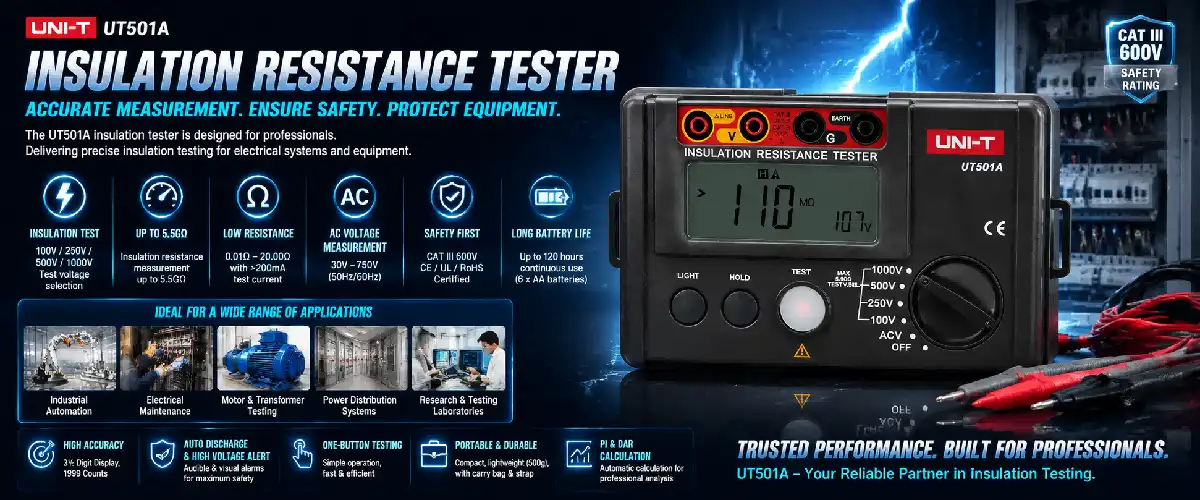
The screen is 70.6 mm × 34 mm and has a precision of 3½ decimal places. It shows 1999 counts. The blue lighting makes it easy to read in dimly lit areas that are common in industrial tests. Insulation resistance values, the chosen test voltage range, low battery indicators, and overload alarms are all shown on the screen.
Being able to use different measurements is an identifying trait. The tester has four different voltage output settings: 100V, 250V, 500V, and 1000V. This means it can be used to test a wide range of things, from low-voltage control circuits to high-voltage power distribution systems. Insulation resistance measurements can go as high as 5.5GΩ, and low resistance measurements can go as low as 0.01Ω with a test current of more than 200 mA. This four-wire measurement method gets rid of lead resistance interference very well, so motor windings, switch contacts, and wire continuity checks can all get accurate results.
The AC voltage range can be measured from 30V to 750V, and the frequency response is 50Hz/60Hz. This lets techs make sure that the circuit is de-energized before they do insulation checks. The input ports have a LINE terminal (red) for high-voltage output, an EARTH terminal (black) for connecting to ground, a V terminal for measuring voltage, and an Ω terminal for checking low resistance. Protections against input overvoltage and incorrect handling keep devices from getting damaged as much as possible.
Safety Features and Operational Simplicity
The safety certifications include a CAT III 600V rating and compliance with CE, UL, and RoHS standards, which are the same as those used for expert test tools around the world. The double insulation, automatic discharge function, and high-voltage alarms that can be heard and seen keep workers safe during tests. These safety features come in handy when checking powered equipment or working in dangerous places, which is common in industrial robotics and aerospace.
This model is different from complicated testing tools because it is easy to use. With the single-knob range selection and one-button testing, you don't have to figure out how to use complex menus. Standard insulation tests can be done in seconds by technicians, which cuts down on downtime during preventative maintenance plans. The Polarization Index (PI) and Dielectric Absorption Ratio (DAR) are automatically calculated, which lets you get a professional opinion on how old your insulation is with just one touch. This helps with planning ahead for repair needs.
With its lightweight of only 500g and included cloth bag and carrying strap, the portable design makes it easy to use by hand in a variety of test sites. Six AA batteries power the low-power design, which can work for up to 120 hours. This longer battery life cuts down on breaks during large-scale testing programs and lowers running costs compared to rechargeable battery systems that need to be charged more often.
Comparing UT501A with Other Insulation Resistance Testers
Performance Benchmarking Against Industry Leaders
When purchasing insulation testers, the UT501A Insulation Resistance Tester is often put up against well-known names like Megger and similar UNI-T types like the UT520. Megger instruments usually cost more than other brands because they have a long history and are designed with features that utility companies and big industrial businesses need. The UT501A, on the other hand, has similar measurement accuracy and voltage range choices but costs 40–50% less. This makes it appealing for small businesses and study centers that are trying to stay within their budgets.
With its wider measurement ranges and extra storage space, the UT520 is a good middle-of-the-road choice. The UT501A only has the most important insulation testing features and doesn't log any data. This makes it perfect for situations where hand recording is enough and instant cost savings are more important than advanced features. Because of its central location, the device is especially appealing to OEM makers who need multiple testers for quality control on the production line or system integrators who want to send testers to work with field service teams.
Digital technology is much better than traditional technology when it comes to meggers. The parallax reading mistakes that happen a lot with needle-based tools are gone with digital displays, and automatic range means that operators don't have to learn how to use them as much. Compared to standard hand-crank generators, the UT501A's switch-mode power source boost technology gives stable voltage output in a small, light package. Standardized quality control methods are supported by this technological approach, which makes sure that test results are the same no matter how the user does them.
Value Proposition for Budget-Conscious Procurement
The UT501A is one of the best insulation resistance testers that costs less than $500 because it has a lot of features and is safety-certified. When two models are priced similarly, they often trade off voltage range choices, measurement accuracy, or safety scores. With its low price, four voltage choices, wide resistance range, PI/DAR calculation, and CAT III 600V approval, this tester meets the basic need for trustworthy, low-cost testing gear in all kinds of industries.
The device does have some problems that buying teams should be aware of. Because it doesn't have built-in storage, test results have to be recorded by hand, which may take longer for quality management systems that need to keep thorough records. The UT502A, UT505A BT, or UT515B models can support over 1,000 saved datasets and can be exported. They are good choices for organizations that need USB connection, Bluetooth data sharing, or PC software interaction. However, the UT501A is a great choice for situations where quick pass/fail decisions are enough or where current documentation systems allow for hand entry.
In industrial settings where insulation integrity is checked over time by frequent measurements, performance uniformity is very important. The switch-mode power source technology keeps the voltage stable even when the battery's charge level changes. This makes sure that measurements are always the same during long testing sessions. This dependability is very important when setting baseline insulation values for predictive maintenance programs or doing regular verification tests as required by industry standards.
How to Buy the UT501A Insulation Resistance Tester
Trusted Procurement Channels and Authorized Distribution
When you buy from an approved dealer, you're sure to get a warranty, a real product, and technical help. We, MXTD (Xi'an Mingxi Taida Information Technology Co., Ltd.), are a reliable source for high-precision test and measurement tools. The UT501A Insulation Resistance Tester is one of our many PXIe platforms, integrated testing systems, and measurement options. Our expert team has worked in this field for more than 12 years and knows what is needed for use in industrial robotics, aerospace, electronics testing, and semiconductors.
If you buy directly from manufacturers or well-known distributors, you can avoid getting fake gadgets that might not have safety certifications or give you wrong measurements. Authorized channels provide important paperwork like user guides, calibration certificates, and compliance statements that are needed for quality management systems and regulatory checks. Our supply chain skills make sure that the UNI-T goods you buy are real and can be tracked back to the maker.
Pricing Structures and Bulk Procurement Advantages
The UT501A usually costs between $280 and $350 at stores, but this depends on the market in your area and the extras that come with it. Orders of more than ten units can get discounts, with price cuts ranging from 15% to 25% based on the number of units ordered and when they need to be delivered. Volume pricing saves a lot of money for research institutions and OEM makers who want to supply multiple techs or add tests to production lines.
We have flexible purchasing terms that allow for both normal product shipping and solutions that are made to fit the needs of each individual parameter. If a company needs different voltage ranges, special connections, or to be able to connect to other test systems, our ODM/OEM services can make it happen. Production processes are set up based on technical requirements. This feature helps system integrators make their own testing tools or helps makers find private-label test equipment.
International Logistics and Delivery Assurance
Global buying teams need shipping options that they can rely on and that keep precision tools safe while they're in transit. We can ship measurement equipment by both land and air in packing that is especially made for it and has features that keep it dry, shock-proof, and anti-static. Standard arrival times for local shipments are between 5 and 7 business days, and for foreign air freight they are between 10 and 15 business days. Express choices are available for urgent needs.
After-sales support includes free software updates, remote video expert help, and a normal one-year guarantee that covers problems caused by manufacturing. During business hours, we answer customer questions within an hour, whether they are about technology issues, testing needs, or problems with how the business is running. This quick technical support is especially helpful when setting up new test equipment in different locations or fixing strange measurement issues that come up during important testing times.
Troubleshooting and Maintaining Your UT501A Tester
Common Issues and Resolution Strategies
Even reliable test tools can have problems from time to time. Knowing about common problems and how to fix them cuts down on downtime and keeps measurement accuracy high. When connections at test points aren't stable, readings or measurements that aren't stable often happen. Isopropyl alcohol can be used to clean the LINE and EARTH connections. This gets rid of rust and contamination that can lower contact resistance. Another common cause of measurement error can be eliminated by making sure that the test lines have the right insulation and safe connections.
Problems with batteries are another usual worry. When the battery level is low, the power output is less stable, which makes measurements less accurate. When the low battery sign shows up, replacing the batteries before they run out keeps testing sessions from being halted. Using good alkaline batteries instead of cheap ones makes sure that the device works longer and delivers power consistently. You can use rechargeable batteries, but make sure the voltage specs match the 9V standard so that under-voltage doesn't affect performance.
When determined resistance is outside of the chosen range or when test connections have too much voltage, overload indicators go off. Before looking into equipment problems, make sure that the test voltage is set correctly for the job and that the item being tested is properly turned off if the readings show low resistance. Most operational problems can be fixed without needing factory service by looking at the user instructions for particular error codes and suggested fixes.
Preventive Maintenance and Calibration Protocols
Consistent regular repair is needed to make devices last as long as possible. When not in use, keeping the tester in its cloth bag keeps it safe from dust, water, and damage. Staying away from places with very high or very low temperatures keeps LCD displays and computer parts working well. Specifications for operating and storing temperatures should be followed, especially in industrial settings where temperatures may get close to or go over the design limits.
Calibration checking makes sure that measurements are accurate for as long as the tool is used. Most workplace quality systems need to be checked for accuracy against traceable standards once a year. It is possible to make sure that ISO 9001 and industry-specific quality standards are met by sending the UT501A Insulation Resistance Tester to approved service centers or using in-house calibration labs with NIST-traceable references. Recording the history of calibrations helps with government inspections and shows dedication to accurate measurements.
Taking care of batteries is more than just replacing them. Taking out the batteries before storing them for a long time stops rust damage from battery leaks. By checking the battery sections on a regular basis, you can find early signs of rust that can be fixed before they damage the circuit board. Keeping extra batteries in places with controlled temperatures keeps their ability to hold a charge and their dependability.
Due to its hardware-based design, the UT501A does not have software changes. However, staying in touch with approved dealers will keep you informed of any product warnings, better accessories, or updated models that offer better capabilities. This long-term connection helps operations run smoothly and helps people make smart choices when they need to add to or improve their test equipment fleets.
Making the Right Choice: Is UT501A Right for Your Business?
Industry-Specific Application Assessment
The usefulness of any test tool rests on how well its features match the needs of the job. The four voltage levels and PI/DAR calculation are very helpful for electrical contractors who do regular repairs on business buildings to check the state of motor insulation and transformers. The compact form and long battery life make it useful for field service work where power sources may not be easy to reach.
OEM makers who use insulation testing as part of quality control for production can save money and make the gadget easy to use. It only takes minutes to train production staff on how to use a single knob, but it takes hours to train them on complex test tools. The 600V CAT III safety grade is enough to protect manufacturing areas while still being affordable enough to equip multiple testing units.
Research centers and electronics testing labs that need to keep thorough records and connect to a PC should think about whether recording data by hand is enough to meet paperwork needs or if more advanced models with built-in storage are better for them. The UT501A Insulation Resistance Tester is still perfectly good for study purposes in terms of its basic measurement accuracy and range; the key thing that makes it different is how it handles data.
System integrators who make automatic test tools can build in basic measurement functions while also coming up with ways to get data from outside sources. The simple electrical interface and reliable operation make it easy to connect to bigger test systems that don't need complicated communication protocols.
Decision Framework for Procurement Teams
Buying test tools needs to be evaluated using a method that takes into account a number of factors. The requirements for measurement precision should match the quality standards and legal requirements in your business. The UT501A's measurement ranges and voltage sets work for most industrial insulation testing situations. However, other models may be needed for specific tasks that need wider ranges or more voltage choices.
Durability factors include both how strong something is physically and how reliable its electronics are. The small size and double insulation make it suitable for use in industrial settings. The relatively simple electronic architecture lowers the number of possible failure points compared to instruments with a lot of features and a lot of digital processing. Knowing the working environment makes it easier to guess how much repair will be needed and how long the service will last.
User-friendliness has a direct effect on how much it costs to train people and how well operations run in the UT501A Insulation Resistance Tester. Because the UT501A only has one knob and one button, it requires less training and fewer mistakes are made by operators. Organizations that lose a lot of technicians or have yearly changes in their staff can benefit from equipment that is easy to use and doesn't need a lot of training.
Price factors include more than just the initial buy price. They also include the costs of tuning, maintenance, and running the machine. The 120-hour battery life and low upkeep needs keep costs low over time. Comparing the buying price alone with the total cost of ownership over the expected service life gives a more true picture of value.
The provision of service help affects the risk of downtime and the long-term continuity of operations. Protecting equipment purchases means working with wholesalers who offer expert advice, calibration services, and quick warranty support. At MXTD, our technical team offers full support throughout the entire lifetime of an item, from helping with the original specifications to providing ongoing operational support.
Customer Confidence and Verified Performance
More and more, industrial buyers choose test equipment based on suggestions from other buyers and a record of how well the equipment has worked in the past. Maintenance and quality control teams have said good things about the UT501A, saying they like how well it balances usefulness and price. Organizations that used traditional meggers before switching to this digital platform regularly report faster measurements and less time spent training operators.
When you put together UNI-T's name for manufacturing and MXTD's knowledge of distribution, you get a stable supply chain that can meet both short-term needs and long-term business possibilities. Our stocking management makes sure that products are available when they are needed right away, and our customization options meet the needs of specific applications that standard products can't fully meet.
Conclusion
When choosing the right insulation resistance testing tools, you have to think about their technical skills, their operational needs, and your budget. The UT501A Insulation Resistance Tester is accurate enough for use in factories, with four voltage sets and a wide range of resistance levels. It is also affordable enough for medium to large businesses. It meets important needs in industrial robotics, aircraft, electronics tests, and semiconductors thanks to its safety certifications, ease of use, and portability. When matching equipment specs to specific working needs, procurement workers do better when they know both the device's strengths and weaknesses. When you work with experienced suppliers, you can be sure that you will get real goods, expert support, and long-term service commitments that protect your equipment investments and help your business stay open.
FAQ
1. What voltage testing scenarios does the UT501A support effectively?
At 100V, 250V, 500V, and 1000V, the four voltage output sets make it possible to test the insulation of low-voltage control circuits, medium-voltage distribution systems, and high-voltage industrial equipment. This range is wide enough to handle most tasks in factories, offices, and industrial automation systems without the need for multiple specialized tools.
2. How frequently should the UT501A undergo calibration verification?
Verification of calibration against known standards once a year is in line with ISO 9001 quality management standards and best practices in the business. Organizations that have to follow tighter rules or do important safety tests may set up proof plans that happen every six months. The best calibration regularity for the UT501A Insulation Resistance Tester is also affected by the level of use and the working surroundings.
3. What technical support services does MXTD provide for commercial clients?
Our support system includes technical questions that are answered within one hour, operational questions that are answered through remote video coaching, and full consultations on choosing tools and integrating systems. We make sure that replacement parts are always available, schedule calibration services, and offer ongoing technical support throughout the lifetime of the equipment. This keeps downtime to a minimum and working efficiency at its highest level.
Partner with MXTD for Your Insulation Testing Equipment Needs
MXTD stands ready to support your precision testing requirements with authentic UT501A Insulation Resistance Testers and complete measurement solutions. As an established supplier with over 12 years of experience in the field, we understand the demanding requirements of industrial automation, aerospace, electronics testing, and semiconductor applications. Our inventory includes basic setups that can be shipped right away, and we offer ODM/OEM services for customers who need specific parameter requirements. Bulk price structures offer big savings on costs for projects that buy more than one thing. Contact our technical team at manager03@mxtdinfo.com to discuss your unique testing needs, request detailed specifications, or arrange product demonstrations. We reply within an hour to ensure your procurement decisions benefit from expert consultation and competitive pricing.
References
1. International Electrotechnical Commission. (2020). Insulation Resistance Testing Standards for Electrical Equipment. IEC Publication 61557-2, Geneva, Switzerland.
2. Johnson, M. & Patterson, R. (2019). Industrial Electrical Testing: Methods and Best Practices. Technical Publishing International, Boston, Massachusetts.
3. Smith, T.L. (2021). Preventive Maintenance Strategies for Industrial Test Equipment. Journal of Quality Assurance in Engineering, Vol. 34, Issue 2, pp. 145-162.
4. American Society for Testing and Materials. (2018). Standard Test Methods for DC Resistance or Conductance of Insulating Materials. ASTM D257-14, West Conshohocken, Pennsylvania.
5. Chen, W. & Rodriguez, A. (2020). Comparative Analysis of Digital Megohmmeters in Industrial Applications. Measurement Science Review, Vol. 20, No. 4, pp. 189-201.
6. National Institute of Standards and Technology. (2019). Calibration Procedures for High-Resistance Measuring Instruments. NIST Technical Note 1802, Gaithersburg, Maryland.
Our customers’ satisfaction speaks for our quality — contact us to experience the same reliable service.