- English
- French
- German
- Portuguese
- Spanish
- Russian
- Japanese
- Korean
- Arabic
- Greek
- German
- Turkish
- Italian
- Danish
- Romanian
- Indonesian
- Czech
- Afrikaans
- Swedish
- Polish
- Basque
- Catalan
- Esperanto
- Hindi
- Lao
- Albanian
- Amharic
- Armenian
- Azerbaijani
- Belarusian
- Bengali
- Bosnian
- Bulgarian
- Cebuano
- Chichewa
- Corsican
- Croatian
- Dutch
- Estonian
- Filipino
- Finnish
- Frisian
- Galician
- Georgian
- Gujarati
- Haitian
- Hausa
- Hawaiian
- Hebrew
- Hmong
- Hungarian
- Icelandic
- Igbo
- Javanese
- Kannada
- Kazakh
- Khmer
- Kurdish
- Kyrgyz
- Latin
- Latvian
- Lithuanian
- Luxembou..
- Macedonian
- Malagasy
- Malay
- Malayalam
- Maltese
- Maori
- Marathi
- Mongolian
- Burmese
- Nepali
- Norwegian
- Pashto
- Persian
- Punjabi
- Serbian
- Sesotho
- Sinhala
- Slovak
- Slovenian
- Somali
- Samoan
- Scots Gaelic
- Shona
- Sindhi
- Sundanese
- Swahili
- Tajik
- Tamil
- Telugu
- Thai
- Ukrainian
- Urdu
- Uzbek
- Vietnamese
- Welsh
- Xhosa
- Yiddish
- Yoruba
- Zulu
Can Serial Port Conversion Cards Support High-Speed Data Transmission?
Serial port conversion cards can definitely handle sending data at a fast rate. Modern serial interface adapters, especially those made for testing and industrial automation, can send data at speeds of up to 3Mb/s for RS-422/RS-485 protocols and 1Mb/s for RS-232 standards. These high-tech cards have hardware features like 128-byte FIFO banks, DMA transfer options, and optimised chipset designs that reduce delay and increase speed. The important thing is to choose connections that are made for hard tasks where speed and data security are musts.
Understanding Serial Port Conversion Cards and Their Capabilities
Fundamental Architecture and Interface Types
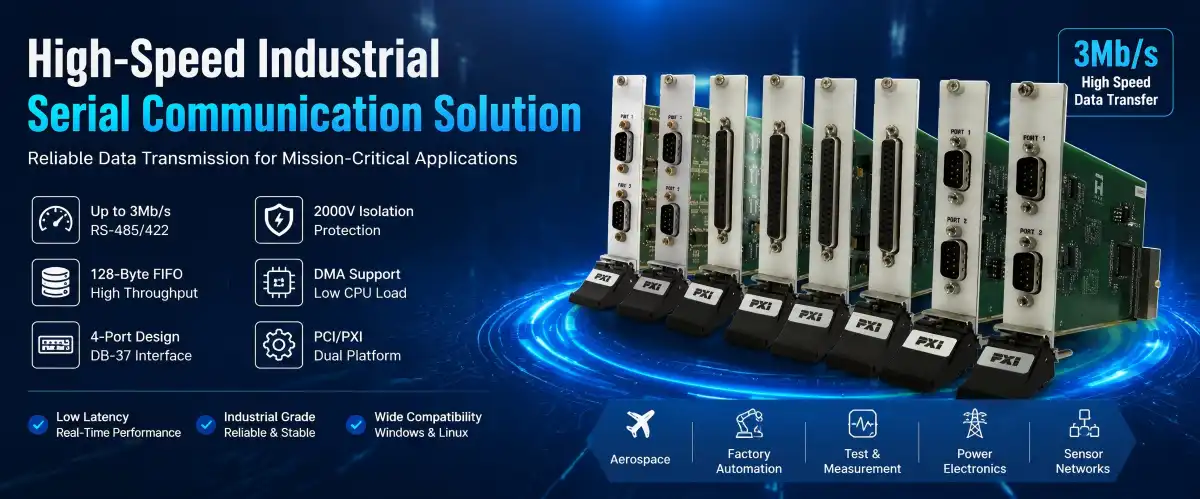
The way serial interface devices work is by taking data from PCI or PXIe slots and turning it into serial communication methods. Industrial-grade cards have specialised UART drivers with better delay and separation hardware than simple USB-to-serial converters made for household use. These changes in architecture have a direct effect on the speed and safety of the gearbox. There are several different protocol versions on the market, and each one is best for a different set of practical needs. Point-to-point contact up to 1Mb/s over shorter distances is what RS-232 ports are best for, which makes them perfect for direct machine control and monitoring. The RS-422 and RS-485 protocols improve both speed and distance. They can handle multi-drop setups that are necessary for spread sensor networks and communication systems on the factory floor, and they can reach 3Mb/s transfer rates.
When it comes to system interaction, PCI and PXIe form factors offer different benefits for serial port conversion cards. Cards built on PCI, like the PCI50101 line, have been shown to work with older industrial computers and control systems. PXIe versions, like the PXI50101 line, work better in flexible equipment settings and work well with test and measurement systems that are popular in aircraft, defence, and electronics testing centers. Both designs allow four-port setups through DB-37 female connections, which lets multiple devices talk to each other at the same time without the need for extra expansion cards.
Hardware Features That Enable High-Speed Performance
Three main pieces of hardware decide how fast a serial device can work. The FIFO buffer level has a direct effect on the amount of data that can be sent. For example, MXTD's PXI50101 and PCI50101 lines use a 128-byte FIFO that lets them send data in bursts without losing any, even when the CPU is briefly busy with other tasks. This buffering ability is very important for real-time testing, where measurement data needs to run constantly without stopping. DMA transfer technology reduces processor overhead by allowing direct memory access between the serial controller and system RAM. This architectural approach minimizes latency and frees CPU cycles for computational tasks rather than data movement operations. When combined with non-standard baud rate flexibility, engineers can fine-tune transmission speeds to match specific equipment requirements rather than being constrained by predefined rate tables.
Electrical isolation represents another critical feature for industrial deployments. The 2000V isolation voltage specification in isolated variants protects both the host computer and connected equipment from ground potential differences and transient voltage spikes common in high-power industrial environments. This isolation safeguards expensive test equipment and prevents communication failures caused by electromagnetic interference, making these cards particularly valuable in motor control, power electronics testing, and high-voltage research applications.
Performance Factors Affecting High-Speed Data Transmission
Latency, Bandwidth, and Throughput Considerations
Achieving reliable high-speed serial communication requires understanding the interplay between three performance metrics. Latency measures the time delay between data transmission and reception—critical for closed-loop control systems where timing precision affects operational stability. Industrial serial adapters minimize latency through hardware-based interrupt handling and optimized driver architectures that reduce software processing overhead.
Bandwidth defines the maximum data rate sustainable over the communication channel. While RS-232 specifications theoretically support rates beyond 1Mb/s, practical implementations must account for cable quality, termination resistance, and electromagnetic environment. RS-485 differential signaling provides superior noise immunity, enabling the full 3Mb/s capability even in electrically harsh manufacturing floors with variable frequency drives and high-current switching equipment.
Throughput represents the actual data successfully transmitted after accounting for protocol overhead, error correction, and flow control mechanisms. The 128-byte FIFO buffers in MXTD's adapter cards maintain high throughput by reducing the frequency of interrupt service requests to the host processor. This design allows sustained data streams approaching theoretical maximum rates, essential for high-resolution sensor data acquisition and continuous production monitoring applications.
Software Compatibility and Driver Architecture
Driver quality profoundly impacts the real-world performance of serial port conversion cards regardless of hardware capabilities. MXTD's serial interface adapters support both standard Windows API access and VISA driver frameworks, providing flexibility for different development environments. Windows API integration enables rapid application development using familiar programming interfaces, while VISA compatibility ensures seamless integration with LabVIEW, TestStand, and other measurement automation software prevalent in test engineering workflows.
Operating system support extends across Windows 10, Windows Server editions, and various real-time operating systems deployed in industrial controllers. Consistent driver performance across these platforms simplifies system qualification and reduces integration risk when deploying mixed computing environments. Firmware upgradeability ensures long-term compatibility as operating systems evolve and new communication standards emerge.
Comparing serial adapters against alternative connectivity solutions reveals important trade-offs. USB converters offer plug-and-play convenience but introduce variable latency due to USB bus arbitration and power management. Ethernet converters provide network-based connectivity suitable for distributed systems but add protocol overhead and require network infrastructure. Direct PCI or PXIe serial cards deliver the lowest latency and most deterministic timing—critical attributes for precision test equipment synchronization and real-time control loops where microsecond-level timing accuracy matters.
Selecting the Best Serial Port Conversion Card for High-Speed Applications
Technical Specifications That Matter for Procurement
When evaluating high-speed serial solutions, several specifications directly impact suitability for demanding applications. Port count determines system scalability—four-port configurations like those in the PXI50101 and PCI50101 series reduce slot consumption while supporting multiple simultaneous instrument connections. This density advantage proves valuable in space-constrained PXI chassis environments and industrial PCs with limited expansion capability.
Protocol flexibility allows a single card design to serve diverse equipment needs. MXTD offers both RS-232 and RS-422/RS-485 variants within the same mechanical form factor, simplifying inventory management for system integrators and OEM manufacturers who support varied customer equipment configurations. The DB-37 connector standard accommodates breakout cables for different pin assignments, providing wiring flexibility without custom adapter manufacturing.
Isolation specifications warrant careful attention for high-noise environments. The 2000V isolation rating protects against common-mode voltage differences between ground planes—a frequent challenge when connecting equipment powered from different electrical services or when long cable runs span multiple building areas. Non-isolated variants suit benign laboratory environments where cost optimization outweighs isolation benefits.
MXTD Product Line Comparison and Selection Criteria
Here are the core advantages of MXTD's industrial serial adapter solutions:
- PXI50101 RS-232 Configuration delivers 1Mb/s transmission across four isolated ports, ideal for direct instrument control in modular test systems. The PXIe form factor integrates with National Instruments-compatible chassis, supporting system-level synchronization and trigger distribution essential for coordinated multi-instrument measurements.
- PXI50101 RS-485 Configuration achieves 3Mb/s high-speed operation suitable for networked sensor arrays and multi-drop communication topologies. The differential signaling inherent to RS-485 provides superior noise immunity in manufacturing environments with heavy electrical interference from motors, welders, and variable frequency drives.
- PCI50101 RS-232 Version offers identical 1Mb/s, four-port isolated performance in standard PCI format, fitting legacy industrial computers and embedded controllers without PXIe capabilities. This backward compatibility protects existing infrastructure investments while enabling performance upgrades.
- PCI50101 RS-485 Version brings 3Mb/s throughput to conventional PCI systems, extending high-speed serial connectivity to a broader range of computing platforms. The isolated design suits industrial automation controllers requiring robust communication in electrically demanding environments.
These capabilities effectively address the testing and automation challenges faced by aerospace, defense, semiconductor, and advanced manufacturing sectors. The consistent four-port configuration across all variants simplifies training, documentation, and spare parts management for organizations maintaining multiple test stations and production lines.
Installation and Troubleshooting for Optimal High-Speed Performance
Hardware Installation and Configuration
Proper physical installation establishes the foundation for reliable high-speed operation. PCI and PXIe cards require secure seating in appropriate slot types—PXI50101 variants must occupy PXI or PXIe slots while PCI50101 cards fit standard 32-bit PCI slots. Ensure adequate clearance for the DB-37 connector and associated breakout cabling, particularly in densely populated chassis where adjacent cards may restrict access.
Driver installation follows straightforward procedures using either the Windows API or the VISA frameworks. Windows Device Manager should recognize the card immediately upon boot, allowing driver software installation from provided media or downloaded packages. VISA driver deployment integrates the serial ports into measurement software environments, exposing standardized programming interfaces that simplify application development and reduce code complexity.
Configuration verification involves confirming port enumeration and basic communication functionality. Simple loopback testing—connecting transmit and receive pins—validates electrical operation and driver functionality before connecting actual equipment. Baud rate configuration, parity settings, and flow control parameters should match connected device requirements precisely to ensure error-free communication at maximum specified speeds.
Common Performance Issues and Resolution Strategies
Connectivity disruptions often stem from cable quality or termination issues rather than adapter card failures. High-speed serial communication requires proper cable impedance matching and termination resistance, particularly for RS-485 networks operating at 3Mb/s rates. Using quality cables with appropriate shielding and ensuring correct termination at network endpoints prevents signal reflections and data corruption that manifest as intermittent communication failures.
Driver conflicts emerge when multiple serial devices compete for system resources or when legacy software expects specific COM port numbering. Modern Windows versions assign COM port numbers dynamically, potentially confusing older applications. Manual COM port reassignment through Device Manager resolves these conflicts, allowing legacy software to find expected ports without application modification.
Electromagnetic interference mitigation requires attention to grounding practices and cable routing. Routing serial cables away from power conductors, motor leads, and high-frequency switching circuits reduces induced noise. The 2000V isolation in MXTD's isolated variants provides substantial protection, but proper grounding practices amplify this protection, ensuring sustained, reliable communication even in electrically severe environments common to industrial automation and power electronics testing.
Benefits of Using Serial Port Conversion Cards in B2B Industrial Applications
Practical Industrial Use Cases
Automation systems rely heavily on serial communication for programmable logic controller interfacing, motor drive control, and sensor network connectivity. Multi-port adapters enable centralized data collection from distributed devices, reducing wiring complexity and improving system maintainability. The four-port configuration supports simultaneous communication with multiple PLCs or drives without requiring complex networking infrastructure or additional computing hardware.
Telemetry applications in aerospace and defense testing demand high-speed, deterministic data acquisition from instrumentation distributed across test articles. The low latency and high throughput of RS-485 adapters operating at 3Mb/s enable real-time data streaming from accelerometers, strain gauges, and environmental sensors during dynamic testing scenarios. Electrical isolation protects expensive data acquisition systems from transient voltages induced during engine testing or electromagnetic compatibility evaluations.
Legacy system integration represents a significant challenge as organizations modernize infrastructure while preserving functional equipment with serial port conversion cards. Many precision instruments, test fixtures, and process controllers communicate exclusively via RS-232 or RS-485 interfaces. High-performance serial adapters bridge these legacy devices to modern computing platforms, extending equipment service life and protecting capital investments while enabling integration with contemporary data management and analysis software.
Future-Proofing Industrial Communication Infrastructure
Industry 4.0 initiatives emphasize connectivity, data analytics, and intelligent automation—objectives that require a robust communication infrastructure. Serial interface adapters provide a cost-effective connectivity layer for existing equipment, enabling data collection that feeds predictive maintenance algorithms, production optimization models, and quality assurance systems. The ability to monitor and control serial-based equipment remotely supports operational flexibility and distributed manufacturing strategies.
IoT integration increasingly extends to industrial equipment traditionally isolated from network connectivity. Serial adapters act as protocol bridges, converting device-level serial communication into formats suitable for edge computing gateways and cloud connectivity platforms. This architecture preserves device-level communication characteristics while enabling enterprise-level data aggregation and analysis capabilities.
Standardization around open driver architectures like VISA ensures long-term software compatibility as measurement platforms evolve. Equipment specified with VISA-compatible serial interfaces integrates seamlessly with current LabVIEW, TestStand, and Python-based automation frameworks while remaining compatible with future software generations. This software continuity reduces obsolescence risk and protects software development investments across multi-decade equipment lifespans.
Conclusion
High-speed data transfer through serial interface devices is a tried-and-true method for integrating old equipment, test and measurement, and industrial automation. New cards that offer 3Mb/s Ethernet and 1Mb/s RS-232 RS-485 performance provide enough bandwidth for most monitoring and control applications, and it is better at blocking electromagnetic noise and keeping electricity from flowing through them than other connection technologies. This guide explains technical specs, hardware features, and seller support capabilities so that buying professionals can make smart choices that meet practical needs and long-term strategy goals. Choosing adapters from makers with a track record of successful research and development (R&D) and quick response times for technical support will ensure long-lasting performance and lower the risk of merging issues in demanding industrial settings.
FAQ
1. Can serial interface adapters match the speed of native motherboard ports?
Quality industrial serial cards typically exceed native motherboard port capabilities. Built-in motherboard serial ports, where still present, usually support only basic RS-232 at limited speeds without advanced features like deep FIFO buffers or electrical isolation. Dedicated adapter cards implement optimized UART controllers, DMA transfers, and enhanced buffering that deliver superior throughput and lower latency. The 128-byte FIFO in MXTD's adapters substantially outperforms typical 16-byte native port buffers, enabling sustained high-speed operation without data loss during CPU-intensive operations. This performance advantage justifies dedicated adapter cards even when the motherboard serial ports exist.
2. What factors determine whether to select RS-232 versus RS-485 configurations?
Application requirements dictate protocol selection. RS-232 suits point-to-point connections under 50 feet where simplicity and direct equipment control are priorities. RS-485 enables longer distances, multi-drop network topologies, and superior noise immunity essential for industrial floor environments. The 3Mb/s capability of RS-485 adapters provides higher throughput for data-intensive applications like high-resolution sensor networks. When uncertain, RS-485 offers greater flexibility and future expandability while maintaining compatibility with most equipment through appropriate cable wiring.
3. How can compatibility with various industrial operating systems be ensured?
MXTD's dual driver support—Windows API and VISA frameworks—ensures broad compatibility. Windows API access serves traditional PC-based applications and embedded Windows systems. VISA driver support guarantees integration with measurement and automation software ecosystems prevalent in test engineering and research environments. Confirming driver availability for your specific operating system version during procurement prevents integration delays. MXTD's technical team provides rapid response to compatibility questions and offers remote guidance for driver deployment, minimizing implementation risk across diverse computing platforms.
Partner with a Trusted Serial Port Conversion Card Manufacturer
MXTD brings over 12 years of specialized expertise in developing high-reliability communication solutions for industrial automation, aerospace testing, and precision measurement applications with serial port conversion cards. Our PXI50101 and PCI50101 series serial adapters deliver the performance, isolation, and multi-port density that demanding test and automation environments require. As an established serial port conversion card supplier, we maintain a ready stock of standard configurations while offering comprehensive OEM/ODM customization to meet unique technical specifications.
Our engineering team responds within one hour to technical inquiries, providing detailed specification guidance, compatibility verification, and application support that accelerates your project timelines. We support both domestic ground transportation and international air freight with specialized packaging featuring moisture-proof, shock-resistant, and anti-static protection appropriate for precision electronic components. Every adapter includes a one-year warranty, free software upgrades, and access to remote video technical guidance. Contact manager03@mxtdinfo.com to discuss your serial communication requirements, request detailed specifications, or obtain volume pricing for your next integration project.
References
1. National Instruments Corporation. (2023). "Serial Communication Best Practices for Industrial Test Systems." Technical White Paper Series on Instrumentation Connectivity.
2. Institute of Electrical and Electronics Engineers. (2022). "IEEE Standard for Serial Communication Protocols in Industrial Automation." IEEE Industrial Electronics Society Conference Proceedings.
3. Semiconductor Equipment and Materials International. (2023). "Interface Standards for Test and Measurement Equipment." SEMI Equipment Communications Standard Documentation.
4. Industrial Automation Association. (2022). "High-Speed Serial Communication in Manufacturing Environments: Implementation Guidelines." Technical Standards and Recommended Practices Publication.
5. Aerospace Industries Association. (2023). "Data Acquisition Standards for Flight Test Instrumentation." AIA Test and Evaluation Technical Committee Report.
6. International Society of Automation. (2022). "Serial Interface Applications in Process Control and Factory Automation." ISA Technical Paper Series on Communication Technologies.
Our customers’ satisfaction speaks for our quality — contact us to experience the same reliable service.