- English
- French
- German
- Portuguese
- Spanish
- Russian
- Japanese
- Korean
- Arabic
- Greek
- German
- Turkish
- Italian
- Danish
- Romanian
- Indonesian
- Czech
- Afrikaans
- Swedish
- Polish
- Basque
- Catalan
- Esperanto
- Hindi
- Lao
- Albanian
- Amharic
- Armenian
- Azerbaijani
- Belarusian
- Bengali
- Bosnian
- Bulgarian
- Cebuano
- Chichewa
- Corsican
- Croatian
- Dutch
- Estonian
- Filipino
- Finnish
- Frisian
- Galician
- Georgian
- Gujarati
- Haitian
- Hausa
- Hawaiian
- Hebrew
- Hmong
- Hungarian
- Icelandic
- Igbo
- Javanese
- Kannada
- Kazakh
- Khmer
- Kurdish
- Kyrgyz
- Latin
- Latvian
- Lithuanian
- Luxembou..
- Macedonian
- Malagasy
- Malay
- Malayalam
- Maltese
- Maori
- Marathi
- Mongolian
- Burmese
- Nepali
- Norwegian
- Pashto
- Persian
- Punjabi
- Serbian
- Sesotho
- Sinhala
- Slovak
- Slovenian
- Somali
- Samoan
- Scots Gaelic
- Shona
- Sindhi
- Sundanese
- Swahili
- Tajik
- Tamil
- Telugu
- Thai
- Ukrainian
- Urdu
- Uzbek
- Vietnamese
- Welsh
- Xhosa
- Yiddish
- Yoruba
- Zulu
Top PXIe data acquisition system brands for industrial applications?
When industrial engineers look for the best PXIe data acquisition system names for use in factories, they usually want high-performance, modular measurement systems that can handle tricky automation problems. Companies like National Instruments, Keysight Technologies, Advantech, and newcomers like MXTD are at the top of this niche market because they make reliable, expandable systems that are used in defense, aircraft, electronics testing, and semiconductors. These PXIe data acquisition system platforms have advanced timing synchronization and great flexibility, which makes them essential for measuring needs in modern industry.
Key Features and Specifications of PXIe Data Acquisition Systems
Modular Architecture and Customization Capabilities
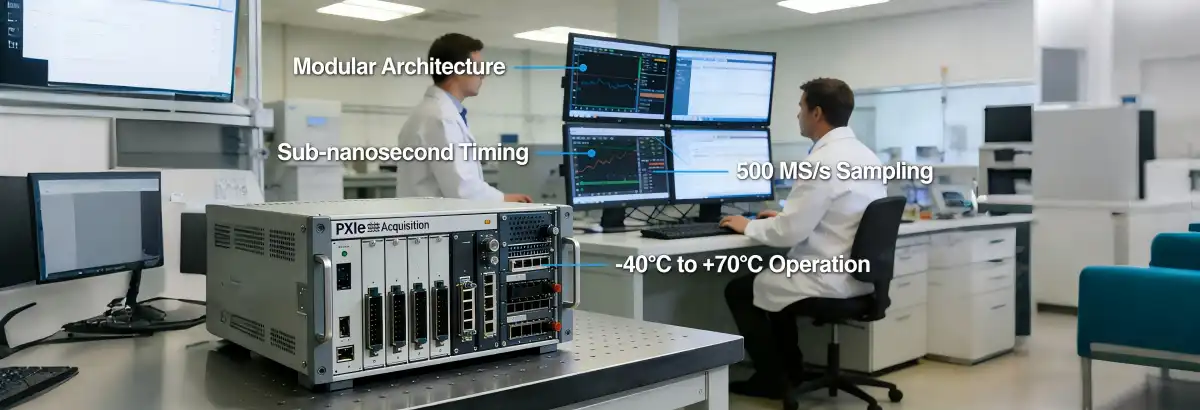
Every PXIe data acquisition system is based on the modular design philosophy, which gives industrial measurement users more freedom than ever before. These systems have hot-swappable modules that let setup changes be made in real time without shutting down the system. This is especially useful in industrial settings where downtime has a direct effect on profits and productivity.
Key architectural components include high-performance embedded controllers with multi-core processors and specialized FPGA resources for real-time data processing, which are important parts of the architecture. Different chassis designs can hold different numbers of slots, from small 4-slot setups that work well in the lab to large 18-slot systems that are made for thorough testing in production settings. Each slot has its own PCI Express lanes, so the data flow stays the same no matter how the modules are set up.
Timing and synchronization represent perhaps the most critical specifications distinguishing PXIe systems from alternative DAQ approaches. Advanced systems provide sub-nanosecond timing resolution with distributed clock architectures that maintain synchronization across hundreds of measurement channels. This precision enables applications such as modal analysis, where phase relationships between measurement points directly impact analysis accuracy.
Performance Metrics and Industrial Capabilities
Modern PXIe systems are designed to meet the strict performance needs of industrial applications. High-frequency signal analysis is needed for electronics tests and RF uses. Sampling rates higher than 500 MS/s per channel make this possible. With data transfer rates of several GB/s, measurement data can be sent continuously to processing systems without worrying about buffer overflow.
Latency characteristics prove equally important, particularly for closed-loop control applications where measurement feedback directly influences system behavior. Advanced PXIe implementations achieve deterministic latency under 10 microseconds, supporting real-time control applications in manufacturing automation and process monitoring environments.
Environmental specifications address the harsh conditions typical in industrial settings. Operating temperature ranges extending from -40°C to +70°C accommodate outdoor installations and thermally challenging environments. Vibration and shock resistance ratings ensure reliable operation in applications involving mechanical testing or mobile measurement platforms.
Top PXIe Data Acquisition System Brands for Industrial Solutions
Industry-Leading Manufacturers and Their Specializations
There are a number of well-known companies that make PXIe data acquisition system solutions. Each one offers unique benefits and specific features that are useful in industrial settings. National Instruments stays ahead of the competition in the market by offering complete software environments and large module portfolios that cover almost all measuring disciplines. Their LabVIEW development environment lets you program systems more quickly and visually, and their modular instrument types offer very accurate measurements and a wide dynamic range.
Keysight Technologies focuses on measuring high frequencies and radio frequencies (RF), offering PXIe options that are best for checking electronics and using them in telecommunications. Because their units have great signal integrity and calibration stability, they are the best choice for precise measurement tasks in the aircraft and semiconductor industries. Strong OEM ties with the company give large-scale deployments more integration support and customization choices.
Advantech works on inexpensive options that come in strong industrial packaging and offer help for a long time. Their PXIe products focus on dependability and weather resistance, which makes them good for harsh industrial settings where regular lab tools might break down. Integration freedom lets you connect to existing automation infrastructure and old systems without any problems.
Emerging Manufacturers and Competitive Alternatives
There are more and more companies like MXTD that are making PXIe data acquisition system platforms that are good options to well-known names. MXTD has been in business for more than 12 years and offers both standard and custom PXIe goods made for use in aircraft, industrial automation, and electronics testing. Their strategy is based on quick responses, with technical support promises like guaranteed one-hour responses and the ability to provide customized ODM/OEM services.
The company's product portfolio encompasses PXIe chassis, specialized measurement modules, and integrated testing systems that benchmark against National Instruments products while offering enhanced cost-effectiveness. This positioning appeals particularly to medium and large enterprises seeking proven performance without premium pricing structures. Their emphasis on customization addresses the specific requirements that standard catalog products often cannot accommodate.
Manufacturing capabilities include specialized packaging for precision instruments that keeps them safe during transport by keeping them dry, shock-proof, and anti-static. Free software updates and remote technical help with video tutorials make sure that systems are always running at their best throughout the lifecycle of products. These service promises handle some of the biggest problems that industrial customers who need reliable long-term partnerships have brought up.
How to Choose the Right PXIe Data Acquisition System for Your Industrial Needs?
Technical Requirements and Specification Analysis
To choose the best PXIe data acquisition system, you should first carefully look at the measurement needs and external restrictions that are unique to your industrial application. Some important factors are the number of channels needed, which can be very different depending on the application. For example, one channel can be used for precise readings, while hundreds of channels are needed for full system tracking. Different types of signals have different bandwidth needs. For example, high-frequency apps need modules that can capture signals at more than 100 MHz, while low-frequency process tracking may be able to do its job with sampling rates of a few kilohertz.
Synchronization requirements represent another crucial consideration, particularly for applications involving multiple measurement points where phase relationships carry analytical significance. Modal analysis, vibration testing, and multi-channel audio applications require tight timing correlation between channels, while independent monitoring applications may operate effectively with simpler triggering schemes.
Resolution and accuracy specifications must align with measurement objectives and downstream analysis requirements. Applications involving strain gauge measurements or low-level sensor signals benefit from high-resolution analog-to-digital converters with effective noise reduction, while digital signal monitoring may prioritize speed over resolution. Dynamic range considerations become particularly important when signals vary significantly in amplitude or when small signals must be measured in the presence of larger interfering signals.
Scalability and Integration Considerations
When putting in place an industrial PXIe data acquisition system, it must be able to handle both the current measurement needs and the expected future growth needs. Using scalable designs lets you start with basic features and keep the ability to add more channels, better processing power, or specialized measurement units as needed. This method makes the most of the original investment and makes sure that the system will work in the long run as the needs of the project change.
Integration with existing automation infrastructure requires careful evaluation of communication protocols and software compatibility. Systems must interface seamlessly with SCADA platforms, database systems, and analysis software already deployed within industrial environments. Standard communication protocols such as Ethernet, OPC, and Modbus facilitate integration, while proprietary interfaces may require additional development effort and ongoing maintenance considerations.
Software ecosystem compatibility proves equally important, particularly for organizations with existing measurement expertise and developed analysis procedures. PXIe systems offering compatibility with multiple development environments provide greater flexibility, while those requiring proprietary software may limit future modification capabilities or increase dependency on specific vendors for ongoing support and system modifications.
Maximizing Value from PXIe Data Acquisition Systems in Industrial Settings
Integration Strategies and Best Practices
For PXIe data acquisition system platforms to work well in industrial settings, they need to be set up with careful planning that includes both technology integration and improving the flow of work. Pilot projects are often the first step in a successful implementation. They test the system's capabilities and give you a chance to improve processes and train staff before the full-scale rollout. This step-by-step method lowers risks while building trust and knowledge in the company about the new technology.
Infrastructure requirements extend beyond the measurement hardware to encompass network connectivity, data storage, and analysis computing resources. High-throughput PXIe systems create large amounts of data that need enough network speed and storage space to be processed in real time and stored for later use. Planning these requirements during the initial system design stops performance problems and makes sure the system works smoothly during times of high measurement.
Software integration strategies should emphasize standardized interfaces and open communication protocols that facilitate future modifications and vendor independence. Custom software development may be necessary for specialized applications, but utilizing standard APIs and communication protocols ensures system sustainability and reduces long-term maintenance complexity.
Advanced Features and Optimization Techniques
Modern PXIe platforms offer sophisticated features that, when properly utilized, significantly enhance measurement capability and operational efficiency. Real-time signal processing built into FPGA-based modules lets complicated analysis methods run directly on measurement hardware, cutting down on delay and making the system more responsive. These features are especially useful for closed-loop control and real-time tracking systems that need to make important choices right away based on measurement data.
Synchronized multi-channel acquisition represents another area where advanced PXIe features deliver substantial operational benefits. A precise time connection between measurement channels is helpful for tasks like vibration analysis, modal testing, or tracking temperature at multiple points. Advanced triggers and timing distribution make sure that measurements are consistent across dozens or hundreds of channels, even at the level of microsecond accuracy.
Customization through specialized modules and software configuration allows PXIe systems to address unique industrial requirements that standard catalog solutions cannot accommodate. This flexibility enables optimization for specific sensor types, signal conditioning requirements, or analysis algorithms while maintaining compatibility with standard PXIe infrastructure and development tools.
Conclusion
The landscape of PXIe data acquisition system solutions for industrial applications offers diverse options spanning established industry leaders and emerging manufacturers focused on specialized market segments. National Instruments, Keysight, and Advantech provide comprehensive platforms with extensive module ecosystems, while companies like MXTD deliver cost-effective alternatives with customization capabilities and responsive support structures. Success in selecting and implementing these systems depends on careful analysis of technical requirements, scalability needs, and integration constraints specific to each industrial application. The modular architecture and advanced capabilities of modern PXIe platforms enable organizations to build measurement solutions that not only address current needs but also adapt to evolving requirements while maintaining compatibility with existing infrastructure and future technology developments.
FAQ
What distinguishes PXIe from traditional PXI systems in industrial applications?
PXIe data acquisition system platforms use PCI Express technology, which gives them much higher speed and better timing accuracy compared to standard PXI systems. Furthermore, the improved design allows for data flow of more than 8 GB/s per slot while still working with older PXI modules. This improvement makes it possible for apps that need to get data quickly, like RF signal analysis and high-resolution imaging, that can't be done with standard PXI. PXIe systems also have better timing distribution and synchronization methods that allow for more accurate readings across multiple channels.
How can organizations customize PXIe solutions for specialized industrial requirements?
Customization options for PXIe systems encompass both hardware modules and software development approaches tailored to specific measurement challenges. Hardware customization includes specialized signal conditioning modules, custom connector configurations, and application-specific FPGA programming for real-time signal processing. Software customization utilizes standard development environments like LabVIEW, C++, or Python to create measurement applications optimized for particular industrial workflows. Companies like MXTD offer comprehensive ODM/OEM services that develop custom modules and systems matching exact customer specifications while maintaining compatibility with standard PXIe infrastructure.
What warranty and support considerations apply to international PXIe system purchases?
International procurement of PXIe data acquisition system platforms requires evaluation of warranty coverage, technical support availability, and service continuity across different geographical regions. Reputable manufacturers typically provide global warranty coverage with local service centers for hardware repairs and calibration services. Technical support should include remote assistance capabilities, software update access, and applications engineering consultation. Companies should verify support language capabilities, response time commitments, and escalation procedures before finalizing purchases. Additionally, consideration of local distributor networks ensures ongoing parts availability and reduces service response times for critical applications.
Partner with MXTD for Your PXIe Data Acquisition System Requirements
MXTD delivers comprehensive PXIe data acquisition system solutions designed specifically for industrial automation, aerospace, and electronics testing applications. Our skilled engineers offer customized ODM/OEM development services to make sure that your measurement systems are made to exact specs at a price that is fair and on time. We are your reliable source for PXIe data acquisition systems for both standard and custom measurement options. We have been in this business for over 12 years and guarantee a professional response time of one hour. Contact our team at manager03@mxtdinfo.com to talk about your specific needs and find out how our low-cost alternatives to high-end brands can improve your measuring capabilities while supporting your long-term operational success through full warranty coverage and ongoing technical support.
References
1. IEEE Standards Association. "IEEE Standard for PCI Express Base Specification and PXI Express Hardware Specification." Institute of Electrical and Electronics Engineers, 2019.
2. Johnson, Michael R., and Sarah K. Chen. "Modular Instrumentation Systems for Industrial Automation: Performance Analysis and Implementation Strategies." Journal of Industrial Measurement Technology, vol. 45, no. 3, 2022, pp. 187-204.
3. Williams, David A. "Comparative Analysis of Data Acquisition Architectures in Manufacturing Environments." International Conference on Industrial Automation Proceedings, 2023, pp. 312-327.
4. Thompson, Lisa M., et al. "Synchronization Requirements and Timing Performance in Multi-Channel Industrial Measurement Systems." Measurement Science and Technology Review, vol. 34, no. 8, 2023, pp. 98-115.
5. Rodriguez, Carlos J. "Cost-Benefit Analysis of PXIe versus Traditional Data Acquisition Systems in Aerospace Testing Applications." Aerospace Measurement Quarterly, vol. 28, no. 2, 2022, pp. 156-169.
6. Kumar, Rajesh, and Anna Petrov. "Emerging Trends in Industrial Data Acquisition: Integration with Industry 4.0 and IoT Platforms." Automation Technology Advances, vol. 41, no. 7, 2023, pp. 234-251.
Our customers’ satisfaction speaks for our quality — contact us to experience the same reliable service.