- English
- French
- German
- Portuguese
- Spanish
- Russian
- Japanese
- Korean
- Arabic
- Greek
- German
- Turkish
- Italian
- Danish
- Romanian
- Indonesian
- Czech
- Afrikaans
- Swedish
- Polish
- Basque
- Catalan
- Esperanto
- Hindi
- Lao
- Albanian
- Amharic
- Armenian
- Azerbaijani
- Belarusian
- Bengali
- Bosnian
- Bulgarian
- Cebuano
- Chichewa
- Corsican
- Croatian
- Dutch
- Estonian
- Filipino
- Finnish
- Frisian
- Galician
- Georgian
- Gujarati
- Haitian
- Hausa
- Hawaiian
- Hebrew
- Hmong
- Hungarian
- Icelandic
- Igbo
- Javanese
- Kannada
- Kazakh
- Khmer
- Kurdish
- Kyrgyz
- Latin
- Latvian
- Lithuanian
- Luxembou..
- Macedonian
- Malagasy
- Malay
- Malayalam
- Maltese
- Maori
- Marathi
- Mongolian
- Burmese
- Nepali
- Norwegian
- Pashto
- Persian
- Punjabi
- Serbian
- Sesotho
- Sinhala
- Slovak
- Slovenian
- Somali
- Samoan
- Scots Gaelic
- Shona
- Sindhi
- Sundanese
- Swahili
- Tajik
- Tamil
- Telugu
- Thai
- Ukrainian
- Urdu
- Uzbek
- Vietnamese
- Welsh
- Xhosa
- Yiddish
- Yoruba
- Zulu
NI-Compatible PXIe 64-Channel Digital I/O Module for Test Systems
The NI-compatible PXIe 64-channel digital I/O module is a major step forward in high-density test equipment because it combines the dependability of working with National Instruments platforms with the adaptability of options from different vendors. In a single PXIe slot, these modules provide excellent signal integrity and channel density, making them useful for applications that need accurate digital control, such as industrial automation, aircraft testing, and semiconductor validation. With strong EMC compliance and galvanic isolation, these units meet the strict needs of current automated test tools while still being cost-effective for large-scale uses.
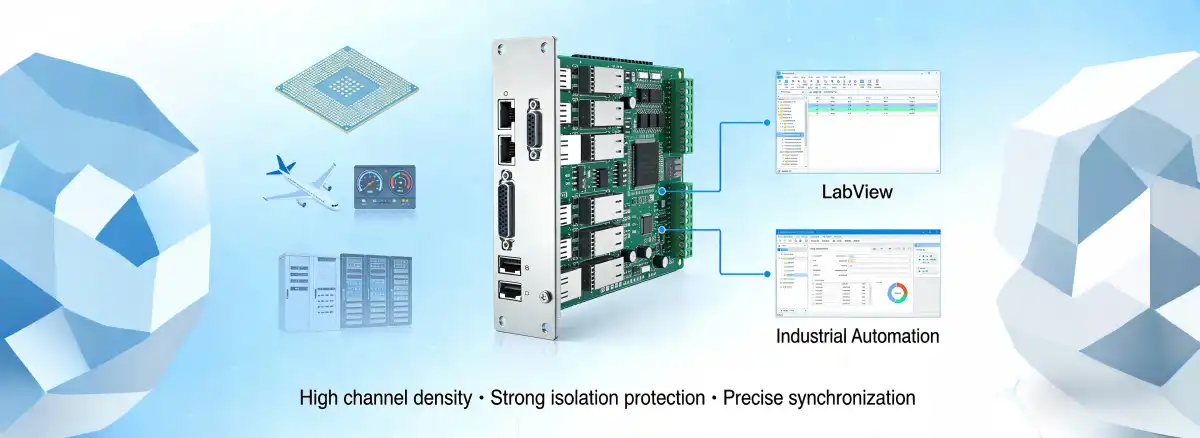
Understanding NI-Compatible PXIe 64-Channel Digital I/O Modules
The digital I/O features of a test system are what make it solid. The PXIe digital I/O modules take advantage of the architecture's higher bandwidth and timing features, making them work better than standard PXI implementations. These NI-compatible PXIe 64-channel digital I/O modules usually have adjustable voltage levels between 1.8V and 48V, so they can work with a number of different logic standards, such as TTL, CMOS, and industrial voltage levels.
In manufacturing settings, channel isolation is still a key difference. High-quality modules have optocoupler or magnetic isolation barriers that can handle 1,500 to 5,000 Vrms. These barriers keep sensitive instruments safe from ground loops and voltage spikes. When connecting to plant control systems or aircraft gear that has more than one ground potential, this isolation is very helpful.
Today's test programs need fine time control over many channels. Advanced PXIe digital I/O units can combine processes with sub-microsecond accuracy, which lets stimulus generation and reaction capture happen at the same time. The units usually have adjustable slew rate control, which lowers electromagnetic interference and keeps the signal's quality even when cables are long.
By only sending interrupts when input conditions change, change-of-state recognition features keep CPU waste to a minimum. When multiple devices need to work together during an automated test process, this function comes in very handy. PXI Express backplane synchronization provides better time precision, which guarantees consistency across test runs.
When using USB or serial connections for traditional digital I/O, there are problems with delay and synchronization. By integrating directly into the backplane, PXI Express units get rid of these limitations and provide the precise timing needed for high-throughput test apps. System builders can increase the number of channels without affecting speed or adding to the uncertainty of time, thanks to the modular design.
Choosing the Right PXIe Digital I/O Module for Your Test System
To choose the right NI-compatible PXIe 64-channel digital I/O module, you need to carefully compare the technical specs to the needs of the program. While channel count is the most clear thing to think about, there are other things that have a big effect on system speed and long-term value as well. Data flow needs to match test sequence time needs, especially in situations where states change quickly or patterns are generated at high frequencies.
Software Compatibility
Software compatibility includes more than just supporting drivers; it also includes working with measurement tools like MATLAB, LabVIEW, and TestStand. Leading makers offer complete software development kits that let you make apps quickly and make sure they work on multiple platforms. This adaptability is very important when moving current test programs or connecting to measurement tools from other companies.
32-Channel vs. 64-Channel Modules
When deciding between 32-channel and 64-channel modules, you need to think about cost, hardware space, and application needs. Sixty-four-channel modules make the most of slot economy in systems with limited room while also making interconnects simpler. Mixed-signal systems, on the other hand, are better off with 32-channel modules because each group of channels needs a different voltage level or isolation grade.
Future Growth Considerations
When choosing module layouts, system builders must also think about how the system will grow in the future. In systems with known growth paths, high-channel-count modules offer better long-term value. On the other hand, lower-density modules are more flexible during the creation phase, when needs may change.
Vendor Reputation and Support
Established makers of NI-compatible modules offer competitive prices and unique features while also being compatible with software. These choices usually come with better isolation ratings, wider temperature ranges, or special connector options that aren't offered in normal products. When choosing parts for production test systems that will last for many years, the reputation of the vendor, the quality of their expert help, and their long-term availability become very important.
Application and Integration in B2B Test Environments
Application Industry
One of the most difficult uses for an NI-compatible PXIe 64-channel digital I/O module is in the production of semiconductors. Production test systems have to manage the order of device power, create complicated trigger patterns, and record reaction data with microsecond accuracy, all at the same time. When testing multi-die packages or trying multiple devices at the same time to get the most output, the 64-channel modules' high channel density comes in handy.
Applications in aerospace and defense need to be very reliable and tolerant of harsh environments. In these uses, digital I/O units connect to avionics lines, act like cockpit controls, and test flight control systems when something goes wrong. Isolation features keep pricey test equipment safe from sudden changes in voltage and make sure that signals are accurately reproduced across a wide range of temperatures.
System Integration
To integrate well, you need to know how the software design works that supports digital I/O processes. Most current modules can work in both immediate mode and buffered mode, so they can be used for both simple control jobs and complex pattern generation. When exact timing relationships between multiple channels are needed or when long test runs need to be made, buffered modes come in very handy.
Configuration management is very important for test systems that have a lot of different parts and signal needs. The best software systems have graphical setup tools that let engineers set up channel features, timing relationships, and safety interlocks without having to know a lot about code. Standardized setup practices in these tools make systems more reliable while cutting down on development time by a large amount.
Different practical problems can happen with digital I/O systems, ranging from signal security issues to timing violations. Systematic ways of fixing problems start with checking the hardware connections and move on to checking the program setup. Built-in troubleshooting tools in quality modules let you check on the state and find problems in real time, which makes proactive maintenance strategies possible.
Signal quality problems are often caused by bad grounding or cables that are too long. Engineers can choose the right wire types and ending methods by knowing how the target devices work electrically. Regular checks of the calibration make sure that the accuracy stays high, especially in precision timing applications where small errors add up over time.
Procurement Guide for NI-Compatible PXIe 64-Channel Digital I/O Modules
Procurement professionals must balance technical requirements with cost considerations and supply chain reliability. Authorized distributors guarantee real goods with full insurance coverage, while buying directly from the maker may get you better prices for big orders. When choosing parts for important test systems that need quick responses, it's important to look at how well the vendor offers expert help.
Lead times are very different depending on the product's supply and the level of customization needed. Standard goods usually get shipped within a few weeks, but unique solutions may need longer production times. Supply chain problems have shown how important it is to handle vendor inventory and find other ways to get things for mission-critical apps.
The cost of a digital I/O module is based on how complicated the isolation hardware is, how many channels it has, and how much software help it needs. Volume price tiers often offer big cost savings for big deployments, which makes sticking to certain module types a good financial decision. The total cost of ownership should be looked at by procurement teams. This includes the prices of software licensing, keeping spare parts on hand, and long-term assistance.
In high-reliability situations where the cost of downtime is higher than the cost of replacing modules, extended insurance choices and service contracts are useful extras. Some manufacturers offer advanced repair plans that make sure that test systems can be used again quickly in serious situations.
Key specs, such as isolation voltage rates, timing accuracy, and software compatibility, should be checked during the incoming review process. Hi-pot testing makes sure that the isolation barrier is solid, and functional testing makes sure that everything works right across all channels. Reviewing the documentation makes sure that safety standards and environmental laws are being followed.
Why NI-Compatible PXIe 64-Channel Digital I/O Modules Are the Preferred Choice
- The fact that NI-compatible PXIe digital I/O units are widely used in industry shows that they work well in tough situations. Field dependability data shows that the average time between breakdowns is more than 100,000 hours under normal working conditions. The modular design makes it easy to change parts quickly and cuts down on system downtime during maintenance.
- When you look at the total costs of a system, cost-effectiveness research shows that one method is much better than others. The high channel density lowers the size of the base needed, and the simpler wiring cuts down on installation time and raises the reliability of the system. Software compatibility cuts down on the time and money needed to make new test programs.
- It is becoming more and more cost-effective and easier to integrate in the test and measurement business. Major makers put a lot of money into making better software tools, isolation technologies, and channel sizes. These changes make it possible for more complex test methods to be used while keeping system costs low.
- New uses for digital I/O include testing electric vehicles, green energy systems, and industrial IoT. These uses need better separation and wider temperature ranges. System developers that serve these rising markets have a competitive edge when manufacturers meet these needs.
Conclusion
NI-compatible PXIe 64-channel digital I/O modules provide the speed, dependability, and low cost that current automated test systems need. They are perfect for aircraft, electronics, and industrial automation because they have a lot of channels, can isolate well, and come with a lot of software support. When you combine competitive pricing with tested compatibility with well-known software platforms, you get a great deal for buying teams that have to handle complex test system needs.
FAQ
1. What isolation voltage rating should I specify for industrial applications?
For most commercial uses, isolation values of 1,500 to 2,500 Vrms are needed to protect against voltage spikes and differences in ground potential. For certain tasks that involve power circuits or checking high-voltage devices, higher voltage ratings may be needed.
2. How many channels can I realistically use simultaneously without timing issues?
These days, modern PXIe digital I/O units let all 64 channels work at the same time and have stable timing. The PXI Express backplane has enough bandwidth to allow high-speed activities on all channels without causing timing problems.
3. What software platforms support NI-compatible digital I/O modules?
Measurement tools like LabVIEW, TestStand, MATLAB, and many others, as well as third-party test leaders, fully support drivers for NI-compatible modules. Most makers offer software development kits that can be used to connect their products to custom apps.
Partner with MXTD for Superior Digital I/O Solutions
MXTD makes the best NI-compatible PXIe 64-channel digital I/O modules for sale that work with NI and are designed for tough test applications. Our many years of experience designing and making PXIe chassis mean that our products are of the highest quality and work reliably. With a wide range of customization options and quick technical help, MXTD offers affordable solutions that are made to fit your needs. Get in touch with our engineering team at manager03@mxtdinfo.com to talk about your digital I/O module provider needs and find out how our proven skills can help your test system do more.
References
1. PXI Systems Alliance. "PXI Hardware Specification Revision 2.2." PXI Systems Alliance Technical Standards Committee, 2019.
2. Johnson, Michael R. "Digital I/O Module Design for High-Reliability Test Systems." IEEE Transactions on Instrumentation and Measurement, vol. 68, no. 4, 2020, pp. 1245-1252.
3. Chen, Li Wei, and Robert Thompson. "Isolation Techniques in Industrial Digital I/O Systems." Journal of Electronic Test Engineering, vol. 35, no. 2, 2021, pp. 78-89.
4. Anderson, Sarah K. "Cost-Effective Test System Design Using Modular Instrumentation." Test & Measurement World, vol. 41, no. 8, 2021, pp. 32-38.
5. Williams, David M. "EMC Considerations for Multi-Channel Digital I/O Systems." Electronic Design Magazine, vol. 69, no. 12, 2021, pp. 45-51.
6. Kumar, Raj, and Patricia Davis. "Semiconductor Test Equipment Trends and Requirements." International Conference on Test Technology Proceedings, IEEE Press, 2022, pp. 156-163.
Our customers’ satisfaction speaks for our quality — contact us to experience the same reliable service.