- English
- French
- German
- Portuguese
- Spanish
- Russian
- Japanese
- Korean
- Arabic
- Greek
- German
- Turkish
- Italian
- Danish
- Romanian
- Indonesian
- Czech
- Afrikaans
- Swedish
- Polish
- Basque
- Catalan
- Esperanto
- Hindi
- Lao
- Albanian
- Amharic
- Armenian
- Azerbaijani
- Belarusian
- Bengali
- Bosnian
- Bulgarian
- Cebuano
- Chichewa
- Corsican
- Croatian
- Dutch
- Estonian
- Filipino
- Finnish
- Frisian
- Galician
- Georgian
- Gujarati
- Haitian
- Hausa
- Hawaiian
- Hebrew
- Hmong
- Hungarian
- Icelandic
- Igbo
- Javanese
- Kannada
- Kazakh
- Khmer
- Kurdish
- Kyrgyz
- Latin
- Latvian
- Lithuanian
- Luxembou..
- Macedonian
- Malagasy
- Malay
- Malayalam
- Maltese
- Maori
- Marathi
- Mongolian
- Burmese
- Nepali
- Norwegian
- Pashto
- Persian
- Punjabi
- Serbian
- Sesotho
- Sinhala
- Slovak
- Slovenian
- Somali
- Samoan
- Scots Gaelic
- Shona
- Sindhi
- Sundanese
- Swahili
- Tajik
- Tamil
- Telugu
- Thai
- Ukrainian
- Urdu
- Uzbek
- Vietnamese
- Welsh
- Xhosa
- Yiddish
- Yoruba
- Zulu
How to Use UT501A Insulation Resistance Tester Effectively?
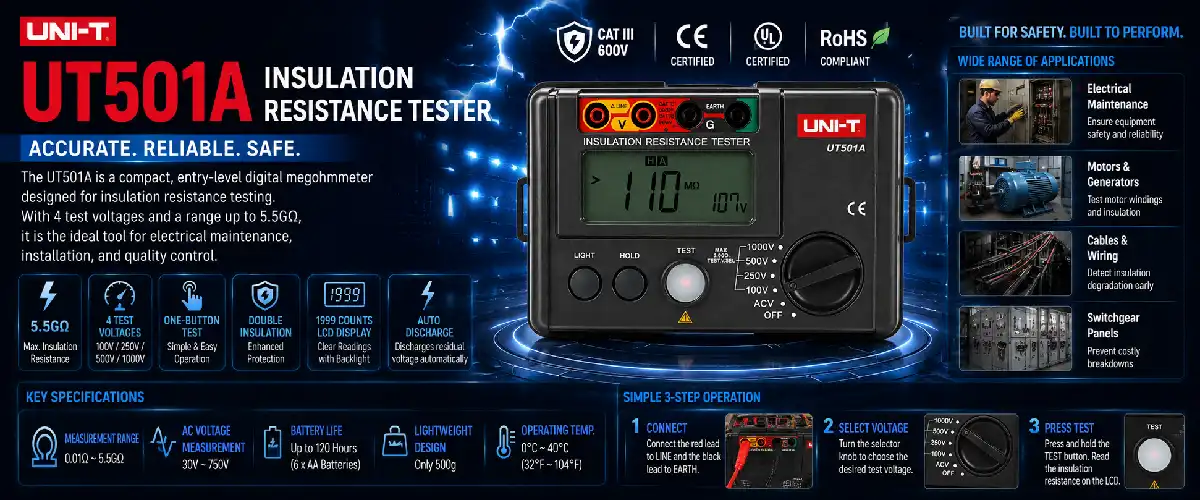
To use the UT501A Insulation Resistance Tester correctly, you need to know how to connect the test leads correctly and follow the steps for measuring in a planned way. It has four voltage settings: 100V, 250V, 500V, and 1000V. With a measurement range of up to 5.5GΩ and CAT III 600V safety approval, this entry-level digital megohmmeter from UNI-T is a solid tool for testing insulation. Mastering its one-knob range selection and one-button testing operation will help you get accurate results and stay safe while doing electrical repairs and preventative maintenance.
Understanding the UT501A Insulation Resistance Tester
The UT501A Insulation Resistance Tester is a big step forward in low-cost technology for checking insulation in commercial settings. As a Test & Measurement Engineer who works on a variety of industrial automation projects, I've seen how well this device matches accuracy with ease of use, making it good for both R&D centers and system installers.
Technical Specifications and Measurement Capabilities
The 1999-count LCD screen on this digital megohmmeter has blue backlighting, which makes sure that results are clear even in poorly lit electrical shelters or the field. The measurement range goes from testing for very low resistance at 0.01Ω to testing for insulation resistance up to 5.5GΩ. This gives you a wide range of troubleshooting options for motor windings, wire installations, and control panels. The gadget is very light—only 500g—so technicians can use it easily while checking for long periods of time. Compared to standard hand-crank generators, its switch-mode power supply boost technology provides stable voltage output. This lowers measurement error that can hurt quality control processes.
The device runs on six AA batteries, which give it a battery life of about 120 hours. This longer battery life is very important for procurement managers who are in charge of operations in the field where access to power is still limited. The automatic discharge function makes things safer by getting rid of any remaining voltage after testing. This keeps people and machinery safe from electrical dangers that come up out of the blue.
Safety Standards and Compliance Features
Safety is still the most important thing in places where electrical tests are done, especially in aircraft and defense settings where broken equipment can have very bad effects. The UT501A is certified to CAT III 600V, which means it can be used for checking electricity at the distribution level. The double insulation adds another layer of safety, and high-voltage alarms that can be heard and seen let workers know right away when dangerous conditions happen. These safety features are in line with CE, UL, and RoHS certifications. They meet the international safety standards that Technical Directors look for in measuring tools used in labs and factories.
Competitive Positioning in the Testing Equipment Market
Technical leaders often look at different types from Megger, Fluke, and UNI-T when they are looking at insulation resistance tests. One thing that makes the UT501A stand out is that it is affordable without losing important features. While more expensive brands have features like advanced data logging and wireless connection, this entry-level model only has the basic measuring features that electricians and repair workers need every day. The accuracy of the device is good enough for simple troubleshooting and regular preventive maintenance programs. System builders like this practical method, especially when they need to equip multiple techs or set up basic testing tools before buying more advanced instruments for specialized tasks.
Step-by-Step Guide on Using the UT501A Insulation Resistance Tester
A well-run operation starts with careful planning and following the rules for testing. I've learned that following a set of steps helps keep measurement mistakes to a minimum and keeps expensive diagnostic tools from getting broken by accident. The UT501A Insulation Resistance Tester requires systematic adherence to established testing protocols.
Pre-Test Preparation and Safety Checks
Before you start measuring insulation resistance, make sure that none of the power sources that are feeding the test circuit are connected at all. To make sure the circuit is off, use the built-in AC voltage reading function (30V to 750V range). As required by your building's safety rules, lock out and tag out all important circuit breakers. Check the test lines for physical damage. Pay special attention to cracks in the insulation or exposed wires that could cause shocks. Clean the test equipment's link points to get rid of any dirt, rust, or moisture that could change the results for resistance. If the device has a low battery sign, make sure it shows it. If it does, replace the batteries before taking any important readings to avoid losing power in the middle of the test.
Conditions in the environment have a big effect on insulation resistance numbers. Temperature and humidity affect how accurate a measurement is. In general, resistance readings are less accurate when temperatures are higher. In your test documentation, write down the environmental conditions so that you can compare them meaningfully in later testing rounds. This helps predictive maintenance methods that R&D managers like.
Configuring Test Parameters and Making Connections
The UT501A uses simple test lead links that make it easier to set up. For high voltage output, connect the red test lead to the LINE terminal. For ground reference, connect the black test lead to the EARTH terminal. Hook up LINE to the motor wound you want to test and EARTH to the motor frame or a ground point. Connect LINE to the wire and EARTH to the cable shield or earth point to test the cable between the conductors and ground.
The single-knob range adjuster lets you choose the right test voltage. Generally, use 250V to test systems that are rated below 600V, 500V to test equipment that is rated between 600V and 1000V, and 1000V to test high-voltage equipment that is rated above 1000V. When it comes to sensitive electronics, lower voltage settings like 100V are best because higher voltages could damage them. This voltage variety meets a wide range of testing needs in places like semiconductor testing, research labs, and electronics factories, where equipment sensitivity changes a lot.
Conducting the Measurement and Interpreting Results
To start measuring, press and hold the TEST button. The chosen DC voltage is applied by the gadget, which then shows the insulation resistance number. Keep the connections stable for the whole test, which should take about 60 seconds for most tools to give stable results. After letting go of the TEST button, check the automatic discharge sign to make sure that the stored charge has gone away before removing the test leads.
To understand resistance values, you need to know about the business and the standards for your tools. In general, insulation resistance above 1MΩ means that the insulation is good enough for most low-voltage electronics, but some uses need higher levels. Values below the bare requirements mean that the insulation is breaking down and needs to be fixed right away. Keep careful records of all data, including the test voltage, the resistance value, the environmental conditions, and the name of the tools used. This paperwork helps with compliance checks and lets Test & Measurement Engineers look at trends, which they then use to plan repair tasks that will be done before they break.
Advanced Testing: Polarization Index and Dielectric Absorption Ratio
The automatic PI/DAR calculation function gives you more information about how insulation is aging and getting wet. The Polarization Index looks at the difference between readings of resistance taken at 1 minute and 10 minutes. Values above 2.0 usually mean that the insulation is good. The Dielectric Absorption Ratio compares data from 60 seconds to 30 seconds. Values above 1.25 mean that the conditions are good. Single-point resistance tests miss some insulation properties that these time-dependent readings show. This makes them useful for OEM makers checking quality and research institutions studying material properties.
Maintenance, Calibration, and Troubleshooting of the UT501A
Instruments last longer and keep their measurement accuracy, which is important for quality control processes, when they are serviced regularly. System architects who use testing tools in automatic systems value performance that can be predicted over the device's entire life. Effective use of the UT501A Insulation Resistance Tester depends on these maintenance protocols.
Routine Maintenance Procedures
After being used in the field, use a soft, slightly wet cloth to clean the outside case and screen. Do not use strong solvents that could hurt plastic parts or display finishes. Check the test leads once a month for damage to the insulation. Pay special attention to the strain relief points close to the connections, where bending puts a lot of mechanical stress on them. When not in use, put the gadget in its fabric bag to keep it safe from dust and damage. When storing things for a long time, take the batteries out to stop rust from battery leaks.
Regularly check the state of the batteries and replace the whole set when the low battery sign shows up. Mixing old and new batteries can hurt their performance and cause them to leak. The low-power design of the device gives it a long battery life, but Technical Directors who are in charge of various testing teams should set up replacement plans that match how the devices are used instead of waiting for indicators to go off during important testing tasks.
Calibration Frequency and Verification
For everyday use, the UT501A doesn't need to be calibrated very often, but it should be checked against known resistance standards once a year to make sure it stays accurate. For compliance reasons, a lot of businesses need written proof of calibration. This is especially true in the military and defense industries, which have strict quality control systems. If the unit's drift is more than the allowed range, it should be sent to a service center that is permitted to do so and has traceable testing standards.
In the time between professional calibrations, use precision resistors with known values to do regular proof checks. Test the resistor at several places across the measurement range and compare the numbers shown to the resistor's specifications. Write down these checks for accuracy in equipment repair logs to show quality testers that you did your job properly. This organized method works well for purchasing managers who need to show that equipment is reliable for supporting important research or manufacturing operations.
Common Issues and Troubleshooting Solutions
Unstable or changing readings are usually a sign of bad connections between the test leads or contamination at the connection points. Before taking more readings, make sure all the contact areas are clean and that the links are firm and stable. If you get very low numbers on equipment that should have high insulation resistance, it could mean that unexpected ground paths or moisture are getting in, which needs to be looked into right away.
If the device won't turn on, check the polarity of the battery placement and the cleaning of the contacts. Corroded battery connections need to be cleaned carefully with the right contact cleaners. If the display shows overload warnings while testing, make sure that the test voltage setting is right for the equipment being tested and that there aren't any parallel lines that could change the results. If troubleshooting doesn't fix practical problems, you should talk to authorized service providers. Making sure that tried changes don't void warranty coverage is an important part of buying planning.
Procurement Insights for the UT501A Insulation Resistance Tester
Buying reliable measuring tools through trusted channels protects your investment and gives you access to expert help in case of problems during use. When Procurement Managers are looking at insulation testers, they should know about the skills of the seller and how well they can help customers after the sale. The UT501A Insulation Resistance Tester represents a strategic investment for technical teams.
Authorized Distribution Channels and Verification
Xi'an Mingxi Taida Information Technology Co., Ltd. was founded in 2014 and has more than 12 years of experience in the measurement and control systems market. Because of this experience, they know more about the products they sell and can offer better expert help than other electronics distributors. When buying from specialized sellers, make sure to check that they are authorized and that they have a good relationship with makers. Authorized wholesalers sell real goods with valid warranties. This eliminates the risks that come with fake or gray-market devices, which may seem cheaper at first but end up costing more because they break down early and don't come with service support.
During the review of the purchase, ask for product certifications and proof of compliance. Suppliers that are trustworthy will gladly give you CE, UL, and RoHS certificates that show they follow the rules. This paperwork is very important during facility checks or when selling equipment to clients who have strict requirements for qualified vendors, which is common in the semiconductor and electronics testing industries.
Pricing Structures and Volume Purchasing Considerations
Small businesses or pilot projects can use single-unit pricing, but system integrators and R&D centers that use multiple testing stations can benefit from volume pricing models. Talk to providers directly to find out about quantity savings that fit the size of your launch. Some wholesalers offer tiered pricing that starts at five units and goes down even more at 10, 25, and 50 units or more. For big companies that only buy certain types of test equipment, these volume deals cut the cost per unit by a large amount.
Aside from the initial purchase price, you should also look at the total costs of ownership, which include calibration services, the availability of new parts, and how quickly expert support can help you. Long-term, suppliers that offer full support packages are often a better deal than those that only compete on price. This all-around review method is in line with the best practices that Technical Directors look for when they choose a recommended supplier.
Logistics and Delivery Considerations for Precision Instruments
Insulation testers have delicate electrical parts that need to be handled carefully while being shipped. Reliable sellers use packaging that is immune to moisture, shock, and static electricity for both land and air shipping. Make sure that your provider does these things, especially for foreign shipments where the conditions for handling can be very different. Damage that happens during shipping slows down projects and makes it harder to get haulers or suppliers to pay for the costs.
Lead times depend on how much stock is available and how much customization is needed. Devices with standard configurations usually ship within days of an order being placed, but devices with personalized specs may need to be scheduled for production. Talk about timelines during the buying process to make sure that the equipment comes on time for the installation plan. Keeping enough product on hand shows that suppliers care about keeping customers happy and providing reliable services, which is something that companies that are in charge of complicated project plans value.
Best Practices and Strategic Benefits of Using the UT501A
Including regular insulation tests in maintenance plans has real benefits that go beyond just showing whether something is working or not. These strategic benefits are appealing to R&D Managers who want to improve the dependability and operating efficiency of their tools using the UT501A Insulation Resistance Tester.
Implementing Predictive Maintenance Programs
Testing insulation regularly turns reactive repair methods into proactive ones that stop breakdowns before they happen. Set a baseline for resistance readings when the equipment is first turned on, and then test it on a regular basis at times that match your industry standards and the criticality of the equipment. By plotting these measures against time, we can see that the insulation is slowly breaking down before it fails. This lets us plan interventions for planned breaks instead of having to make emergency repairs that stop production.
The design's lightweight and portability promote testing across sites more often. Technicians can easily move the device to different places, so they don't have to move big tools to central testing stations. This makes testing easier, which makes sure that maintenance tools do what they're supposed to do, which is secure.
Maximizing Return on Investment Through Proper Utilization
The UT501A is affordable, so companies that are starting up or growing their testing skills can use it. To get the most value, though, workers need to be taught the right way to operate and understand measurements. Spend money on training for operators that focuses on safety, relationships, and analyzing results. Well-trained techs get the most diagnostic information out of test results, finding small problems early on before they get worse and cost a lot to fix.
Systematically write down all testing activities, keeping records that can be used to track the past of tools and show that it meets regulatory requirements. This paperwork is very helpful when filing a warranty claim, when an insurance company looks into why equipment broke, or when safety standards are being followed during checks. The relatively small amount of money spent on this testing instrument pays off in a big way: failures are avoided, machine life is stretched, and safety program compliance is shown.
Industry Applications and Integration Examples
Insulation testing is used in industrial automation facilities to make sure that motors are working properly before they are installed and also during regular maintenance. For aerospace and defense applications, strict testing procedures are needed to make sure that important systems keep up with required levels of reliability. In order to make sure that designs meet safety standards before they go into production, electronics testing labs use insulation readings as part of the product approval process. These gadgets are used by research institutions to characterize new insulation materials or look into how things fail. The fact that these applications can be used with the device in a variety of technical settings shows how useful it is.
Conclusion
The UT501A Insulation Resistance Tester is easy for expert staff in various fields, such as industrial automation, aircraft, electronics testing, and research, to use and provides important diagnostic features. Its four voltage options, large measurement range, automatic PI/DAR calculation, and many safety features make it a good choice for regular testing. Companies that know the right way to operate, maintain, and interpret test results can set up successful predictive maintenance plans that cut down on costly downtime and increase the life of their equipment. When you buy from verified wholesalers, you can be sure that the product is real, that your warranty is protected, and that you can get the expert help you need to keep your business running smoothly in tough industrial settings.
FAQ
1. What accuracy can I expect from the UT501A during insulation resistance measurements?
The UT501A Insulation Resistance Tester stays accurate within ±(2% + 5 digits) across its entire range, making it suitable for regular preventative maintenance and fixing tasks. Readings are affected by things like temperature and humidity in the air, so keep the test settings the same when comparing readings from different times. Every year, calibrations are checked against known standards to make sure they are still accurate.
2. How often should I calibrate my insulation resistance tester?
Professional testing once a year is usually enough to meet most industry standards, but some uses may need more frequent checks. In between professional calibrations, use known resistance standards to do regular checks and write down the results in maintenance records. Calibration rounds every six months might be needed for high-precision uses or to meet regulations in the aircraft and pharmaceutical industries.
3. Where can I find the user manual and technical documentation for the UT501A?
For complete documents, such as user manuals, specification sheets, and application notes, contact approved dealers or go to the manufacturer's website. When customers have questions about how to use a gadget, suppliers like Xi'an Mingxi Taida Information Technology offer expert tools to help with correct operation and troubleshooting.
Partner with MXTD for Your Insulation Testing Requirements
If you need to test or measure insulation, Xi'an Mingxi Taida Information Technology Co., Ltd. (MXTD) has real goods and helpful expert support ready to help you. We know how to meet the tough needs of industrial robotics, aerospace, electronics testing, and research uses thanks to our 12 years of experience in the field. We answer all customer questions within an hour, so you can be sure that your technical and purchasing questions are answered quickly. MXTD provides more than just the UT501A Insulation Resistance Tester and testing tools that go with it. They also offer complete solutions that include PXIe chassis, specific ports, and built-in measurement systems. Our goods meet strict quality standards and are also very cost-effective, which is important for buying managers who have to balance performance with limited budgets. Whether you need a single insulation resistance tester or a lot of them as a maker or seller, we offer a range of flexible purchasing options and reliable shipping, including packaging that is resistant to shock and moisture. Get in touch with our technical team at manager03@mxtdinfo.com to talk about how MXTD can meet your needs for measurement and control tools by offering both standard goods and the ability to make changes to them.
References
1. Institute of Electrical and Electronics Engineers. "IEEE Recommended Practice for Testing Insulation Resistance of Rotating Machinery." IEEE Standard 43-2013, Revised 2020.
2. National Electrical Manufacturers Association. "Application Guide for Ground Insulation Testing of Electrical Equipment." NEMA Standards Publication MG-1, Section IV.
3. International Electrotechnical Commission. "Insulation Resistance Testing Equipment - Performance Specifications and Calibration Procedures." IEC 61557-2:2019 Technical Standard.
4. Johnson, Robert T. and Williams, Sarah K. "Predictive Maintenance Through Insulation Resistance Trending in Industrial Facilities." Journal of Quality Maintenance Engineering, Vol. 28, No. 4, 2022, pp. 487-503.
5. Anderson, Michael P. "Comparative Analysis of Portable Insulation Testers for Field Diagnostics." Electrical Construction & Maintenance Magazine, Professional Testing Equipment Review Series, March 2023.
6. Thompson, David L. and Chen, Jennifer. "Safety Protocols for High-Voltage Insulation Testing in Aerospace Manufacturing." Society of Automotive Engineers Technical Paper 2023-01-1847, Aerospace Testing Standards Conference Proceedings.
Our customers’ satisfaction speaks for our quality — contact us to experience the same reliable service.