- English
- French
- German
- Portuguese
- Spanish
- Russian
- Japanese
- Korean
- Arabic
- Greek
- German
- Turkish
- Italian
- Danish
- Romanian
- Indonesian
- Czech
- Afrikaans
- Swedish
- Polish
- Basque
- Catalan
- Esperanto
- Hindi
- Lao
- Albanian
- Amharic
- Armenian
- Azerbaijani
- Belarusian
- Bengali
- Bosnian
- Bulgarian
- Cebuano
- Chichewa
- Corsican
- Croatian
- Dutch
- Estonian
- Filipino
- Finnish
- Frisian
- Galician
- Georgian
- Gujarati
- Haitian
- Hausa
- Hawaiian
- Hebrew
- Hmong
- Hungarian
- Icelandic
- Igbo
- Javanese
- Kannada
- Kazakh
- Khmer
- Kurdish
- Kyrgyz
- Latin
- Latvian
- Lithuanian
- Luxembou..
- Macedonian
- Malagasy
- Malay
- Malayalam
- Maltese
- Maori
- Marathi
- Mongolian
- Burmese
- Nepali
- Norwegian
- Pashto
- Persian
- Punjabi
- Serbian
- Sesotho
- Sinhala
- Slovak
- Slovenian
- Somali
- Samoan
- Scots Gaelic
- Shona
- Sindhi
- Sundanese
- Swahili
- Tajik
- Tamil
- Telugu
- Thai
- Ukrainian
- Urdu
- Uzbek
- Vietnamese
- Welsh
- Xhosa
- Yiddish
- Yoruba
- Zulu
How to Select the Right PXI Arbitrary Waveform Generator for Your System?
Selecting the right PXI arbitrary waveform generator begins with understanding your exact application requirements—sampling rate, vertical resolution, trigger capabilities, and system compatibility. Modern test environments in aerospace, defense, and industrial automation demand instruments that deliver both precision and flexibility. The ideal waveform generator balances technical specifications with supplier reliability, offering not just hardware but comprehensive support and customization options that align with long-term testing goals.
Understanding PXI Arbitrary Waveform Generators
What Makes PXI Signal Generation Unique
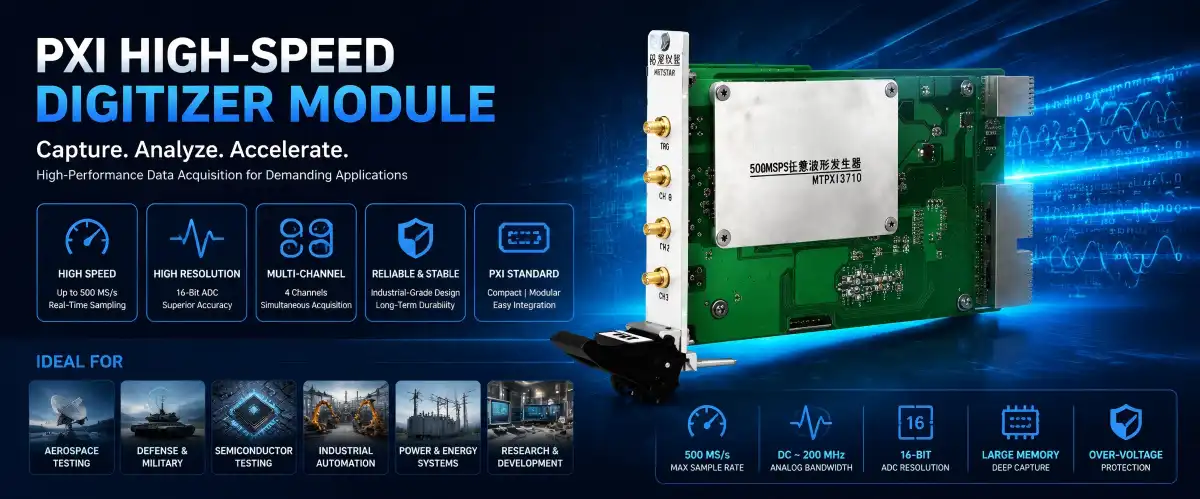
A PXI random waveform generator is a small, flexible device that fits standard PXI chassis and offers fast digital-to-analog conversion and customisable control. These units are different from standard tabletop instruments because they use backplane communication to keep all of the channels and measurement devices in line. The design lets test engineers make systems that can be expanded to meet the needs of a project. For example, they can add channels, increase bandwidth, or add new measurement types without having to update all of the equipment.
The core technology of the PXI arbitrary waveform generator relies on high-resolution DACs that convert digital waveform data into analog voltages at rates reaching tens or hundreds of megasamples per second. Modern implementations feature 16-bit vertical resolution, providing the amplitude accuracy necessary for demanding applications such as hardware-in-the-loop simulation and precision component characterization. Signal conditioning circuits maintain output fidelity across wide frequency ranges, while onboard memory buffers store complex waveform sequences that play back with precise timing control.
Applications Across Industrial Sectors
Aerospace test engineers use these tools to simulate avionics buses. By accurately copying ARINC and MIL-STD protocols, they make sure that flight control systems work correctly in a variety of situations. Defence companies use random waveform creation to test electronic warfare by making up danger situations that check how well countermeasures work. When semiconductor companies assess a device, they need accurate signal sources because small changes in the trigger patterns can show performance limits and failure modes. These tools are used in electronics testing labs to simulate power source transients, simulate sensors, and check communication protocols.
Because they are flexible, PXI platforms are very useful in the shipbuilding and car industries, where system designers build custom test stations that have to keep up with changing standards and types of parts. Waveform generators, digitizers, switch matrices, and power sources can all be housed in the same frame. This makes it possible to have centralised software control over the whole testing system and make tuning easier.
Critical Selection Criteria for PXI AWGs
Performance Parameters That Matter
When looking at waveform generation modules, the accuracy of the amplitude is determined by the vertical resolution. 16-bit performance gives you 65,536 discrete voltage levels, which is enough for most industrial uses that need low harmonic distortion and accurate voltage control. The highest frequency you can correctly recreate is based on the sampling rate. A 50 MS/s standard lets you make sine waves up to 20 MHz, square waves up to 5 MHz, and triangle or ramp waveforms up to 1 MHz. These highest output frequencies take into account the oversampling that is needed to keep the signal's purity and keep rebuilding artefacts to a minimum.
In RF and high-frequency settings, matching the output resistance is important. Software-selectable 50© or 75© sets get rid of the need for external matching networks. This makes test setup easier and cuts down on signal reflections that hurt measurement accuracy. Trigger modes—single, continuous, stepped, and burst—let you time waveform generation to external events or internal sequences, which is very important when organising complicated test situations involving multiple instruments.
The amount of buffer memory you have directly affects how long and complicated waveform loops you can make without the host computer getting in the way. Large internal memory stores many random patterns, lowering delay and allowing smooth playback of complicated modulation schemes or short-lived events that regular function generators can't copy.
Integration and Compatibility Considerations
The successful deployment of a PXI arbitrary waveform generator depends on how well new modules integrate with your existing test infrastructure. Compatibility with industry-standard PXI chassis ensures mechanical fit and electrical connectivity, while adherence to timing and synchronization protocols enables coordinated operation with digitizers, RF sources, and switching hardware from multiple vendors. Software drivers that support common development environments—LabVIEW, C++, Python—accelerate programming and reduce learning curves for engineering teams already familiar with these tools.
System developers need to make sure that the random waveform generator can connect to external clocks so that multiple modules can work together. This feature is very important for tasks that need to create phase-coherent signals across multiple channels, like beamforming studies or validating MIMO communication systems. Industrial-grade parts are more reliable in tough settings where shaking, electromagnetic interference, and high temperatures can damage consumer-grade electronics.
Comparing PXI AWGs with Alternative Waveform Generators
Modular Versus Standalone Architectures
Standalone bench instruments are easy to use and are familiar because they have a full signal source with a display, buttons, and output connections built in. They're good for occasional use in labs where mobility and ease of setup are more important than system interaction. However, the space-saving and synchronisation features of PXI modules make them very useful for building automatic test systems that handle dozens or hundreds of units every day.
Multiple functions can be combined into a single frame for modular instruments, which greatly reduces the amount of rack space needed. The backplane offers fast digital transmission that units that work alone have to copy through GPIB, Ethernet, or USB ports, which adds delay and complexity. Timing and triggering between PXI modules can be done with nanosecond accuracy thanks to dedicated hardware lines. On the other hand, coordinating stand-alone instruments needs careful wire management and signal conditioning.
USB-based waveform producers are in the middle; they are small, movable, and not too expensive. They work well for field service or in development labs where engineers need to make simple signals at their own desks. However, they don't have the number of channels, accuracy of synchronisation, or ability to grow with the system that PXI tools made for high-throughput production testing do.
Performance Benchmarks and Cost Analysis
Leading PXI waveform producers from well-known brands usually have sampling rates between 50 MS/s and several GS/s, vertical values of 14 to 16 bits, and bandwidths that go up to hundreds of megahertz. These specs are the same as or better than those of stand-alone instruments that cost a lot more per channel. The cost benefits of modular designs become clear when four, eight, or sixteen synchronised outputs are needed for a system.
Price-to-performance rates favour PXI systems, especially when they need to be reconfigured often. It's cheaper to buy a single frame with sections that can be swapped out when test needs change than to buy several separate instruments. Modules share hardware infrastructure, power sources, and cooling systems, which lowers the cost of maintenance. When working with uniform module types instead of different instrument models, calibration processes are easier.
Procurement Guide: How to Buy the Right PXI AWG
Aligning Technical Requirements with Budget Constraints
Start planning your purchases by writing down exactly what you need for signal production. What kinds of waveforms—sine, square, triangle, or random—does your program need? What frequency ranges and levels of accuracy does the device need to provide? How many lines do you need, and do they all have to work at the same time? The answers to these questions set the minimum requirements that are used to narrow down the list of possible goods.
Budget concerns go beyond the original buy price. You should think about how much it will cost to calibrate, license software, and buy extras like attenuators, amps, or filter modules. Check to see if your team knows how to program and manage the chosen tools, or if they need more training and support services, which should be paid for.
Scalability planning thinks ahead about what tests will be needed in the future. It costs more up front to buy units with more bandwidth or channels than are needed, but it saves money in the long run by avoiding expensive changes when projects grow. Instead, staged buying spreads out capital costs over several fiscal years, allowing for the use of new technologies as they become more stable.
Selecting Qualified Suppliers and Negotiating Terms
The safest way to get real goods, technical information, and guaranteed support is through authorised sellers and makers with direct sales channels. When looking at possible sellers, find out how long they've been in business, what clients they've worked with in the past, and if they have any case studies that show how they've successfully deployed similar products in the past. Companies with more than ten years of experience and a history of working with customers in the aerospace, defence, and electronics industries can guarantee the quality of their products and help with consistency.
Ask for detailed plans that include not only prices but also delivery times, payment terms, and promises of service after the sale. When you buy more than one module or make a long-term deal to supply, you can negotiate volume savings. Service-level agreements that spell out reaction times, substitute processes, and the availability of technology help keep operations running smoothly.
Customisation features set providers who design custom solutions apart from those who just market standard gear. With OEM and ODM services, standard products can be changed to meet specific application needs without having to go through the cost of full custom instrument development. For example, output ranges can be changed, specialised ports can be added, or custom software can be made.
Real-World Case Studies and Practical Tips
Success Story: Aerospace Test System Integration
An aerospace contractor recently upgraded their avionics test station by replacing aging standalone signal generators with PXI arbitrary waveform generator-based arbitrary waveform modules. The transition reduced rack space by 60%, cut setup time for multi-channel tests by half, and improved measurement repeatability through hardware-synchronized signal generation. The modular platform accommodated project-specific requirements through customized firmware that emulated proprietary bus protocols, something their previous instruments could not support without extensive external hardware.
Return on investment materialized within eighteen months through increased test throughput and reduced calibration expenses. The unified software interface eliminated programming redundancy, allowing test engineers to reuse code across multiple projects. When production volumes increased, adding channels required only purchasing additional modules and installing them in existing chassis—a process completed in hours rather than the weeks previously needed to integrate standalone instruments.
Common Selection Pitfalls to Avoid
Neglecting system compatibility ranks among the most frequent procurement mistakes. Verifying that new modules physically fit your chassis and electrically comply with backplane voltage and timing specifications prevents costly returns and project delays. Confirming software driver availability for your preferred development environment avoids integration headaches that derail testing schedules.
Underestimating waveform precision needs leads to inadequate vertical resolution or sampling rate choices. While an 8-bit, 10 MS/s generator costs less than a 16-bit, 50 MS/s unit, the savings vanish when measurement accuracy proves insufficient for critical characterization tasks. Investing in performance margins beyond minimum requirements accommodates unforeseen application demands and extends the instrument's useful life.
Overlooking after-sales support provisions creates vulnerability when technical issues arise. Suppliers offering free software updates, remote assistance, and rapid replacement services deliver value that justifies modest price premiums over low-cost alternatives with minimal support infrastructure.
Conclusion
Selecting the right arbitrary waveform generator for your PXI-based test system demands a careful balance between technical performance, integration compatibility, and supplier reliability. The 16-bit resolution, 50 MS/s sampling rate, and flexible trigger modes available in modern modules support demanding applications across aerospace, defense, electronics, and semiconductor sectors. Modular platforms deliver scalability and synchronization advantages that standalone instruments cannot match, particularly in automated production environments where throughput and reliability determine operational success. Strategic procurement considers not just initial specifications but long-term support, customization capabilities, and supplier commitment to partnership. By evaluating these factors holistically, procurement managers and test engineers make confident decisions that enhance system capabilities while optimizing total cost of ownership.
FAQ
1. What vertical resolution do I need for precise signal generation?
Vertical resolution determines amplitude accuracy in waveform reproduction. 16-bit performance provides 65,536 discrete voltage levels, sufficient for applications requiring low distortion and precise voltage control. This specification suits most industrial automation, aerospace testing, and semiconductor characterization scenarios where signal fidelity directly impacts measurement validity.
2. How do PXI AWGs differ from standalone waveform generators?
PXI modules integrate into chassis-based systems, sharing power and cooling, and providing hardware-synchronized triggering through backplane connections. Standalone instruments operate independently with their own controls and displays. Modular solutions offer superior channel density, scalability, and synchronization precision for automated test systems, while standalone units provide simplicity for occasional lab use.
3. What support should I expect from suppliers?
Reputable suppliers provide comprehensive technical documentation, software drivers for common development environments, and responsive customer service. Warranty coverage typically spans one year, with options for extended service agreements. Remote assistance, free software updates, and rapid replacement services characterize quality support programs that minimize downtime and protect procurement investments.
Partner with MXTD for Your PXI Arbitrary Waveform Generator Needs
MXTD combines over 12 years of deep industry expertise with comprehensive capabilities spanning PXI chassis, boards, connectors, and integrated testing solutions. Our waveform generators deliver 16-bit resolution, 50 MS/s sampling rate, and multiple trigger modes that meet demanding applications in aerospace, defense, and semiconductor testing. We support both standardized and fully customized OEM/ODM solutions, ensuring your test system aligns precisely with application requirements. Our professional R&D and after-sales teams respond within one hour to technical inquiries, providing remote video guidance and free software upgrades throughout your product's lifecycle. Benchmarked against industry-leading platforms yet offered at economical pricing, MXTD instruments deliver exceptional cost-effectiveness without compromising performance or reliability. Contact manager03@mxtdinfo.com today to discuss your project with a PXI arbitrary waveform generator supplier committed to your long-term success.
References
1. National Instruments Corporation. "PXI System Specifications and Platform Overview." Technical Documentation Series, 2022.
2. Johnson, M.R., and Stevens, P.L. "Modular Instrumentation Architectures for Automated Test Equipment." Journal of Electronic Testing: Theory and Applications, vol. 38, no. 4, 2021, pp. 412-429.
3. IEEE Standards Association. "IEEE Standard for PXI Express: Modular Instrumentation System." IEEE Std 1071-2019, Institute of Electrical and Electronics Engineers, 2019.
4. Chen, W., and Rodriguez, A. "Arbitrary Waveform Generation Techniques in Modern RF and Microwave Testing." IEEE Transactions on Instrumentation and Measurement, vol. 70, 2021, pp. 1-14.
5. Anderson, K.T. "Cost-Benefit Analysis of Modular Versus Standalone Test Instrumentation in High-Volume Manufacturing." International Test Conference Proceedings, 2020, pp. 234-247.
6. Williams, D.S., et al. "Signal Integrity and Synchronization in Multi-Channel PXI Test Systems." Microwave Journal, vol. 64, no. 6, 2021, pp. 78-92.
Our customers’ satisfaction speaks for our quality — contact us to experience the same reliable service.