- English
- French
- German
- Portuguese
- Spanish
- Russian
- Japanese
- Korean
- Arabic
- Greek
- German
- Turkish
- Italian
- Danish
- Romanian
- Indonesian
- Czech
- Afrikaans
- Swedish
- Polish
- Basque
- Catalan
- Esperanto
- Hindi
- Lao
- Albanian
- Amharic
- Armenian
- Azerbaijani
- Belarusian
- Bengali
- Bosnian
- Bulgarian
- Cebuano
- Chichewa
- Corsican
- Croatian
- Dutch
- Estonian
- Filipino
- Finnish
- Frisian
- Galician
- Georgian
- Gujarati
- Haitian
- Hausa
- Hawaiian
- Hebrew
- Hmong
- Hungarian
- Icelandic
- Igbo
- Javanese
- Kannada
- Kazakh
- Khmer
- Kurdish
- Kyrgyz
- Latin
- Latvian
- Lithuanian
- Luxembou..
- Macedonian
- Malagasy
- Malay
- Malayalam
- Maltese
- Maori
- Marathi
- Mongolian
- Burmese
- Nepali
- Norwegian
- Pashto
- Persian
- Punjabi
- Serbian
- Sesotho
- Sinhala
- Slovak
- Slovenian
- Somali
- Samoan
- Scots Gaelic
- Shona
- Sindhi
- Sundanese
- Swahili
- Tajik
- Tamil
- Telugu
- Thai
- Ukrainian
- Urdu
- Uzbek
- Vietnamese
- Welsh
- Xhosa
- Yiddish
- Yoruba
- Zulu
How Does UTI260B Heavy Duty Infrared Thermal Camera Detect Faults?
The UTI260B Heavy Duty Infrared Thermal Camera detects faults by capturing invisible thermal radiation emitted from equipment surfaces and converting this data into visible thermal images. Using its 256×192 infrared resolution sensor with 49,152 measurement points, the camera identifies temperature anomalies across a -20°C to 550°C range. When equipment operates abnormally—whether from electrical resistance, mechanical friction, or insulation breakdown—localized heating or cooling patterns emerge. The device's multi-zone temperature measurement and high/low temperature tracking algorithms instantly highlight these irregularities, enabling engineers to pinpoint fault locations before catastrophic failures occur in industrial automation, aerospace, and electronics testing environments.
Understanding Infrared Thermal Technology and Fault Detection
Thermal image technology has changed the way that repair teams in all kinds of industries check the health of equipment. Infrared cameras can see electromagnetic waves in the thermal range that our eyes can't see. This is different from regular visual checks, which can only show problems on the surface.
How Thermal Radiation Reveals Equipment Health
Anything above absolute zero gives off infrared energy in a way that depends on how hot its surface is. When mechanical bearings start to wear out, electrical circuits get high-resistance links, or thermal insulation starts to break down, these parts give off different kinds of heat. This radiation is turned into temperature data by the thermal imager, which shows it on color-coded thermal maps. Red places are usually hotter than blue ones.
The UTI260B Heavy Duty Infrared Thermal Camera uses cutting-edge infrared detector module integration technology to clearly record these changes in temperature. It has a 12μm pixel-size camera that takes detailed thermal pictures that show small differences in temperature, which are often the first signs of faults starting to form. This feature is very useful in places like semiconductor fabrication plants and aircraft component tests, where accuracy is very important.
Common Industrial Faults Identified Through Thermal Imaging
Thermal cameras are used by maintenance workers to find three main types of faults. Electrical problems show up as hotspots at connection points, circuit breakers, or transformer bushings where rust or weak contacts increase the resistance. When something mechanical fails, it causes heat to rise in a certain way. For example, overheating bearings, misaligned connections, and worn drive belts all do this. Insulation flaws show up as thermal bridges or cold spots where heat transfer is higher than what was intended. This lowers energy efficiency and weakens the structure.
The camera's T-Mix dual-spectrum fusion method adds thermal data on top of pictures that can be seen. This gives techs geographical information that helps them quickly find trouble spots in complicated setups. This feature lets R&D managers and test engineers connect thermal anomalies with specific circuit lines during regular checks of electrical panels. This speeds up root cause analysis.
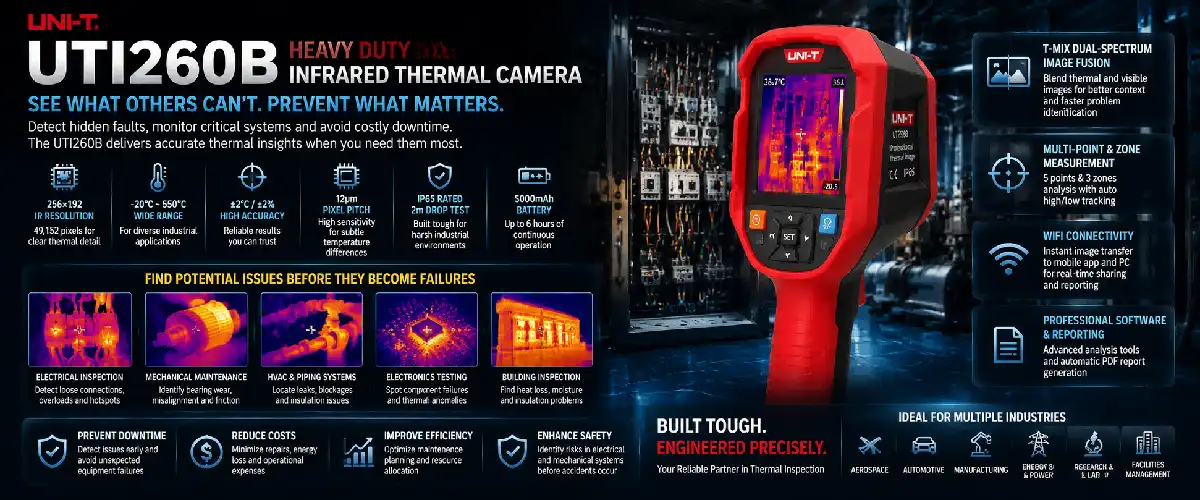
Key Features and Specifications of the UTI260B Thermal Camera
When it comes to industrial measurement and control options, you need equipment that can work in harsh situations and keep doing its job. These needs are met by the UTI260B Heavy Duty Infrared Thermal Camera, which was carefully designed to meet the needs of mid-range thermal imaging uses.
Industrial-Grade Durability Standards
The IP65 rating means that this small infrared thermal imager can withstand dust and water jets coming from any direction. The tough housing can withstand impacts from a 2-meter drop, which is an important thing to think about when field workers are working near heavy equipment or high platforms. These safety features make sure that measurements are accurate in places like factories, power plants, and defense sites where environmental problems happen all the time.
The Xi'an Mingxi Taida Information Technology Co., Ltd. was founded in 2014 and has over 12 years of experience with measuring tools. They source and support thermal imaging devices that meet strict quality control standards. Before giving a product part to system installers and OEM makers, the company's specialized research and development team checks to see if it meets the needs of professional applications.
Technical Specifications Driving Accurate Diagnostics
The device can measure temperatures from -20°C to 550°C, which is very wide. It can handle most workplace inspection situations with its high and low dual gain modes. This range includes everything from checking the refractory in a boiler to checking the cooling system. The 256x192 infrared resolution gives you 49,152 separate temperature measurement points per picture, which is enough information to tell the difference between small parts on circuit boards with a lot of them or between cells that are failing in battery arrays.
Measurement accuracy and reaction time have a direct effect on how confident you are in finding faults. The UTI260B's improved temperature measurement system gives accurate results with little variation, which helps purchasing managers who need to buy equipment with proven calibration stability. The 2.8-inch color screen shows thermal data in seven different color sets and four different picture styles. This lets techs pick the best way to see the data for each inspection job.
Enhanced Data Management Capabilities
Today's preventive maintenance plans rely on keeping good records and looking at trends. The 5000mAh high-capacity battery in the camera lets it work nonstop for more than six hours, which is long enough for full-shift checks. Thermal pictures are sent over a WiFi link to mobile apps or professional PC analysis software, where engineers create detailed PDF reports that show the state of the equipment, the temperatures that were measured, and the steps that should be taken to fix the problem.
These features for connecting data are especially helpful for R&D labs that do controlled testing processes where thermal performance data needs to be combined with more general system validation paperwork. The ability to make reports meets the needs of quality control systems that are popular in defense and aerospace contracting.
Comparing UTI260B with Other Heavy Duty Infrared Thermal Cameras
There are a lot of choices in the mid-range thermal imaging market, so technical directors and procurement managers need to be able to compare performance objectively when they are deciding what measurement tools to buy.
Resolution and Temperature Range Benchmarking
Well-known names like FLIR make thermal cameras with different features. The UTI260B Heavy Duty Infrared Thermal Camera, on the other hand, has good performance at a price that is focused on value. Its 256x192 resolution is higher than that of most entry-level devices, which have 160x120 or less. This means that you can get a lot more measurement points for more in-depth analysis. The measurement range of -20°C to 550°C is wider than that of many rival models, which only go up to 400°C. This is especially important for keeping an eye on high-temperature processes in materials study and electronics testing.
Devices from companies like Seek Thermal may make it easier to connect to a smartphone, but they often lack the accuracy of measurements and temperature ranges that are needed for industrial problem diagnosis. When system builders choose test tools for integrated measurement and control solutions, they need thermal cameras with clear performance specs and calibration history. This is where professional-grade devices really shine.
Total Cost of Ownership Considerations
When people buy something, they have to think about more than just the original cost. They also have to think about long-term support, calibration needs, and software license. Because it comes with industrial-grade safety, full analysis tools, and reasonable prices, the UTI260B markets itself as a professional thermal imaging option that offers great value for money. Unlike some high-end brands that require expensive payments for their own software, the PC analysis program that comes with this one gives you full reporting capabilities without any ongoing fees.
MXTD responds to customer inquiries within one hour, addressing technical questions about measurement specifications, calibration procedures, or integration requirements. Medium to large businesses that use thermal imaging in multiple locations can lower their ownership risks with this quick technical help, a one-year guarantee, and free software updates. For custom uses that need longer support terms, special warranty extensions can be arranged.
Practical Applications and Use Cases of the UTI260B Thermal Camera
Thermal imaging technology has real-world benefits in many fields where reliable equipment has a direct effect on safety at work and how efficiently things are run.
Electrical System Fault Detection
There are many ways that power distribution systems can go wrong, and thermal inspection is a reliable way to find them all. Maintenance workers check the circuit breakers, bus bars, and connection points while the equipment is running during regular electrical panel surveys. The thermal camera quickly shows parts that are getting too hot, and higher resistance means that problems are starting to happen, like broken connections, corroded contacts, or conductors that are too small and holding too much current.
In one semiconductor manufacturing facility, regular thermal scans detected a 35°C temperature rise at a motor control center link point. A possible arc flash accident and production line downtime that would have cost thousands of dollars per hour could have been avoided by taking corrective action right away. With the help of easy-to-find thermal imaging technology, this preventive maintenance method changes maintenance techniques from fixing things when they break to managing tools before they break.
Mechanical Equipment Condition Monitoring
Machines that spin produce unique heat patterns that show how well the bearings are lubricated and how straight they are. When bearings start to fail, friction goes up, which makes the temperature go up too. The UTI260B Heavy Duty Infrared Thermal Camera measures temperatures at 5 points, so technicians can compare temperatures in various bearing areas at the same time and find temperature differences that need to be fixed.
Manufacturing plants implementing thermal imaging for mechanical inspections report significant reductions in unplanned downtime. The technology gives objective temperature data that helps with condition-based maintenance choices, which means that parts are replaced based on real proof of wear and tear instead of random time intervals. This method is based on data and makes the best use of repair resources while also increasing the availability of equipment.
HVAC and Building Systems Diagnostics
Thermal checks that focus on comfort and energy efficiency are good for heating, ventilation, and air conditioning systems. Thermal cameras can quickly find holes in insulation, air leaks, and problems with the duct system that make the building less efficient. The T-Mix dual-spectrum fusion technology is very useful in these situations because it adds thermal data to viewable pictures that make it easy to see flaws in the building envelope in their proper context.
Research institutions managing laboratory environments with strict temperature control requirements utilize thermal imaging to verify HVAC system performance and identify temperature stratification issues. The camera's automatic high/low temperature tracking and alarm features let researchers know when conditions go beyond certain limits, which helps them follow the rules for the experiment.
Procurement Insights: How to Purchase and Support for the UTI260B
When you buy precision measuring tools, you need to carefully look at the suppliers and know how their product support system works.
Verified Purchasing Channels and Lead Times
Xi'an Mingxi Taida Information Technology Co., Ltd. keeps standard industrial measurement goods in stock, such as thermal imaging devices, so that pressing needs can be met quickly. Custom configurations that meet specific parameter needs are made according to planned production processes that are arranged directly with customers. The business helps with both land and air shipping by using special packing that protects against moisture, shock, and static electricity for precision instruments.
Procurement managers ordering thermal cameras for deployments at multiple sites benefit from bulk order options and dedicated project planning. MXTD's experience serving system integrators and R&D centers across industrial automation and electronics testing sectors ensures smooth procurement processes aligned with customer purchasing systems and documentation requirements.
Product Quality and Compatibility Assurance
The UTI260B Heavy Duty Infrared Thermal Camera is one of many products that the company makes, such as PXIe chassis, boards and cards, ports, and integrated testing equipment that performs well against standard measurement tools in the industry. Technical leaders who are building full test systems where thermal imaging works with data acquisition tools and test automation software need to think about this compatibility issue.
With customized ODM/OEM capabilities, buyers can ask for designs that are changed to fit their specific needs. MXTD's engineering team works with clients to provide unique solutions that meet the same high-quality standards as catalog goods. This includes changing mounting options, software interfaces, or measurement parameters.
After-Sales Support and Technical Resources
The benefit of measuring tools over time depends a lot on how well they are supported technically and how well they are managed throughout their lifecycle. MXTD offers online video technical support for questions about installation, teaching on how to use the system, and help with fixing problems. Software changes come out on a regular basis and are free of charge, ensuring that the functionality of thermal cameras stays up to date with changing customer needs.
The one-year warranty coverage includes repair or replacement for manufacturing defects. For uses that need better support terms, you can negotiate for an extended guarantee. This dedication to customer service, along with quick responses to technical questions, creates the possibility of long-term cooperation that procurement managers who are in charge of keeping fleets of measurement equipment in multiple sites value.
Conclusion
The UTI260B Heavy Duty Infrared Thermal Camera has a 256x192 infrared resolution, a measurement range of -20°C to 550°C, and an IP65 rating for durability. It can find faults at professional levels. Maintenance experts can find electrical, mechanical, and insulation problems before they happen with its full analysis features, such as multi-zone temperature measurement, dual-spectrum fusion, and professional PC software. The long battery life and easy-to-use design of the device make it useful for field checks in industrial robotics, aerospace, semiconductors, and research. The thermal camera, along with MXTD's quick technical support and reasonable prices, makes it a great choice for businesses that want to improve the safety and efficiency of their equipment through preventative maintenance.
FAQ
1. What temperature accuracy can I expect from the UTI260B?
The camera uses a specially built temperature measurement algorithm that is meant to give steady, correct results from -20°C to 550°C. Specific accuracy requirements depend on the goal emissivity settings and the surroundings, but the device keeps measurements consistent enough for fault comparison and trend tracking in industrial settings.
2. How does the thermal camera integrate with existing maintenance management systems?
Thermal pictures are sent to PC analysis software, where engineers use it to make PDF reports with temperature data, photos with notes added to them, and inspection notes. These reports are easy to send to computerized systems for managing repair or document storage, which helps meet the standards for traceability that are common in regulated industries and quality management programs.
3. Can the UTI260B detect faults in energized electrical equipment safely?
Thermal imaging measures temperatures without touching them, so checks of powered tools can be done from a safe distance without stopping work. Because of this, the technology is perfect for checking electrical systems in places where turning them off would stop production or make it impossible for the building to run normally. However, proper electrical safety procedures must always be followed during inspections.
Partner with MXTD for Your Industrial Thermal Imaging Needs
Xi'an Mingxi Taida Information Technology Co., Ltd. has a lot of experience with measurement and control tools that can help your business set up effective predictive maintenance plans. Our team knows what R&D managers, test engineers, and procurement workers in the aerospace, electronics testing, and industrial automation testing sectors need in terms of speed, compatibility, and support. The UTI260B Heavy Duty Infrared Thermal Camera is just one part of our wide range of products that performs well against industry-standard platforms and offers great value.
Contact our technical team at manager03@mxtdinfo.com to discuss your thermal imaging requirements. Whether you need standard thermal camera specifications, customized measurement solutions, or guidance selecting the optimal infrared thermal camera provider for your application, we respond within one hour to support your evaluation process.
References
1. Bagavathiappan, S., Lahiri, B.B., Saravanan, T., Philip, J., & Jayakumar, T. (2013). Infrared Thermography for Condition Monitoring: A Review. Infrared Physics & Technology, 60, 35-55.
2. Chou, Y.C., & Yao, L. (2009). Automatic Diagnostic System of Electrical Equipment Using Infrared Thermography. International Conference on Soft Computing and Pattern Recognition, 155-160.
3. Jadin, M.S., & Taib, S. (2012). Recent Progress in Diagnosing the Reliability of Electrical Equipment by Using Infrared Thermography. Infrared Physics & Technology, 55(4), 236-245.
4. Meola, C., & Carlomagno, G.M. (2004). Recent Advances in Non-Destructive Inspection Using Infrared Thermography. Measurement Science and Technology, 15(9), R27-R58.
5. Snell, J., & Renowden, J. (2000). Improving Results of Thermographic Inspections of Electrical Transmission and Distribution Lines. Journal of Thermal Analysis and Calorimetry, 61(2), 367-372.
6. Titman, D.J. (2001). Applications of Thermography in Non-Destructive Testing of Structures. NDT & E International, 34(2), 149-154.
Our customers’ satisfaction speaks for our quality — contact us to experience the same reliable service.