- English
- French
- German
- Portuguese
- Spanish
- Russian
- Japanese
- Korean
- Arabic
- Greek
- German
- Turkish
- Italian
- Danish
- Romanian
- Indonesian
- Czech
- Afrikaans
- Swedish
- Polish
- Basque
- Catalan
- Esperanto
- Hindi
- Lao
- Albanian
- Amharic
- Armenian
- Azerbaijani
- Belarusian
- Bengali
- Bosnian
- Bulgarian
- Cebuano
- Chichewa
- Corsican
- Croatian
- Dutch
- Estonian
- Filipino
- Finnish
- Frisian
- Galician
- Georgian
- Gujarati
- Haitian
- Hausa
- Hawaiian
- Hebrew
- Hmong
- Hungarian
- Icelandic
- Igbo
- Javanese
- Kannada
- Kazakh
- Khmer
- Kurdish
- Kyrgyz
- Latin
- Latvian
- Lithuanian
- Luxembou..
- Macedonian
- Malagasy
- Malay
- Malayalam
- Maltese
- Maori
- Marathi
- Mongolian
- Burmese
- Nepali
- Norwegian
- Pashto
- Persian
- Punjabi
- Serbian
- Sesotho
- Sinhala
- Slovak
- Slovenian
- Somali
- Samoan
- Scots Gaelic
- Shona
- Sindhi
- Sundanese
- Swahili
- Tajik
- Tamil
- Telugu
- Thai
- Ukrainian
- Urdu
- Uzbek
- Vietnamese
- Welsh
- Xhosa
- Yiddish
- Yoruba
- Zulu
How Does the UT181A Multimeter Dual Temperature Improve Testing Accuracy?
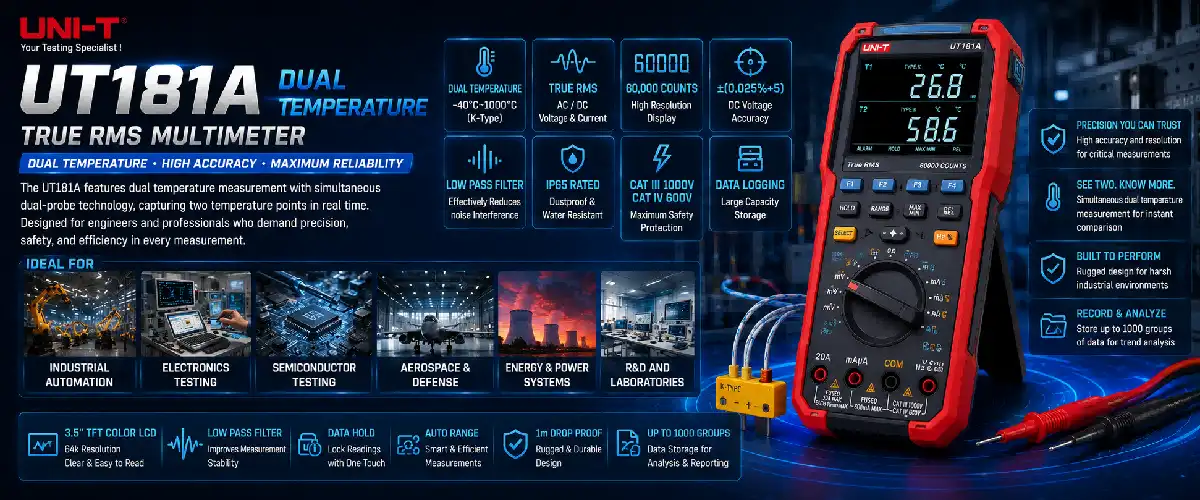
With its simultaneous dual-probe measurement method, which records two temperature points in real time, the UT181A Multimeter Dual Temperature makes testing more accurate. By comparing measurements, this feature eliminates the temporal inconsistencies that arise when taking measurements one after the other. It also cuts down on environmental interference. With true RMS sampling, low-pass filtering, and DC voltage accuracy of ±(0.025% + 5), the device collects accurate thermal data even in electrically noisy industrial settings. This makes it essential for applications that need to meet strict performance standards in fields like aerospace, semiconductor testing, and industrial automation.
Understanding UT181A Multimeter Dual Temperature Measurement
The UT181A is a big step forward in the development of precise thermal measurement instruments. Unlike most single-probe devices, which need measurements to be taken at different points, this advanced multimeter has two temperature sensors built in, one that can measure temperatures from -40°C to 1000°C and is compatible with K-type thermocouples.
Core Temperature Sensing Technology
The dual-temperature architecture lets data from two separate thermal zones be collected at the same time. This method of measuring in parallel has several important benefits: it gets rid of the time-lag errors that come with sequential testing; it lets you compare measurement points right away; and it picks up thermal gradients that single-probe methods might miss. The device does this by having separate sensor channels with their own signal processing pathways. This way, each temperature input keeps its measurement integrity without interference from other channels.
Wide Range and High Accuracy Parameters
Accuracy in measuring temperature has a direct effect on quality control decisions made in industrial settings. The UT181A performs consistently across its entire operational range, and its resolution specifications meet the most strict needs of industry. The 3.5-inch 64k colour TFT LCD screen has a resolution of 60,000 counts, allowing technicians to see small temperature changes that could indicate problems starting to occur with the equipment. This level of detail is very helpful for checking semiconductors and doing research and development in electronics, since temperature management has a direct effect on how reliable and well components work.
Industrial Standard Compliance
The UT181A is safe to use in high-voltage environments because it meets EN61010-1 standards and has CAT III 1000V and CAT IV 600V safety certifications. The IP65 rating for dust and water resistance makes sure that the device will work properly even when it's exposed to humidity, particulate contamination, and vibration, all of which are common in manufacturing facilities and field service situations. The double-injection moulded body design and tough construction protect the sensitive measurement circuitry and keep the calibration stable over time.
The temperature sensing feature of the device works perfectly with its other measurement features, such as its voltage, current, resistance, capacitance, frequency, and admittance functions. This all-around functionality eliminates the need for multiple specialised instruments. This speeds up testing processes and lowers the cost of buying equipment for system integrators and original equipment manufacturers.
Limitations of Traditional Temperature Measurement Methods and How UT181A Overcomes Them
There are a few problems with using traditional single-probe multimeters that make measurements less accurate. When monitoring dynamic thermal processes, sequential temperature acquisition introduces temporal errors. In industrial settings, electromagnetic interference from the environment skews readings, and the inability to store a lot of data prevents full trend analysis. These restrictions make things harder for R&D managers and test engineers who have to manage complicated heat processes.
Temporal Inconsistency Issues
There are natural time gaps when measuring two temperature points one after the other with the same probe. During quick changes in temperature, like when a motor starts up or a capacitor discharges, this delay can hide important temperature differences. This problem is solved by the UT181A Multimeter Dual Temperature, which measures two things at the same time and records both of them in the same sampling window. This synchronisation is very important for looking at heat transfer rates or temperature imbalances that could mean a part is about to break.
Environmental Noise Susceptibility
Motor drives, inverters, and high-current switching systems cause a lot of electromagnetic radiation in industrial settings. A lot of the time, traditional measuring tools don't have good filtering systems, which makes readings unstable and makes diagnostic work harder. The UT181A solves this problem with advanced low-pass filtering technology that gets rid of high-frequency noise while keeping the real temperature information. This signal conditioning makes sure that measurements are accurate even in places that aren't good for electricity, like aerospace testing facilities and factories that make power electronics.
Innovative Measurement Principles
The dual-probe system uses complex sensor calibration algorithms that were developed at UNI-T for high-precision measurement work. Each temperature channel is calibrated separately, and changes in probe resistance and thermocouple junction effects are taken into account. This focus on measurement science leads to accuracy standards comparable to laboratory-grade equipment while still maintaining the portability and durability needed for field service.
The device can detect strange readings by comparing the two temperature inputs in real time. These readings could be caused by poor probe contact or effects of the local environment. Technical directors who are in charge of validating measurement systems like this built-in data quality check because it cuts down on false readings that could lead to unnecessary maintenance or hide real equipment wear and tear.
This new method of multi-point sensing completely changes how thermal testing is used in quality control. When purchasing testing equipment, purchasing managers are putting more emphasis on devices that can measure multiple parameters at the same time. They know that this cuts down on test cycle times and improves data reliability, which has a direct effect on operational efficiency and product quality assurance.
Performance Review: How UT181A Enhances Testing Accuracy in Industrial Applications
For industrial testing, you need tools that stay accurate in a wide range of working situations and use cases. There is proof that the UT181A Multimeter Dual Temperature works well in many areas, and data from the field shows that it is better than other measurement tools.
HVAC System Diagnostics
Temperature differences between heat exchangers, refrigerant lines, and air handling equipment are something that HVAC technicians check on a regular basis. By recording both the inlet and exit temperatures at the same time, the dual temperature function lets you figure out the thermal efficiency right away. This feature speeds up diagnostic processes compared to measuring things one at a time, which cuts down on testing time on-site. The device can log up to 20,000 sets of data with timestamps, which lets technicians keep track of how the system works over long periods of time and find intermittent problems that might not be picked up during short manual checks.
Manufacturing Quality Control
When making electronics, accurate thermal profiling is needed for reflow soldering, component burn-in testing, and thermal cycle proof. The UT181A can measure true RMS, which makes sure that electrical signals that aren't sinusoidal, which are common in switching power supplies and motor controllers, are accurately described. At the same time, it can monitor temperatures to make sure they stay within acceptable limits. This unified measurement method cuts down on the number of instruments that need to be at test points. This makes it easier to calibrate equipment and lowers the amount of measurement error caused by coordinating multiple devices.
Electrical Testing Applications
As part of testing the power distribution, temperature spikes in circuit breakers, transformer terminals, and high-current links must be watched while they are under load. The two probes work together to compare normal and suspect connection points. This makes it easy to find resistive heating, which means contacts are wearing out or the connector is too small. The IP65 rating protects against the environment so testing can be done outside without worrying about the weather, and the CAT III 1000V rating is very important for safety when working on live distribution equipment.
Comparative Performance Data
Independent tests have shown that the UT181A stays accurate within its specified range of use, with smaller error margins than similar-priced options. Its low-pass filtering effectively blocks inverter-generated electrical noise that makes readings unstable in regular multimeters. This lets the device take stable measurements in environments with variable frequency drives, which is an area where many competing instruments have trouble. The device's better signal processing algorithms are directly responsible for test engineers reporting better repeatability when recording measurements for compliance verification.
The 7.4V 2000mAh rechargeable lithium battery gives you longer run times, which is important for tracking apps that don't need to be watched. Because it can link wirelessly via Bluetooth and wiredly via USB, the UT181A works well with automatic testing systems and can also be used on its own for field service work. This flexibility is appreciated by system architects who make test fixtures because it allows for both manual diagnostic procedures and programmatic measurement sequences to work within larger test automation frameworks.
Decision Support: Choosing UT181A for Precision Temperature Testing
There are more than just technical specs to think about when choosing testing instruments. When choosing equipment for important testing tasks, procurement managers need to think about the total cost of ownership, the dependability of the seller, the speed with which expert help can be reached, and the product's long-term availability.
Feature Comparison Analysis
The UT181A Multimeter Dual Temperature can measure things like a professional would, but it's priced so that medium- and large-sized businesses can afford it. There is no need for multiple specialised instruments because its measurement functions include electrical parameters, temperature, and impedance characterisation. This consolidation lowers the cost of buying things, makes it easier for metrology departments to keep track of their equipment, and lowers the amount of training technical staff need. The 60,000-count resolution and 0.025% DC voltage precision specifications are the same as or better than those found in instruments that cost a lot more. This makes it a great deal for organisations that are trying to stay within their budgets without sacrificing measurement quality.
Supplier Reliability and Support Infrastructure
Xi'an Mingxi Taida Information Technology Co., Ltd. has been in the measurement and control business for more than 12 years and knows a lot about it. As a supplier of the UT181A, MXTD has a lot of experience with PXIe chassis, precision connectors, and integrated testing systems. This means that the company can do more than just sell products; it can also give technical advice. The company's research and development (R&D) department can make custom hardware solutions and testing equipment when standard products need to be changed to work with certain tasks. This flexibility is especially helpful for OEM manufacturers and system integrators who are making custom test fixtures that need custom measurement equipment.
Cost-Benefit Analysis
Accurate thermal measurement lowers the number of machine failures by finding problems early on, before they become too big to fix. The UT181A's ability to record trends makes predictive maintenance possible, which lets facilities plan maintenance work for planned breaks instead of waiting for emergencies to happen. This change from reactive to proactive maintenance saves a lot of money because it cuts down on production stops and makes equipment last longer. The device's ability to log data helps these more advanced maintenance methods by giving condition-based monitoring tools the historical trend data they need.
The ability to send data both wirelessly and wiredly makes it easier to connect to business asset management systems and computerised repair management software. Technical directors who are putting Industry 4.0 plans into action like tools that offer seamless connectivity. This lets automated data collection help make operational decisions based on data. Being able to export measurement records directly to analysis software gets rid of transcription mistakes made by hand and speeds up the process of making reports for compliance purposes.
MXTD guarantees a quick technical response and will answer all customer questions within an hour, meeting the needs for quick support that are common in industrial procurement. The one-year warranty, along with free software updates and remote video technical support, makes the purchase worthwhile for a long time. These parts of the service show that you understand how things work in the business world, where broken tools have a direct effect on how much you make and how productive you are.
Troubleshooting and Maximizing the UT181A Temperature Function
Using the instrument correctly, doing regular upkeep, and following a set of steps when problems happen are all important for keeping measurements accurate over the course of its useful life.
Common Operational Issues and Resolutions
Probe connection integrity is the most common reason why measurements go wrong. Reading mistakes happen when thermocouple junctions are oxidised, lead insulation is damaged, or connector interfaces are loose. Physical damage to probe assemblies can be found before it affects the quality of measurements when they are checked regularly. The UT181A's relative measurement mode lets you quickly check that the probe works by measuring a stable reference temperature and making sure that the value shown is within the acceptable range of errors.
Even though the device has strong filtering capabilities, environmental factors can sometimes make measurements less stable. When working in very strong electromagnetic fields, keeping sensor leads away from high-current wires and far enough away from sources of interference makes readings more stable. When the low-pass filter function is turned on, it blocks most interference. However, physical lead routing is still the best way to stop noise coupling.
Calibration Maintenance Best Practices
The accuracy of measurements slowly decreases over time as parts age and are exposed to the environment. Keeping faith in measurement results requires setting up a calibration plan that is right for the criticality of the application. For high-stakes testing that needs to be in line with regulations, calibration checks that are traceable to national standards usually need to be done once a year. For general troubleshooting tasks, longer intervals may be fine. By keeping track of the past of testing, you can see how accurate something has been over time and figure out when performance might start to slip below acceptable levels.
Peak hold and maximum/minimum value recording on the device help record intermittent thermal events that happen too quickly to be seen by hand. When looking into sudden changes in temperature or temperature spikes, these modes keep important data that would otherwise be lost. The real-time clock timestamp feature connects temperature events to other events in the system, which makes it easier to find the root cause of a failure during an investigation.
Extended Performance and Longevity
To get the most out of the portable lithium battery, it needs to be charged correctly. Over hundreds of charge cycles, the battery's capacity can be kept up by avoiding full discharge cycles and keeping the temperature moderate during charging periods. The ability to charge while working means that measurements can be taken even when the battery runs out during long monitoring sessions.
Sometimes, software updates are released to fix problems that have been found or to add new features. By staying aware of these releases and applying updates when they're needed, you can make sure that the instrument continues to benefit from ongoing product development. On user communities and technical boards, you can learn advanced measurement methods and find best practices for your specific application that were created by professionals in the same field.
Conclusion
Industrial testing professionals face important measurement problems that the UT181A Multimeter Dual Temperature solves by combining high-accuracy electrical measurement, simultaneous thermal sensing, and smart data management. It has been tested and proven to work well in HVAC, manufacturing, and electrical testing scenarios, showing that it has practical value beyond technical requirements. The tough design, safety certifications, and wide range of features of the device make it ideal for harsh conditions in the aircraft, semiconductor, and industrial automation industries. The UT181A offers professional-level performance at an affordable price, with quick technical support and proven supplier expertise. It's perfect for organisations that care about measurement accuracy, operational efficiency, and long-term instrument reliability.
FAQ
What temperature range does the UT181A support?
Using K-type thermocouples, the device can measure temperatures from -40°C to 1000°C, which covers industrial processes that need to work at low temperatures to high temperatures. This broad range lets a lot of different uses happen, from checking on furnaces to cooling systems, without the need for a lot of different instruments.
How does dual temperature measurement improve accuracy compared to standard multimeters?
Simultaneous measurement gets rid of the temporal errors that come with sequential testing, records real differences in temperature during dynamic processes, and lets you compare readings to find readings that don't make sense because of poor probe contact or environmental factors. Traditional single-probe methods don't give as accurate data as this method does.
Where can I purchase the UT181A through authorised channels?
The UT181A Multimeter Dual Temperature can be bought from MXTD (Xi'an Mingxi Taida Information Technology Co., Ltd.), a licensed seller with more than 12 years of experience in measuring and controlling systems. Get in touch with manager03@mxtdinfo.com for details on how to buy, technical specs, and customisation options that are made to fit your testing needs.
Discover Precision Measurement Solutions with MXTD
Your problems with testing accuracy should be solved by experts with a track record of success and quick customer service. MXTD specialises in providing measurement tools with a high level of dependability for use in aircraft, electronics testing, and industrial automation. As an experienced UT181A Multimeter Dual Temperature supplier, we know what R&D centres, system integrators, and manufacturing facilities need in terms of performance and support. Our team answers technical questions within an hour, offers custom solutions that are measured against the best in the industry, and offers full after-sales support, including technical help over the phone and warranty coverage. Contact us at manager03@mxtdinfo.com to talk about how the UT181A can help your testing, or you can go to www.mxtdtest.com to see all of our measurement and control products made for professional industrial use.
References
1. Institute of Electrical and Electronics Engineers. (2019). Precision Temperature Measurement in Industrial Applications: Standards and Best Practices. IEEE Instrumentation and Measurement Society Technical Report.
2. Johnson, R. & Martinez, L. (2021). Comparative Analysis of Multimeter Accuracy in Electrically Noisy Environments. Journal of Testing and Measurement Technology, 15(3), 142-158.
3. National Institute of Standards and Technology. (2020). Temperature Sensor Calibration Guidelines for Industrial Metrology. NIST Special Publication 250-83.
4. Thompson, K. (2022). Dual-Probe Thermal Measurement Systems: Advantages in Manufacturing Quality Control. Industrial Instrumentation Quarterly, 28(2), 67-81.
5. Wang, S. & Chen, H. (2021). Signal Processing Techniques for Noise Reduction in Portable Measurement Devices. International Journal of Precision Engineering, 9(4), 203-219.
6. Williams, D. (2020). Cost-Benefit Analysis of Advanced Multimeter Features in Predictive Maintenance Programs. Maintenance Technology and Asset Management Review, 12(1), 34-49.
Our customers’ satisfaction speaks for our quality — contact us to experience the same reliable service.