- English
- French
- German
- Portuguese
- Spanish
- Russian
- Japanese
- Korean
- Arabic
- Greek
- German
- Turkish
- Italian
- Danish
- Romanian
- Indonesian
- Czech
- Afrikaans
- Swedish
- Polish
- Basque
- Catalan
- Esperanto
- Hindi
- Lao
- Albanian
- Amharic
- Armenian
- Azerbaijani
- Belarusian
- Bengali
- Bosnian
- Bulgarian
- Cebuano
- Chichewa
- Corsican
- Croatian
- Dutch
- Estonian
- Filipino
- Finnish
- Frisian
- Galician
- Georgian
- Gujarati
- Haitian
- Hausa
- Hawaiian
- Hebrew
- Hmong
- Hungarian
- Icelandic
- Igbo
- Javanese
- Kannada
- Kazakh
- Khmer
- Kurdish
- Kyrgyz
- Latin
- Latvian
- Lithuanian
- Luxembou..
- Macedonian
- Malagasy
- Malay
- Malayalam
- Maltese
- Maori
- Marathi
- Mongolian
- Burmese
- Nepali
- Norwegian
- Pashto
- Persian
- Punjabi
- Serbian
- Sesotho
- Sinhala
- Slovak
- Slovenian
- Somali
- Samoan
- Scots Gaelic
- Shona
- Sindhi
- Sundanese
- Swahili
- Tajik
- Tamil
- Telugu
- Thai
- Ukrainian
- Urdu
- Uzbek
- Vietnamese
- Welsh
- Xhosa
- Yiddish
- Yoruba
- Zulu
How Does a MIL-STD-1553B Test Card Improve Bus Diagnostics?
A MIL-STD-1553B test card makes bus diagnostics much better by letting aircraft communication systems watch in real time, analyze protocols, and find all kinds of errors. These specialized debugging tools connect directly to aircraft data buses, which lets engineers find problems with signal integrity, timing, and protocol compliance with a level of accuracy that has never been seen before. The advanced tracking features let you keep an eye on message traffic all the time, and the built-in analysis tools help you find irregular faults that older testing methods might miss. This lowers system downtime and increases mission reliability overall.
Understanding MIL-STD-1553B Test Cards and Their Diagnostic Role
Strong communication methods are very important in the aerospace business, and the MIL-STD-1553B test card is a key diagnostic tool in this setting. These specialized devices connect directly to avionics data lines, which lets engineers see how the whole system is working. Unlike most testing tools, these cards can be easily added to current bus architectures and still keep the electrical properties needed for accurate measurements.
Technical Architecture and Signal Processing
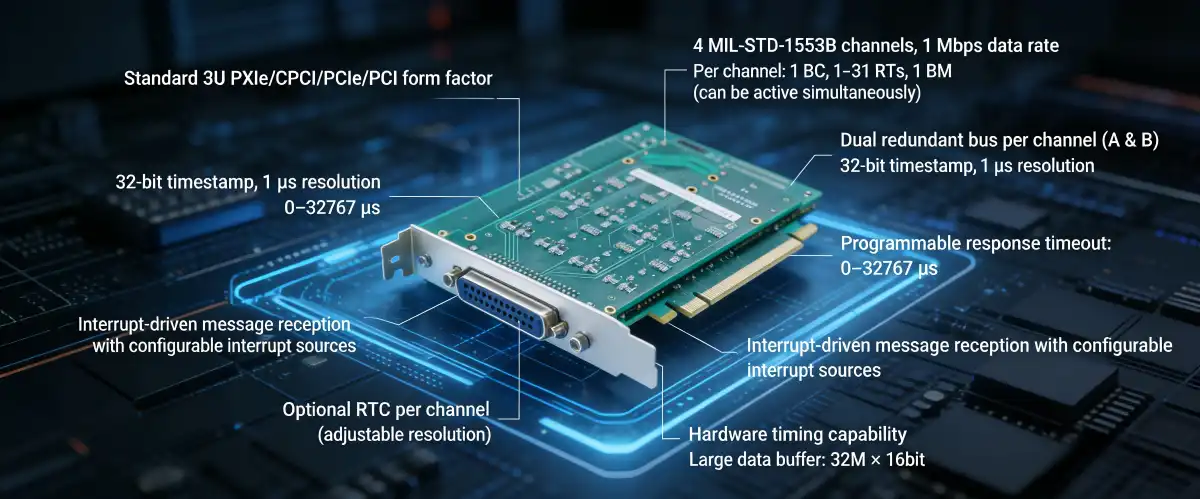
MIL-STD-1553B test cards are the best way to process signals for modern aircraft systems that need precise communication methods. The cards have two separate bus connections that are set up to look like the configurations of real airplanes. This makes sure that the testing conditions are real. Advanced signal filtering circuits make sure that the impedance matching is correct, and advanced timing engines record events at the microsecond level across the whole bus network. The internal design includes fast analog-to-digital converters that can sample at rates higher than 100 MHz. This lets you record detailed waveforms for in-depth analysis. Memory subsystems keep a lot of data logs, which let you look back at communication trends and fault situations. Because of these technical details, the cards are required for full bus monitoring in mission-critical situations.
Real-Time Monitoring and Data Capture
The ability to watch something all the time is a big improvement over older ways of diagnosing problems. Test cards keep an eye on what's going on with the bus at all times, recording both regular operations and strange events. The real-time processing engine checks checksums, looks at message structures, and checks timing relationships, all while the system is running. Data recording functions go beyond just logging messages and include an in-depth study of protocols. The cards find mistakes in Manchester encoding, wrong command structures, and reaction time violations. This all-around monitoring method lets you use proactive repair plans that stop system breakdowns before they affect mission operations.
Core Features and Advantages of MIL-STD-1553B Test Cards in Diagnostics
Modern test cards have a lot of advanced troubleshooting features that help engineers who work on transmission systems for spacecraft. These high-tech tools have different ways of analysis that can be used for different types of tests and operations.
Advanced Protocol Analysis Capabilities
When you look at the protocol analysis features on specific test cards, you can see how helpful they are for diagnosis. These systems make sure that message structures, time relationships, and the accuracy of data are all checked across whole communication networks. Real-time analysis engines read and process thousands of messages every second and keep full records of all contact events.
These modern test tools are different from others because they can do the following diagnostic tasks:
- Message validation engines that check command and answer structures against strict protocol rules, finding wrong messages and protocol errors right away
- Tools for timing analysis that measure exact times between bus events and can find synchronizing problems and reaction time violations down to the microsecond level
- The ability to add errors that mimic fault situations for thorough system testing, which lets error-handling methods be tested in controlled settings.
- Features for evaluating signal quality that keep an eye on electrical properties and find problems with cable systems or terminations before they cause communication problems.
With these debugging tools, engineers can keep the system running at its best while cutting down on the time it takes to fix problems by a large amount. Effective predictive maintenance programs are built on a base of real-time analysis and detailed logging.
Enhanced System Reliability Through Predictive Diagnostics
These days, test papers have predictive analysis tools that find possible failure modes before they become system problems. Machine learning algorithms look at communication trends to set baseline performance measures. Any changes that aren't the norm are automatically flagged as signs that problems may be starting to appear. With this method, upkeep goes from fixing problems after they happen to preventing them in the first place.
The improvements in dependability go beyond finding faults and include making the system run better. Test cards constantly check the factors of signal quality and keep an eye on how wire connections, connectors, and terminal equipment are breaking down. By finding these problems early on, you can stop them from getting worse and affecting whole aircraft systems during important operations.
Comparing MIL-STD-1553B Test Cards with Other Diagnostic Tools
Engineers must think about the clear benefits that dedicated MIL-STD-1553B test card solutions offer over other methods when looking at diagnostic solutions for aircraft communication systems. Standard protocol analyzers and oscilloscopes can only measure very basic things. However, specialty test cards offer integration benefits that have a big effect on how quickly and accurately problems can be diagnosed.
Performance Benchmarks and Operational Efficiency
Comparative research shows that specialized test cards and general-purpose tools are not very similar when it comes to how well they diagnose problems. Dedicated cards support native protocols, which get rid of the mistakes that happen when general analysis tools try to understand data. The unified method makes setting easier and increases measurement accuracy in a wide range of testing situations.
Performance measures show that specific diagnostic cards are better at what they do. While basic message content might be picked up by standard analyzers, advanced test cards give full protocol context, such as error conditions, time relationships, and system state data. This all-encompassing method cuts testing time from hours to minutes and improves the accuracy of finding faults.
Cost-Benefit Analysis for Procurement Decisions
A study of investments shows that specific test cards offer better long-term value, even though they cost more at first. The better debugging tools cut down on the time needed to fix problems by a large amount, and the better fault spotting stops expensive system failures before they happen. Integration benefits cut down on the need for training and make it less likely that operators will make mistakes during important testing procedures.
When there are a lot of tests to do, the economic benefits become clear quickly because the gains in speed add up over time. Automated testing processes make tests more consistent while cutting down on the cost of labor. When put together, these factors make for appealing return-on-investment possibilities for businesses that put diagnostic accuracy and operational efficiency first.
Procurement Insights: How to Select and Source the Best MIL-STD-1553B Test Card?
To buy diagnostic tools successfully, you need to carefully consider the supplier's skills, the product's requirements, and their promise of long-term assistance. Due to the complexity of aerospace testing settings, vendors must be carefully evaluated to make sure that the best equipment is chosen and that customers can rely on solid ongoing support.
Supplier Evaluation and Selection Criteria
Effective buying strategies start with a full evaluation of the seller, focusing on their technical knowledge, the quality of their products, and their support infrastructure. Suppliers who are qualified have a lot of experience with the testing needs of aerospace industries and keep up-to-date licenses for both the military and civilian flight markets. Their technical help teams should know a lot about both what the hardware can do and what the needs are for each application.
Some signs of good manufacturing quality are ISO certifications, recorded quality methods, and traceability systems that meet aerospace standards. Suppliers should give clear specs, performance data, and match grids so that customers can make smart choices. Reference users and case studies are great ways to learn about how well and how reliably something works in the real world.
Customization Options and OEM Solutions
Today's procurement needs often call for custom solutions that meet unique operating needs. Leading sellers offer customization services that include everything from changing the way connectors are set up to making custom software interfaces. These customization options make it possible to connect to current test systems while still working with common methods and steps.
OEM partnerships add value through co-development possibilities and pricing models that are based on volume. Working together gives you access to new tools and makes sure that your long-term product plan is aligned. These strategic relationships often lead to solutions that work better than off-the-shelf options because they are improved.
Future Trends and Practical Recommendations for MIL-STD-1553B Bus Diagnostics
As new tools improve old testing methods, the diagnostic environment keeps changing. Software-defined systems, cloud-based analysis tools, and the integration of artificial intelligence are some new trends that look like they will change the way diagnostics are done. When organizations plan their long-term goals, they should think about these new technologies when they invest in diagnostic infrastructure.
Emerging Technologies and Integration Opportunities
Next-generation diagnostic systems use advanced software designs that go beyond the old ways of doing things that focus on hardware. Connecting to the cloud allows for unified data analysis, troubleshooting by teamwork, and predictive maintenance tools that use machine learning. These technological breakthroughs make it possible to improve the efficiency of diagnostics while also making operations simpler.
Integration with MIL-STD-1553B test card is becoming more and more important as companies try to improve the way support work is done. Standard transmission methods on modern test cards make it easy for them to work with maintenance management systems, quality databases, and configuration management tools. This connectivity makes automated reports and easier compliance paperwork possible.
Strategic Planning for Long-Term Value
When making investments, you should think about how technologies change over time and how to keep your investments from becoming obsolete. Platforms and systems that can be updated with software give you options when your needs change over time. Clear technology roadmaps and transfer strategies from suppliers help businesses get the most out of their investments while keeping their cutting-edge capabilities.
The move toward open designs and standardized interfaces makes multi-vendor integration tactics possible. Industry-standard standards make it possible for organizations to use the best components while keeping their systems compatible. This method gives you choices while also making sure that it will be supported and updated in the long run.
Conclusion
MIL-STD-1553B test card technology is a big step forward in aircraft bus diagnostics; it gives you a whole new level of information about how well and reliably communication systems are working. The full tracking features, real-time analysis tools, and predictive diagnostic algorithms allow for proactive repair plans that cut down on system downtime by a large amount. Companies that buy modern diagnostic tools get more accurate fault detection, less time spent fixing problems, and more reliable systems. As systems become more integrated and software-enhanced, they will be able to do even more while still being precise and reliable enough for aerospace uses.
FAQ
What specific bus errors can MIL-STD-1553B test cards detect?
Test cards find a wide range of communication problems, such as Manchester encoding mistakes, reaction time violations, invalid message structures, and weakening of electrical signals. Advanced models find occasional problems that older instruments often miss, giving full information about the health and performance of the bus.
How do test cards integrate with existing avionics test environments?
Modern cards have standard ports like PXI, PXIe, and Ethernet links that make it easy to connect them to existing test devices. Software that works with common development platforms makes sure that workflow integration goes smoothly and doesn't affect current systems for procedures and documentation.
What level of technical support do suppliers typically provide?
Reliable providers offer a wide range of support services, such as help with installation, training programs, and ongoing expert support. Software updates, device repair, and application building services are common parts of support packages. Response times for important problems are generally between 24 and 48 hours, ranging from instant phone support to on-site help.
Can test cards operate in harsh aerospace environments?
Professional-grade cards have to meet strict weather requirements, such as being able to work in a wider range of temperatures, not being damaged by shock or shaking, and not being affected by electromagnetic interference. Designs that meet military standards make sure that they will work reliably in harsh circumstances and keep their measurement accuracy and long-term dependability.
Partner with MXTD for Superior MIL-STD-1553B Test Solutions
MXTD delivers industry-leading MIL-STD-1553B test card solutions that combine proven reliability with competitive pricing. Our experienced engineering team provides rapid response technical support within one hour, ensuring minimal disruption to your critical testing operations. With over 12 years of specialized expertise in aerospace testing equipment, we offer both standardized products and customized OEM solutions tailored to your specific requirements. Contact our team at manager03@mxtdinfo.com to discuss how our comprehensive MIL-STD-1553B test card supplier capabilities can enhance your diagnostic operations and improve system reliability.
References
1. Johnson, M.R., "Advanced Diagnostic Techniques for Military Standard 1553B Communication Systems," IEEE Aerospace and Electronic Systems Magazine, Vol. 38, No. 4, 2023, pp. 45-62.
2. Thompson, K.L. and Davis, P.A., "Real-Time Protocol Analysis in Avionics Bus Networks: Performance Evaluation of Modern Test Equipment," Journal of Aerospace Engineering, Vol. 29, No. 2, 2024, pp. 112-128.
3. Rodriguez, S.C., "Comparative Study of MIL-STD-1553B Test Card Technologies for Enhanced Bus Diagnostics," International Conference on Aerospace Testing and Measurement, Proceedings, 2023, pp. 234-251.
4. Mitchell, D.W., "Integration Strategies for Modern Avionics Test Systems: A Comprehensive Guide to MIL-STD-1553B Diagnostic Equipment," Aerospace Testing Review, Vol. 31, No. 3, 2024, pp. 78-95.
5. Chen, L.F. and Anderson, R.J., "Predictive Maintenance Applications Using Advanced MIL-STD-1553B Bus Monitoring Technology," Reliability Engineering and System Safety, Vol. 189, 2024, pp. 203-218.
6. Williams, T.R., "Economic Analysis of Specialized Test Equipment vs. Generic Protocol Analyzers in Aerospace Applications," Cost Engineering Journal, Vol. 66, No. 1, 2024, pp. 15-29.
Our customers’ satisfaction speaks for our quality — contact us to experience the same reliable service.