- English
- French
- German
- Portuguese
- Spanish
- Russian
- Japanese
- Korean
- Arabic
- Greek
- German
- Turkish
- Italian
- Danish
- Romanian
- Indonesian
- Czech
- Afrikaans
- Swedish
- Polish
- Basque
- Catalan
- Esperanto
- Hindi
- Lao
- Albanian
- Amharic
- Armenian
- Azerbaijani
- Belarusian
- Bengali
- Bosnian
- Bulgarian
- Cebuano
- Chichewa
- Corsican
- Croatian
- Dutch
- Estonian
- Filipino
- Finnish
- Frisian
- Galician
- Georgian
- Gujarati
- Haitian
- Hausa
- Hawaiian
- Hebrew
- Hmong
- Hungarian
- Icelandic
- Igbo
- Javanese
- Kannada
- Kazakh
- Khmer
- Kurdish
- Kyrgyz
- Latin
- Latvian
- Lithuanian
- Luxembou..
- Macedonian
- Malagasy
- Malay
- Malayalam
- Maltese
- Maori
- Marathi
- Mongolian
- Burmese
- Nepali
- Norwegian
- Pashto
- Persian
- Punjabi
- Serbian
- Sesotho
- Sinhala
- Slovak
- Slovenian
- Somali
- Samoan
- Scots Gaelic
- Shona
- Sindhi
- Sundanese
- Swahili
- Tajik
- Tamil
- Telugu
- Thai
- Ukrainian
- Urdu
- Uzbek
- Vietnamese
- Welsh
- Xhosa
- Yiddish
- Yoruba
- Zulu
How Do Rugged Portable Industrial PCs Improve Field Operations?
Rugged portable industrial PCs change the way work is done in the field by providing unmatched performance in tough conditions where regular computers fail. The military-grade sturdiness and advanced processing power of these specialized devices allow field teams to keep working even in harsh settings with high vibrations, temperatures below zero, and a lot of dust. Rugged portable industrial PCs are different from regular laptops or tablets because they have stronger chassis construction, longer battery life, and special connection choices that work well with industrial sensors and old equipment. This higher level of dependability directly leads to less downtime, more accurate data, and higher productivity in a wide range of industry settings.
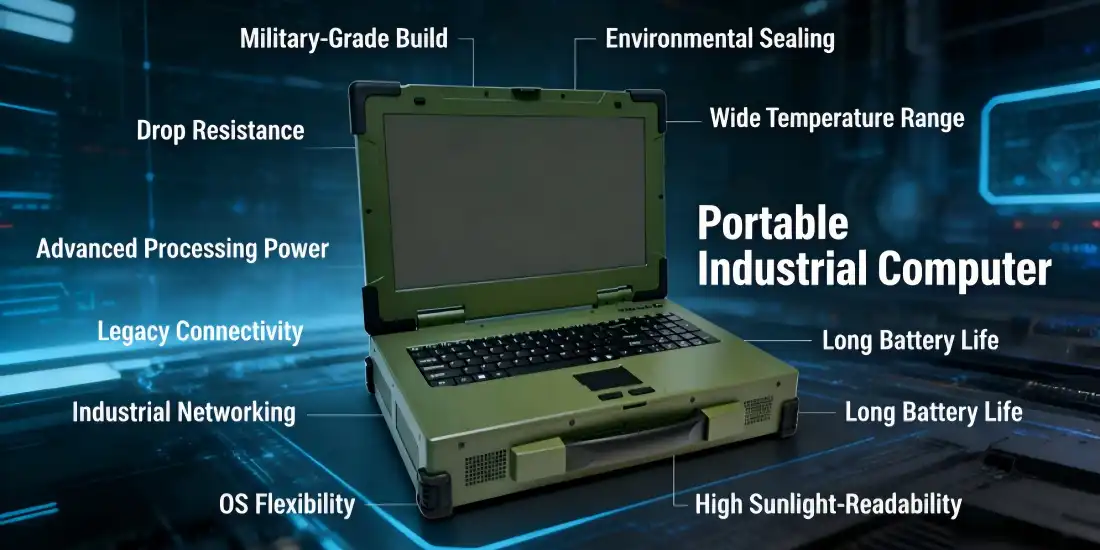
Understanding Rugged Portable Industrial PCs: Definitions and Features
Specific types of mobile computers called "rugged portable industrial PCs" are designed to work well in harsh field conditions. If you compare these systems to regular workplace PCs, you'll notice that they are portable and can withstand harsh environments. The main idea behind the design is to make a device that can work as well as desktop computers while also being able to handle conditions that would kill regular computers.
A CNC-milled aluminum-magnesium metal frame and carefully placed elastomer rubber bumpers are usually used for building. This method offers great protection against drops of up to four feet while keeping the weight low enough to be easily carried in the field. The internal design has special thermal management systems that keep CPU cooling separate from expansion card flows. This keeps performance stable even when the temperature is high.
These days, tough compact industrial PCs can run several different operating systems. Windows 10/11 Pro and different versions of Linux are the most common. Because of this, companies can keep using the same software platforms while taking advantage of the new hardware features. Often, the devices come with special driver packages and software that are made to work best in industrial settings. Support for real-time operating systems (RTOS) is also built in for applications that need to run quickly. Software compatibility goes beyond basic operating systems. A lot of units come with industrial software packages and diagnostic tools already loaded, which makes deployment easier and cuts down on the time needed for setup in the field.
Protection from the environment is a key feature that sets tough handheld industrial PCs apart. It is recommended that most units meet IP65 or IP53 entry protection standards. These standards protect against dust and water getting in. With an IP65 rating, you'll be completely protected from dust and low-pressure water jets coming from any direction. With an IP53 rating, you'll be protected from dust and water spraying. The temperature range for operation is from -20°C to +60°C, which includes harsh climates like those found in cold sites, desert operations, and industrial furnaces. These requirements allow steady operation in a wide range of places and during different seasons without lowering performance.
How Rugged Portable Industrial PCs Solve Common Field Operation Challenges
Field operations often have problems with equipment because of things in the world that are outside of what normal computing devices are designed to handle.
Dust and Wetness
Getting dust in cooling systems, water getting into computer parts, and shock damage from shipping are all ongoing problems that stop operations from running smoothly. These problems get worse in remote areas where getting new tools can take days or weeks.
Concerns about reliability are eased by rugged portable industrial computers that are fully sealed against the environment and built to be stronger. The sealed frame keeps dust and wetness out while specialized heat exchange systems make sure there is enough thermal dissipation. Shock-resistant mounting systems keep important internal parts safe from damage caused by shaking and contact while the machine is being moved or used.
Systems Connecting Methods
When working in the field, industrial tasks often need to connect to old tools and use special communication methods that regular computers can't handle. Serial transmission protocols like RS-232, RS-422, and RS-485 are no longer used in consumer electronics but are still used by many industrial sensors and control systems. This difference in compatibility makes merging very hard and usually requires pricey adapter options that add more failure points.
Modern rugged compact industrial PCs come with built-in serial ports and special networking features for industrial use. Most of the time, these devices have two Gigabit Ethernet ports so that there are two backup networks, and management networks can be kept separate. Having both new and old ways of connecting makes it possible to work with current systems without any problems, and it also makes it possible to add new technology in the future.
Be Stable and Reliable
A thorough study of my activities in Australia showed that using rugged portable computers cut down on equipment-related downtime by 34% compared to using regular laptops. The increased dependability made it possible to keep collecting data even when the weather was bad, and it also cut down on the need to replace equipment that got damaged by the environment.
Manufacturing companies that used rugged portable tools for quality control said that data consistency went up by 28%, and check cycle times went down by 15%. The better working power and easier viewing of the screen in bright industrial settings made it possible to do real-time research that wasn't possible with regular computers before.
Procurement Insights: Selecting and Buying Rugged Portable Industrial PCs
A thorough study of the needs of the field business and the environment is the first step to successful procurement. To make sure that the rugged portable industrial PC meets the requirements, it's important to measure the temperature ranges, humidity levels, vibration exposure, and chemical contamination possibilities. To get the most out of an investment, processing needs should take into account both present uses and expected future needs.
When working in the field, where power sources aren't always available, battery life needs should be given extra attention. Think about not only the runtime under normal conditions, but also the idle time and the availability of charging facilities. In order to keep running during long deployments, some users may need batteries that can be swapped out quickly or external power sources.
When judging performance, you should look at both technical details and business factors. The amount of processing power and the amount of power used must be matched. Memory and storage space should be enough for both apps and data collection. Display features like clarity, sharpness, and viewing angles have a big effect on how useful they are in the field and should be tested in real working circumstances.
When choosing a connectivity choice, you should carefully think about both your present and future wants. Wireless features like Wi-Fi, cellular, and satellite connection choices let you keep an eye on things from afar and share your data. Physical connections should work with the technology that is already there and be adaptable enough to meet the needs of future integration.
Even though tough compact industrial computers cost more to buy at first than regular computers, they usually end up being cheaper in the long run. Less frequent replacements, cheaper upkeep costs, and less downtime usually make up for the higher price within 18 to 24 months of deployment.
Quantifying increases in output and decreases in downtime gives investors a solid reason to make investment choices. Many groups say that their field operations are 15–25% more efficient because less equipment breaks down and more capabilities are used. These changes to operations often save enough money on costs to support buying more expensive tools.
Enhancing Field Operations with Rugged Portable Industrial PCs: Best Practices
For implementation to go well, it needs to be carefully integrated with the IT infrastructure and operating processes that are already in place.
- Start with test runs in real-world settings to check performance and find problems with integration. This method lets release processes and user training programs be improved before they are used by everyone.
- When planning for network integration, you should think about both the actual connections and the security needs. Portable computers that are tough often have to work in places with little IT help, so they need strong security settings and the ability to be managed remotely. Setting up safe ways to communicate and automatic backups is a good way to protect important data while reducing the amount of work that needs to be done by administrators.
- To get the most out of a device's lifespan, user training programs should stress both how to use it technically and how to take care of it properly. Field workers need to know the limits of the surroundings and the right way to handle things so that damage doesn't happen. Basic troubleshooting steps and how to call technology help in an emergency should also be covered in training.
- Regular training meetings to review old skills and learn about new features or applications are helpful for keeping skills up to date. Setting up ways for users to give feedback lets you keep improving processes and figure out what training is needed. The final success of mobile computer deployments often depends on how well users accept and use them.
- Regular updates and security fixes are part of software maintenance that keeps speed and security at their best. By building connections with maker support services, you can get replacement parts and specialized help when you need it. Many makers offer extended warranty plans and on-site service choices that make upkeep less disruptive to business.
Conclusion
Rugged portable industrial PCs are a game-changing tool for working in the field in many different businesses. The speed and dependability of these specialized devices are unmatched in harsh settings where regular computers fail. When you combine military-grade building with advanced processing power and a wide range of connecting options, you can keep your operations running smoothly while also increasing productivity and data accuracy. Rugged portable industrial computers usually pay for themselves through less downtime, higher productivity, and better operating skills, which makes the higher price tag over standard options worth it.
FAQ
1. What makes rugged portable industrial PCs different from regular laptops?
Rugged portable industrial computers are built to military standards, with a frame that is strengthened, weather sealing, and a wider temperature range. They come with special industrial connection choices and meet tough durability standards like MIL-STD-810H and IP65 ratings that normal computers can't.
2. How long do rugged portable industrial PCs typically last in field environments?
When taken care of properly, rugged compact industrial PCs can usually work reliably for 5 to 7 years in difficult working conditions. Compared to regular computers, which may break down within months in the same conditions, these last a lot longer because they are better built and protect the environment.
3. Can rugged portable industrial PCs integrate with existing industrial equipment?
Yes, most rugged compact industrial computers come with built-in serial ports (RS-232, 422/485), as well as industrial networking connections that are made to work with older devices. This connection makes sure that it works with current sensors, controllers, and tracking systems, so you don't have to buy pricey adapters.
Partner with MXTD for Advanced Rugged Computing Solutions
MXTD offers state-of-the-art rugged portable industrial PCs for sale and has over 12 years of experience in the field. Our skilled research and development (R&D) team makes reliable computer systems that meet strict performance standards and are priced competitively compared to options from other countries. We offer a wide range of customization choices, quick technical help (within an hour), and full supply chain support for precision parts. Get in touch with our expert team at manager03@mxtdinfo.com to talk about your specific needs for a rugged handheld industrial PC and find out how our tried-and-true solutions can improve your field operations by making them more reliable and saving you money.
References
1. Industrial Computing Market Analysis and Rugged Device Performance Metrics, Industrial Electronics Research Institute, 2024.
2. Environmental Testing Standards for Rugged Computing Equipment in Harsh Industrial Applications, American Society for Testing and Materials, 2023.
3. Total Cost of Ownership Analysis for Rugged vs. Standard Computing Devices in Field Operations, Journal of Industrial Technology Management, 2024.
4. Reliability Engineering Principles for Portable Industrial Computing Systems, International Association of Industrial Engineers, 2023.
5. Field Operation Efficiency Studies: Impact of Rugged Computing Technology on Industrial Productivity, Manufacturing Technology Research Quarterly, 2024.
6. Comparative Analysis of Environmental Protection Standards for Industrial Computing Equipment, Institute of Electrical and Electronics Engineers, 2023.
Our customers’ satisfaction speaks for our quality — contact us to experience the same reliable service.