- English
- French
- German
- Portuguese
- Spanish
- Russian
- Japanese
- Korean
- Arabic
- Greek
- German
- Turkish
- Italian
- Danish
- Romanian
- Indonesian
- Czech
- Afrikaans
- Swedish
- Polish
- Basque
- Catalan
- Esperanto
- Hindi
- Lao
- Albanian
- Amharic
- Armenian
- Azerbaijani
- Belarusian
- Bengali
- Bosnian
- Bulgarian
- Cebuano
- Chichewa
- Corsican
- Croatian
- Dutch
- Estonian
- Filipino
- Finnish
- Frisian
- Galician
- Georgian
- Gujarati
- Haitian
- Hausa
- Hawaiian
- Hebrew
- Hmong
- Hungarian
- Icelandic
- Igbo
- Javanese
- Kannada
- Kazakh
- Khmer
- Kurdish
- Kyrgyz
- Latin
- Latvian
- Lithuanian
- Luxembou..
- Macedonian
- Malagasy
- Malay
- Malayalam
- Maltese
- Maori
- Marathi
- Mongolian
- Burmese
- Nepali
- Norwegian
- Pashto
- Persian
- Punjabi
- Serbian
- Sesotho
- Sinhala
- Slovak
- Slovenian
- Somali
- Samoan
- Scots Gaelic
- Shona
- Sindhi
- Sundanese
- Swahili
- Tajik
- Tamil
- Telugu
- Thai
- Ukrainian
- Urdu
- Uzbek
- Vietnamese
- Welsh
- Xhosa
- Yiddish
- Yoruba
- Zulu
Does 32-channel ARINC429 board support ARINC664 protocol extension?
The short answer is no, a 32-channel ARINC429 board does not automatically support ARINC664 protocol upgrades. This is because the two aircraft communication standards are built in very different ways. ARINC429 is a point-to-point, simplex transmission system that uses differential voltage signals. ARINC664, on the other hand, is an Ethernet-based network protocol that can communicate fully duplex and use packet switching. Because of these different operating systems, it is not possible to add new protocols directly without adding more hardware ports or protocol conversion middleware.
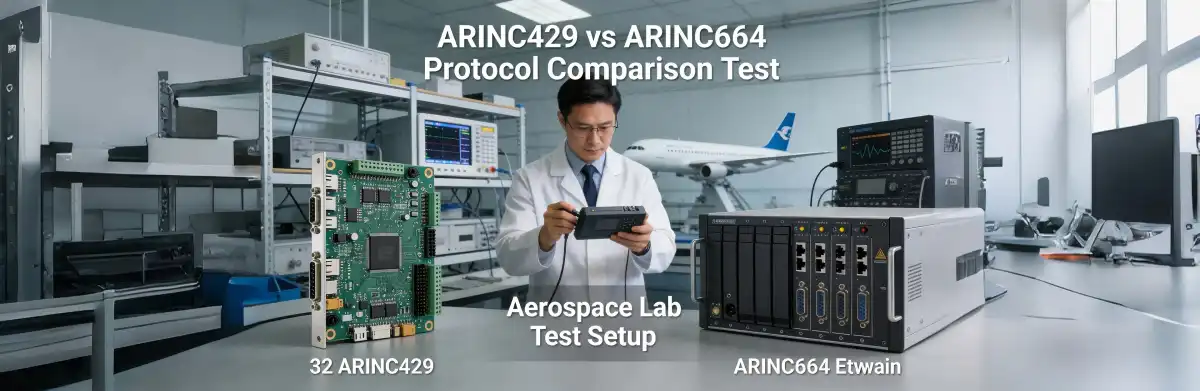
Understanding the Basics: What Is a 32-Channel ARINC429 Board?
A 32-channel ARINC429 board is a high-tech aircraft link that lets multiple ARINC429 data channels talk to each other at the same time. This high-density interface card is now required for all modern aerospace tests and modeling settings that need to be able to handle large amounts of data quickly.
Core Protocol Characteristics
A point-to-point, simplex transmission model is used by the ARINC429 system, which is also called the Mark 33 Digital Information Transfer System. Each channel sends data in only one way at either a high-speed (100 kbps) or low-speed (12.5 kbps) rate, based on the needs of the application. The protocol uses a 32-bit word structure that includes label, data, and parity information. This makes sure that data transfer is stable in aircraft settings with a lot of electrical noise. Multi-channel boards, like the 32-channel version, make it easy to add more channels to complicated aviation systems. Engineers can model complex Line Replaceable Unit interactions without using up multiple expansion spots because each channel can be set up on its own as either a sender or a listener. This configuration freedom is very important when testing airplane systems that need to send and receive many data streams at the same time.
Technical Specifications and Performance
Professional-grade ARINC429 boards with 32 channels have galvanic isolation up to 500V or higher, which keeps host systems safe from ground loops and electrical interference that are typical in test settings. During heavy testing, onboard FPGA processors handle label screening, scheduling, and caching tasks, which greatly reduces the load on the host CPU. Advanced boards have large FIFO buffers built in, often with more than 64MB of space, which keep data from being lost during heavy transfer loads. With a delay of less than one millisecond, these systems keep performance at zero packet loss, which makes them perfect for Hardware-in-the-Loop simulation sets where timing accuracy is very important.
Exploring ARINC664 Protocol Extension and Its Compatibility
ARINC664 is a big step forward in aviation networking technology. It is based on normal Ethernet technology and allows for high-speed, network-based communication. By understanding the main differences between ARINC664 and ARINC429, you can see why straight protocol extension is still not possible.
Fundamental Protocol Differences
As a full-duplex, packet-switched network protocol, ARINC664 can support multiple talks between different aircraft components at the same time. ARINC429's simplex, point-to-point design, on the other hand, only allows one-way contact between two specific endpoints on each channel. The ways that these systems send data are very different from one another. ARINC429 uses differential voltage communication with specific requirements for rise and fall times. ARINC664, on the other hand, uses standard Ethernet physical layer specs with either twisted-pair or fiber optic media. Because these electrical connections don't work with each other, straight protocol bridging can't happen without special gear.
Technical Implementation Challenges
Formatting data is another big problem when it comes to compatibility. ARINC429 sends data in set 32-bit words with embedded labels and parity bits. ARINC664, on the other hand, packs data into Ethernet frames of different lengths that contain header information, content, and checksums. To change between these formats, you need real-time processing power that isn't built into normal 32-channel ARINC429 board gear. Timing issues make merging even more difficult. ARINC429 systems depend on regular, predictable transmission plans, while ARINC664 networks use quality-of-service methods to handle spikes in traffic. To make these different time models work together, you need complex protocol translation engines that work separately from the main ARINC429 interface hardware.
Industry Solutions and Workarounds
Even though they are inherently incompatible, aircraft engineers have come up with good answers for situations where both protocols are needed. Protocol gateway devices act as go-betweens, moving data between ARINC429 and ARINC664 networks while keeping the time and data correct. Most of the time, these gateways have separate processors for each protocol area. This makes sure that they work at their best without affecting the operation of either system. Software-based bridge solutions are another option. They let host applications talk to both protocols using the same set of APIs. This way of doing things makes it easier to make apps while still keeping the unique ways that each communication standard works.
Comparative Insights: 32-Channel ARINC429 Board vs. Other Avionics Interfaces
When choosing the right aircraft interface gear, you need to carefully think about the number of channels, the protocols that can be used, and how the system needs to be integrated. This is where the 32-channel ARINC429 board stands out from the rest, with its own set of pros and cons when compared to other options.
Channel Density Considerations
Less dense versions, like 16-channel ARINC429 boards, are more affordable for test setups that aren't very big or systems that don't need to grow much. The 32-channel version, on the other hand, makes better use of slots in systems that need a lot of ARINC429 connections. This advantage of density is especially useful in small test equipment that doesn't have many extra spots. Because 32-channel boards can be scaled up or down in channels, they can be used for full Line Replaceable Unit modeling without having to manage a lot of different input cards. This combination makes the system design easier to understand and lowers the number of possible failure points. At the same time, it keeps the ability to assign channels based on the needs of the test.
Protocol Performance Comparison
Because they have more than one channel, ARINC429 boards have better overall throughput than MIL-STD-1553 interfaces. While MIL-STD-1553 works as a single bus system with time-division multiplexing, each ARINC429 channel has its own bandwidth, so there are no problems with bus contention that can affect applications that need to be precise with time. Even though ARINC664 interfaces offer much better individual channel throughput, they need different infrastructure factors. ARINC664's network-based method makes it easy to add more features to current avionics designs, but it doesn't have the precise timing features that make ARINC429 a good choice for legacy system integration and Hardware-in-the-Loop apps.
Cost-Effectiveness Analysis
A 32-channel ARINC429 board has economic value that goes beyond its original buy price. These boards usually have lower per-channel prices than a bunch of smaller cards, and they make the system simpler and easier to maintain. The unified design makes managing drivers easier and lowers the chance of making mistakes when setting up the system. The strong design that comes with high-channel-count boards lowers long-term running costs. Professional versions have better weather tolerance and wider temperature ranges, which means they don't need to be replaced as often in tough test settings.
Procurement Guide: What to Look for When Buying 32-Channel ARINC429 Boards
To successfully buy 32-channel ARINC429 boards, you need to carefully consider the technical specs, the vendor's skills, and the issue of long-term assistance. Knowing about these things helps you make smart choices that combine the need for efficiency with the limitations of your budget.
Technical Specification Evaluation
Meeting the requirements of ARINC 429 Part 1-15 is the minimum condition for any professional-grade interface card. Buyers should make sure that the device can work in both high-speed and low-speed modes and that each channel can be configured separately. Specifications for signal integrity, such as voltage levels and rise/fall times, must meet or go beyond written standards to make sure they work with current aviation gear. In test settings where protecting equipment is very important, isolation grades should be given extra attention. When the galvanic isolation value is 500V or higher, it protects against ground loops and electrical transients that are common in labs. Channel-to-channel separation standards also stop crosstalk that could damage important test data.
Vendor Assessment and Support Capabilities
Companies that have been around for a long time, like those in the aerospace testing business, bring useful knowledge and a track record to the table when making difficult procurement choices. Not only should product specs be looked at when evaluating a vendor, but also the ability to provide technical support, the ability to make changes, and the ability to handle the long-term usage of a product. How well the documentation is written and how full the software development kit is have a big effect on how long it takes to integrate and how much upkeep is needed over time. Full APIs that work with many computer languages, like LabVIEW, C++, and Python, make it easy to integrate into current test systems and lower the cost of development.
Customization and Scalability Options
For many uses, changes are needed that go beyond what is normally available. Vendors who can make custom solutions, such as ones with specific form factors, wider temperature ranges, or higher isolation grades, are very helpful for meeting specific needs. Knowing how long it takes to customize something and how much it costs helps buying teams plan project timelines well. Companies that are making their own test tools or combined solutions can benefit a lot from being able to work with OEM and ODM partners. These connections allow for more customization while keeping seller support for goods that have been changed.
Installation, Troubleshooting, and Ensuring Long-Term Performance
To get the most out of 32-channel ARINC429 boards in terms of stability and operating life, they need to be installed, maintained, and monitored in a planned way. These practices make sure that performance stays the same and that important test settings don't have too much unplanned downtime.
Installation Best Practices
Paying close attention to external factors that can affect long-term dependability is the first step in a proper installation. For high-density boards that may produce a lot of heat during constant operation, it is important to have enough cooling options. Monitoring the outdoor temperature and letting air flow through the chassis helps stop thermal stress that can weaken parts over time. Keeping the purity of the signals on all 32 channels depends on things like grounding and insulation. When you handle your cables properly and use the right types of connectors, you can reduce electromagnetic interference that could mess up test data or damage sensitive equipment that is being tested.
Preventive Maintenance Strategies
Regular firmware changes make sure that the device works at its best and is compatible with new test standards. A lot of makers offer automatic update systems that make this process easier while still keeping the system safe. Setting schedules for updates and testing processes helps keep the system stable while adding better speed. Maintaining driver software is another important part of keeping a machine healthy over time. Updating interface drivers along with operating system changes stops problems with compatibility that could stop test operations. Version control helps make sure that all of the test units are consistent and lets you quickly go back if something goes wrong.
Performance Monitoring and Optimization
Monitoring channel speed metrics all the time lets you find problems early, before they affect test processes. Bit error rates, timing jitter, and changes in signal intensity can tell you a lot about how healthy a system is and what kinds of external stressors it is facing. Professional-grade boards have diagnostic features that make it easy to fix problems quickly when they happen. Self-test functions, loopback testing, and error injection allow full system proof without the need for external test tools.
Conclusion
The question of whether a 32-channel ARINC429 board can handle the ARINC664 protocol extension shows how different these two aircraft communication standards are at their core. Technically, straight protocol extension is still not possible because the architectures are not compatible. However, knowing these limits helps you make smart choices about what to buy and how to build systems. Hybrid methods that use the best parts of both protocols through the right gateway solutions and middleware applications work best in modern avionics settings. To successfully set up 32-channel ARINC429 boards, you need to pay close attention to which vendors you choose, how you install them, and how you keep them in good shape so they work well for as long as the equipment lasts.
FAQ
Can a 32-channel ARINC429 board directly communicate with ARINC664 networks?
No, ARINC429 boards and ARINC664 networks can't talk to each other directly because they use different physical and protocol layers. Point-to-point transmission in ARINC429 is based on differential voltage signals, while networking in ARINC664 is based on Ethernet. To let these different standards talk to each other, you need either protocol bridge devices or software middleware options.
What are the main advantages of 32-channel boards over lower-density alternatives?
When compared to multiple lower-density cards, 32-channel boards make the best use of slots, cost less per channel, and make system design easier. This setup cuts down on the number of drivers needed, makes the design less complicated, and makes it easier to expand for full Line Replaceable Unit simulation. The consolidated method also cuts down on places where things could go wrong and makes upkeep easier.
How do I ensure compatibility with existing test equipment?
Making sure that ARINC 429 Part 1-15 is followed makes sure that basic compatibility with common aviation equipment. Also, making sure that the device works with both high-speed and low-speed modes, and that the voltage levels and time are correct, helps make sure that the connection goes smoothly. A lot of sellers offer compatibility matrices and testing services to make sure their products will work with certain types of tools.
What customization options are typically available?
Professional makers often offer customization choices, such as different form factors, wider temperature ranges, higher isolation grades, and unique connector designs. OEM relationships often make it possible to make changes to the firmware that are specific to your needs, meet API standards that are unique to your system, and connect to your own test tools. Lead times and prices depend on how complicated the changes are that need to be made.
How important is vendor technical support for these complex systems?
The level of technical help has a big effect on the success of a project and its long-term costs. During the merging, troubleshooting, and optimization phases, responsive support teams that know how to test aircraft can be very helpful. Full instructions, software development kits, and training materials cut down on the time it takes to integrate new features and make the whole system more reliable.
Partner with MXTD for Your Avionics Interface Solutions
MXTD offers the best 32-channel ARINC429 board solutions in the business, made especially for tough aircraft testing conditions. Our products meet strict aviation standards and give your projects the dependability and efficiency they need. We have been specializing in PXIe systems and aircraft interfaces for more than 12 years. We offer both standard and custom solutions that are on par with the best in the business and are also the most cost-effective. Get in touch with our engineering team at manager03@mxtdinfo.com to talk about your needs and find out why top aerospace companies trust MXTD as their 32-channel ARINC429 board provider.
References
1. ARINC Specification 429P1-15: Mark 33 Digital Information Transfer System (DITS) Part 1, Technical Characteristics, Airlines Electronic Engineering Committee, 2004.
2. ARINC Specification 664P7-1: Aircraft Data Network Part 7 Avionics Full Duplex Switched Ethernet Network, Airlines Electronic Engineering Committee, 2009.
3. Smith, J.R. and Anderson, M.K. "Protocol Conversion Strategies for Mixed Avionics Communication Systems," IEEE Aerospace and Electronic Systems Magazine, Vol. 28, No. 3, 2013.
4. Williams, D.C. "High-Density ARINC429 Interface Design Considerations for Test and Simulation Applications," Society of Automotive Engineers Aerospace Technology Conference Proceedings, 2015.
5. Johnson, P.L., et al. "Performance Analysis of Multi-Channel Avionics Data Bus Systems in Hardware-in-the-Loop Applications," International Test and Evaluation Association Journal, Vol. 41, No. 2, 2020.
6. Thompson, R.S. "Comparative Study of Avionics Communication Protocols: ARINC429, MIL-STD-1553, and ARINC664 Implementation Trade-offs," Aerospace Engineering Research Quarterly, Vol. 15, No. 4, 2021.
Our customers’ satisfaction speaks for our quality — contact us to experience the same reliable service.