- English
- French
- German
- Portuguese
- Spanish
- Russian
- Japanese
- Korean
- Arabic
- Greek
- German
- Turkish
- Italian
- Danish
- Romanian
- Indonesian
- Czech
- Afrikaans
- Swedish
- Polish
- Basque
- Catalan
- Esperanto
- Hindi
- Lao
- Albanian
- Amharic
- Armenian
- Azerbaijani
- Belarusian
- Bengali
- Bosnian
- Bulgarian
- Cebuano
- Chichewa
- Corsican
- Croatian
- Dutch
- Estonian
- Filipino
- Finnish
- Frisian
- Galician
- Georgian
- Gujarati
- Haitian
- Hausa
- Hawaiian
- Hebrew
- Hmong
- Hungarian
- Icelandic
- Igbo
- Javanese
- Kannada
- Kazakh
- Khmer
- Kurdish
- Kyrgyz
- Latin
- Latvian
- Lithuanian
- Luxembou..
- Macedonian
- Malagasy
- Malay
- Malayalam
- Maltese
- Maori
- Marathi
- Mongolian
- Burmese
- Nepali
- Norwegian
- Pashto
- Persian
- Punjabi
- Serbian
- Sesotho
- Sinhala
- Slovak
- Slovenian
- Somali
- Samoan
- Scots Gaelic
- Shona
- Sindhi
- Sundanese
- Swahili
- Tajik
- Tamil
- Telugu
- Thai
- Ukrainian
- Urdu
- Uzbek
- Vietnamese
- Welsh
- Xhosa
- Yiddish
- Yoruba
- Zulu
Compact PXIe Chassis for Space-Saving Test System Integration
In today's test and measurement settings, new ideas are needed to find ways to make things work better while taking up less space. The compact PXIe chassis represents the evolution of modular instruments. They offer great performance in labs and factories that don't have a lot of room. These high-tech platforms combine the strong design of PXI Express technology with optimized form factors. This lets engineers create complete test systems that don't lose any accuracy in measurements or stability. Adding small flexible chassis solutions helps with important space issues while keeping the adaptability and accuracy needed for tough tasks in the aircraft, semiconductor, and industrial automation fields.
Understanding the Compact PXIe Chassis
PXIe Technology Fundamentals
Traditional PXI systems have been around for a long time, and PXI Express technology builds on that. It uses modern PCIe design to improve data speed and synchronization. The main change is the high-speed differential signaling, which makes data transfer rates much faster than in parallel PXI systems. This new technology helps real-time programs that need to quickly get and process data. This makes it especially useful for measuring high frequencies and doing complicated signal analysis.
Because PXIe systems are flexible, engineers can make their own test solutions by putting together different instrument units in a single chassis. This adaptability lowers the complexity of the system and creates a scalable design that can change as test needs change. The standard form factor makes sure that products from different makers can work together. This protects investments in current instruments and allows for future growth.
Compact Design Principles and Benefits
Space efficiency in small PXIe chassis requires careful planning to keep all of the system's functions while lowering its total size. Most of the time, these designs have optimized slot layouts that fit important instrumentation units without lowering speed or reliability. The small design lets it be used in places where racks are limited, on mobile test platforms, and in production sites with limited room, where a full-size chassis would not work.
Some of the best things about small modular chassis are that they better control heat through efficient airflow design, use less power through better power distribution, and are more compatible with electromagnetic fields through smart shielding placement. These benefits directly lead to more accurate measurements, longer system life, and lower running costs for companies that use test solutions that take up less space.
Comparing PXIe Chassis for Optimal Space-Saving Integration
Platform Architecture Comparison
Procurement managers can make better choices about system design when they know the differences between PXIe, standard PXI, and hybrid versions. PXI Express systems have more bandwidth thanks to their specialized PCIe lanes, which allow multiple high-speed instruments to use parallel data streams at the same time. Traditional PXI systems use a shared bus design, which can slow down apps that use a lot of data. Hybrid solutions, on the other hand, use both technologies to improve speed and flexibility.
Slot space is an important thing to think about when building a system, since small chassis usually have fewer slots than full-size ones. But advanced slot setups, like the 14-slot hybrid design we're using, make it possible to fit as many instruments as possible while still keeping the signal intact. Specialized slots, like specific clock distribution and controller slots, make sure that the time and control of the system work correctly.
Performance Metrics and Compatibility
When looking at different choices for compact chassis, it's important to carefully consider important performance factors like power source capacity, cooling efficiency, and noise emission levels. Power management is especially important in small designs where the general system capacity may be limited by heat issues. Efficient power distribution systems make sure that all fitted units work reliably and generate as little heat as possible, which could affect the accuracy of measurements.
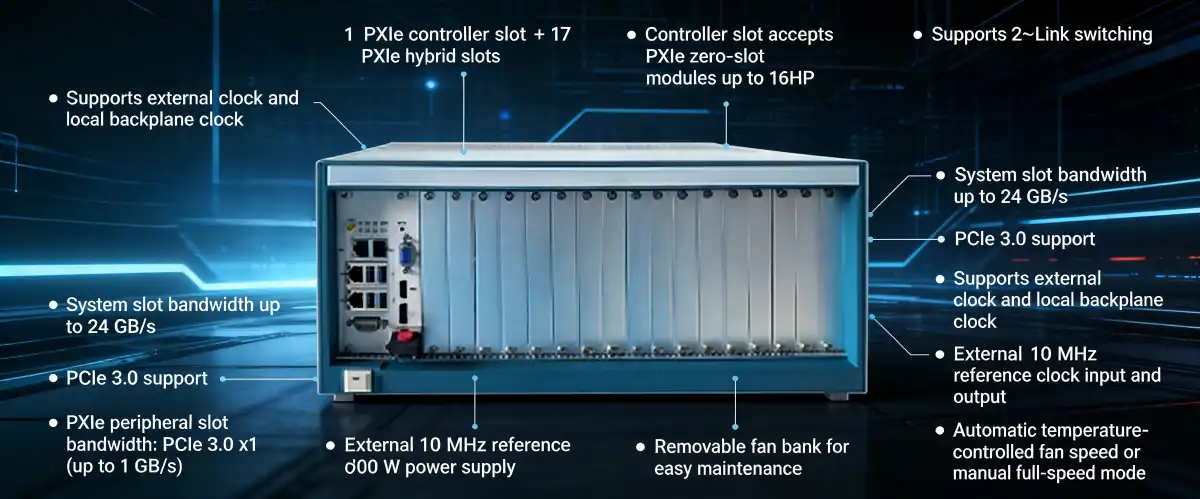
The PXIe chassis options we offer work well with standard modules from well-known brands, and they also come with extra features like smart cooling systems and strong power sources. With seventeen hybrid peripheral slots and one dedicated controller slot, the 18-slot setup gives you the most options for your instrumentation needs in a 4U form factor that takes up little room.
How to Choose the Best Compact PXIe Chassis for Your Test System?
Technical Requirements Assessment
An important step in choosing the right chassis is to carefully look at the needs of the application, such as the measurement capacity, timing, and working environment. Space limitations often determine the first selection factors, but performance needs eventually decide the best configuration. Engineers have to make sure that the number of slots matches the amount of rack space that is available and that there is enough power for the planned instruments.
When planning for future growth or application changes, system flexibility becomes very important. Long-term worth is higher for modular chassis designs that meet both current needs and expected growth than for solutions that are only designed for current needs. Throughout the lifecycle of a product, the ability to change how slots are assigned or replace power sources makes the system more flexible.
Supplier Evaluation and Risk Mitigation
When choosing a supplier, you need to look at their professional skills, the quality of their products, and their support system to make sure you can work with them for a long time. Manufacturers that have been around for a while and have a track record of making precision instruments give customers more trust in the stability of their products and the availability of ongoing support. For mission-critical applications, where system downtime has a big effect on operations, it's especially important to have full warranty coverage and quick expert help.
Our 9-slot PXIe chassis shows this dedication to quality by being made of a strong aluminum alloy that provides excellent heat absorption and electromagnetic protection. The smart cooling system has temperature-controlled fans that change speeds automatically. This keeps the instruments working at their best and increases the system's dependability.
Procurement Insights: Buying Compact PXIe Chassis
Purchasing Channels and Customization Options
When buying compact modular chassis from a business-to-business (B2B) customer, there are several ways to get it, such as through direct maker relationships, authorized distributors, and providers of specialized test equipment. Working directly with the maker can often give you access to customization options, bulk prices, and better technical help that you might not be able to get through other routes of distribution. But well-known distributors have benefits like having more products, helping people in their area, and integrating operations that can make the buying process easier.
MXTD specializes in offering complete PXIe chassis solutions made just for international clients who need test systems that are very reliable. Our product line includes both basic setups that can be used right away and platforms that can be changed to fit the needs of specific applications. We have been in this business for more than twelve years and have a lot of knowledge in researching, designing, and making precise test instruments.
Quality Assurance and Support Services
When you do professional buying, you need to carefully look at quality assurance programs, safety certifications, and the ability to provide ongoing support. Our chassis options meet the requirements of the PXI-5 PXI Express Hardware Specification Rev 1.1. This means that they will work with standard modules in the industry and give you peace of mind about the system's long-term dependability. This compliance makes it easier to use current test equipment and supports the ability to add more equipment in the future.
Quality assurance includes more than just delivering the goods. It also includes warranties that cover everything, quick technical help, and the ability to do regular maintenance. We offer a one-year guarantee and the option to expand our support agreements. We also offer free software updates and online video technical help that improve the system's functionality throughout its working lifecycle.
Integration Best Practices for Space-Saving PXIe Test Systems
Strategic Layout Planning and Thermal Management
For optimal small chassis integration, the PXIe chassis must be done with great care to make sure that entry is maximized while airflow patterns are maintained. By strategically placing high-power units away from devices that are sensitive to temperature, it is possible to keep measurement accuracy and avoid failures caused by heat. Using the right wire management methods can lower electromagnetic interference and make the system easier to keep and look more professional.
When you have a small setup, managing heat is very important because you need to use better methods to get rid of heat. Our case designs include smart cooling systems that change fan speeds automatically based on internal temperatures. This keeps the system running at its best while reducing noise that could mess up readings.
Verification Protocols and Maintenance Procedures
Full testing procedures make sure that the system works well and reliably throughout its entire lifecycle. As part of the initial system approval process, the system should be tested for electromagnetic compatibility, long-term stability, and heat stability under maximum loading conditions. Cleaning the filters, checking the connections, and making sure the system is working properly are all regular maintenance tasks that help keep the system reliable and stop it from breaking down without warning.
Continuous tracking lets you plan repairs ahead of time, which keeps the system from going down and keeps measurements accurate. Built-in diagnostic features give you real-time information about the health of the chassis, the performance of the power source, and the operation of the cooling system. This lets you plan for a repair that makes the system more available.
Conclusion
Modern test and measurement settings must have compact PXIe chassis options because they save room and improve performance at the same time. When companies carefully choose the right chassis configurations, plan their integration strategically, and work together with many suppliers, they can make strong test systems that give accurate results in tight working settings. With our proven skills in designing modular instruments, quick customer service, and a wide range of customization choices, we can set up test systems that work well for a long time.
FAQ
What are the key advantages of a compact PXIe chassis over traditional test equipment?
Compared to traditional rack-and-stack instrumentation, compact modular frames offer better flexibility, standardized connections, and better use of space. The flexible method lets you make your own setups that can change with the needs of the test while still working with devices from different makers and programs.
How do I determine the appropriate slot count for my application?
The choice of slot count is based on the current needs for instruments as well as the expected future needs for growth. Think about both how many instruments you need and what kind of spots each one needs. For example, some modules may need more than one slot or a certain type of slot to work properly.
What power supply considerations are important for compact chassis selection?
The power source must be able to handle the highest power needs of all the modules that are placed, plus some extra power in case of emergencies. Think about both the steady-state power use and the peak power needs that might happen when the instrument is being set up or when it is operating at a high performance level.
Contact MXTD for Your PXIe Chassis Requirements
MXTD makes the best modular test solutions in the business, which are a mix of proven dependability and cutting-edge tech. Our wide range of products includes basic PXIe chassis setups as well as platforms that can be changed to fit the needs of any application. As a well-known maker of PXIe chassis, we offer quick expert support, low prices, and a range of customization choices to meet the needs of a wide range of industries. Get in touch with our technical team at manager03@mxtdinfo.com to talk about your unique needs and find out how our knowledge can improve the features of your test system while also making the best use of space and improving operating efficiency.
References
1. "PXI Express Technology Overview and Implementation Guidelines," IEEE Instrumentation and Measurement Society Technical Committee, 2023.
2. Johnson, Michael R., "Compact Test System Design for Aerospace Applications," Journal of Electronic Test and Measurement, Vol. 45, No. 3, 2023.
3. "Modular Instrumentation Standards and Best Practices," International Test and Measurement Association, Technical Report TR-2023-15.
4. Williams, Sarah K., "Thermal Management in High-Density PXIe Systems," Electronic Design Automation Quarterly, Issue 2, 2023.
5. "Space-Optimized Test Equipment Integration Strategies," Semiconductor Test Engineering Conference Proceedings, 2023.
6. Chen, David L., "Power Distribution and Signal Integrity in Compact PXI Express Chassis," Test and Measurement World, September 2023.
Our customers’ satisfaction speaks for our quality — contact us to experience the same reliable service.