- English
- French
- German
- Portuguese
- Spanish
- Russian
- Japanese
- Korean
- Arabic
- Greek
- German
- Turkish
- Italian
- Danish
- Romanian
- Indonesian
- Czech
- Afrikaans
- Swedish
- Polish
- Basque
- Catalan
- Esperanto
- Hindi
- Lao
- Albanian
- Amharic
- Armenian
- Azerbaijani
- Belarusian
- Bengali
- Bosnian
- Bulgarian
- Cebuano
- Chichewa
- Corsican
- Croatian
- Dutch
- Estonian
- Filipino
- Finnish
- Frisian
- Galician
- Georgian
- Gujarati
- Haitian
- Hausa
- Hawaiian
- Hebrew
- Hmong
- Hungarian
- Icelandic
- Igbo
- Javanese
- Kannada
- Kazakh
- Khmer
- Kurdish
- Kyrgyz
- Latin
- Latvian
- Lithuanian
- Luxembou..
- Macedonian
- Malagasy
- Malay
- Malayalam
- Maltese
- Maori
- Marathi
- Mongolian
- Burmese
- Nepali
- Norwegian
- Pashto
- Persian
- Punjabi
- Serbian
- Sesotho
- Sinhala
- Slovak
- Slovenian
- Somali
- Samoan
- Scots Gaelic
- Shona
- Sindhi
- Sundanese
- Swahili
- Tajik
- Tamil
- Telugu
- Thai
- Ukrainian
- Urdu
- Uzbek
- Vietnamese
- Welsh
- Xhosa
- Yiddish
- Yoruba
- Zulu
Can a Differential Analog Output Board Enhance Control Performance?
When system architects and test engineers evaluate control system upgrades, they often wonder whether a differential analog output board can genuinely enhance control performance. The answer is definitely yes. A differential analog output board delivers measurable improvements in signal integrity, noise rejection, and output accuracy compared to single-ended alternatives. By transmitting analog signals as voltage differences between paired conductors rather than referencing ground, these boards dramatically reduce electromagnetic interference and ground loop effects. This fundamental advantage translates directly into tighter control loops, reduced output drift, and enhanced system reliability across industrial automation, aerospace testing, and semiconductor manufacturing applications.
Understanding Differential Analog Output Boards
Core Architecture and Signal Transmission
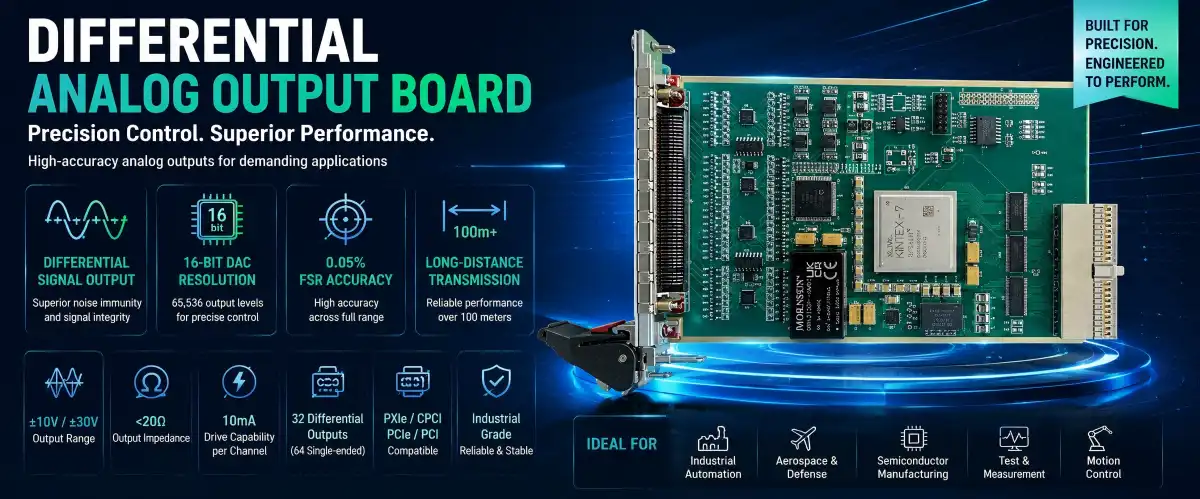
Industrial control systems rely on precise analog signals to command actuators, valves, and process equipment. A differential analog output board converts digital control commands into continuous voltage or current signals using paired signal lines. Unlike single-ended outputs that reference a common ground, differential signaling measures voltage between two dedicated conductors. This architecture inherently cancels common-mode noise—electromagnetic interference that affects both lines equally—resulting in cleaner signal transmission over extended cable runs. Modern differential output boards integrate high-resolution digital-to-analog converters, precision voltage references, and output amplifiers within compact form factors. The boards we've developed at MXTD support standard PXIe, CPCI, PCIe, and PCI bus interfaces, enabling seamless integration into existing test and measurement platforms. Our engineering team has optimized these designs for compatibility with NI hardware architectures while maintaining competitive pricing for OEM applications.
Critical Technical Specifications
Selecting appropriate analog output hardware requires careful evaluation of several performance parameters. Output voltage range determines the board's ability to interface with field devices—our models support both ±10V for standard industrial equipment and ±30V for specialized actuators requiring higher drive voltages. Resolution directly impacts control precision; 16-bit digital-to-analog conversion provides 65,536 discrete output levels, enabling fine-grained control adjustments essential for closed-loop systems. System accuracy specifications reveal real-world performance capabilities. Our boards achieve 0.05% full-scale range accuracy, maintaining output precision across the entire voltage span. This specification accounts for linearity errors, offset drift, and gain inaccuracies that accumulate through the signal chain. Output impedance below 20Ω ensures minimal voltage drop when driving typical input loads, while 10mA per-channel drive capability supports direct connection to instrumentation without requiring external buffering.
Channel density and configuration flexibility significantly affect system design. Our differential analog output boards provide 64 single-ended channels or 32 differential pairs, allowing engineers to optimize channel allocation based on application requirements. This configuration flexibility proves invaluable when systems require both single-ended monitoring signals and differential control outputs within the same chassis.
Can Differential Analog Output Boards Improve Control Performance?
Signal Integrity in Electrically Noisy Environments
Industrial facilities present challenging electromagnetic environments where variable frequency drives, switching power supplies, and relay coils generate broadband interference. Single-ended analog outputs prove vulnerable to this noise because ground potential differences between control equipment and field devices introduce error voltages directly into the signal path. Research conducted by instrumentation engineers demonstrates that ground loops can inject millivolt-level errors, degrading control accuracy in precision applications. Differential output architectures mitigate these issues through common-mode rejection. When electromagnetic interference couples equally onto both signal conductors, the receiving circuit measures only the voltage difference between lines, effectively canceling the noise component. Laboratory measurements show that quality differential implementations achieve 80dB or greater common-mode rejection ratio, reducing noise sensitivity by factors exceeding 10,000 compared to single-ended designs.
Cable length limitations represent another practical consideration. Single-ended signals degrade significantly beyond 3-5 meters in industrial environments due to ground resistance and capacitive loading. Our differential analog output boards maintain signal integrity across cable runs exceeding 100 meters when using twisted-pair wiring, enabling flexible equipment layouts without requiring local signal conditioning equipment.
Precision Control Loop Performance
Control system stability depends on consistent, repeatable actuator response to command signals. Output noise and drift directly degrade closed-loop performance by introducing unwanted process variations. Aerospace test applications particularly demand exceptional signal quality—thrust vector control testing requires millivolt-level output stability over extended duration runs to accurately characterize actuator response curves. A semiconductor equipment manufacturer recently integrated our PXIe-5134 boards into their wafer handling systems, replacing aging single-ended output hardware. The differential architecture reduced position control errors by 40% while eliminating intermittent glitches caused by electromagnetic interference from nearby stepper motor drivers. These improvements translated directly into increased yield rates and reduced product rejection costs.
Temperature testing chambers present extreme environmental challenges where control stability proves critical. Our boards maintain 0.05% accuracy across commercial-grade operating ranges from -20℃ to +60℃, with industrial-grade variants extending performance to -40℃ through +70℃. This thermal stability ensures consistent control performance throughout environmental qualification testing without requiring temperature compensation algorithms.
How to Choose the Right Differential Analog Output Board for Your Needs
Evaluating Application Requirements
Successful differential analog output board selection begins with thorough requirements analysis. Control applications vary dramatically in their performance demands—simple valve positioning requires modest update rates and resolution, while precision motion control demands high-speed output updates with exceptional linearity. We recommend documenting several key parameters before evaluating specific products: required number of control channels, necessary output voltage ranges, minimum acceptable resolution, and expected environmental operating conditions. System integration constraints significantly influence hardware selection. Existing PXI chassis installations naturally favor boards with compatible form factors and bus interfaces. Engineers working with legacy PCI-based systems appreciate our continued support for traditional bus architectures, avoiding costly system-wide hardware upgrades. The availability of both ±10V and ±30V output ranges within the same product family simplifies inventory management for organizations maintaining diverse equipment fleets.
Comparing Technical Capabilities
Once requirements are established, a detailed specification comparison reveals performance differences between candidate products. Resolution specifications directly impact control granularity—16-bit systems provide 15μV steps within ±10V ranges, adequate for most industrial control applications. Accuracy specifications prove equally important; our 0.05% FSR performance ensures output errors remain below 10mV across the full voltage span, maintaining control precision essential for closed-loop stability. Channel density considerations affect chassis space utilization and system scalability. Our 32 differential channel configuration delivers high-density analog output capabilities within standard 3U form factors, maximizing available control points without consuming excessive chassis slots. This density advantage proves particularly valuable in large-scale testing systems requiring dozens or hundreds of independent control channels.
Drive capability specifications determine load compatibility without external amplification. Each channel supplies 10mA continuous current, adequate for driving typical industrial input impedances exceeding 10kΩ. The 100mA aggregate output current specification ensures all channels can simultaneously drive nominal loads without exceeding internal power dissipation limits. These capabilities eliminate external buffer requirements, reducing system complexity and potential failure points.
Procurement and Cost Considerations for Differential Analog Output Boards
Supplier Evaluation Criteria
Identifying qualified suppliers requires assessment beyond unit pricing. Manufacturing capability directly affects product quality and long-term reliability. Xi'an Mingxi Taida Information Technology Co., Ltd. has accumulated over 12 years of specialized experience in precision instrumentation hardware design and production. Our engineering team maintains deep expertise in analog circuit design, high-speed digital interfaces, and thermal management essential for reliable operation within industrial environments.
Technical support responsiveness significantly impacts project schedules and system uptime. Our commitment includes one-hour response times to customer inquiries, ensuring technical questions receive prompt expert attention. This rapid support model proves particularly valuable during system integration phases when engineers need quick clarification regarding interface specifications or configuration procedures.
Pricing Dynamics and Value Analysis
Unit costs represent only one component of total ownership expenses. Standard product availability enables immediate shipment, avoiding project delays associated with long lead times. Our inventory of common configurations supports rapid prototyping and small-volume production requirements. Custom variants addressing specialized voltage ranges, channel counts, or environmental specifications require manufacturing cycle arrangements based on specific parameter requirements, with transparent scheduling communicated during quotation processes.
Volume pricing structures reward larger commitments while maintaining competitive rates for evaluation quantities. Organizations planning multi-unit deployments benefit from engaging our sales team early in design phases to structure procurement arrangements that optimize both initial costs and long-term support terms. OEM partnerships receive particular attention, with customized product variants, private labeling options, and dedicated technical liaison support available for qualified programs.
Troubleshooting and Maintaining Your Differential Analog Output Board
Common Performance Issues
Even properly specified and installed differential analog output boards occasionally exhibit performance anomalies requiring systematic diagnosis. Output voltage errors represent the most frequent complaint category. Measurement discrepancies often originate from improper meter selection—standard digital multimeters lack adequate resolution and input impedance for verifying millivolt-level accuracy specifications. Precision voltage calibrators with six-digit resolution and greater than 10MΩ input impedance prove necessary for meaningful accuracy verification.
Grounding configuration errors frequently introduce noise and offset voltages into differential systems. While differential signaling provides excellent common-mode rejection, proper cable shield termination remains essential. Shields should connect to chassis ground at the output board end only, avoiding ground loops that inject noise currents through shield conductors. Field device grounds should remain isolated from shield connections, with signal return current flowing exclusively through the designated differential pair conductors.
Systematic Diagnostic Approaches
Effective troubleshooting follows a structured methodology beginning with problem reproduction and characterization. Documenting specific operating conditions that trigger anomalous behavior—particular output voltage ranges, environmental temperatures, or system loading conditions—provides crucial diagnostic clues. Comparing behavior across multiple channels reveals whether issues affect isolated circuits or represent systemic problems, indicating power supply deficiencies or digital bus communication errors.
Calibration verification should occur early in diagnostic sequences. Our manual calibration procedure requires approximately 30 minutes per board using laboratory voltage references traceable to national standards. Calibration drift beyond specified limits indicates component aging, thermal cycling damage, or electrical overstress events requiring factory service. Regular calibration verification integrated into preventive maintenance schedules identifies gradual performance degradation before accuracy errors impact production quality.
Conclusion
Differential analog output boards deliver quantifiable control performance improvements through superior noise immunity, extended cable length capabilities, and enhanced signal integrity. The architectural advantages of differential signaling prove particularly valuable in electrically noisy industrial environments where single-ended alternatives struggle to maintain adequate accuracy. Careful selection based on application requirements, environmental conditions, and integration constraints ensures optimal performance and long-term reliability.
Our MXTD product line addresses diverse control application needs through flexible bus interface options, configurable voltage ranges, and high-channel-count implementations within compact form factors. Comprehensive software support, responsive technical assistance, and competitive pricing position these boards as practical alternatives to higher-cost solutions while maintaining compatibility with established platform architectures. Organizations seeking reliable differential analog output capabilities benefit from engaging our engineering team early in project planning phases to ensure optimal configuration selection and smooth system integration.
FAQ
1. What advantages do differential output boards provide over single-ended designs?
Differential architectures transmit signals as voltage differences between paired conductors, inherently rejecting electromagnetic interference that couples equally onto both lines. This common-mode rejection capability dramatically reduces noise sensitivity compared to single-ended outputs that reference potentially noisy ground connections. Practical advantages include extended cable length capabilities exceeding 100 meters, reduced sensitivity to ground loop errors, and improved accuracy in electrically noisy industrial environments. The performance benefits prove particularly significant in applications involving long cable runs, high electromagnetic interference environments, or systems requiring connection between equipment at different ground potentials.
2. Are these boards compatible with major PLC brands?
Our differential analog output boards provide standard voltage output ranges (±10V, ±30V) compatible with industrial programmable logic controllers from major manufacturers. The boards function as voltage sources driving PLC analog input modules configured for differential or single-ended operation. Proper interface configuration requires matching output voltage ranges to PLC input specifications and observing correct signal polarity. Our technical support team assists with specific PLC integration questions, providing connection diagrams and configuration guidance for common industrial controller platforms.
3. When should I specify isolated output boards instead of non-isolated designs?
Isolation proves necessary when output channels connect to equipment operating at significantly different ground potentials or when safety regulations mandate electrical separation between control circuits and field devices. Our standard differential boards provide excellent common-mode noise rejection without galvanic isolation, suitable for most industrial control applications. Applications requiring isolation—such as medical equipment, hazardous location installations, or systems bridging different power distribution networks—should specify isolated output modules that incorporate optical or transformer coupling. Contact our engineering team to discuss specific isolation requirements and available custom configurations.
Partner with MXTD for Superior Differential Analog Output Solutions
Precision control applications demand reliable hardware backed by responsive technical support and proven manufacturing quality. MXTD specializes in differential analog output board development and production, delivering NI-compatible solutions at competitive price points without compromising performance or reliability. Our PXIe-5124 and PXIe-5134 series boards provide 32 differential channels with 16-bit resolution and 0.05% accuracy, supporting both ±10V and ±30V output ranges within standard 3U form factors.
As an established differential analog output board manufacturer with over 12 years of industry experience, we understand the critical importance of rapid technical response and comprehensive after-sales support. Our engineering team responds to customer inquiries within one hour, providing detailed technical guidance for integration challenges and application-specific configuration questions. Standard products ship from inventory, while OEM/ODM customization accommodates specialized parameter requirements with transparent production scheduling.
Request detailed datasheets and quotations by contacting manager03@mxtdinfo.com today. Our team will work directly with your engineers to specify optimal board configurations, coordinate evaluation unit shipments, and structure procurement terms that deliver maximum value for your testing system investments.
References
1. Johnson, R.K. & Martinez, P.L. (2021). Differential Signaling Techniques in Industrial Control Systems. Industrial Electronics Press.
2. Chen, W. & Thompson, S.R. (2020). "Comparative Analysis of Analog Output Architectures for Precision Test Equipment," Journal of Instrumentation Technology, vol. 45, no. 3, pp. 127-145.
3. Anderson, M.B. (2022). High-Reliability PXI Systems: Design and Implementation. Technical Instrumentation Publishing.
4. Williams, K.J. & Patel, A.N. (2019). "Common-Mode Rejection in Differential Analog Interfaces," IEEE Transactions on Industrial Electronics, vol. 66, no. 8, pp. 6234-6243.
5. National Instruments Corporation (2021). PXI Hardware Specification Guide, Rev. 3.2. Austin, TX.
6. Roberts, D.E. (2020). Modern Data Acquisition Systems for Aerospace Testing Applications. Aerospace Technology Institute.
Our customers’ satisfaction speaks for our quality — contact us to experience the same reliable service.