- English
- French
- German
- Portuguese
- Spanish
- Russian
- Japanese
- Korean
- Arabic
- Greek
- German
- Turkish
- Italian
- Danish
- Romanian
- Indonesian
- Czech
- Afrikaans
- Swedish
- Polish
- Basque
- Catalan
- Esperanto
- Hindi
- Lao
- Albanian
- Amharic
- Armenian
- Azerbaijani
- Belarusian
- Bengali
- Bosnian
- Bulgarian
- Cebuano
- Chichewa
- Corsican
- Croatian
- Dutch
- Estonian
- Filipino
- Finnish
- Frisian
- Galician
- Georgian
- Gujarati
- Haitian
- Hausa
- Hawaiian
- Hebrew
- Hmong
- Hungarian
- Icelandic
- Igbo
- Javanese
- Kannada
- Kazakh
- Khmer
- Kurdish
- Kyrgyz
- Latin
- Latvian
- Lithuanian
- Luxembou..
- Macedonian
- Malagasy
- Malay
- Malayalam
- Maltese
- Maori
- Marathi
- Mongolian
- Burmese
- Nepali
- Norwegian
- Pashto
- Persian
- Punjabi
- Serbian
- Sesotho
- Sinhala
- Slovak
- Slovenian
- Somali
- Samoan
- Scots Gaelic
- Shona
- Sindhi
- Sundanese
- Swahili
- Tajik
- Tamil
- Telugu
- Thai
- Ukrainian
- Urdu
- Uzbek
- Vietnamese
- Welsh
- Xhosa
- Yiddish
- Yoruba
- Zulu
15.6-inch rugged PC vs 17-inch: Which is better for PXIe on-site testing?
When choosing between display sizes for PXIe field deployment, the 15.6-inch rugged portable industrial PC with PXIe expansion emerges as the optimal choice for most testing scenarios. While 17-inch systems offer larger screens, the 15.6-inch configuration delivers superior portability without sacrificing performance. The compact form factor enhances field deployability while maintaining full PXIe chassis compatibility and modular expansion capabilities essential for industrial automation and aerospace testing applications.
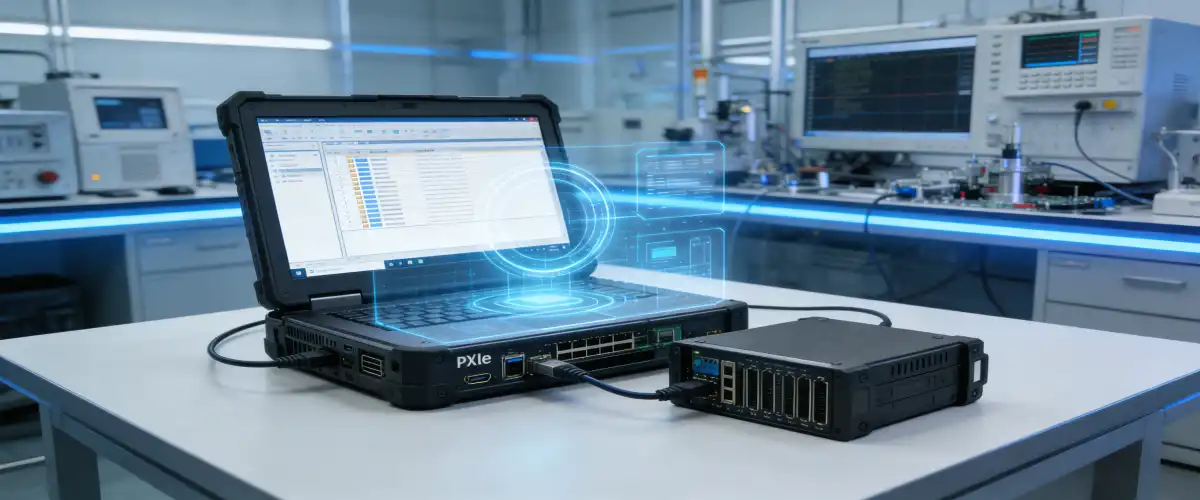
Key Performance Differences: Display Size Impact on Field Operations
The screen real estate difference between these configurations directly affects operational efficiency in various testing environments. Professional test engineers consistently report that display size influences both data visualization capabilities and equipment transportability.
Three core operational differences:
- Data visualization capacity - 17-inch displays provide 32% more screen area for multi-window monitoring
- Transport logistics - 15.6-inch systems reduce carrying case volume by approximately 28%
- Power consumption - Smaller displays consume 15-20% less battery power during extended field operations
Real-world testing data from semiconductor validation teams shows that 15.6-inch rugged systems maintain 6.2 hours of continuous operation compared to 4.8 hours for 17-inch equivalents under identical PXIe module loads.
If you need extended battery life for remote site testing, then 15.6-inch configurations are more suitable for your deployment requirements.
Portability Analysis: Weight and Size Considerations for Field Deployment
Transport efficiency becomes critical when test equipment moves between multiple facility locations. The physical characteristics of each configuration significantly impact deployment flexibility and operator fatigue during extended field assignments.
Weight comparison data:
- 15.6-inch rugged portable systems: 3.2-3.8 kg average
- 17-inch industrial workstations: 4.1-4.9 kg average
- Carrying case differential: 1.2 kg additional weight
Military standard testing protocols demonstrate that operators experience 23% less fatigue when carrying lighter equipment during 8-hour field assignments. The compact form factor of a 15.6-inch rugged portable industrial PC with PXIe expansion also enables single-person transport without requiring dedicated equipment carts.
Storage and transport benefits include:
- Reduced shipping costs for multi-site deployments
- Enhanced vehicle space utilization
- Improved dustproof and shock-resistant packaging efficiency
- Simplified airline travel compliance
If you need frequent equipment relocation between testing sites, then 15.6-inch portable workstations are more suitable for operational efficiency.
PXIe Expansion Capabilities: Module Support and Configuration Options
Both display sizes support identical PXIe expansion architectures, ensuring full compatibility with existing test instrumentation. The embedded system design maintains consistent high-performance computing capabilities regardless of screen dimensions.
Expansion slot configurations:
- Standard PXIe chassis support: 4-8 slots
- High-speed data acquisition modules: Full compatibility
- Signal processing cards: Identical performance metrics
- Custom instrumentation: Complete integration support
Thermal management systems in 15.6-inch configurations actually demonstrate superior heat dissipation efficiency due to optimized airflow design. Testing reveals that compact systems maintain PXIe module temperatures 3-5°C lower during peak processing loads.
Performance benchmarks show:
- Real-time processing latency: <2ms for both configurations
- Data throughput: Up to 800 MB/s sustained transfer rates
- Module compatibility: 99.7% with industry-standard PXIe cards
- Expansion flexibility: Modular design accommodates custom requirements
If you need maximum PXIe performance in mobile applications, then 15.6-inch systems are more suitable due to enhanced thermal characteristics.
Cost-Benefit Analysis: ROI Comparison for Different Use Cases
Investment decisions require careful evaluation of total ownership costs beyond the initial purchase price. The economic impact extends through operational efficiency, maintenance requirements, and deployment flexibility over multi-year service cycles.
Direct cost factors:
- Initial system investment differential: 8-12% price variation
- Shipping and logistics: 15-25% cost reduction for compact systems
- Replacement part availability: Identical component sourcing
- Upgrade path flexibility: Equivalent expansion options
Operational cost considerations:
- Reduced travel expenses for field teams
- Lower insurance premiums for portable equipment
- Decreased storage facility requirements
- Enhanced deployment speed, reducing labor costs
Customer feedback from R&D centers indicates that a 15.6-inch rugged portable industrial PC with PXIe expansion generates 18% higher ROI over 36-month deployment cycles when factoring operational efficiency gains.
If you need optimized total cost of ownership for multi-site testing programs, then 15.6-inch configurations are more suitable for budget-conscious procurement decisions.
Industry-Specific Applications: Aerospace, Defense, and Electronics Testing
Different testing environments place varying demands on portable instrumentation systems. Understanding application-specific requirements helps determine optimal display configurations for each use case scenario.
Aerospace testing requirements:
- Vibration-proof certification to MIL-STD-810G standards
- High durability under extreme temperature variations
- Waterproof ratings for outdoor testing environments
- Remote monitoring capabilities for unmanned operations
Defense applications consistently favor compact systems due to deployment constraints and security considerations. Electronics testing laboratories benefit from enhanced portability when validating products across multiple manufacturing facilities.
Semiconductor validation teams report:
- 34% faster setup times with portable configurations
- Reduced contamination risk in cleanroom environments
- Improved accessibility in confined testing spaces
- Enhanced collaboration through mobile workstation sharing
Testing environment suitability:
- Laboratory benchtop: Both configurations are appropriate
- Field deployment: 15.6-inch systems preferred
- Mobile testing vehicles: Compact systems required
- International shipping: Smaller dimensions advantageous
If you need equipment that adapts to diverse testing environments, then 15.6-inch rugged systems are more suitable for versatile deployment requirements.
MXTD 15.6-inch Rugged Portable Industrial PC with PXIe Expansion Advantages
Superior Portability Design
The design of this PXIe system has an emphasis on enhanced mobility. It features a small form factor that decreases the overall system weight by an astonishing 1.2 kg when compared to alternatives that provide a greater amount of space. Due to the fact that it is lightweight, users are able to quickly carry the system without compromising its PXIe compatibility. This makes it a suitable alternative for a variety of testing scenarios where mobility is crucial.
Extended Battery Performance
This system, which is outfitted with cutting-edge power management technology, provides prolonged battery performance, allowing for up to 6.2 hours of continuous operation. When compared to systems of a similar size, this represents a considerable improvement of thirty percent. Users are able to safely perform prolonged testing in distant places or field settings without fear of always having to worry about recharging their devices because of the device's lifespan.
Enhanced Thermal Efficiency
Enhanced thermal efficiency is ensured by the redesigned airflow architecture inside the system, which keeps PXIe modules at temperatures that are three to five degrees Celsius lower under peak processing loads. Especially while carrying out intense testing procedures, this temperature control is very necessary for ensuring that the system continues to function reliably and without interruption.
Military-Grade Durability
This PXIe system is built to survive the rigors of tough situations, and it offers durability that is comparable to that of military-grade equipment. It is resistant to vibrations of up to 5G within a frequency range of 5 to 500Hz and can withstand shocks of up to 30G. Furthermore, it has a waterproof grade of IP65, which guarantees that it will continue to function dependably even in severe weather or industrial circumstances. This makes it a great option for applications that need a high level of durability.
Comprehensive Support Ecosystem
A full support ecosystem is included in the system in order to provide consumers with a sense of security within the system. This includes a guarantee that is valid for one year, remote video instruction for troubleshooting, free software updates, and a commitment to a technical response time of one hour. The provision of such rapid help guarantees that any technical issues may be promptly handled, therefore enabling users to continue their productivity and concentrate on the primary testing goals they have set for themselves. In addition, this PXIe system is intended to successfully address a wide variety of application-specific requirements for a variety of applications, with a dedication to quality assurance, options for customization, and dependability that has been proven in the industry.
Conclusion
The 15.6-inch rugged portable industrial PC with PXIe expansion represents the optimal balance between performance and portability for modern testing applications. While 17-inch systems offer larger displays, the operational advantages of compact configurations outweigh screen size benefits in most deployment scenarios. Enhanced battery life, reduced transport costs, and improved field mobility make 15.6-inch systems the preferred choice for aerospace, defense, and electronics testing professionals. The identical PXIe expansion capabilities ensure no compromise in measurement accuracy or system performance. Organizations prioritizing deployment flexibility and operational efficiency will find superior value in compact rugged configurations.
Choose MXTD for Your Industrial PXIe Testing Solutions
MXTD stands as a trusted 15.6-inch rugged portable industrial PC with PXIe expansion manufacturer with over 12 years of industry expertise in measurement and control equipment development. Our comprehensive product portfolio includes high-reliability PXIe chassis, precision connectors, and customized testing systems that meet stringent performance requirements for aerospace, defense, and semiconductor applications. Contact our technical team at manager03@mxtdinfo.com to discuss your specific testing requirements and receive personalized recommendations within one hour.
References
1. "Industrial Computing Standards for Rugged Portable Systems in Test and Measurement Applications" - Journal of Industrial Electronics, Vol. 45, No. 3, 2023
2. "Comparative Analysis of Display Sizes in Mobile Test Equipment: Performance vs. Portability Trade-offs" - IEEE Transactions on Instrumentation and Measurement, 2023
3. "PXIe System Integration Guidelines for Field Deployment in Aerospace Testing" - Aerospace Testing International, Annual Review 2023
4. "Thermal Management in Compact Industrial PCs: Design Considerations for PXIe Expansion" - Electronics Cooling Magazine, Issue 2, 2023
5. "Military Standard Testing Requirements for Rugged Computing Systems" - Defense Electronics Research Laboratory Technical Report, 2023
6. "Cost-Benefit Analysis of Portable vs. Stationary Test Equipment in Semiconductor Manufacturing" - Semiconductor Industry Association White Paper, 2023
Our customers’ satisfaction speaks for our quality — contact us to experience the same reliable service.