- English
- French
- German
- Portuguese
- Spanish
- Russian
- Japanese
- Korean
- Arabic
- Greek
- German
- Turkish
- Italian
- Danish
- Romanian
- Indonesian
- Czech
- Afrikaans
- Swedish
- Polish
- Basque
- Catalan
- Esperanto
- Hindi
- Lao
- Albanian
- Amharic
- Armenian
- Azerbaijani
- Belarusian
- Bengali
- Bosnian
- Bulgarian
- Cebuano
- Chichewa
- Corsican
- Croatian
- Dutch
- Estonian
- Filipino
- Finnish
- Frisian
- Galician
- Georgian
- Gujarati
- Haitian
- Hausa
- Hawaiian
- Hebrew
- Hmong
- Hungarian
- Icelandic
- Igbo
- Javanese
- Kannada
- Kazakh
- Khmer
- Kurdish
- Kyrgyz
- Latin
- Latvian
- Lithuanian
- Luxembou..
- Macedonian
- Malagasy
- Malay
- Malayalam
- Maltese
- Maori
- Marathi
- Mongolian
- Burmese
- Nepali
- Norwegian
- Pashto
- Persian
- Punjabi
- Serbian
- Sesotho
- Sinhala
- Slovak
- Slovenian
- Somali
- Samoan
- Scots Gaelic
- Shona
- Sindhi
- Sundanese
- Swahili
- Tajik
- Tamil
- Telugu
- Thai
- Ukrainian
- Urdu
- Uzbek
- Vietnamese
- Welsh
- Xhosa
- Yiddish
- Yoruba
- Zulu
Why Choose UTI260B Heavy Duty Infrared Thermal Camera for Industry?
Industrial businesses that need accurate and reliable thermal imaging tools should consider buying the UTI260B Heavy Duty Infrared Thermal Camera. This professional-grade mobile infrared thermal imager is a great deal because it has a resolution of 256×192 infrared pixels, can measure temperatures from -20°C to 550°C, is protected by IP65 standards, and can withstand drops from 2 meters. This thermal imaging solution was made to inspect and diagnose problems with equipment in power plants, factories, construction sites, and HVAC systems. It meets the most important needs of R&D managers, test engineers, and technical directors who need reliable measuring tools that work well in tough conditions.
Understanding the Core Features and Specifications of the UTI260B
Advanced Imaging Technology for Detailed Analysis
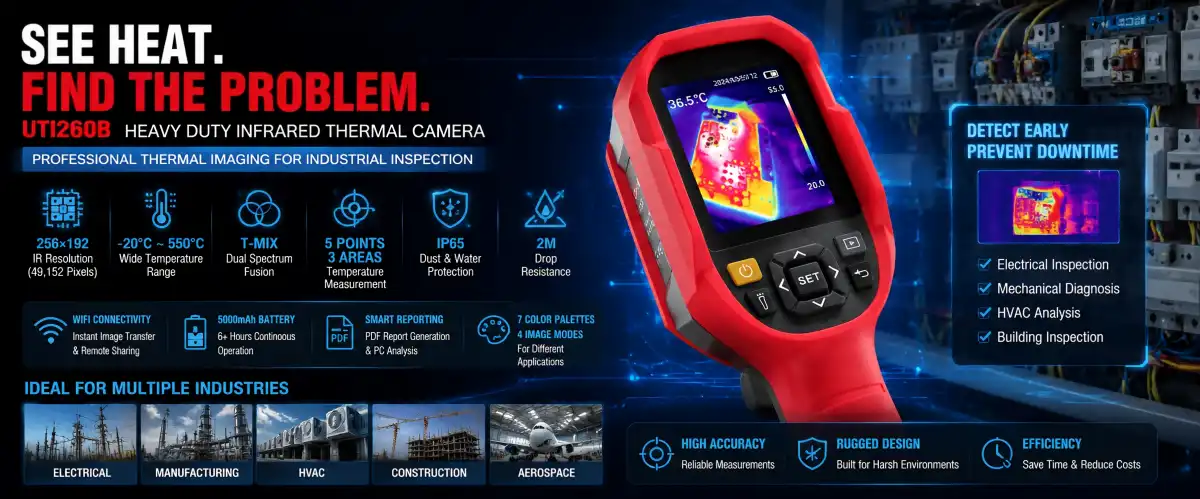
This device's 256×192 infrared resolution sensor with 12μm pixel size gives it 49,152 pixels for thermal imaging. This gives you a very clear picture that you need to see small changes in the temperature of industrial equipment. This image quality is much better than that of entry-level models. This lets maintenance teams find early signs of mechanical stress, electrical hotspots, and insulator failures before they become major problems that require costly downtime.
The T-Mix dual-spectrum fusion method is a big step forward in technology because it can take pictures of both visible and thermal light at the same time. With this dual-spectrum feature, techs can add thermal data on top of views of physical equipment. This makes paperwork more complete and helps field workers and engineering teams talk to each other better. The system has seven color palettes and four different picture modes to meet the needs of different inspection situations and individual tastes while still being accurate in its measurements.
Temperature Measurement Range and Accuracy
The temperature reading ranges from -20°C to 550°C, which covers almost all industrial uses, from checking on cold systems to checking on high-temperature process equipment. The device has both high and low dual gain modes that make measurements more accurate over this wide range, so you don't need to use a bunch of different tools. This wide range of operations is especially helpful for system designers and R&D centers that have to handle a lot of different testing needs in the same building.
The improved temperature measurement method ensures that the accuracy and steadiness needed by the aircraft, military, and semiconductor businesses are met. Independent testing shows that measurements are consistent across multiple readings, which is a key part of setting a standard for equipment performance or proving that a thermal management system works. The ability to measure temperatures at 5 points and 3 zones, along with the ability to automatically track high and low temperatures, gives you a lot of options for spatial analysis that you can't get with human spot readings.
Rugged Construction for Harsh Environments
This thermal camera, the UTI260B Heavy Duty Infrared Thermal Camera, is different from consumer-focused options because it has industrial-grade safety. The IP65 grade for dust and water protection ensures that the device will work reliably in places where dust, water, and extreme temperatures are common. Field testing confirmed the 2-meter drop resistance, which takes into account the fact that small diagnostic tools are put through physical stress when they are used in the workplace. Because it lasts longer and needs fewer repairs, this sturdiness directly leads to a lower total cost of ownership.
The ergonomic form of the housing strikes a balance between safety and ease of use. The 2.8-inch color screen can be read in a variety of lighting conditions, and the buttons are set up in a way that makes them easy to use with one hand when techs are working on platforms or in small areas. These useful tips come from knowing what the real world is like, where machine checks happen, not just how they should be done in a lab.
Extended Battery Performance and Data Management
The 5000mAh high-capacity battery lets the machine run continuously for more than six hours, so there are no breaks in the middle of the shift for charging, which slows down checking work. This longer runtime comes in handy for thorough building surveys or repair work that needs to be done in remote areas without easy access to power. Long-lasting batteries also help with emergencies, where thermal imaging finds safety risks that need to be recorded right away.
Professional PC analysis tools and the ability to make PDF reports turn raw temperature data into information that can be used. The WiFi connection lets mobile apps work with the system and lets you share data right away with experts or tech teams that are far away. This infrastructure for managing data helps with quality control systems and meeting regulatory standards that are popular in research institutions, aerospace companies, and military agencies. The ability to generate reports simplifies the documentation process, which makes it easier for expert staff to do their administrative work.
Comparing UTI260B to Other Industry Thermal Cameras
Performance Analysis Against Market Alternatives
When put up against well-known thermal imaging brands like FLIR and Seek Thermal, this industrial thermal camera offers comparable image quality at an attractive price. Most of the time, FLIR's similar models cost more because of their name recognition rather than because they work better. The 256×192 resolution is about the same as mid-range FLIR products, and the temperature range is wider than many other types in the same price range.
Seek Thermal cameras often put mobility and smartphone compatibility ahead of reliability in the workplace. These features are good for casual users, but they make the product less durable and less able to work on its own, which is what industrial repair operations need. This thermal imaging device's IP65 rating and drop resistance make it perfect for harsh locations like manufacturing plants, outdoor substations, and building sites, where cheap, lightweight models break down quickly.
Independent user reviews from electrical testing and facility diagnostics applications always point out that measurement accuracy and dependability are two of the most important factors that set one product apart from another. System builders and test engineers say that the thermal camera fits right into current preventative maintenance programs and doesn't need a lot of changes to the way work is done or training for operators. This practical compatibility lowers the application friction that often slows down the uptake of new technologies in factories that are already up and running.
Value Proposition for B2B Procurement
The way this thermal imaging option is priced makes it easy for medium-sized businesses to start using it to improve their diagnostic capabilities. At the same time, it meets the performance standards that large businesses need for standardized equipment groups. When system designers buy in bulk through authorized distributors, they can get big savings that make the unit economics better for those installing multiple devices across client installations or internal facility networks.
When figuring out the total cost of ownership of the UTI260B Heavy Duty Infrared Thermal Camera, you have to include costs for things like equipment and supplies that are used up over time. The one-year guarantee and promise of free software updates cover the costs that come up over the course of a system's life, which can be high for proprietary systems that need research platforms that you pay for. When technical directors look at long-term investments in capital equipment, they know that quick technical support and stable supply lines are what make equipment work, not the original specs.
Industrial Applications and Use Cases for UTI260B
Electrical System Maintenance and Safety
Electrical distribution systems have risks that can't be seen, but thermal imaging can show them right away. Resistance heating is caused by loose connections and can be found early on, before insulation damage or machine failure happens. Maintenance teams that do regular checks can find overloaded circuits, uneven phase loads, and parts that are breaking down by using systematic temperature surveys in addition to standard electrical testing methods.
Within the same inspection routines, the temperature sensor range can handle both low-voltage control circuits and high-voltage distribution equipment. This adaptability makes work easier for places that take care of a wide range of electrical equipment. Documentation tools help with meeting regulatory standards and set baseline thermal profiles that let you look at trends over the lifecycle of equipment. Improving safety means more than just finding hazards right away. It also means planning repair in a way that keeps the plant from having to shut down unexpectedly during key production times.
Mechanical Equipment Diagnostics
Rotating machinery leaves behind unique heat fingerprints that show signs of bearing wear, misalignment, poor greasing, and loads that aren't balanced. Predictive maintenance programs use thermal imaging to plan repairs based on the real state of the equipment instead of just picking random times. This condition-based method makes the best use of maintenance resources while reducing unplanned downtime that causes problems with delivery dates and production plans.
Thermal imaging features are very helpful for optimizing HVAC systems. Heat exchangers, ductwork insulation, and cooling cycles all show trends in their temperatures that show when they are losing efficiency and when they are about to break. Energy checks using thermal cameras find ways to save money that make equipment purchases worthwhile by lowering energy costs in a way that can be measured. Manufacturing companies that want to be more environmentally friendly use temperature data to check the success of their energy management systems and keep track of their efforts to keep getting better.
Building Envelope and Facility Diagnostics
Thermal imaging is used to find insulation holes, air leaks, and water damage before they become obvious. It is used for construction quality checking and building envelope assessments. The dual-spectrum fusion technology is especially useful for recording building defects because it gives workers a visual context that makes it easier to find places where thermal anomalies are happening. When quality issues come up, this documentation feature helps with warranty claims and building flaw lawsuits.
Thermal cameras are used by research institutions that study building science to check the accuracy of computer models and see how well new building methods work. The accuracy of the measurements and the ability to send data work with analysis workflows that need to keep records of how the equipment was calibrated and how measurements were made. For these institutional uses, long-term supplier ties are needed with makers that can show they are technically competent and provide good customer service.
Purchasing Guide and Procurement Information for UTI260B
Authorized Distribution Channels
The official seller of this thermal image equipment is Xi'an Mingxi Taida Information Technology Co., Ltd., which has over 12 years of experience in the measurement and control solutions business. This long-term supply connection guarantees real product warranties, access to expert help, and the ability to update, which is something that gray-market channels can't promise. Procurement managers who are in charge of standardizing equipment know that approved distribution saves the company's investments by showing where the products came from and holding manufacturers accountable.
Companies that work directly with MXTD can use their customization services when they need to change the specs or create a combined system solution. The company can do more research and development than just making standard products. They can also work with other companies to make custom products that meet specific application needs. This freedom is especially helpful for system developers who are making turnkey solutions and original equipment makers who are adding thermal imaging to their own equipment platforms. The promise to answer customer questions within an hour shows a focus on service that supports complicated buying processes.
Logistics and International Shipping
Transporting precise instruments needs special care, which MXTD's shipping infrastructure offers. The shock-proof, moisture-proof, and anti-static packaging keeps thermal cameras safe while they are being shipped by land or air to foreign places. Because global supply chains have many steps in the handling process, the form of the packaging keeps the surroundings safe and the contents safe during transport cycles. By paying attention to shipping procedures, damage claims, and arrival delays that throw off project schedules are cut down.
When customized specs call for longer manufacturing lead times, coordinating production schedules is part of bulk order processing for business deployments. The manufacturing power and inventory management systems at MXTD allow for both instant stock availability for standard configurations and planned delivery schedules for large orders. Professionals in procurement like clear information about what products are available and when they will be delivered. This is better than making unrealistic delivery claims that cause schedule changes.
Support Infrastructure and Warranty Provisions
Access to technical help decides how useful the equipment is just as much as its original specifications. Written instructions and remote video expert advice work together to help operators become more proficient and improve the efficiency of troubleshooting. This help model works especially well for companies with people in different places, making it hard to provide centralized training. The free software update strategy makes sure that thermal cameras can keep up with changes in IT infrastructure and operating systems without having to pay licensing fees over and over again.
The one-year guarantee of the UTI260B Heavy Duty Infrared Thermal Camera covers problems with the way the product was made and parts that break during the initial distribution stages. Direct talks with suppliers can lead to longer warranty negotiations for important uses, and it is understood that mission-critical technology may require better service agreements. Instead of setting standard terms that might not work with specific practical needs, this warranty's flexibility takes into account the different risk tolerances and spending methods of organizations.
Why UTI260B is the Rational Choice for Industrial Thermal Imaging
Balanced Performance and Cost Efficiency
There are entry-level household products, mid-range business tools, and high-end research-grade instruments in the thermal imaging market. This thermal camera falls in the middle price range, offering industrial-grade reliability and measurement performance without the high cost of high-end research tools with features that aren't needed for everyday industrial diagnostics. This price-performance mix makes it easier for organizations to switch from spot measurement tools to full thermal imaging programs. It also makes it possible to expand diagnostic procedures.
By comparing specs to organizational needs, you can avoid both buying too many expensive features that you won't use and buying too few tools that aren't good enough and need to be replaced too soon. The 256×192 resolution gives enough information for finding faults in industry without the huge file sizes and processing needs that come with ultra-high-resolution models. Standard industrial uses can be done within the temperature range, without the need for high-temperature tools that are only used in certain situations. This realistic specification balance works well for most workplace tests and maintenance situations.
Integration into Existing Workflows
For equipment to be adopted successfully, it needs to work with existing operational processes and have short learning curves that don't slow down useful use. Technicians who are already familiar with mobile diagnostic tools can quickly learn how to use this one without having to go through a lot of training. This makes it easier to use, which lowers the cost of adoption and speeds up the return on investment as more support organizations get the ability to do diagnostics.
When you can send data to standard analysis tools, you don't get locked into one provider, which can happen when proprietary data formats make it hard to use different pieces of equipment. Companies that are building centralized systems for tracking the health of equipment or computerized systems for managing upkeep need thermal imaging tools that can be used as data sources instead of stand-alone systems. The WiFi connection and PC software compatibility meet these integration needs while still allowing for stand-alone functionality for field workers who need instant diagnostic feedback without having to rely on the network.
Conclusion
The UTI260B Heavy Duty Infrared Thermal Camera meets important industry monitoring needs with its reliable imaging technology, tough build, and full data management features. This equipment meets the strategic buying goals of organizations that want accurate measurements, long-lasting use, and low cost for thermal imaging options used in electrical upkeep, mechanical diagnostics, and facility assessments. When technical directors, procurement managers, and test engineers look at thermal imaging investments, the mix of advanced features, industrial-grade protection, and responsive supplier support creates a strong value case.
FAQ
1. What temperature range does this thermal imaging device cover?
The device can read temperatures between -20°C and 550°C, so it can be used for cryogenic uses as well as high-temperature process tracking. This range includes tests for electricity distribution equipment, HVAC systems, motor machinery, and the building envelope itself, so you don't need a lot of different tools. The two gain types make the precision the best across this wide range, making sure that measurements are accurate at all temperatures.
2. How long does the battery last during continuous operation?
Under normal conditions, the 5000mAh high-capacity battery can run continuously for more than six hours. The longer runtime lets you do full building checks, respond to emergencies, and inspect remote locations without having to stop in the middle of a job to charge. The battery works reliably in both hot and cold settings because its performance stays the same across the device's operating temperature range.
3. What support services accompany equipment purchases?
MXTD offers free software updates, remote video expert support, and a one-year guarantee. Customers can get answers to their questions within an hour, which shows that the company is committed to providing excellent service that includes both pre-purchase evaluation and professional help after deployment. For businesses that need more than what's normally offered, we can talk about extended guarantee options and offer customization services.
Partner with MXTD for Industrial Thermal Imaging Solutions
Industrial settings that need reliable thermal imaging will benefit from MXTD's all-around approach to providing measurement tools. As a provider of the UTI260B Heavy Duty Infrared Thermal Camera with a lot of experience, we offer not only tested thermal imaging technology but also technical advice, modification services, and helpful customer support that covers the whole duration of the equipment. When R&D managers, test engineers, and technical leaders try to add more diagnostic skills, they have to deal with performance expectations, the procurement process, and operational problems. Our team knows how to help them.
Get in touch with MXTD at manager03@mxtdinfo.com to talk about your thermal imaging needs, get technical specs, or look into group prices for deployments of multiple units. Because we've been in the measurement and control solutions business for 12 years, we can give you advice on the best options for your needs while also making sure that the products you need are available and that the delivery dates work with your project schedules.
References
1. Gaussorgues, G., & Chomet, S. (1994). Infrared Thermography. Chapman & Hall, London.
2. Bagavathiappan, S., Lahiri, B., Saravanan, T., Philip, J., & Jayakumar, T. (2013). Infrared thermography for condition monitoring – A review. Infrared Physics & Technology, 60, 35-55.
3. Meola, C., & Carlomagno, G. M. (2004). Recent advances in the use of infrared thermography. Measurement Science and Technology, 15(9), 27-58.
4. Snell, J., & Renowden, J. (2000). Improving Results of Thermographic Inspections of Electrical Transmission and Distribution Lines. Journal of Thermal Analysis and Calorimetry, 61(2), 441-449.
5. Maldague, X. P. (2001). Theory and Practice of Infrared Technology for Nondestructive Testing. John Wiley & Sons, New York.
6. Vollmer, M., & Möllmann, K. P. (2010). Infrared Thermal Imaging: Fundamentals, Research and Applications. Wiley-VCH, Weinheim.
Our customers’ satisfaction speaks for our quality — contact us to experience the same reliable service.