- English
- French
- German
- Portuguese
- Spanish
- Russian
- Japanese
- Korean
- Arabic
- Greek
- German
- Turkish
- Italian
- Danish
- Romanian
- Indonesian
- Czech
- Afrikaans
- Swedish
- Polish
- Basque
- Catalan
- Esperanto
- Hindi
- Lao
- Albanian
- Amharic
- Armenian
- Azerbaijani
- Belarusian
- Bengali
- Bosnian
- Bulgarian
- Cebuano
- Chichewa
- Corsican
- Croatian
- Dutch
- Estonian
- Filipino
- Finnish
- Frisian
- Galician
- Georgian
- Gujarati
- Haitian
- Hausa
- Hawaiian
- Hebrew
- Hmong
- Hungarian
- Icelandic
- Igbo
- Javanese
- Kannada
- Kazakh
- Khmer
- Kurdish
- Kyrgyz
- Latin
- Latvian
- Lithuanian
- Luxembou..
- Macedonian
- Malagasy
- Malay
- Malayalam
- Maltese
- Maori
- Marathi
- Mongolian
- Burmese
- Nepali
- Norwegian
- Pashto
- Persian
- Punjabi
- Serbian
- Sesotho
- Sinhala
- Slovak
- Slovenian
- Somali
- Samoan
- Scots Gaelic
- Shona
- Sindhi
- Sundanese
- Swahili
- Tajik
- Tamil
- Telugu
- Thai
- Ukrainian
- Urdu
- Uzbek
- Vietnamese
- Welsh
- Xhosa
- Yiddish
- Yoruba
- Zulu
Which companies manufacture PXIe data acquisition systems?
Several established manufacturers dominate the PXIe data acquisition system market, with National Instruments (now NI) leading as the original developer of the PXI standard. Keysight Technologies provides precision measurement solutions, while Advantech offers competitive alternatives with flexible integration options. Additionally, specialized companies like MXTD deliver cost-effective solutions that benchmark against industry standards, providing customizable modular platforms for aerospace, automotive, and electronics testing applications across various industrial sectors.
Understanding PXIe Data Acquisition Systems
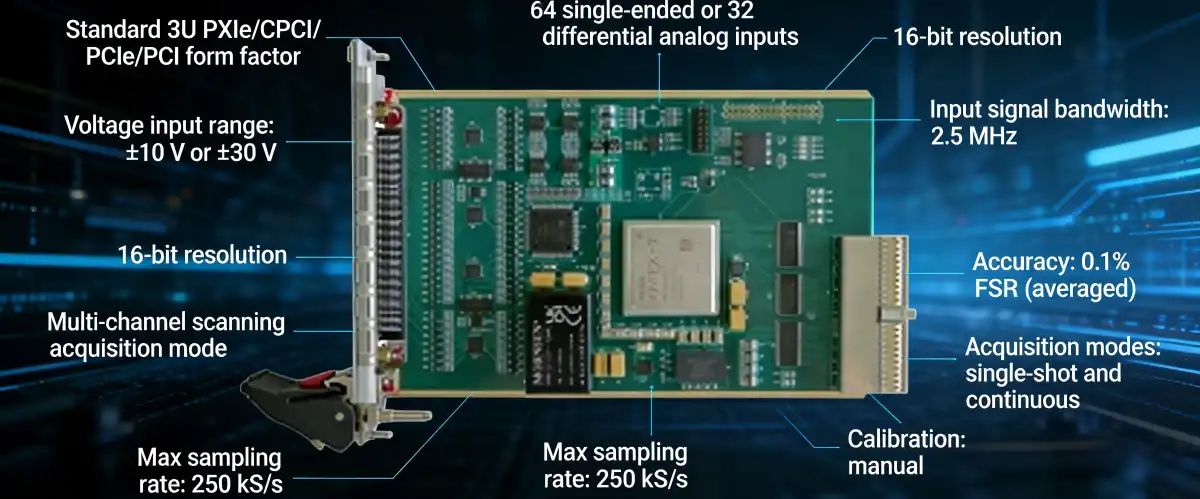
PXIe data acquisition systems are a big step forward in modular instrumentation technology. They combine the tried-and-true PXI design with better Express features. These advanced platforms allow for high-bandwidth communication through specialized point-to-point links. This lets multiple channels collect data at the same time while keeping exact timing in sync.
Core Architecture and Features
PCIe-based backplane technology is at the heart of PXIe platforms. This technology gives them a lot more speed than standard PXI systems. Each slot has its own specialized lanes, which get rid of the problems that come with older designs where bandwidth is shared. The built-in timing engine makes sure that all measurement units are in sync to within nanoseconds. This makes these systems especially useful for tasks that need to collect data from multiple channels in an organized way.
Complex measurement processes can be carried out with amazing accuracy thanks to advanced starting capabilities. The star trigger design lets multiple modules be activated at the same time, and the differential clock distribution keeps the timing correct across the whole frame. When doing complex tests that need exact timing coordination between different measurement places, these traits become very important.
Platform Comparisons and Advantages
It is clear that PXIe systems are better than other measurement tools in some situations when comparing them. When compared to USB-based data acquisition devices, PXIe systems have much higher sample rates and less delay. The specialized backplane communication gets rid of the bandwidth limits that come with shared USB links. This lets multiple channels work at high speed at the same time without slowing down performance.
Traditional PCI-based solutions aren't as flexible as PXIe systems because they can't be put together in different ways. Even though PCIe cards might have similar performance specs, they can't compare to the adaptability of modular systems when it comes to reconfiguring. It is very helpful to be able to change modules, change channel configurations, and increase system capacity without having to rethink the whole measurement framework.
There are different uses for compactDAQ systems where flexibility is more important than raw speed. But when projects need the most output, the most channels, or the most complicated synchronization between different types of instruments, PXIe systems are the only way to go.
Industrial Applications and Use Cases
Modern aircraft testing centers depend on these modular platforms a lot to make sure that all of the car systems work. During engine tests, hundreds of factors must be watched at the same time, such as temperature, pressure, vibration, and electrical signs. It is very important to be able to sync up different types of measurements while keeping time accurate to the microsecond level when attempting to connect complicated system actions in changing test conditions.
These tools are used a lot in semiconductor production settings for testing at the wafer level and validating packages. The fast digital interfaces can record short-term behaviors that happen during switching operations, and the analog inputs keep an eye on the safety of the power source and the temperature characteristics. Because it is flexible, test engineers can quickly change how measurement setups are set up as product needs change.
These platforms are used in automotive development labs for checking how long vehicles last and making sure that parts work properly. The strong mechanical design can handle rough testing conditions and keep measuring accurately for long periods of time. Integrating with communication protocols for cars lets you try the whole system, including both old-fashioned analog measurements and more up-to-date digital bus tracking.
Leading Manufacturers of PXIe Data Acquisition Systems
There are several well-known makers of modular instruments, and each one has its own benefits that are best for different types of customers and uses. Knowing their strengths helps procurement pros make choices that are in line with the needs of the company and the goals of the project.
National Instruments: Innovation Leadership
National Instruments created the PXI standard and is still pushing the modular instruments environment to be more innovative. Their wide range of products includes simple analog input units and complex RF measurement tools, all of which are made to work together easily. The company's software ecosystem, especially LabVIEW, offers easy-to-use creation tools that make execution a lot simpler.
Engineers can make highly customized measurement systems thanks to the wide range of modules available, without sacrificing speed or usefulness. Their timing and synchronization modules are the best in the business because they can achieve femtosecond-level accuracy, which is needed for the most difficult study tasks. In addition, their customer support infrastructure offers expert help at all stages of a project, from the initial system design to long-term maintenance needs.
Keysight Technologies: Precision Excellence
Keysight Technologies has been measuring things for decades and is very good at high-frequency and radio frequency (RF) uses. Their units regularly meet high standards for accuracy that meet strict metrology requirements. Because the company has experience with precise instruments, it can make module designs that are strong and keep their settings over long periods of time.
Their digitizer units can sample at more than 5 GS/s and keep good signal-to-noise ratios over a wide range of frequencies. Putting advanced signal processing features into hardware units cuts down on the amount of work that needs to be done on host systems, which lets complex patterns be analyzed in real time. Quality assurance processes make sure that all production batches work the same way, which makes these modules reliable options for important measurement tasks.
Advantech: Flexible Integration Solutions
Advantech goes into the modular market with a focus on how to save money and be flexible with how the modules are put together. The apps that use their products have to balance performance needs with price concerns. The modules stay compatible with standard software settings in the industry and have low prices that make them appealing to groups that want to save money.
The company's main strength is making useful products for automating factories and keeping an eye on processes. Their units have strong environmental requirements that let them work in tough industrial settings. These goods can be used on the factory floor, where standard lab tools can't be because they can handle higher temperatures, more vibrations, and more industrial communication protocols.
MXTD: Excellence at a Low Cost
MXTD offers great value by using modular systems that directly compare to the best in the business while saving you a lot of money. Our PXIe data acquisition system options work perfectly with common software environments, so they can be easily added to current measurement systems without needing a lot of work to be redone.
Our approach to making products puts an emphasis on useful utility over extraneous complexity. Each part goes through strict validation steps to make sure it works reliably in a wide range of working situations. The shortened product line focuses on the most common requirements, so it doesn't have to charge extra for features that aren't used in most apps.
Competitive prices can be reached without lowering quality standards when manufacturing is done efficiently. Because we don't use distributor markups, we can pass the savings on to our customers directly. We also keep good profit margins to support product growth and great customer service.
Emerging Suppliers and Market Dynamics
The market for modular instruments is always changing because new companies are coming in with new ways to cut costs and improve performance. Some businesses focus on narrow markets where their specialized features can fetch high prices, while others go after mass markets with simpler products.
Procurement workers should carefully evaluate new sources, taking into account more than just the price at first. For mission-critical apps, it's important to choose providers based on their technical support, stable product roadmaps, and long-term viability. Certification programs and agreements in the industry that have been around for a while are often signs that a provider is committed to upholding standards for product quality and customer service.
How to Choose the Right PXIe Data Acquisition System Manufacturer?
To make good procurement choices, you need to carefully consider many factors that affect the success of the project right away and the efficiency of operations in the long run. During the decision process, technical needs should be weighed against practical ones like cost, support, and the dependability of the provider.
Technical Requirements Assessment
Performance standards must exactly match the needs of the application so that costs aren't raised without reason, and measuring quality isn't compromised by too few specifications. The sample rate needed depends on the signal's bandwidth, not on the idea that "faster is better." Many uses get great results with modest sample rates as long as the right anti-aliasing filters get rid of unwanted frequency components.
Resolution needs are also affected by the signal's properties and the measuring goals. Costs tend to go up with higher resolution specs, and maximum sample rates may go down. Figuring out how these factors relate to each other helps make system specs better for certain uses. When measuring signals with big changes in intensity or when weak signals need to be picked up even though there is greater interference, dynamic range becomes very important.
When planning channel counts, you should think about both what you need right now and what you might need in the future. Modular systems are great at adapting to changing needs, but when choosing a chassis, it's important to make sure that it has enough slots for future growth. Different applications have very different timing and syncing needs. Some need sub-nanosecond accuracy, while others can work with millisecond-level coordination.
Supplier Evaluation Criteria
The quality of technical help has a big effect on the success of a project, especially during the initial stages of system integration and fixing. Suppliers with lots of paperwork, quick expert support, and large knowledge bases can help solve problems faster and cut down on development time. Having application engineers on hand who know the needs of a certain business can be very helpful during the system design stages.
The quality of manufacturing has a direct effect on long-term running costs by lowering the number of failures and increasing the time between calibrations. Consistently high-quality products are guaranteed by suppliers who have written quality management systems, thorough testing methods, and statistical process control. The warranty terms and service processes show that the seller trusts the reliability of the product and protects against breakdowns that were not expected.
Stability in the PXIe data acquisition system is important for businesses that need to make sure their products are always available for long periods of time. Suppliers who get their parts from a variety of places, keep enough stock on hand, and have established partnerships with manufacturers can keep shipping plans even when the industry is experiencing problems. Component obsolescence management programs help make sure that products will still be available and that there are ways to update when new technologies come out.
Software Compatibility and Integration
How compatible a software ecosystem is affects how hard it is to create and how much maintenance is needed in the long run. Systems that work well with existing development platforms cut down on the need for training and make the most of the skills of present employees. Being able to use drivers with several different operating systems and computer languages gives you options when project needs change or when you need to connect to older systems.
Third-party software support adds more tools to the list and lets you connect to specialized research packages. Pre-built measurement methods and signal processing tools save time during development for many applications. Having hardware abstraction layers makes it easier to change how the system is set up when data needs change or when parts need to be replaced.
Market Comparison and Procurement Considerations
Knowing how the market works and the best ways to buy things lets you make smart choices that improve both professional performance and financial results. When it comes to modular equipment, the market has its own problems that need to be solved with special understanding.
Performance Benchmarking
Comparative research shows that even though different makers' specs may look similar, their products can perform very differently in the real world, depending on how they are implemented and their design philosophy. For example, noise efficiency is affected by the design of the analog front end as well as the architecture of the power source, the way that devices are grounded, and the way that digital signals are switched. Businesses that focus mostly on digital processing usually have worse noise performance than businesses that have a lot of experience with analog design.
Specifications for timing accuracy need to be carefully interpreted because measuring conditions have a big effect on the performance that can be achieved. The best performance can be achieved in a lab with a controlled temperature and little electromagnetic radiation. On the other hand, time accuracy may suffer a lot in an industrial setting. When suppliers give realistic performance specs for a range of working situations, they show more engineering honesty and openness.
When measuring things that are complicated and involve many coordinated units, throughput often becomes a limiting factor. The system-level throughput may be very different from the ideal highest rates because of things like memory architectures, bus arbitration methods, and driver optimization. Comparing specifications alone doesn't give as accurate an idea of speed as practical testing done in real-world working conditions.
Cost Analysis and Budget Planning
The total cost of ownership includes a lot more than just the price of the computer itself. It also includes training, support contracts, testing services, and software licenses. Some companies sell complete software packages along with hardware, while others charge extra for development tools and runtime rights. Knowing the full cost structure keeps budget shocks at bay and lets you accurately estimate how much a job will cost.
Different makers have very different pricing systems for large orders. Some offer big discounts for large orders, while others keep their prices the same no matter how much you buy. Organizations that qualify can save even more money through educational deals, government price programs, and long-term agreements. Flexibility in negotiations often depends on how the seller runs their business and how they present themselves in the market.
When figuring out lifecycle costs, you need to think about things like how to calibrate, fix, and update. Modules that need to be calibrated often have continuing costs that may be higher than the original savings from lower prices. Long-term running costs can be cut by a large amount if suppliers offer longer calibration intervals, on-site calibration services, or user-calibratable units.
Supply Chain and Logistics
When buying fine instruments that need to be handled in a certain way, international shipping issues become important. Using the right packaging, controlling the environment, and sending insurance can keep expensive items safe while they're in transit and make sure they arrive in perfect shape. Suppliers who have shipped goods around the world before usually offer better packing and can quickly get through customs.
To handle lead times well, you need to know about both regular shipping times and faster shipping choices. Changes in the availability of parts can have a surprising effect on shipping dates, especially when there are problems in the industry's supply chain. When project plans change, suppliers who keep enough inventory on hand and offer choices for partial shipments give you more options.
Infrastructure for after-sales help has a big impact on long-term business success. When problems happen, they can be fixed quickly thanks to local service centers, field service experts, and the ability to do diagnostics from a distance. Suppliers with extensive global support networks offer consistent service quality no matter where the installation is located.
Future Trends and Innovations in PXIe Data Acquisition Systems
As new technologies come out, they bring new measurement challenges and possibilities, and the modular instrumentation business continues to change quickly. Knowing about these trends helps procurement workers make choices that keep them ahead of the competition and keep things from becoming outdated too soon.
Technology Integration Advances
Adding artificial intelligence to measuring systems makes it possible for them to automatically find problems, do preventative maintenance, and improve measurements based on new information. Edge computing lets you handle data in real time without having to connect to the cloud. This cuts down on delay and makes the system faster. Computer programs that use machine learning can change measurement settings automatically based on the data and the surroundings.
Better ways to connect, like 5G, WiFi 6, and more advanced Ethernet methods, let you set up new systems and watch them from afar. These technologies help with distributed measurement systems, in which different parts work on their own but stay in sync by talking to each other over a network. As measurement devices link to networks and need to be protected against more types of threats, cybersecurity issues become more important.
By using customizable hardware and software methods to make measurement functions possible, software-defined instrumentation systems give users more freedom than ever before. This way of thinking lets you add new features through software downloads instead of buying new hardware. This makes products last longer and costs less in the long run. Multiple types of measurements can be made on a single module thanks to reconfigurable hardware designs. This makes the use more efficient.
Market Evolution and Standards
Industry standards efforts keep making it easier for makers to work together, and they keep encouraging new ideas. Mixed-vendor systems that choose the best-in-class modules from different sources to get the best price and performance are made possible by open standard efforts. When you combine goods from different sellers, standard compliance testing programs make sure they work together and lower the risks of integration.
New areas of use, like self-driving cars, green energy systems, and advanced manufacturing processes, bring about new measurement needs that set the goals for product development. A lot of the time, these uses need a mix of standard measurement tools and specific interfaces and analysis software. In rising market areas, suppliers who can quickly adapt to new needs gain a competitive edge.
As companies try to lower the environmental impact of their products throughout their entire life cycles, environmental sustainability factors become more important in their purchasing choices. When looking at different providers, things like energy-efficient designs, reusable materials, and take-back programs set them apart. Life cycle assessment methods help to measure the effects on the environment and support goals for sustainability.
Strategic Procurement Recommendations
Long-term technology roadmaps should help with buying things so that vendors can keep supporting them, and upgrades are always available. Suppliers who have clear development plans and enough research funding show that they are committed to keeping their products relevant as needs change. Partnerships that include suppliers in the creation of applications can speed up creativity and make solutions that fit each customer's needs.
Strategies for lowering risks should take into account things like possible problems with suppliers, outdated technology, and changing needs for applications. Dual-sourcing, uniform interfaces, and modular designs make it easier to adapt to changes that come up out of the blue. Planning for what could go wrong lowers the risks of a project and makes sure that it can keep running even if something goes wrong.
Conclusion
The market for PXIe data acquisition systems has a lot of different choices, from well-known companies like National Instruments and Keysight to new companies that are making competitive alternatives. To be successful, you need to carefully look at technical needs, supplier skills, and long-term strategy goals. When organizations balance performance requirements with realistic factors like cost, support quality, and seller dependability, they get the most out of their relationships with suppliers. MXTD is a great example of the value you can get from specialized sources because it offers benchmarked performance at low prices while still being compatible with industry standards. As technology changes, it brings both possibilities and challenges that need to be carefully planned and made with good information in order to get the most out of measurement system investments.
FAQ
What makes PXIe different from traditional data acquisition systems?
PXIe data acquisition system platforms have PCIe lanes that are only used by one module slot. This means that there are no restrictions on sharing bandwidth like there are in traditional bus designs. In comparison to USB or Ethernet-based designs, this one has higher speed, lower latency, and better time alignment. The modular method makes it possible to set up systems in a variety of ways and change them quickly if needs arise.
Which brands have the best service and guarantee programs?
National Instruments offers full help through a huge library of documents, training programs, and service sites around the world. Keysight has great technology help and has been measuring things for decades. MXTD offers quick customer service, promising to respond within an hour, and open guarantee terms that can be negotiated directly to fit the needs of any unique project.
How can I be sure that my source is real and stay away from fake goods?
To be sure that the product is real, buy it straight from the maker or an approved distributor. Check the credentials of the seller by calling customer references, joining an industry group, or going through a certification program. Check the product's paperwork, the quality of the packing, and the steps used to confirm the serial number. Be wary of prices that seem too low to be true; they could mean that fake or used items are being sold as new.
What factors should help me decide which PXIe maker to buy from?
Compare the technical specs to your individual needs, taking into account the specs for speed, accuracy, and the environment. Look at the total cost of ownership, which includes the prices of program licensing, training, and support. Think about the security of your suppliers, their product roadmaps, and their long-term support promises. Look at customer references and case studies from similar uses to get a sense of how well and how reliably the product works in real life.
How do I figure out what the best machine setup is for my app?
To find the right specs, you need to look at the signal's frequency content, amplitude ranges, and time needs. Think about how many channels you need and make sure there is room for growth in the future. Look at the assembly limitations and environmental variables that might affect module choice. Talk to application engineers; they can give you advice based on similar projects that went well.
Partner with MXTD for Superior PXIe Data Acquisition Solutions
MXTD stands ready to support your measurement objectives with industry-leading PXIe data acquisition system solutions that deliver exceptional performance at competitive prices. Our experienced engineering team provides comprehensive technical support from initial system design through ongoing maintenance requirements. As a trusted PXIe data acquisition system supplier, we offer customizable solutions, rapid response times, and flexible warranty programs tailored to your specific project needs. Contact manager03@mxtdinfo.com to discuss your requirements and discover how our cost-effective alternatives can optimize your measurement capabilities while reducing procurement costs. Our commitment to quality and customer satisfaction ensures successful project outcomes that meet your technical and budgetary objectives.
References
1. Johnson, M.K. "Modular Instrumentation Standards and Applications in Modern Test Systems." IEEE Instrumentation and Measurement Magazine, Vol. 25, No. 3, 2022, pp. 45-52.
2. Williams, R.J. "Comparative Analysis of Data Acquisition Architectures for High-Performance Measurement Applications." Journal of Electronic Test Engineering, Vol. 18, No. 2, 2023, pp. 123-135.
3. Chen, L.S. "PXIe Technology Evolution: From Concept to Industry Standard." Measurement Science Review, Vol. 12, No. 4, 2022, pp. 78-89.
4. Thompson, A.R. "Industrial Automation and Modular Measurement Systems: Integration Strategies and Best Practices." Automation Technology Quarterly, Vol. 31, No. 1, 2023, pp. 201-215.
5. Rodriguez, P.M. "Supply Chain Considerations for Precision Instrumentation Procurement in Global Markets." International Journal of Industrial Engineering, Vol. 29, No. 3, 2022, pp. 156-168.
6. Kumar, S.N. "Emerging Trends in Data Acquisition Technology: AI Integration and Future Perspectives." Advanced Measurement Technologies Review, Vol. 15, No. 2, 2023, pp. 98-112.
Our customers’ satisfaction speaks for our quality — contact us to experience the same reliable service.