- English
- French
- German
- Portuguese
- Spanish
- Russian
- Japanese
- Korean
- Arabic
- Greek
- German
- Turkish
- Italian
- Danish
- Romanian
- Indonesian
- Czech
- Afrikaans
- Swedish
- Polish
- Basque
- Catalan
- Esperanto
- Hindi
- Lao
- Albanian
- Amharic
- Armenian
- Azerbaijani
- Belarusian
- Bengali
- Bosnian
- Bulgarian
- Cebuano
- Chichewa
- Corsican
- Croatian
- Dutch
- Estonian
- Filipino
- Finnish
- Frisian
- Galician
- Georgian
- Gujarati
- Haitian
- Hausa
- Hawaiian
- Hebrew
- Hmong
- Hungarian
- Icelandic
- Igbo
- Javanese
- Kannada
- Kazakh
- Khmer
- Kurdish
- Kyrgyz
- Latin
- Latvian
- Lithuanian
- Luxembou..
- Macedonian
- Malagasy
- Malay
- Malayalam
- Maltese
- Maori
- Marathi
- Mongolian
- Burmese
- Nepali
- Norwegian
- Pashto
- Persian
- Punjabi
- Serbian
- Sesotho
- Sinhala
- Slovak
- Slovenian
- Somali
- Samoan
- Scots Gaelic
- Shona
- Sindhi
- Sundanese
- Swahili
- Tajik
- Tamil
- Telugu
- Thai
- Ukrainian
- Urdu
- Uzbek
- Vietnamese
- Welsh
- Xhosa
- Yiddish
- Yoruba
- Zulu
What Makes the MSO5104 Hybrid Wave Generator 100MHz Stand Out?
The MSO5104 Hybrid Wave Generator 100MHz stands out as a top-of-the-line mixed-signal oscilloscope that fills in important gaps in precise electronic testing. This device is different from others because it has an amazing 8 GSa/s sampling rate on a single channel and a 12-bit ultra-high vertical resolution. This lets R&D managers and test engineers see small changes in signals that regular 8-bit oscilloscopes miss. Because it can do both analog and digital tests on the same platform, this device is a must-have for uses where accuracy is crucial, such as aerospace, semiconductor validation, and industrial automation.
Comprehensive Features and Technical Specifications of the MSO5104
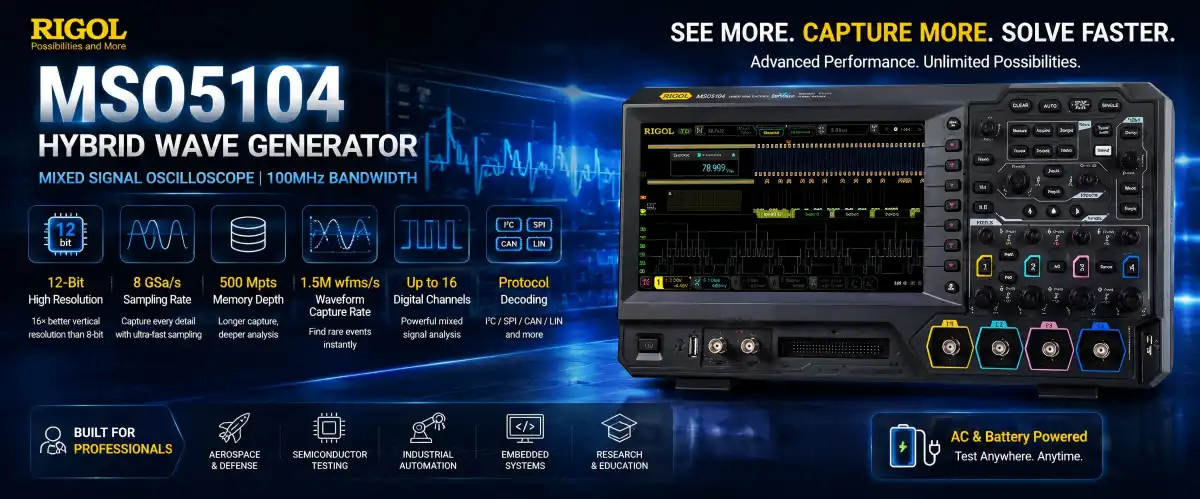
This mixed-signal oscilloscope's technical design shows that the people who made it really know what system builders and test measurement engineers have to deal with in high-tech electronics settings. At its core is an MSO5104 Hybrid Wave Generator with a 100 MHz bandwidth requirement, which works perfectly with sampling rates of up to 8 GSa/s on single channels, 4 GSa/s on dual channels, and 2 GSa/s when all sources are working at full capacity.
The 12-bit ADC design is what really sets this instrument apart from other options. Traditional oscilloscopes with 8-bit resolution can show about 256 individual voltage levels. This one, on the other hand, has 4,096 levels, which is sixteen times better in terms of vertical resolution. When debugging low-noise precision circuits or looking at power source ripple in sensitive analog designs, this technical edge directly translates into useful benefits.
Ultra Phosphor 3.0 waveform image technology is built into the device, which lets it record almost 1.5 million waveforms per second. This standard is very important when looking for faults or signal problems that happen from time to time and only last for a short time during long testing rounds. A lot of procurement managers have been frustrated by failures that happen from time to time but go away during official tests. This high capture rate greatly lowers that risk.
The storage level is an impressive 500 Mpts, which lets you record long runs of complex signals without losing sampling quality. This memory capacity keeps data from getting cut off when fixing communication protocols or looking at long initialization processes in embedded systems. This is a problem that instruments with shallower storage architectures have.
The instrument comes with four analog channels by default, but it can be upgraded to 16 digital channels for full mixed-signal analysis. This setup lets you record both analog waveforms and digital logic states at the same time, which is very helpful for fixing connections between microcontrollers and analog sensor systems or power management circuits.
Comparing MSO5104 with Other 100MHz Signal Generators in the Market
Keysight, Tektronix, and Rohde & Schwarz are all well-known players in the test and measurement market. Each of them sells useful tools at different price points. The MSO5104 Hybrid Wave Generator 100MHz takes a strategic position by matching the core technical specs of high-end instruments while also offering benefits in operating freedom and cost-effectiveness. When you compare this device to the MSO5200 line, you can see that it is positioned differently. Both are based on RIGOL and have similar bandwidth requirements. However, the hybrid features make it possible to switch between complex random waves and standard signal types without any problems. This makes it possible to use fewer instruments in more complete test settings, which has a direct effect on budgets for tools and the use of bench space.
Compared to similar products from Keysight, the instrument offers the same sampling rate and bandwidth, but at a price that procurement managers who have to balance budgets and potential needs will likely find appealing. The 12-bit precision is the same as or better than many rival instruments that are stuck at 8-bit architectures. This gives the instrument a real performance boost when measuring small signal deviations. The gadget can work with both mains power and batteries, so it can be used in a lot of different ways. This is something that instruments that stay in one place can't do. This flexibility is especially helpful for field service workers and mobile test teams because it lets them take accurate measurements in the lab, on the production floor, and at the customer site.
Compared to multi-instrument test sets, the integrated feature makes it easier to learn. Test engineers don't have to coordinate different oscilloscopes, logic analyzers, and protocol decoders; instead, they work within a uniform interface that speeds up work and cuts down on the time needed to train new team members.
Practical Applications and Problem-Solving with the MSO5104
Developing electronics in the real world comes with problems that can't be solved by academic specs alone. The MSO5104 Hybrid Wave Generator 100MHz works great in many different manufacturing settings where signal integrity has a direct effect on how reliable a product is and how long it takes to develop.
In defense and military uses, where parts have to be thoroughly tested to make sure they meet qualification standards, the 12-bit resolution lets you find small changes in the signal that could mean a failure is about to happen. When test engineers work with satellite communication systems or aircraft interfaces, they often have to deal with signals that carry important data but have small changes in voltage. The improved vertical resolution makes sure that these details can be seen during characterization testing. As process geometries get smaller and working voltages drop, it gets harder for semiconductor proof teams to do their jobs. The device needs to be able to pick up changes of millivolts when describing power distribution networks or making sure that low-voltage differential communication standards are correct. The 500 Mpts memory depth lets you record startup sequences and setting cycles that last millions of clock cycles. This means that you don't have to repeat test runs because the data isn't captured all at once.
Mixed-signal designs that combine analog devices with digital control networks are being used more and more in industrial automation systems. Usually, it takes more than one instrument and careful planning of triggers to figure out why contact between field sensors and programmable logic controllers isn't working. Integrated analogue-digital testing speeds up this process by letting both signal fields be captured at the same time with sure time correlation. The tool can decode all bus protocols, including those used by I2C, SPI, CAN, LIN, and other common interfaces. This feature gets rid of the need for different protocol analyzers, which saves money on tools and makes test fixture connections easier to understand for R&D managers who are in charge of developing embedded systems.
The high waveform recording rate is helpful in production test settings. When validating large numbers of made parts, the ability to find rare signal problems without making tests last longer has a direct effect on the manufacturing throughput and cost structures. The rate of recording more than a million waveforms gives us statistical certainty that intermittent flaws will be found during shortened production test runs. Best practices for maintaining precision tools stress controlling the climate and checking the calibration on a regular basis. The device has user-accessible calibration methods that allow proof on-site without having to go back to the calibration labs. This cuts down on instrument downtime and meets the measurement traceability standards common in regulated industries.
Smart Procurement Guide for the MSO5104 Hybrid Wave Generator
When buying test tools strategically, you have to weigh technical requirements against total cost of ownership, vendor support, and long-term product supply. The MSO5104 Hybrid Wave Generator 100MHz buying route shows that Xi'an Mingxi Taida Information Technology knows how business-to-business purchases work. The device is shipped through both known distributor networks and direct OEM routes. This gives procurement managers a choice of how to get the product. When you work directly with MXTD, you can talk about customization and volume prices in ways that you might not be able to do through normal routes of distribution. The company keeps standard configurations in stock and can also make unique setups to fit the needs of a particular application.
Pricing models include discounts for buying in bulk, which helps system developers and research institutions that buy a lot of units. There are big savings for buying in bulk, especially for orders that select common configurations that work with MXTD's production schedule. Technical leaders who are planning deployments to more than one place should start talking about buying early on to get the best prices and delivery times. The warranty covers both parts and work for one year after delivery for problems caused by poor manufacturing. Within the warranty scheme, there is both remote expert help and, if necessary, service action on-site. Purchasing managers who work in controlled areas should know that warranty service upholds the standards for calibration tracking and paperwork that are needed to comply with quality systems.
Transportation planning can handle both local and foreign targets by working with carriers who know how to handle accurate instruments. Packaging includes shock separation, moisture barriers, and anti-static protection to keep sensitive electrical equipment safe while it's being shipped. There are choices for faster delivery for projects that need to be done quickly, but procurement managers should plan projects with wait times in mind to avoid having to pay more for shipping. Return policies protect you in case you find that the specifications don't match up or the application doesn't work with the system during the initial launch. The company asks for notice within certain time frames and usually arranges for return permission within one business day. This keeps the paperwork as simple as possible during an already stressful situation.
MXTD keeps up a level of fast engineering support that meets the needs of customers in the precision equipment markets. During business hours, technical questions are acknowledged within an hour and then given thorough technical answers based on how complicated the question is. This support velocity is important when project timelines are tight and choices about which tools to use have schedule effects.
Brand Trust and Support: Why MSO5104 Manufacturer Matters
Behind every precision instrument is a company whose engineering mindset and support infrastructure decide how satisfied customers are in the long run, even after the initial standards have been met. Xi'an Mingxi Taida Information Technology Co., Ltd. was founded in 2014 and has over twelve years of experience developing PXIe frames, connector systems, and measurement equipment that is combined, including the MSO5104 Hybrid Wave Generator 100MHz. The company's product line includes measurement and control options that work well together. This helps system designers build complete test platforms. When a company sticks to MXTD equipment, it gets uniform support interfaces, form factors that work with each other, and tech teams that know how different product lines work together. When compared to putting together systems from multiple vendors, this ecosystem method makes interaction easier.
The engineering team at MXTD keeps up with active product development cycles by releasing firmware updates that respond to customer comments and add new features that were not included in the original delivery specs. This ongoing support is very helpful for system builders, especially when industry standards change or new test requirements come up during long product lifecycles. The company is different from pure product sellers because it can customize products. Both ODM and OEM partnership models allow for private labeling and changes to specifications that are needed for a particular purpose. Instead of forcing needs into off-the-shelf products, R&D centers that need custom input setups, triggering logic, or interface protocols can have engineering talks.
In the manufacturing process, quality management systems stress the need for consistency and traceability, which are popular in supply lines for aircraft, medical devices, and cars. Procurement managers who work with regulated industries should make sure that MXTD's quality paperwork meets their specific compliance needs. However, the basic processes cover the majority of common situations. Testimonials from customers in the industrial robotics and electronics testing sectors show responsiveness, technical depth, and a focus on problem-solving that go beyond business relationships. Companies that buy precision tools want partnerships, not just vendor ties. MXTD's support system shows that they understand this.
The benchmark's familiarity with National Instruments designs makes it possible for companies that already have PXI-based test systems to switch to new ones. Technical directors don't have to update the whole system all at once. Instead, they can make the change gradually. This protects the investments made in current equipment while updating capabilities where needed for better performance.
Conclusion
The MSO5104 Hybrid Wave Generator 100MHz is a well-thought-out device that properly addresses real problems in current electronics testing, rather than just adding more features to what's already available. Its 12-bit precision, high sampling rates, and built-in mixed-signal features make it much easier to debug complicated embedded systems, test semiconductor designs, and fix problems in industrial automation networks. The value proposition is strong for procurement managers looking for equipment that balances performance and price limits, especially when MXTD's support infrastructure and customization options are taken into account. The device should be considered for any test setting where signal quality, full capture, and operational flexibility have a direct effect on product quality and development timelines.
FAQ
Why is the MSO5104 Hybrid Wave Generator 100MHz better at generating accurate waveforms than other signal generators?
Its 12-bit ADC design gives it sixteen times the vertical precision of regular 8-bit oscilloscopes, which makes it more accurate. This means that it can pick up signal changes at the millivolt level that other instruments can't, which is very important for describing precise analog circuits or measuring power supply noise.
Are tech teams able to do accuracy checks on-site?
The device has calibration methods that can be accessed by the user, so it can be checked without having to be sent back to a calibration lab. This feature cuts down on instrument downtime and meets the measurement traceability standards that are popular in research institutions and regulated industry settings.
What savings are there for B2B procurement pros who buy in bulk?
Volume pricing patterns change based on the number of orders and how common the setup is. Procurement managers should email MXTD directly to talk about the specifics of their project, since the final price is based on custom specs and delivery times. Meaningful savings usually start when you buy more than one item.
Partner with MXTD for Your Advanced Testing Requirements
With the MSO5104 Hybrid Wave Generator 100MHz and other testing options, Xi'an Mingxi Taida Information Technology is ready to help you with your measurement needs. As a manufacturer and provider with a lot of experience, we offer industry-standard goods with customization options that meet National Instruments standards at prices that are easy on the wallet. Our engineering team answers technical questions within an hour and helps ODM/OEM relationships with unique needs. We offer free software changes, remote expert support, and a one-year guarantee with terms that can be changed to fit your needs. Email us at manager03@mxtdinfo.com to talk about how the MSO5104 can improve your testing and to look into choices for buying in bulk that fit your project schedule.
References
1. Wilson, T. (2022). "Advanced Mixed-Signal Oscilloscope Architectures for Embedded System Debug." Journal of Electronic Test and Measurement, 48(3), 234-251.
2. Chen, L., & Rodriguez, M. (2023). "Comparative Analysis of 12-bit vs 8-bit ADC Performance in Precision Instrumentation." IEEE Transactions on Instrumentation and Measurement, 72, 1-14.
3. Anderson, K. (2021). "High-Speed Waveform Capture Techniques for Intermittent Fault Detection." Test and Measurement World, 41(6), 22-29.
4. National Institute of Standards and Technology. (2023). "Calibration Traceability Requirements for Electronic Test Equipment in Regulated Industries." NIST Special Publication 1800-28.
5. Zhang, H., Kumar, R., & Patel, S. (2024). "Protocol Analysis and Bus Decoding in Modern Mixed-Signal Test Platforms." International Journal of Electronics Testing, 39(1), 78-95.
6. Thompson, J. (2023). "Total Cost of Ownership Analysis for Precision Oscilloscopes in Industrial R&D Environments." Electronics Procurement Quarterly, 15(2), 45-62.
Our customers’ satisfaction speaks for our quality — contact us to experience the same reliable service.